 Reviews


This Specimen has been sold.


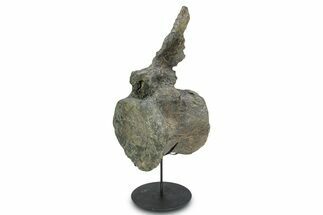
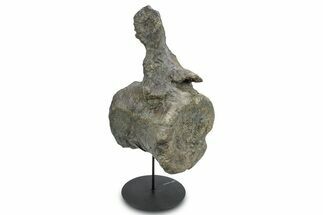
14.3" Rare Stegosaurian Dinosaur (Adratiklit) Vertebra - Morocco


This is a fascinating and incredibly uncommon, 14.3" tall Adratiklit boulahfa dorsal vertebra, collected from the Middle Jurassic - Bathonian Stage El Mers Group (El Mers Formation II) near Boulahfa, Morocco. It's nearly complete and amazingly displays both transverse processes, postzygapophyses, and an intact spinous process.
Upon request, we can have a custom metal display stand created for this specimen at an additional cost. If interested in a quote, please contact support@fossilera.com.
While gap fill restoration is minimal, there are many repaired and glue stabilized fractures throughout the bone, primarily along the vertebral arch.
Upon request, we can have a custom metal display stand created for this specimen at an additional cost. If interested in a quote, please contact support@fossilera.com.
While gap fill restoration is minimal, there are many repaired and glue stabilized fractures throughout the bone, primarily along the vertebral arch.
About Adratiklit boulahfa
Adratiklit boulahfa is a Middle Jurassic stegosaurian dinosaur from the El Mers Group of the Middle Atlas region of Morocco and represents the first named stegosaur from North Africa. Described in 2019, it is among the oldest definitive stegosaurs known, dating to the Bathonian stage (~168–166 Ma). The taxon is based on fragmentary material, with the holotype consisting of a single dorsal vertebra and additional referred elements including cervical vertebrae and a humerus, likely representing more than one individual. Despite the limited remains and uncertain exact locality (due to the specimens’ acquisition through the fossil trade), the vertebral anatomy preserves distinctive features that support its validity as a new genus and species within Stegosauria.
Anatomically, Adratiklit exhibits unequivocal stegosaurian characteristics in its axial and appendicular skeleton, although no dermal armor has been recovered. Its overall body plan is inferred by comparison with related taxa to have been that of a medium to large-sized, quadrupedal herbivore bearing plates and spikes typical of stegosaurs. Phylogenetic analyses place Adratiklit among early-diverging stegosaurs with affinities to European forms, highlighting faunal connections across the western Tethyan region during the Middle Jurassic. The discovery is significant for filling a major geographic and temporal gap in the fossil record of thyreophoran dinosaurs and for demonstrating that stegosaurs had already achieved a broad distribution early in their evolutionary history.
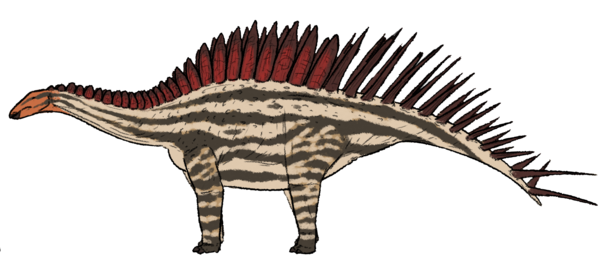
An artists reconstruction of A. boulahfa. Creative commons artist "Connor Ashbridge"
Adratiklit boulahfa is a Middle Jurassic stegosaurian dinosaur from the El Mers Group of the Middle Atlas region of Morocco and represents the first named stegosaur from North Africa. Described in 2019, it is among the oldest definitive stegosaurs known, dating to the Bathonian stage (~168–166 Ma). The taxon is based on fragmentary material, with the holotype consisting of a single dorsal vertebra and additional referred elements including cervical vertebrae and a humerus, likely representing more than one individual. Despite the limited remains and uncertain exact locality (due to the specimens’ acquisition through the fossil trade), the vertebral anatomy preserves distinctive features that support its validity as a new genus and species within Stegosauria.
Anatomically, Adratiklit exhibits unequivocal stegosaurian characteristics in its axial and appendicular skeleton, although no dermal armor has been recovered. Its overall body plan is inferred by comparison with related taxa to have been that of a medium to large-sized, quadrupedal herbivore bearing plates and spikes typical of stegosaurs. Phylogenetic analyses place Adratiklit among early-diverging stegosaurs with affinities to European forms, highlighting faunal connections across the western Tethyan region during the Middle Jurassic. The discovery is significant for filling a major geographic and temporal gap in the fossil record of thyreophoran dinosaurs and for demonstrating that stegosaurs had already achieved a broad distribution early in their evolutionary history.
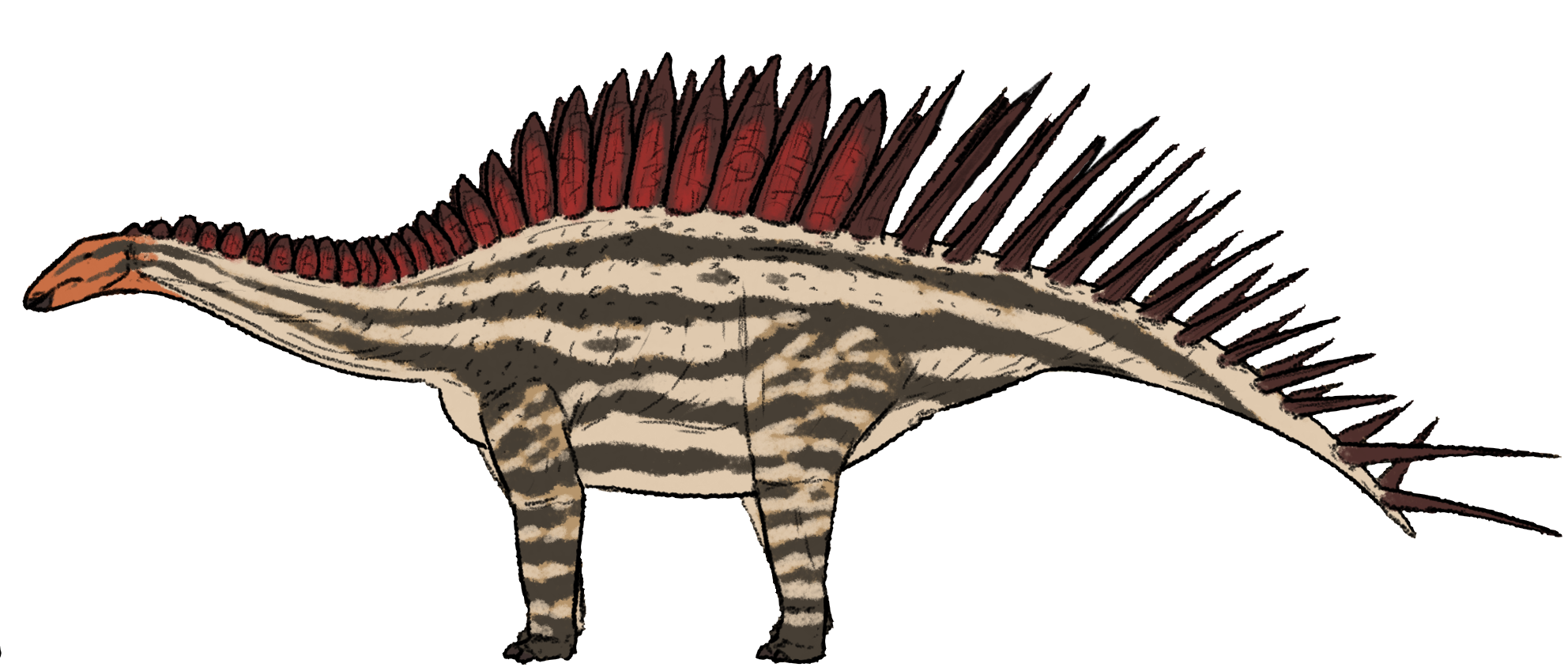
An artists reconstruction of A. boulahfa. Creative commons artist "Connor Ashbridge"
The El Mers Group is a group of geologic deposits with a stratigraphic range of approximately 164 to 168 million years (Bathonian to Callovian), located near Boulahfa, Morocco. It is divided into three formations know as El Mers I, II, and III. The El Mers III formation bears the youngest fossils (~164 million years). The group has produced a good amount of dinosaur material, including indeterminate theropod (Allosauridae indet. & Megalosauridae? indet.), sauropod (Cetiosaurus mogrebiensis), stegosaur (Adratiklit boulahfa), the ichnofossil "Selenichnites" (crescent-shaped impressions), indeterminate teleosauroid (Machimosauridae indet.) material, and a very interesting ankylosaur (Spicomellus afer) specimen.
The ankylosaur (Spicomellus afer gen. et sp. nov.) material found in this deposit appears to represent the earliest-known ankylosaur, and the first to be named from Africa. It would have lived during the time of the Laurasian and Gondwanan continents, split by an ocean called Tethys. Prior to the discovery of this unusual ankylosaur bone, ankylosauria were almost entirely restricted to Laurasian continents. This find filled an important gap in dinosaur evolution and suggests strongly that ankylosaurs had a global distribution.
The specimen is a T-shaped dorsal rib bone featuring multiple spikes along the dorsal surface. Strangely enough, the spikes are naturally fused to the rib, indicating more morphological diversity of armored dinosaurs during their early evolution than previously thought. This bizarre fusing is confusing, considering structures like that would seemingly hinder the growth and movement of muscles. Thanks to the discovery, continued excavation of this deposit will provide a better understanding of Spicomellus, and hopefully yield more interesting fossil discoveries.
The ankylosaur (Spicomellus afer gen. et sp. nov.) material found in this deposit appears to represent the earliest-known ankylosaur, and the first to be named from Africa. It would have lived during the time of the Laurasian and Gondwanan continents, split by an ocean called Tethys. Prior to the discovery of this unusual ankylosaur bone, ankylosauria were almost entirely restricted to Laurasian continents. This find filled an important gap in dinosaur evolution and suggests strongly that ankylosaurs had a global distribution.
The specimen is a T-shaped dorsal rib bone featuring multiple spikes along the dorsal surface. Strangely enough, the spikes are naturally fused to the rib, indicating more morphological diversity of armored dinosaurs during their early evolution than previously thought. This bizarre fusing is confusing, considering structures like that would seemingly hinder the growth and movement of muscles. Thanks to the discovery, continued excavation of this deposit will provide a better understanding of Spicomellus, and hopefully yield more interesting fossil discoveries.
SPECIES
Adratiklit boulahfa

LOCATION
Middle Atlas Mountains, Near Boulahfa, Morocco
FORMATION
El Mers Group (El Mers Formation II)
SIZE
Vertebra: 14.3" tall, 9.7" wide
CATEGORY
SUB CATEGORY
ITEM
#350529
We guarantee the authenticity of all of our specimens.