 Reviews


This Specimen has been sold.


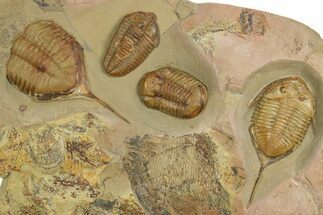
19" Line Of Lonchodomas Trilobites Showing Migrating Behavior


This spectacular trilobite mortality plate captures what appears to be preserved migratory behavior among these ancient arthropods. Measuring 19 inches wide, the plate features a striking linear arrangement of 26 Lonchodomas trilobites all oriented in the same general direction, accompanied by several Asaphellus and Bathycheilus specimens. Collected from the Lower Ordovician Fezouata Formation near Zagora, Morocco, this remarkable piece has been expertly prepared, with only a few minute areas of restoration.
480-million-year-old trilobite ‘traffic jams’ may reveal ancient migratory behavior
480-million-year-old trilobite ‘traffic jams’ may reveal ancient migratory behavior
About Trilobites
Trilobites were a very diverse group of extinct marine arthropods. They first appeared in the fossil record in the Early Cambrian (521 million years ago) and went extinct during the Permian mass extinction (250 million years ago). They were one of the most successful of the early animals on our planet: over 25,000 species have been described, filling nearly every evolutionary niche. Due in large part to their hard exoskeletons (shells), they left an excellent fossil record.
Trilobites were a very diverse group of extinct marine arthropods. They first appeared in the fossil record in the Early Cambrian (521 million years ago) and went extinct during the Permian mass extinction (250 million years ago). They were one of the most successful of the early animals on our planet: over 25,000 species have been described, filling nearly every evolutionary niche. Due in large part to their hard exoskeletons (shells), they left an excellent fossil record.

SPECIES
Lonchodomas sp, Asaphellus sp. & Bathycheilus sp.
AGE

LOCATION
Ouled Slimane, Zagora area, Morocco
FORMATION
Lower Fezouata Formation
SIZE
Rock 19 x 9.5" , Longest Trilobite 2"
CATEGORY
SUB CATEGORY
ITEM
#338987
We guarantee the authenticity of all of our specimens.