 Reviews


This Specimen has been sold.


7" Cretaceous Fossil Ammonite (Discoscaphites) Cluster - South Dakota


This is a beautiful, 7" tall cluster of ammonite fossils of the genus Discoscaphites, collected from the Cretaceous-age Fox Hills Formation of South Dakota. They have been meticulously prepped to expose them from the hard concretion they were found in. One of the ammonites is incomplete, with the calcite replaced interior visible in cross section.
One edge of the concretion has been cut flat for vertical presentation.
One edge of the concretion has been cut flat for vertical presentation.
About These Ammonites
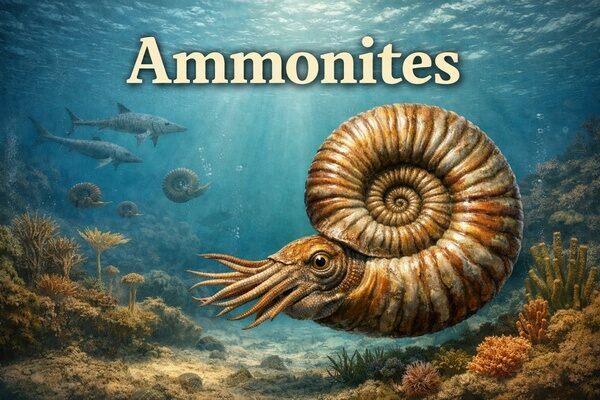
These 70-million-year-old Cretaceous ammonite fossils come from a time when South Dakota was submerged beneath the Western Interior Seaway, a warm, shallow inland ocean that once stretched from the Arctic to the Gulf of Mexico. Ammonites were extinct marine cephalopods related to modern squid, octopus, and cuttlefish, but unlike their soft-bodied relatives, they lived inside coiled, chambered shells. As the animal grew, it added new chambers, using them to regulate buoyancy and move efficiently through the ancient seas. Their abundance and rapid evolution make ammonites some of the most important index fossils for dating marine rocks.
After death, these ammonites settled into seafloor sediments where mineral-rich waters slowly formed concretions around the shells, protecting them from crushing and decay for tens of millions of years. When these stone nodules are split open today, the fossils are revealed locked inside and must be carefully hand-prepared to remove the surrounding rock. This delicate, time-consuming process—often done with air scribes and fine tools—can take many hours per specimen, gradually exposing the shell’s ribs, sutures, and natural curvature. The finished fossils are striking remnants of South Dakota’s ancient ocean, preserving a moment from a world that vanished long before dinosaurs walked on land.
These 70-million-year-old Cretaceous ammonite fossils come from a time when South Dakota was submerged beneath the Western Interior Seaway, a warm, shallow inland ocean that once stretched from the Arctic to the Gulf of Mexico. Ammonites were extinct marine cephalopods related to modern squid, octopus, and cuttlefish, but unlike their soft-bodied relatives, they lived inside coiled, chambered shells. As the animal grew, it added new chambers, using them to regulate buoyancy and move efficiently through the ancient seas. Their abundance and rapid evolution make ammonites some of the most important index fossils for dating marine rocks.
After death, these ammonites settled into seafloor sediments where mineral-rich waters slowly formed concretions around the shells, protecting them from crushing and decay for tens of millions of years. When these stone nodules are split open today, the fossils are revealed locked inside and must be carefully hand-prepared to remove the surrounding rock. This delicate, time-consuming process—often done with air scribes and fine tools—can take many hours per specimen, gradually exposing the shell’s ribs, sutures, and natural curvature. The finished fossils are striking remnants of South Dakota’s ancient ocean, preserving a moment from a world that vanished long before dinosaurs walked on land.
About Ammonites
Ammonites were ancient marine cephalopods, similar to today's squids and octopuses, but with a defining feature: their distinctive, tightly coiled spiral shells. These shells, resembling those of modern nautiluses, served as both a protective home and a buoyancy aid, allowing ammonites to navigate the prehistoric seas with ease. First emerging around 240 million years ago in the Triassic Period, ammonites thrived for over 175 million years, adapting through numerous forms and sizes. As predatory creatures, they likely fed on smaller marine organisms, using their tentacles to capture prey. However, their long reign came to an end 65 million years ago at the close of the Cretaceous, coinciding with the mass extinction event that also eliminated the dinosaurs.
Ammonites were ancient marine cephalopods, similar to today's squids and octopuses, but with a defining feature: their distinctive, tightly coiled spiral shells. These shells, resembling those of modern nautiluses, served as both a protective home and a buoyancy aid, allowing ammonites to navigate the prehistoric seas with ease. First emerging around 240 million years ago in the Triassic Period, ammonites thrived for over 175 million years, adapting through numerous forms and sizes. As predatory creatures, they likely fed on smaller marine organisms, using their tentacles to capture prey. However, their long reign came to an end 65 million years ago at the close of the Cretaceous, coinciding with the mass extinction event that also eliminated the dinosaurs.
SPECIES
Discoscaphites sp.

LOCATION
South Dakota
FORMATION
Fox Hills Formation
SIZE
Largest Ammonite: 4.8" wide, Entire Specimen: 7 x 5.5 x 4.3"
CATEGORY
SUB CATEGORY
ITEM
#362048
We guarantee the authenticity of all of our specimens.


