 Reviews

What Is a Concretion?
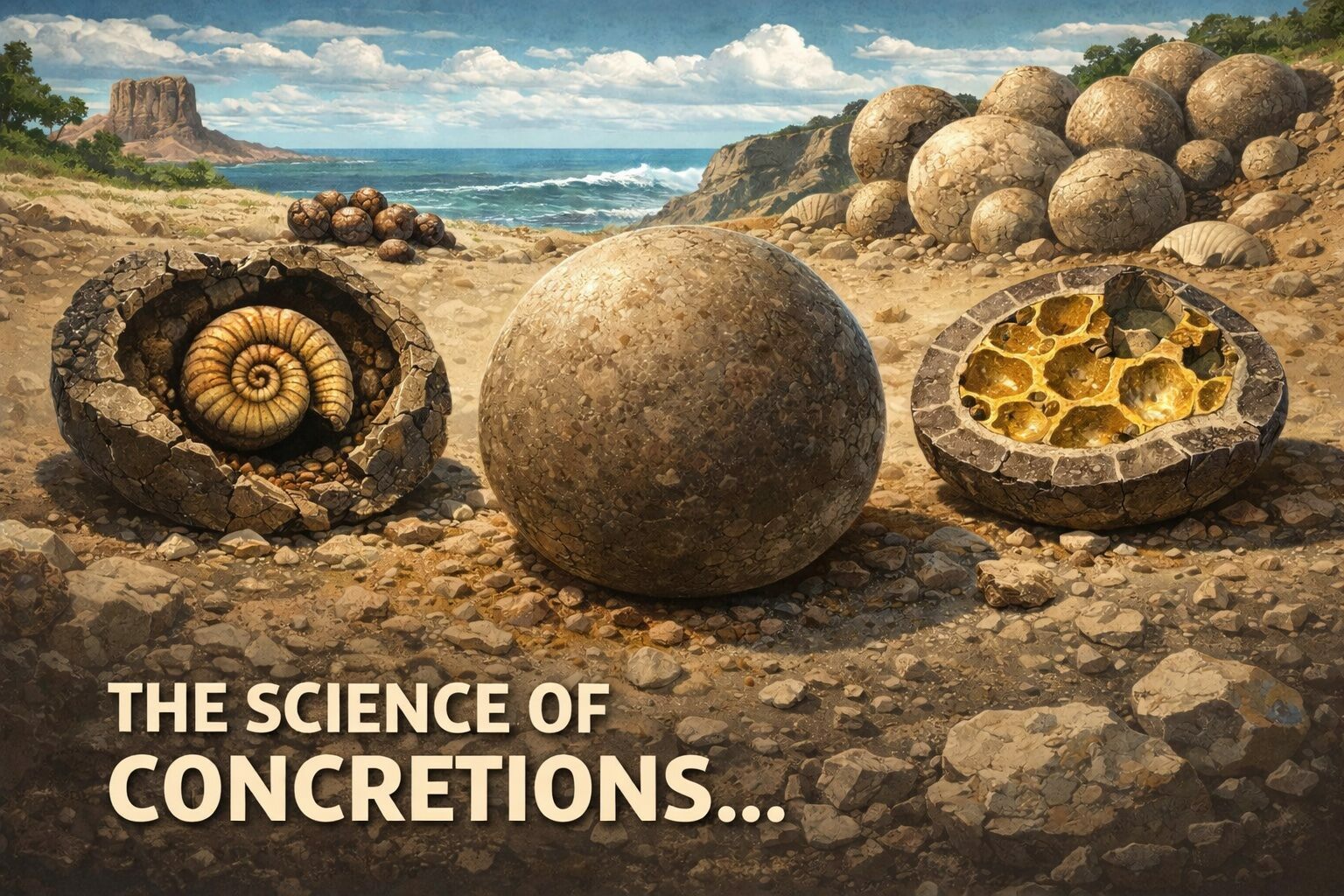
Imagine a stone forming inside the sediment around it, rather than being broken from a larger rock. That’s the essence of a concretion: a hard, compact mass that grows within softer host material like mud, sand, or clay, cemented together by minerals that precipitate out of groundwater. Most begin their lives clustered around a nucleus of organic matter—a shell, an ammonite, a bone fragment, or sometimes just a concentrated pocket of microbial activity. In many cases, that core later becomes a fossil preserved in the middle.

A concretion is a mineral-cemented mass that forms in place inside sedimentary rock, typically growing around an organic or material nucleus that may or may not leave a fossil core behind.
In others, the nucleus vanishes without a trace, leaving no fossil at all, only the geochemical fingerprint that sparked the stone’s growth. They commonly appear spherical or oval, but concretions also form as discs, pipes, clusters, and strange organic silhouettes. Though they look like ordinary rocks, concretions are more like geologic pearls, grown from chemical concentration around a nucleus rather than carved from bedrock.
A Hidden Reaction in the Subsurface
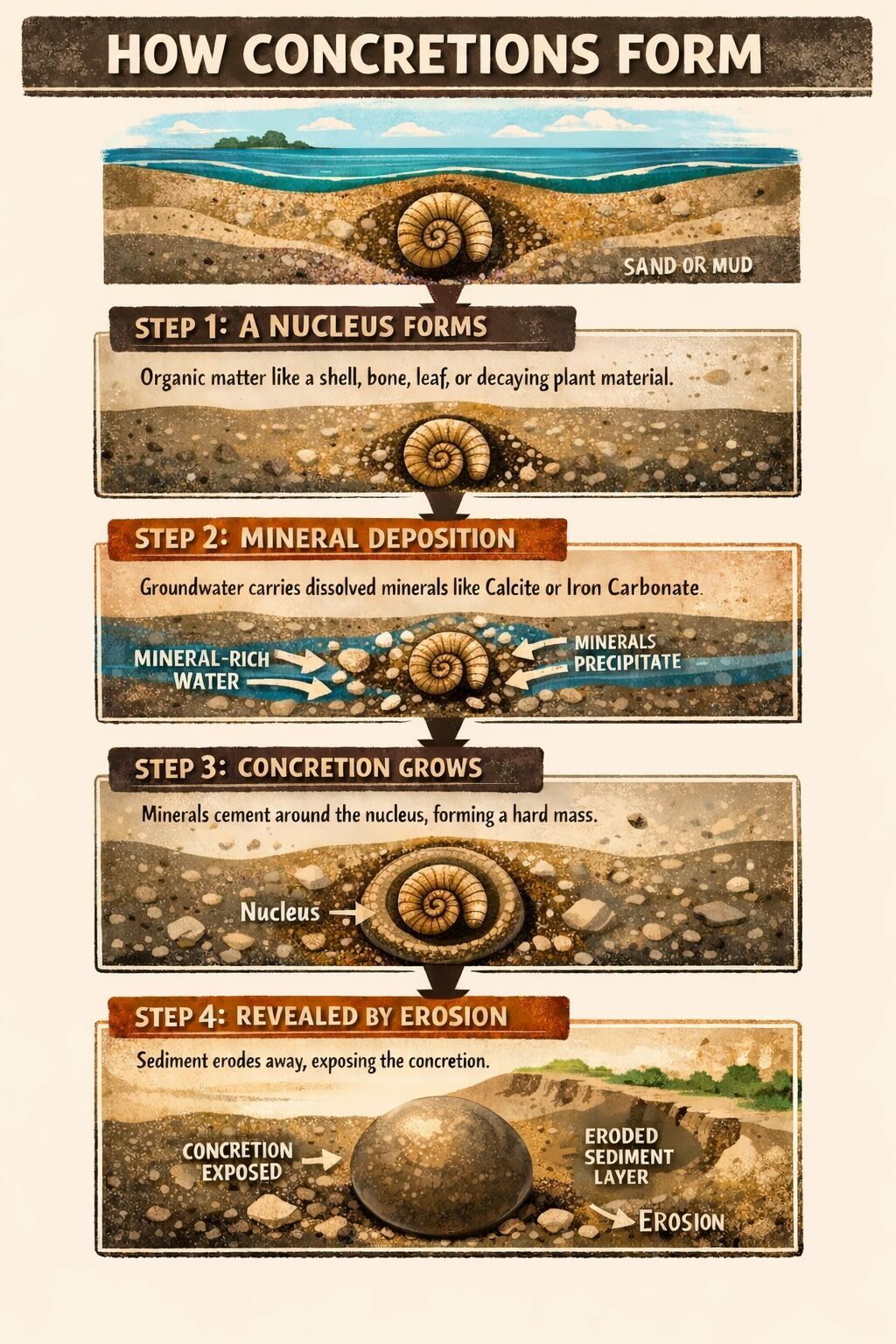
Concretions form after sediment is deposited, usually underground, in the quiet zone beneath oxygenated surface layers. Water moves through pores in the sediment, carrying dissolved minerals—most commonly calcite (CaCO₃), silica (SiO₂), or iron carbonates like siderite (FeCO₃). When chemistry shifts—perhaps due to decaying organic matter, pH change, microbial activity, or redox reactions—the minerals fall out of solution and begin to crystallize between sediment grains, binding them together.
The Power of a Nucleus
Nearly every concretion begins with a core: a fossil fragment, bone, leaf, shell, burrow, or even a tiny patch of organic slime. This nucleus creates a chemical micro-environment that alters the surrounding pore water. Microbes digesting organic matter release CO₂ and organic acids, lowering pH and encouraging carbonate minerals to precipitate. Iron concretions commonly form when sulfate-reducing bacteria convert dissolved iron into iron carbonate minerals in anoxic conditions.
Growth Patterns: From Radial to Layered
Some concretions grow outward evenly in all directions, forming near-perfect spheres. Others form in layers, like an onion, if groundwater chemistry fluctuates over time. Still others grow along cracks, bedding planes, or burrows, producing flattened or elongated shapes. In sandstones, concretions may form along zones of increased permeability, creating disc-like or pancake concretions that look almost engineered.
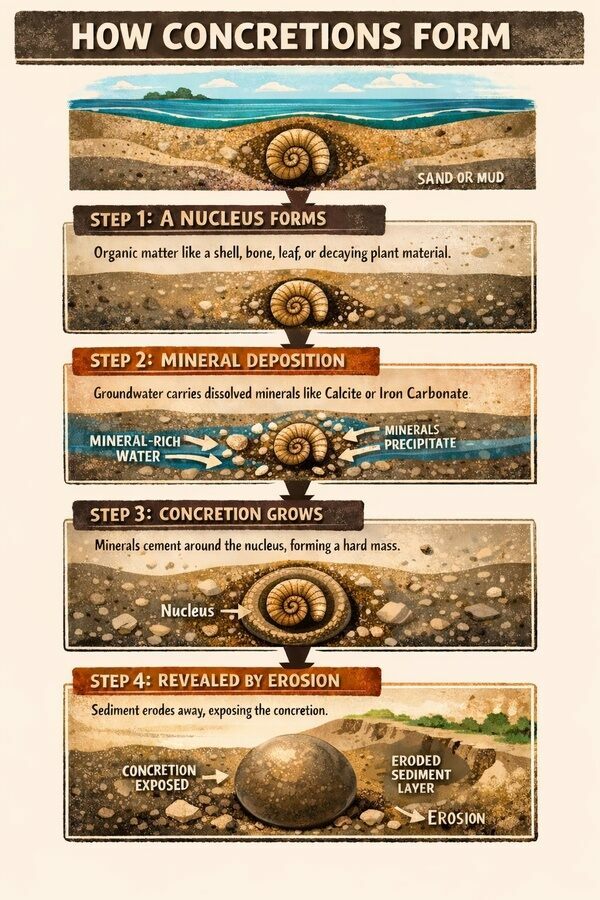
Infographic: How Concretions Form
Timing Matters
A key detail is that concretions form early in the burial history of sediment—often before the surrounding sediment fully hardens into rock. This is why they are frequently found intact after erosion: the concretion becomes more resistant than its host, eventually weathering free like a cannonball rolling from crumbling castle walls.
Fossil-Centered Concretions — The Museum-in-a-Rock Effect
Some of the most striking concretions grow around fossils, forming protective mineral armor around ancient life. The Mazon Creek concretions of Illinois are a famous example, preserving Carboniferous plants and soft-bodied organisms with exceptional fidelity. Because the concretion forms quickly around the fossil in low-oxygen mud, decay slows dramatically, allowing even jellyfish, worms, and shrimp-like creatures to leave crisp outlines.
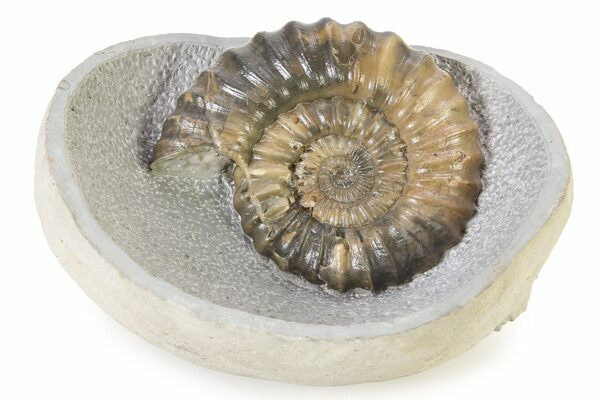
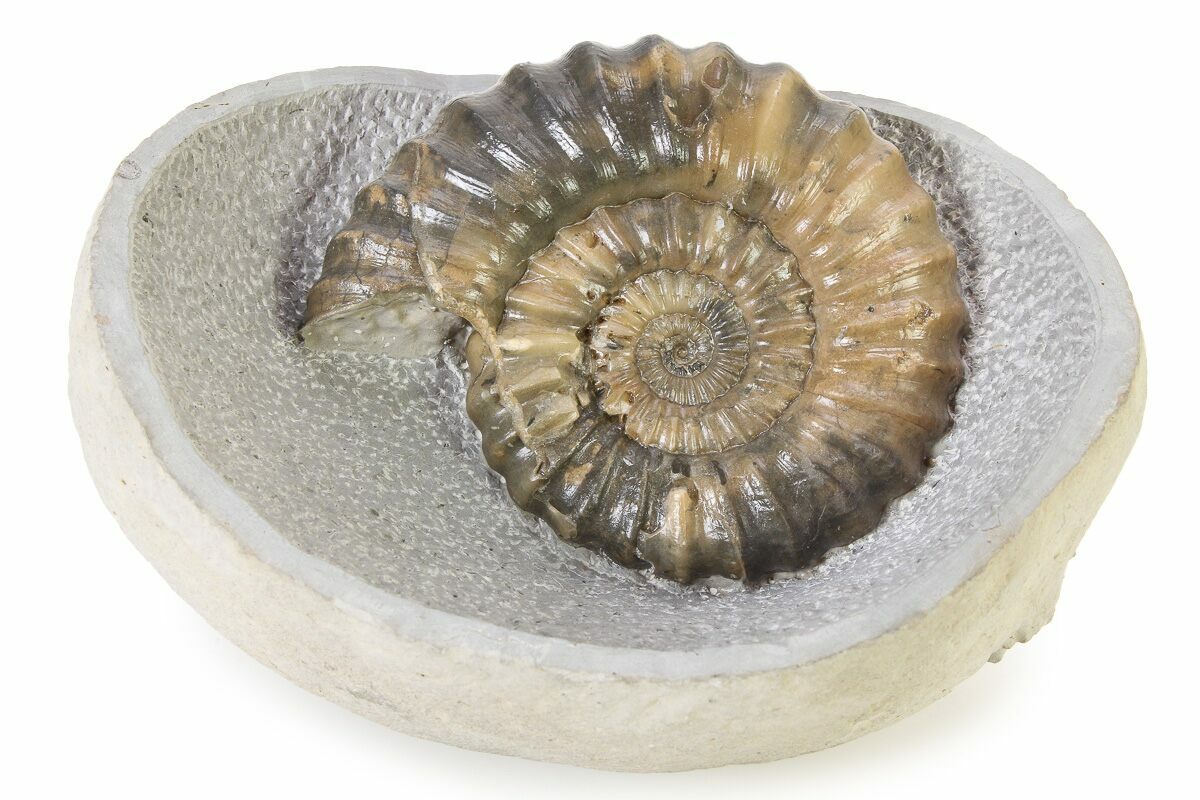
An Androgynoceras ammonite fossil preserved in a concretion.
Septarian Nodules — The Cracked-Egg Concretion
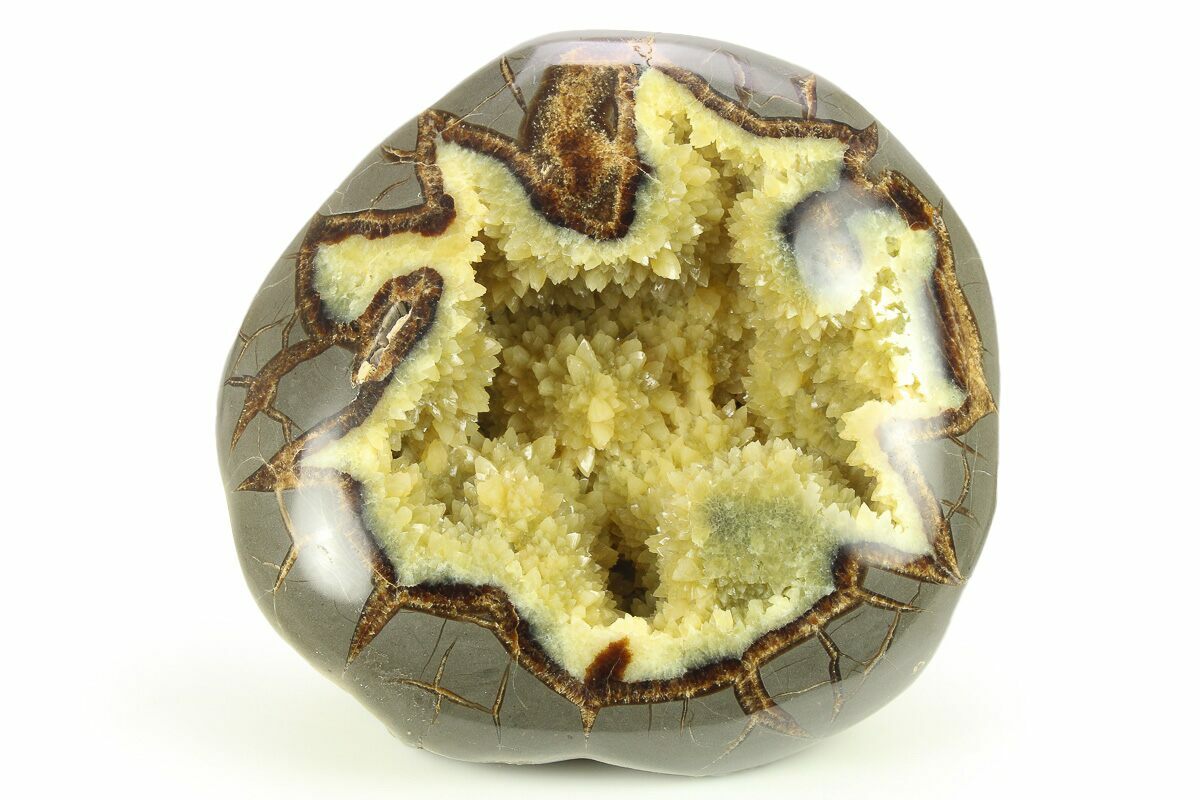
Septarian nodules are carbonate concretions that contain internal polygonal cracks later filled with minerals like calcite, aragonite, dolomite, or barite. The cracks form inside the concretion while the exterior remains intact.
There are three leading explanations for the cracking:
Shrinkage of clay-rich interiors as the concretion dehydrates
Gas expansion from decaying organics, creating internal stress
Rapid mineral precipitation, causing the concretion to self-fracture from the inside
Once cracked, mineral-rich fluids later invade the fractures, depositing sparkling veins that make septarians so popular among collectors. The result resembles a dragon egg split open to reveal treasure. A well-known subtype is the Septarian “lightning stone” from Madagascar, where dramatic yellow and brown calcite veins contrast against dark grey limestone interiors.
Moqui Marbles — Ironstone Concretions of the Desert
Found in the Navajo Sandstone of Utah and Arizona, Moqui marbles are small, rusty-red to black iron-oxide concretions. They form when iron-rich fluids moving through sandstone precipitate minerals around a grain of sand or organic speck, later oxidizing into hematite or goethite. Their otherworldly look once led to legends that they were meteorites or dinosaur eggs.
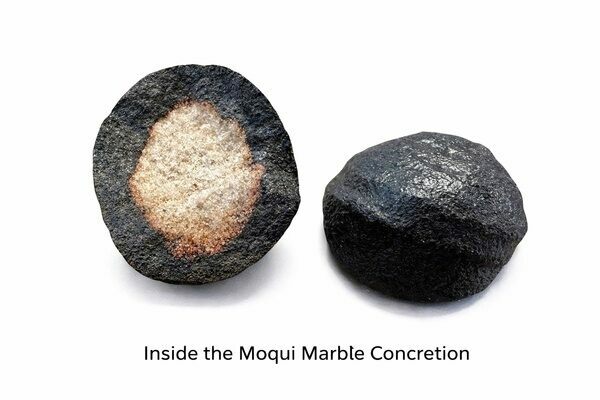
Inside a Moqui Marble
Gogotte Concretions — France’s Natural Sculptures
Gogottes are among the rarest and most visually arresting concretions on Earth, formed beneath the dune sands of the Fontainebleau region south of Paris, where silica-rich groundwater cemented tightly packed sand along irregular, migrating mineral fronts. Their twisting, bulbous, and flanged shapes were created not by transport or carving, but by the movement of mineral-laden water itself, binding grains of ancient sand into surreal silhouettes that resemble intentional sculpture. They typically nucleate around subtle pockets of organic films or chemical irregularities that often dissolve away entirely, leaving no fossil core behind, though occasional small shells or fossils can appear in exceptional pieces. Admired for centuries as natural curiosities, gogottes were collected by French aristocrats, famously excavated for decorative use at Versailles under Louis XIV, and today occupy a unique space between geology and art—prized as “natural sculptures in stone,” sold in galleries, mineral shows, and design auctions as examples of sediment transformed into abstraction purely through patient underground chemistry.

Gogotte Sandstone Concretion
Long before concretions became display pieces in rock shops and museums, they were curiosities whispered about by locals—odd stones that looked too deliberate to be natural. Among the most memorable are the Koutu Boulders of New Zealand. Scattered along a quiet stretch of coast, some reach a staggering 10 feet across, rising from the beach like abandoned stone eggs from some primordial nesting ground. They weren’t sculpted by waves, nor rolled smooth by rivers. They grew underground in ancient mud, expanding outward evenly, grain by grain, until erosion finally freed them. When the sea eventually reached them, it did nothing but polish their reputations.
Halfway across the world in Kansas, there’s a place called Rock City, though no skyline breaks the horizon there—only prairie grass, wind, and a field of massive stone spheres. The largest are 9 feet in diameter, weathered from soft Cretaceous chalk. Visitors describe the sensation of arriving there as surreal, like stumbling into a forgotten giant’s game board, where the marbles were limestone and the players long gone. The stones sit exactly where they formed, only now their cradle has eroded away, leaving them exposed but unmoved.
Then there is North Dakota’s Cannonball River region, a land of crumbling shale bluffs and slow-moving water. Here, iron-rich groundwater once cemented sediments into enormous rounded masses, many 3 to 10 feet wide, dense with siderite that would later oxidize to rust-toned exteriors. They spill from outcrops like artillery, giving the illusion of an ancient bombardment—but the only explosion was chemical, not physical. Their name, “cannonballs,” stuck not because it was scientifically correct, but because it felt emotionally true.
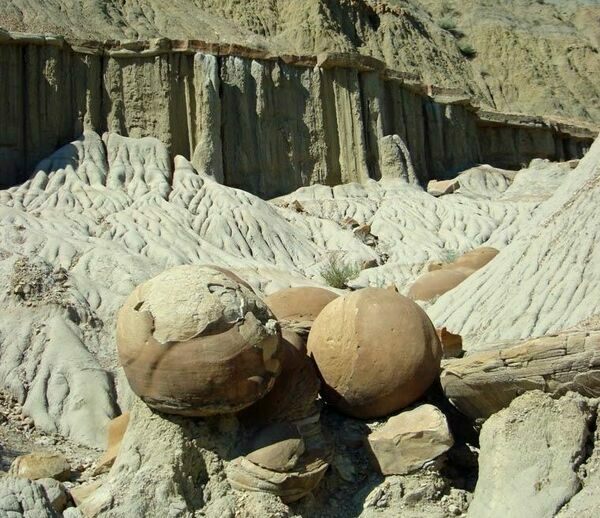
Cannonbball river concretions eroding out of the rock.
Yet the true heavyweights—the largest by sheer mass and total volume—aren’t the perfect spheres that grace postcards. They are the fused concretionary masses of Siberia, where entire concretion horizons merged into one another in the subsurface. Some span 13 to 20 feet or more, sprawling, irregular, and intergrown like crowded crystal cities built in silence beneath the sediment. They lack symmetry, but make up for it in scale, volume, and mystery. Most remain only partially excavated, their full size known not from a single specimen, but from geologic continuity traced through cliffs and river cuts.
These giants tell the same story in different accents: concretions aren’t shaped by travel—they’re shaped by time. They don’t roll into place. They grow into place, expanding patiently underground, harder than their host, until the world erodes around them and leaves them behind as monuments to a process that required no motion at all—only chemistry, pressure, and immense, quiet persistence.
A concretion is a mineral-cemented mass that forms in place inside sedimentary rock, typically growing around an organic or material nucleus that may or may not leave a fossil core behind.
In others, the nucleus vanishes without a trace, leaving no fossil at all, only the geochemical fingerprint that sparked the stone’s growth. They commonly appear spherical or oval, but concretions also form as discs, pipes, clusters, and strange organic silhouettes. Though they look like ordinary rocks, concretions are more like geologic pearls, grown from chemical concentration around a nucleus rather than carved from bedrock.
The Long, Slow Birth of a Concretion
A Hidden Reaction in the Subsurface
Concretions form after sediment is deposited, usually underground, in the quiet zone beneath oxygenated surface layers. Water moves through pores in the sediment, carrying dissolved minerals—most commonly calcite (CaCO₃), silica (SiO₂), or iron carbonates like siderite (FeCO₃). When chemistry shifts—perhaps due to decaying organic matter, pH change, microbial activity, or redox reactions—the minerals fall out of solution and begin to crystallize between sediment grains, binding them together.
The Power of a Nucleus
Nearly every concretion begins with a core: a fossil fragment, bone, leaf, shell, burrow, or even a tiny patch of organic slime. This nucleus creates a chemical micro-environment that alters the surrounding pore water. Microbes digesting organic matter release CO₂ and organic acids, lowering pH and encouraging carbonate minerals to precipitate. Iron concretions commonly form when sulfate-reducing bacteria convert dissolved iron into iron carbonate minerals in anoxic conditions.
Growth Patterns: From Radial to Layered
Some concretions grow outward evenly in all directions, forming near-perfect spheres. Others form in layers, like an onion, if groundwater chemistry fluctuates over time. Still others grow along cracks, bedding planes, or burrows, producing flattened or elongated shapes. In sandstones, concretions may form along zones of increased permeability, creating disc-like or pancake concretions that look almost engineered.
Infographic: How Concretions Form
Timing Matters
A key detail is that concretions form early in the burial history of sediment—often before the surrounding sediment fully hardens into rock. This is why they are frequently found intact after erosion: the concretion becomes more resistant than its host, eventually weathering free like a cannonball rolling from crumbling castle walls.
Special Concretions: When Nature Gets Artistic
Fossil-Centered Concretions — The Museum-in-a-Rock Effect
Some of the most striking concretions grow around fossils, forming protective mineral armor around ancient life. The Mazon Creek concretions of Illinois are a famous example, preserving Carboniferous plants and soft-bodied organisms with exceptional fidelity. Because the concretion forms quickly around the fossil in low-oxygen mud, decay slows dramatically, allowing even jellyfish, worms, and shrimp-like creatures to leave crisp outlines.
An Androgynoceras ammonite fossil preserved in a concretion.
Septarian Nodules — The Cracked-Egg Concretion
Septarian nodules are carbonate concretions that contain internal polygonal cracks later filled with minerals like calcite, aragonite, dolomite, or barite. The cracks form inside the concretion while the exterior remains intact.
There are three leading explanations for the cracking:
Once cracked, mineral-rich fluids later invade the fractures, depositing sparkling veins that make septarians so popular among collectors. The result resembles a dragon egg split open to reveal treasure. A well-known subtype is the Septarian “lightning stone” from Madagascar, where dramatic yellow and brown calcite veins contrast against dark grey limestone interiors.
Moqui Marbles — Ironstone Concretions of the Desert
Found in the Navajo Sandstone of Utah and Arizona, Moqui marbles are small, rusty-red to black iron-oxide concretions. They form when iron-rich fluids moving through sandstone precipitate minerals around a grain of sand or organic speck, later oxidizing into hematite or goethite. Their otherworldly look once led to legends that they were meteorites or dinosaur eggs.
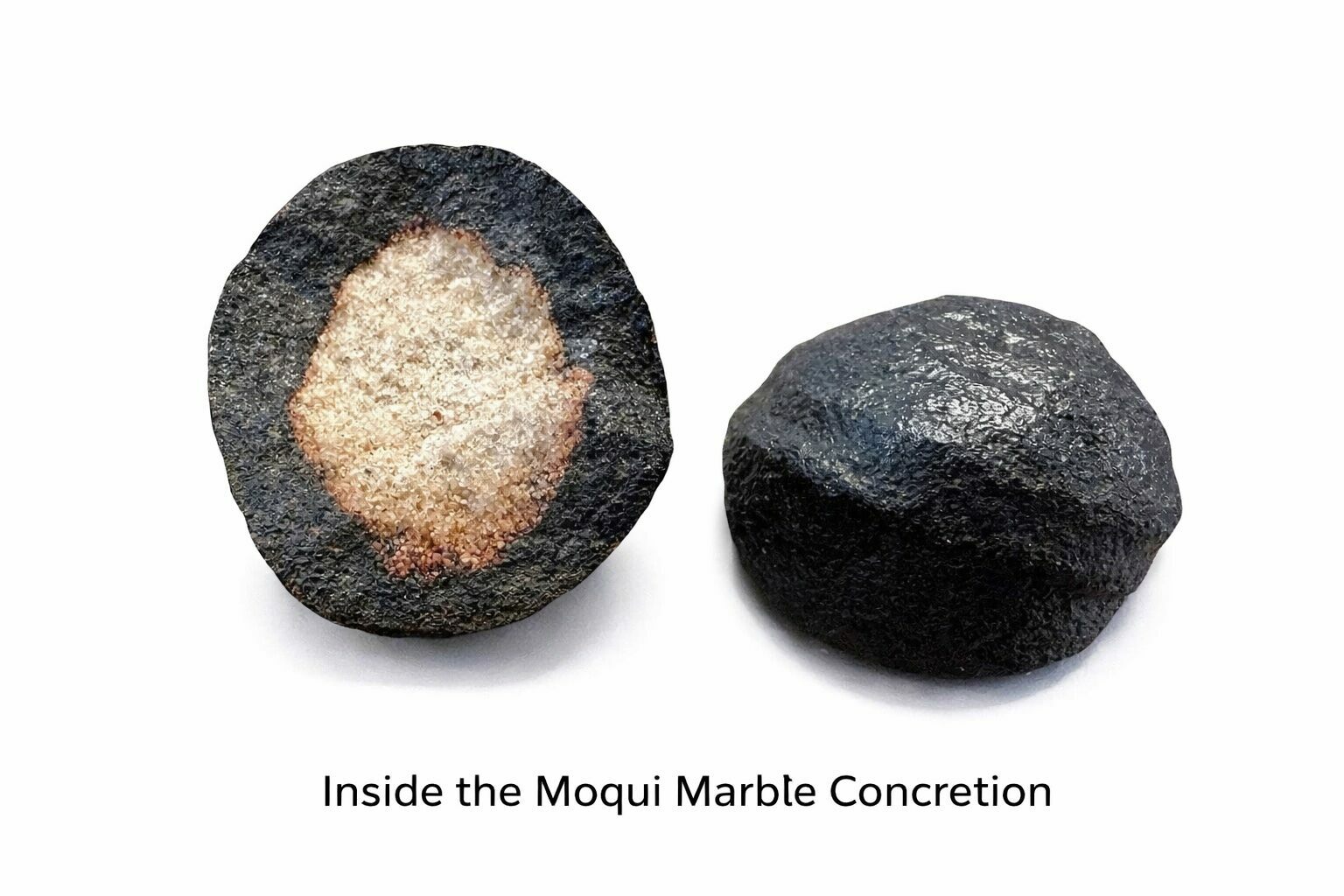
Inside a Moqui Marble
Gogotte Concretions — France’s Natural Sculptures
Gogottes are among the rarest and most visually arresting concretions on Earth, formed beneath the dune sands of the Fontainebleau region south of Paris, where silica-rich groundwater cemented tightly packed sand along irregular, migrating mineral fronts. Their twisting, bulbous, and flanged shapes were created not by transport or carving, but by the movement of mineral-laden water itself, binding grains of ancient sand into surreal silhouettes that resemble intentional sculpture. They typically nucleate around subtle pockets of organic films or chemical irregularities that often dissolve away entirely, leaving no fossil core behind, though occasional small shells or fossils can appear in exceptional pieces. Admired for centuries as natural curiosities, gogottes were collected by French aristocrats, famously excavated for decorative use at Versailles under Louis XIV, and today occupy a unique space between geology and art—prized as “natural sculptures in stone,” sold in galleries, mineral shows, and design auctions as examples of sediment transformed into abstraction purely through patient underground chemistry.
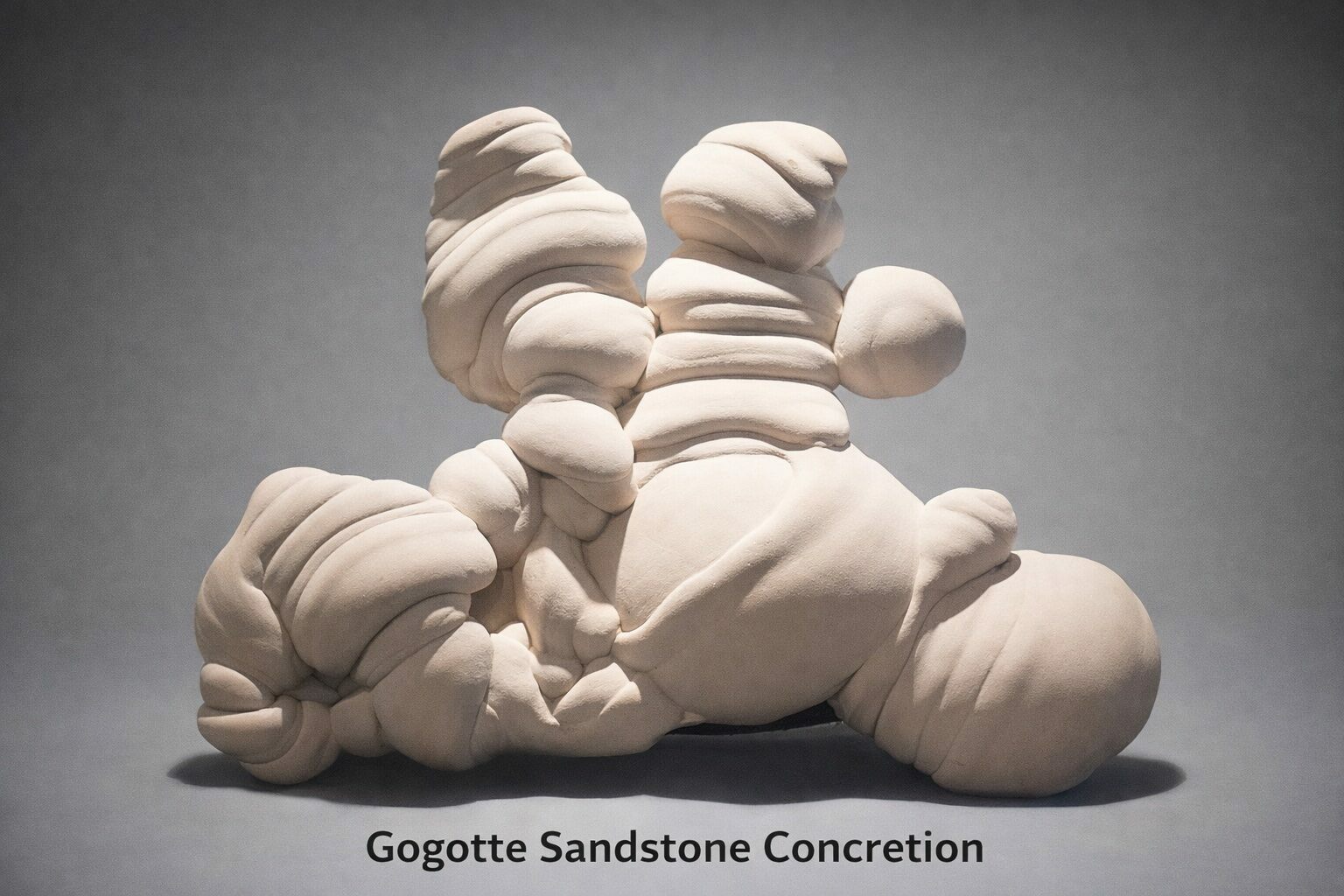
Gogotte Sandstone Concretion
The Giants: The Largest Concretions Ever Discovered
Long before concretions became display pieces in rock shops and museums, they were curiosities whispered about by locals—odd stones that looked too deliberate to be natural. Among the most memorable are the Koutu Boulders of New Zealand. Scattered along a quiet stretch of coast, some reach a staggering 10 feet across, rising from the beach like abandoned stone eggs from some primordial nesting ground. They weren’t sculpted by waves, nor rolled smooth by rivers. They grew underground in ancient mud, expanding outward evenly, grain by grain, until erosion finally freed them. When the sea eventually reached them, it did nothing but polish their reputations.
Halfway across the world in Kansas, there’s a place called Rock City, though no skyline breaks the horizon there—only prairie grass, wind, and a field of massive stone spheres. The largest are 9 feet in diameter, weathered from soft Cretaceous chalk. Visitors describe the sensation of arriving there as surreal, like stumbling into a forgotten giant’s game board, where the marbles were limestone and the players long gone. The stones sit exactly where they formed, only now their cradle has eroded away, leaving them exposed but unmoved.
Then there is North Dakota’s Cannonball River region, a land of crumbling shale bluffs and slow-moving water. Here, iron-rich groundwater once cemented sediments into enormous rounded masses, many 3 to 10 feet wide, dense with siderite that would later oxidize to rust-toned exteriors. They spill from outcrops like artillery, giving the illusion of an ancient bombardment—but the only explosion was chemical, not physical. Their name, “cannonballs,” stuck not because it was scientifically correct, but because it felt emotionally true.
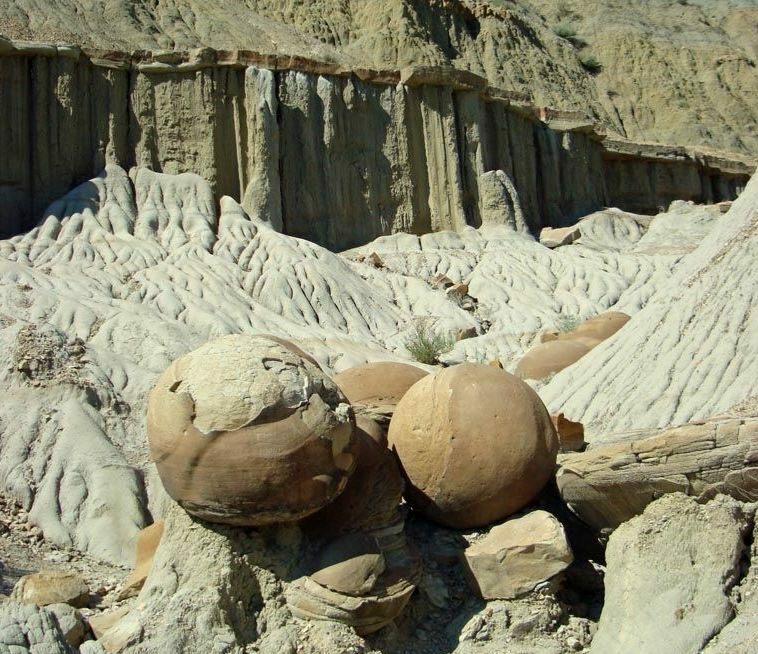
Cannonbball river concretions eroding out of the rock.
Yet the true heavyweights—the largest by sheer mass and total volume—aren’t the perfect spheres that grace postcards. They are the fused concretionary masses of Siberia, where entire concretion horizons merged into one another in the subsurface. Some span 13 to 20 feet or more, sprawling, irregular, and intergrown like crowded crystal cities built in silence beneath the sediment. They lack symmetry, but make up for it in scale, volume, and mystery. Most remain only partially excavated, their full size known not from a single specimen, but from geologic continuity traced through cliffs and river cuts.
These giants tell the same story in different accents: concretions aren’t shaped by travel—they’re shaped by time. They don’t roll into place. They grow into place, expanding patiently underground, harder than their host, until the world erodes around them and leaves them behind as monuments to a process that required no motion at all—only chemistry, pressure, and immense, quiet persistence.


