 Reviews


This Specimen has been sold.


Aciculolenus, Wujiajiania & Labiostria Trilobites - Mckay Group


This is a cool association of three different genus of trilobites from the Mckay Group of British Columbia. The rare one of this piece is a .25" long Aciculolenus palmeri. There are also a pair of Wujiajiania on the same side of the shale and a Labiostria molt on the back of the rock.
About Trilobites
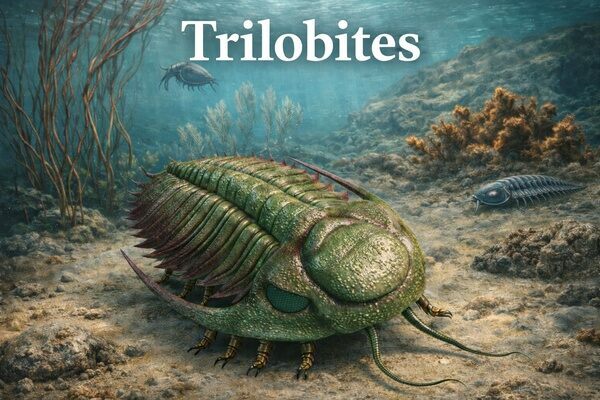
Trilobites were a very diverse group of extinct marine arthropods. They first appeared in the fossil record in the Early Cambrian (521 million years ago) and went extinct during the Permian mass extinction (250 million years ago). They were one of the most successful of the early animals on our planet: over 25,000 species have been described, filling nearly every evolutionary niche. Due in large part to their hard exoskeletons (shells), they left an excellent fossil record.
Trilobites were a very diverse group of extinct marine arthropods. They first appeared in the fossil record in the Early Cambrian (521 million years ago) and went extinct during the Permian mass extinction (250 million years ago). They were one of the most successful of the early animals on our planet: over 25,000 species have been described, filling nearly every evolutionary niche. Due in large part to their hard exoskeletons (shells), they left an excellent fossil record.
SPECIES
Aciculolenus palmeri, Wujiajiania sutherlandi & Labiostria westropi
AGE

LOCATION
Tanglefoot Creek, North of Cranbrook, British Columbia
FORMATION
McKay Group - Elvinia Biozone
SIZE
Rock 4.3 x 3.7", Largest trilobite .4"
CATEGORY
SUB CATEGORY
ITEM
#212692
We guarantee the authenticity of all of our specimens.