 Reviews


This Specimen has been sold.


15" Placenticeras Ammonite with Septarian Base - Elk Creek


This spectacular specimen features a 15" wide Placenticeras ammonite fossil that's perched atop a large calcite encrusted piece of septarian, collected from the Pierre Shale Formation of South Dakota. These ammonites are found within large concretions and are between 69 - 74 million years old. One edge of the ammonite is incomplete, allowing for the crystal filled chambers to be seen in great detail.
The ammonite is accompanied by both the septarian nodule and an additional metal stand for your preferred presentation. When including the septarian base, the entire specimen stands about 21" tall.
The ammonite is accompanied by both the septarian nodule and an additional metal stand for your preferred presentation. When including the septarian base, the entire specimen stands about 21" tall.
Note: Because of its size and weight, this piece will ship via freight on a pallet or in a crate. Our website can’t automatically calculate freight charges, so shipping costs will be determined and billed after purchase. If you’d like a quote beforehand, please contact us prior to ordering.
About Ammonites
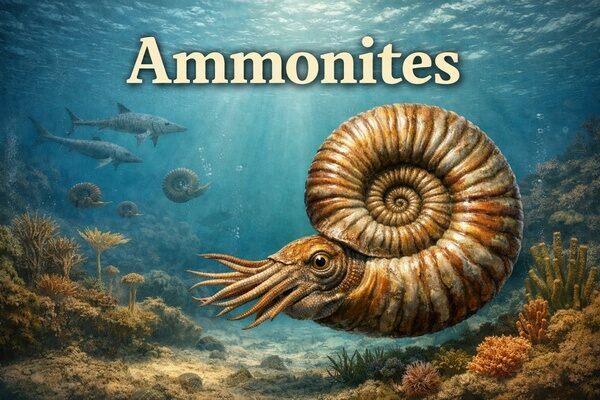
Ammonites were ancient marine cephalopods, similar to today's squids and octopuses, but with a defining feature: their distinctive, tightly coiled spiral shells. These shells, resembling those of modern nautiluses, served as both a protective home and a buoyancy aid, allowing ammonites to navigate the prehistoric seas with ease. First emerging around 240 million years ago in the Triassic Period, ammonites thrived for over 175 million years, adapting through numerous forms and sizes. As predatory creatures, they likely fed on smaller marine organisms, using their tentacles to capture prey. However, their long reign came to an end 65 million years ago at the close of the Cretaceous, coinciding with the mass extinction event that also eliminated the dinosaurs.
Ammonites were ancient marine cephalopods, similar to today's squids and octopuses, but with a defining feature: their distinctive, tightly coiled spiral shells. These shells, resembling those of modern nautiluses, served as both a protective home and a buoyancy aid, allowing ammonites to navigate the prehistoric seas with ease. First emerging around 240 million years ago in the Triassic Period, ammonites thrived for over 175 million years, adapting through numerous forms and sizes. As predatory creatures, they likely fed on smaller marine organisms, using their tentacles to capture prey. However, their long reign came to an end 65 million years ago at the close of the Cretaceous, coinciding with the mass extinction event that also eliminated the dinosaurs.
About Elk Creek Calcite
Superb rhombohedral crystals of septarian calcite occur in cavities within large concretions from the 70-million-year-old Pierre Shale in Elk Creek, South Dakota. The calcite crystals can be yellow, orange, or gold in color and are sometimes associated with golden Barite crystals and selenite. The calcite crystals fluoresce a bright yellow-white under shortwave UV light.
Superb rhombohedral crystals of septarian calcite occur in cavities within large concretions from the 70-million-year-old Pierre Shale in Elk Creek, South Dakota. The calcite crystals can be yellow, orange, or gold in color and are sometimes associated with golden Barite crystals and selenite. The calcite crystals fluoresce a bright yellow-white under shortwave UV light.
SPECIES
Placenticeras

LOCATION
Elk Creek, Meade County, South Dakota
FORMATION
Pierre Shale Formation
SIZE
Ammonite: 15" Wide, Entire Piece: 21 x 15 x 9"
CATEGORY
SUB CATEGORY
ITEM
#316057
We guarantee the authenticity of all of our specimens.


