 Reviews

Barite - Mineral & Crystal Guide
Pick up a typical rock and you expect it to feel… rock-ish. Solid, sure, but not surprising. Barite breaks that expectation instantly. For its size, it feels almost unnaturally heavy, like someone secretly swapped it for a metal block. That little jolt of disbelief—that “wait, why does this weigh so much?” moment—comes from barite’s defining trait: an exceptionally high specific gravity compared to most common minerals. It’s dense in a way that your hands notice before your brain catches up.
That density isn’t just a curiosity; it’s the reason barite has been recognized and relied upon for centuries. Long before laboratory instruments or formal mineralogy, miners and prospectors knew barite as the heavy mineral. If a pale crystal felt oddly weighty in the hand, chances were good it was barite. Even today, that simple heft test is still one of the quickest ways to identify it in the field.
Barite’s influence stretches far beyond the display cabinet. It plays a crucial role in oil and gas drilling, where its weight helps control pressure deep underground. In medicine, barium compounds derived from barite are used in imaging to make the invisible visible inside the human body. Few minerals can claim to be equally at home in a drill rig, a hospital, and a museum case.
Collectors, of course, love barite for entirely different reasons. Its crystals can look improbably refined—ice-like blades, thick golden tablets, delicate rosettes, or glassy blue fans with edges so sharp and clean they seem machined rather than grown. Many specimens show remarkable clarity and luster, catching light in a way that makes them feel almost fragile despite their weight. Add in trace impurities that paint barite in honey yellows, sky blues, smoky grays, rusty reds, or even soft greens, and it becomes a mineral that rewards long looks as much as first impressions.
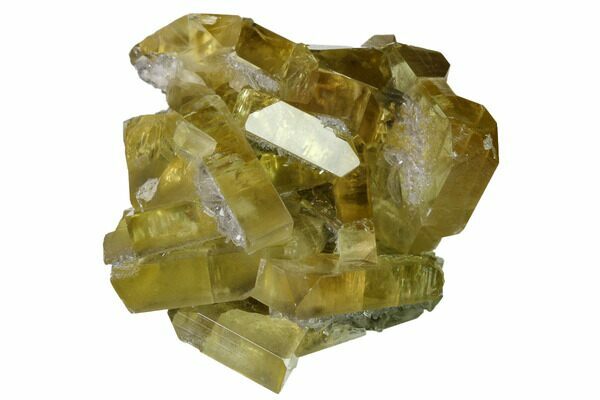
Gemmy, tabular barite crystals from the Meikle Mine in Nevada.
Even its name gives the game away. Derived from the Greek barys, meaning “heavy,” barite is literally “the heavy one” It’s a title it wears well—a mineral that quietly forces your senses to recalibrate, reminding you that in geology, appearances can be deceiving, and weight can be the most memorable feature of all.
Key Properties Of Barite:
Chemical formula: BaSO₄ (barium sulfate)
Mineral class: Sulfate
Crystal system: Orthorhombic
Habit: Tabular crystals, bladed forms, cockscomb aggregates, rosettes, massive and granular varieties
Color: Often colorless/white; also yellow, brown, gray, blue, greenish, reddish depending on impurities
Luster: Vitreous to pearly (especially on cleavage surfaces)
Transparency: Transparent to translucent; sometimes opaque in massive forms
Hardness (Mohs): ~3–3.5 (can be scratched by a copper coin)
Cleavage: Perfect in one direction; good in others—fresh breaks can show bright, pearly planes
Streak: White
Specific gravity: Typically high (~4.3–4.6) — the “heavy” hallmark
Common mineral association: Galena, sphalerite, fluorite, calcite, quartz, dolomite, calcite, pyrite
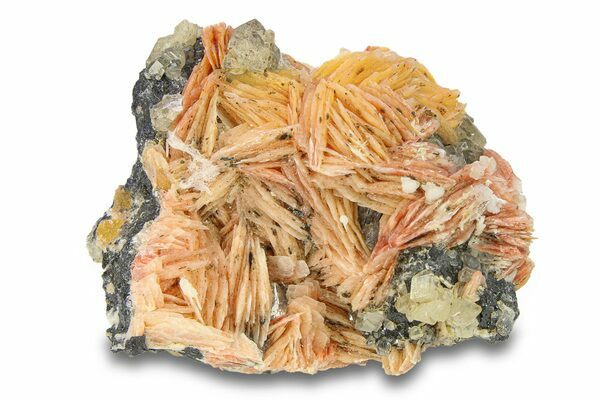
Pink bladed barite with galena and Cerussite from Morocco.
Yes—baryte and barite are the same mineral, barium sulfate (BaSO₄). The difference comes down to regional spelling preference: “barite” is widely used in North America and is especially common in industry and among collectors, while “baryte” is often preferred in the UK and in some international scientific contexts.
Barite is a mineral that forms when barium (Ba²⁺) meets sulfate (SO₄²⁻) in the right environment—and that “right environment” comes in several flavors. The key is that barium sulfate is extremely insoluble, so when the ingredients come together, barite tends to precipitate and stay put.
One of the most classic formation pathways involves hot, mineral-rich fluids moving through cracks and faults in the rock. These fluids can carry barium leached from the surrounding material, and when conditions change—such as a drop in temperature, a shift in pressure, or the introduction of sulfate—barite crystallizes in veins. It commonly forms alongside minerals like fluorite, calcite, quartz, galena (lead sulfide), and sphalerite (zinc sulfide). In these environments, barite may grow as tabular blades, radiating sprays, or distinctive cockscomb aggregates that resemble layered crystal feathers.
Barite can also form in sedimentary basins, sometimes as nodules or cement in limestone and shale. In marine environments, barite may precipitate from seawater or pore fluids under specific chemical conditions. Over time, during diagenesis (the “post-deposition” changes sediments undergo), barite can grow as concretions, veinlets, or disseminated crystals.
In carbonate rocks like limestone or dolostone, barite can form by replacement, where barium-bearing fluids react with the host rock. This can yield masses of barite intimately mixed with calcite/dolomite and sulfides—a process that can produce substantial ore bodies as well as striking specimens.
Where sulfate-rich brines are present (think evaporite-related systems), the availability of sulfate increases. If barium is introduced—through fluid mixing, leaching, or hydrothermal input—barite can precipitate readily.
The recurring theme is fluid mixing. Barite most commonly forms when barium-rich fluids meet sulfate-rich fluids, often in fractures, pore spaces, or open cavities within rock. On their own, these fluids can remain stable and invisible, but the moment they interact, barium sulfate becomes insoluble and precipitates almost instantly. The result is rapid crystal growth, sometimes so fast it resembles a mineral “snowfall” suspended in fluid that immediately hardens into stone. This sudden precipitation helps explain why barite frequently appears as dense vein fillings, sharp crystal clusters, or finely layered masses, preserving a snapshot of a brief but dramatic geochemical event.
Barite is found worldwide, but certain regions are especially famous among collectors for the mineral’s size, clarity, color, or distinctive crystal habits. Here are several standout sources specimen-hunters commonly recognize:
Missouri (Tri-State & Viburnum Trend regions): Classic barite occurrences, often associated with lead-zinc mineralization; “rose rocks” and attractive crystal clusters appear in some areas.
Arkansas: Noted for a variety of specimen materials (often in combination with quartz/calcite in certain districts).
Colorado: Hydrothermal vein barite can show sharp blades and associations with sulfides and fluorite.
California & Nevada: Vein systems can produce aesthetic crystals, sometimes with interesting color zoning.
Chihuahua (and other northern states): Mexico is renowned for high-aesthetic barite, including honey-gold blades, tabular crystals, and dramatic clusters—often very showy and well-formed.
Mibladen and surrounding districts: One of the most famous modern sources for collectors, producing abundant excellent crystals in attractive habits, sometimes with fluorite, calcite, or other companions.
United Kingdom (Cumbria and other historic mining areas): Britain has a long barite heritage in mining districts; specimens can be classic and well-documented.
Romania: Known for beautiful mineral specimens from historic districts; barite can occur with sulfides and other vein minerals.
Spain: Certain districts produce barite with strong color and crisp forms.
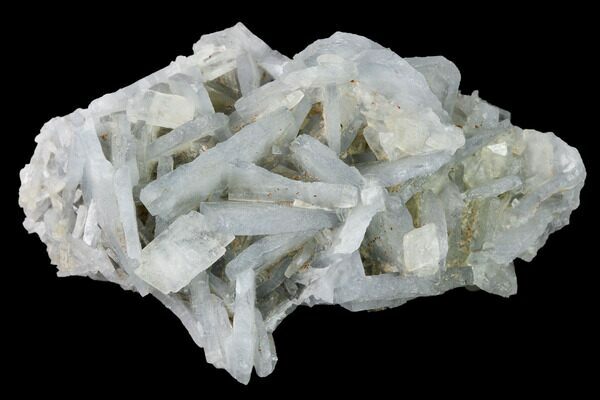
Tabular, blue barite crystals from the San Simon Mine in Spain
China has produced a wide range of barite specimens over the years, including large, bright clusters and distinct crystal habits, depending on locality and era.
Collector Tip: With barite, locality can strongly influence style—some areas are “blade factories,” others specialize in tabular plates, rosettes, or colorful fans.
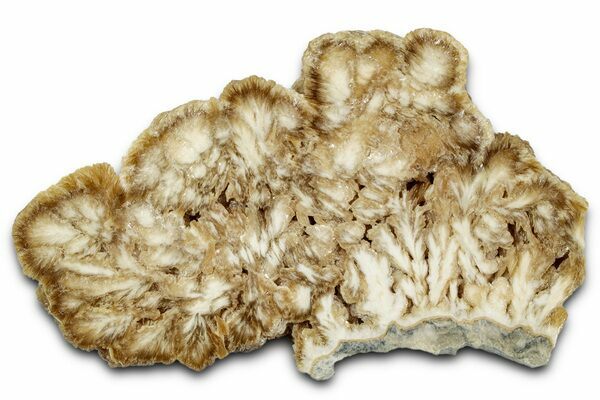
A polished slab of barite with pyrite from the Lubin Mine in Poland
Long before barite powered modern industry, it announced itself in a much simpler way: by feeling wrong in the hand. Early mineral observers didn’t need chemical tests or microscopes to notice that certain pale crystals felt dramatically heavier than they looked. This unusual density was so striking that it ultimately gave the mineral its name.
The word barite comes from the Greek barys (βαρύς), meaning “heavy.” The name was formally introduced in 1808 by German mineralogist Dietrich Ludwig Gustav Karsten, who recognized that this sulfate mineral deserved a classification anchored in its most obvious and defining trait. Earlier references exist under descriptive or local names—sometimes confused with other white minerals—but Karsten’s naming helped establish barite as a distinct species in the growing science of mineralogy.
At the time, mineral classification was rapidly evolving. Chemists were beginning to understand elemental composition, and the discovery of barium as a distinct element (by Carl Wilhelm Scheele and later isolated by Humphry Davy) helped clarify barite’s true nature as barium sulfate (BaSO₄). What had once been simply “that heavy white stuff in the vein” now had a firm chemical identity.
Throughout the 18th and 19th centuries, barite became a familiar sight in European mining districts. It was rarely the target mineral itself, but it appeared persistently alongside more economically valuable ores—especially lead and zinc sulfides. Miners learned that barite often marked productive ground, even if it was discarded as gangue. In places like England, Germany, and later the United States, barite-filled veins became geological signposts, silently recording the movement of mineral-rich fluids through fractured rock.
As the Industrial Revolution gathered momentum, barite’s role quietly shifted. Its chemical stability, brightness, and density made it useful as a pigment extender and filler. Finely ground barite found its way into paints, papers, rubber, and ceramics, where it improved opacity, durability, and weight without reacting chemically with other ingredients. Unlike many heavy minerals, barite could do its job without introducing toxicity or instability—a crucial advantage.
Barite’s most transformative chapter began in the 20th century, with the rise of deep oil and gas exploration. Drilling engineers faced a serious problem: as wells went deeper, underground pressures increased, threatening blowouts and collapses. What they needed was a way to make drilling fluids heavier—dense enough to counter subsurface pressures, yet stable and finely grindable.
Barite proved nearly perfect. Its high specific gravity allowed drillers to precisely control fluid density, while its chemical inertness meant it wouldn’t interfere with drilling chemistry. Once adopted, barite became indispensable. Today, the majority of the world’s barite production is still consumed by the energy industry, making it one of the most important “invisible” minerals supporting modern infrastructure.
Beyond drilling and manufacturing, barite’s identity as barium sulfate opened doors in science and medicine. Because BaSO₄ is extremely insoluble, it can be safely used where other barium compounds cannot. This property led to its use in radiographic imaging, where barium sulfate suspensions allow soft tissues to be visualized under X-rays—a striking example of a mineral bridging geology and human health.
Despite its industrial importance, barite never lost its aesthetic appeal. As mineral collecting grew in popularity, especially in the 20th century, collectors began to appreciate barite not just as an industrial commodity but as a crystal artist. Its ability to form razor-sharp blades, glowing honey plates, icy blue clusters, and desert-rose aggregates elevated it from “useful” to desirable.
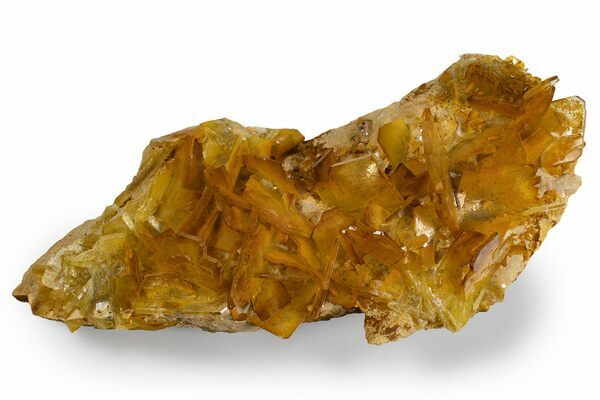
A lustrous orange bladed barite crystal cluster from Peru.

That density isn’t just a curiosity; it’s the reason barite has been recognized and relied upon for centuries. Long before laboratory instruments or formal mineralogy, miners and prospectors knew barite as the heavy mineral. If a pale crystal felt oddly weighty in the hand, chances were good it was barite. Even today, that simple heft test is still one of the quickest ways to identify it in the field.
Barite’s influence stretches far beyond the display cabinet. It plays a crucial role in oil and gas drilling, where its weight helps control pressure deep underground. In medicine, barium compounds derived from barite are used in imaging to make the invisible visible inside the human body. Few minerals can claim to be equally at home in a drill rig, a hospital, and a museum case.
Collectors, of course, love barite for entirely different reasons. Its crystals can look improbably refined—ice-like blades, thick golden tablets, delicate rosettes, or glassy blue fans with edges so sharp and clean they seem machined rather than grown. Many specimens show remarkable clarity and luster, catching light in a way that makes them feel almost fragile despite their weight. Add in trace impurities that paint barite in honey yellows, sky blues, smoky grays, rusty reds, or even soft greens, and it becomes a mineral that rewards long looks as much as first impressions.
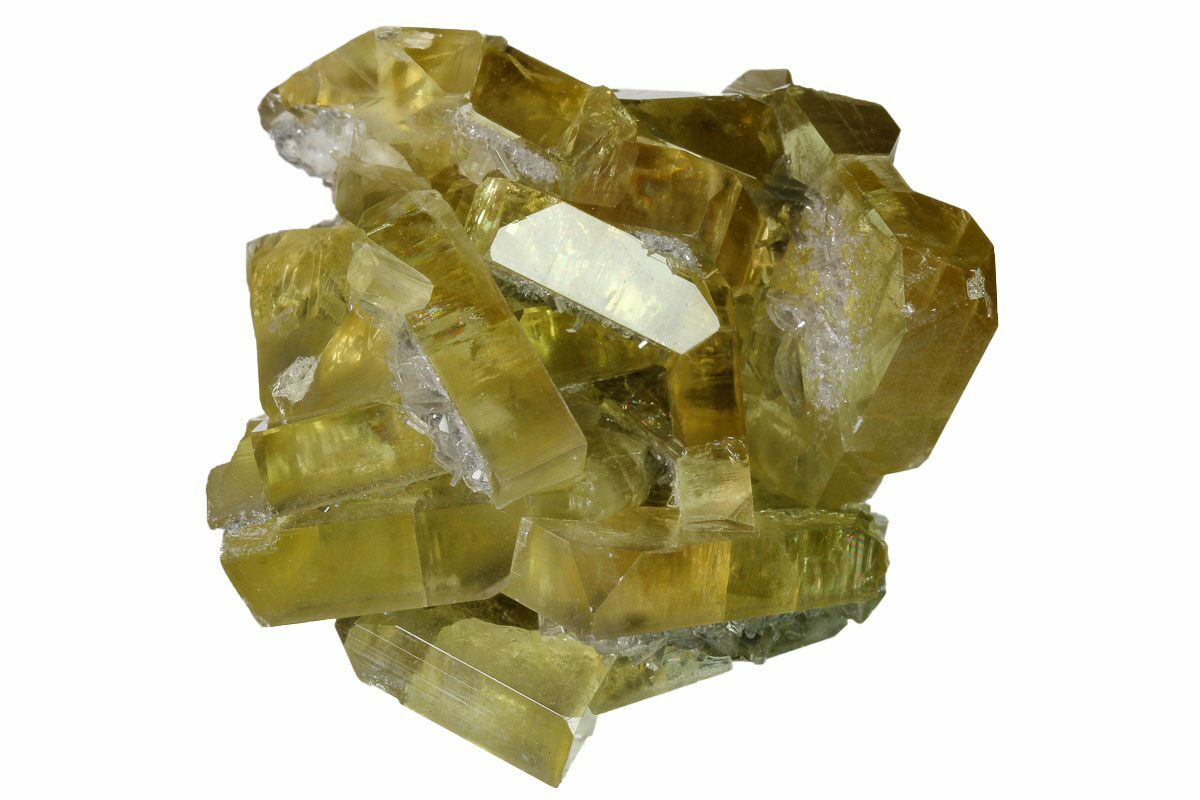
Gemmy, tabular barite crystals from the Meikle Mine in Nevada.
Even its name gives the game away. Derived from the Greek barys, meaning “heavy,” barite is literally “the heavy one” It’s a title it wears well—a mineral that quietly forces your senses to recalibrate, reminding you that in geology, appearances can be deceiving, and weight can be the most memorable feature of all.
Key Properties Of Barite:
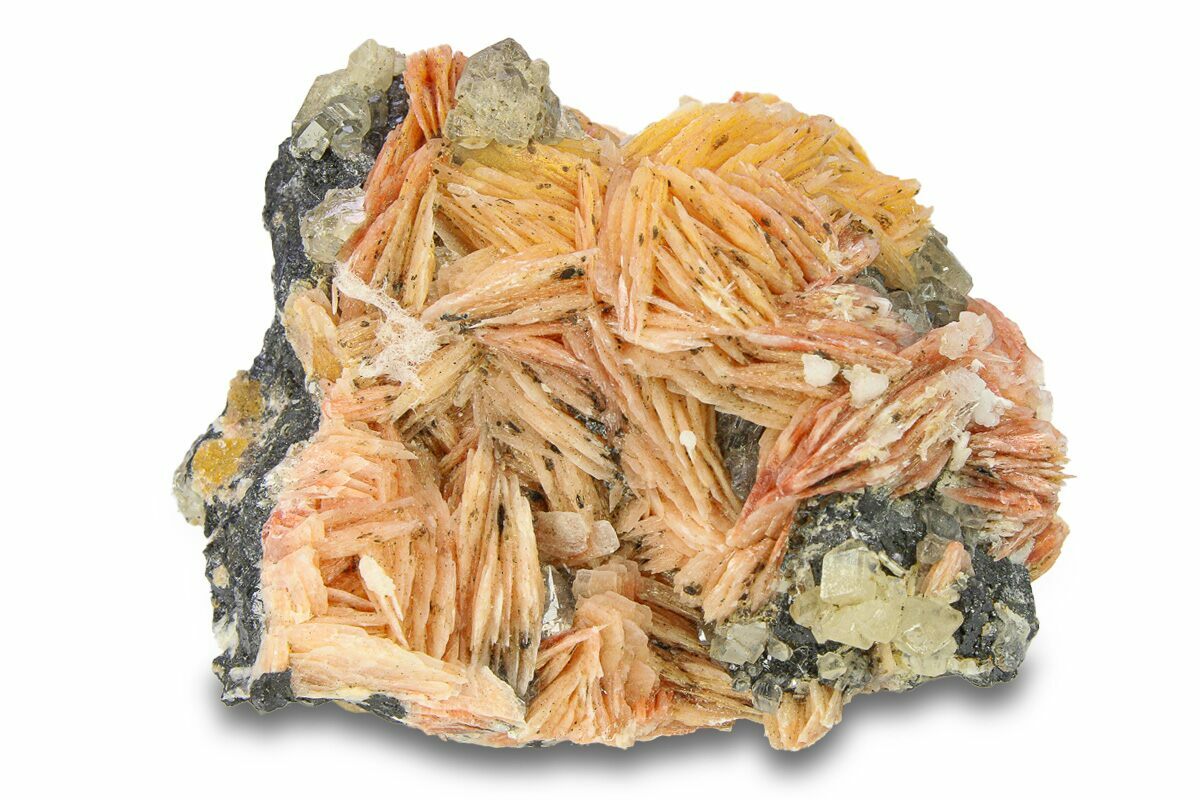
Pink bladed barite with galena and Cerussite from Morocco.
Is “Baryte” the Same as “Barite”?
Yes—baryte and barite are the same mineral, barium sulfate (BaSO₄). The difference comes down to regional spelling preference: “barite” is widely used in North America and is especially common in industry and among collectors, while “baryte” is often preferred in the UK and in some international scientific contexts.
How Barite Forms: The Chemistry of a Heavy Sulfate
Barite is a mineral that forms when barium (Ba²⁺) meets sulfate (SO₄²⁻) in the right environment—and that “right environment” comes in several flavors. The key is that barium sulfate is extremely insoluble, so when the ingredients come together, barite tends to precipitate and stay put.
1) Hydrothermal Veins: Barite as a Mineral “Plumbing Deposit”
One of the most classic formation pathways involves hot, mineral-rich fluids moving through cracks and faults in the rock. These fluids can carry barium leached from the surrounding material, and when conditions change—such as a drop in temperature, a shift in pressure, or the introduction of sulfate—barite crystallizes in veins. It commonly forms alongside minerals like fluorite, calcite, quartz, galena (lead sulfide), and sphalerite (zinc sulfide). In these environments, barite may grow as tabular blades, radiating sprays, or distinctive cockscomb aggregates that resemble layered crystal feathers.
2) Sedimentary & Diagenetic Settings: Barite Growing in the “Quiet Zones”
Barite can also form in sedimentary basins, sometimes as nodules or cement in limestone and shale. In marine environments, barite may precipitate from seawater or pore fluids under specific chemical conditions. Over time, during diagenesis (the “post-deposition” changes sediments undergo), barite can grow as concretions, veinlets, or disseminated crystals.
3) Replacement Deposits: When Barite Swaps Places with Carbonates
In carbonate rocks like limestone or dolostone, barite can form by replacement, where barium-bearing fluids react with the host rock. This can yield masses of barite intimately mixed with calcite/dolomite and sulfides—a process that can produce substantial ore bodies as well as striking specimens.
4) Evaporite-Adjacent Environments: Sulfate-Rich Chemistry
Where sulfate-rich brines are present (think evaporite-related systems), the availability of sulfate increases. If barium is introduced—through fluid mixing, leaching, or hydrothermal input—barite can precipitate readily.
The recurring theme is fluid mixing. Barite most commonly forms when barium-rich fluids meet sulfate-rich fluids, often in fractures, pore spaces, or open cavities within rock. On their own, these fluids can remain stable and invisible, but the moment they interact, barium sulfate becomes insoluble and precipitates almost instantly. The result is rapid crystal growth, sometimes so fast it resembles a mineral “snowfall” suspended in fluid that immediately hardens into stone. This sudden precipitation helps explain why barite frequently appears as dense vein fillings, sharp crystal clusters, or finely layered masses, preserving a snapshot of a brief but dramatic geochemical event.
Key Localities for Barite Specimens
Barite is found worldwide, but certain regions are especially famous among collectors for the mineral’s size, clarity, color, or distinctive crystal habits. Here are several standout sources specimen-hunters commonly recognize:
United States
Mexico
Morocco
Europe
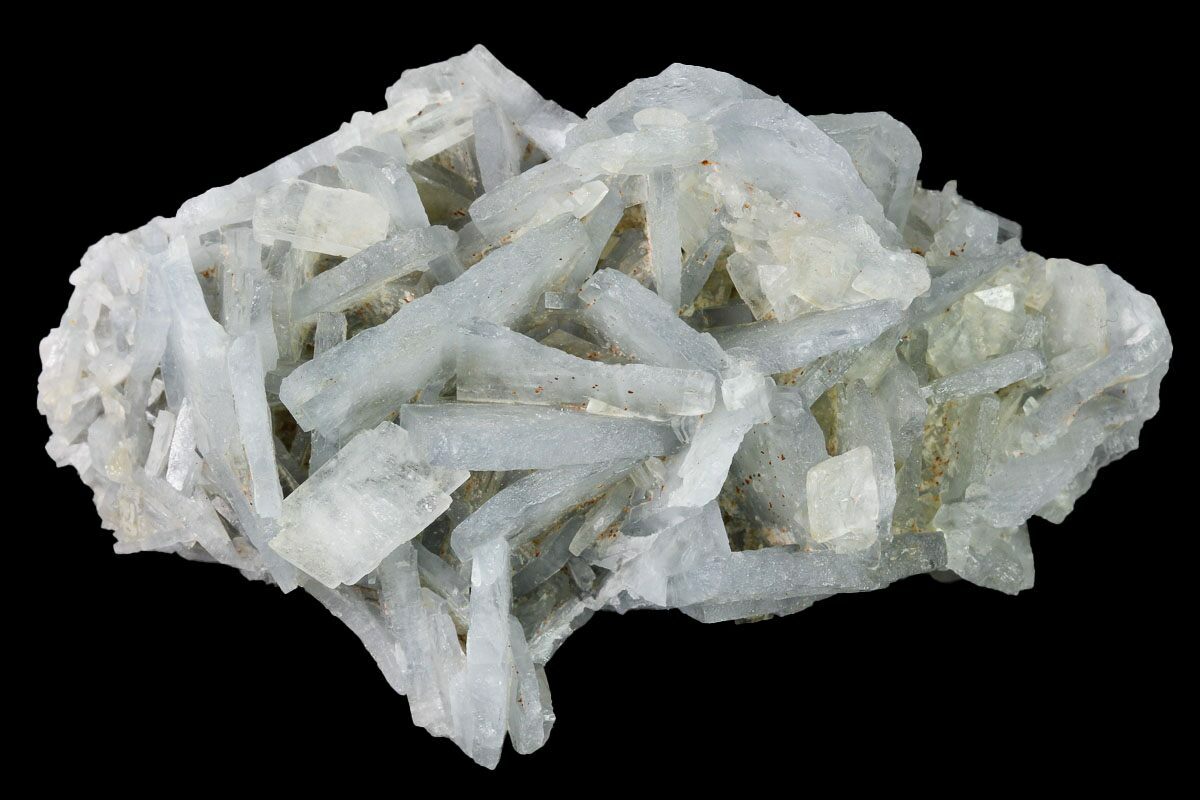
Tabular, blue barite crystals from the San Simon Mine in Spain
China
Collector Tip: With barite, locality can strongly influence style—some areas are “blade factories,” others specialize in tabular plates, rosettes, or colorful fans.
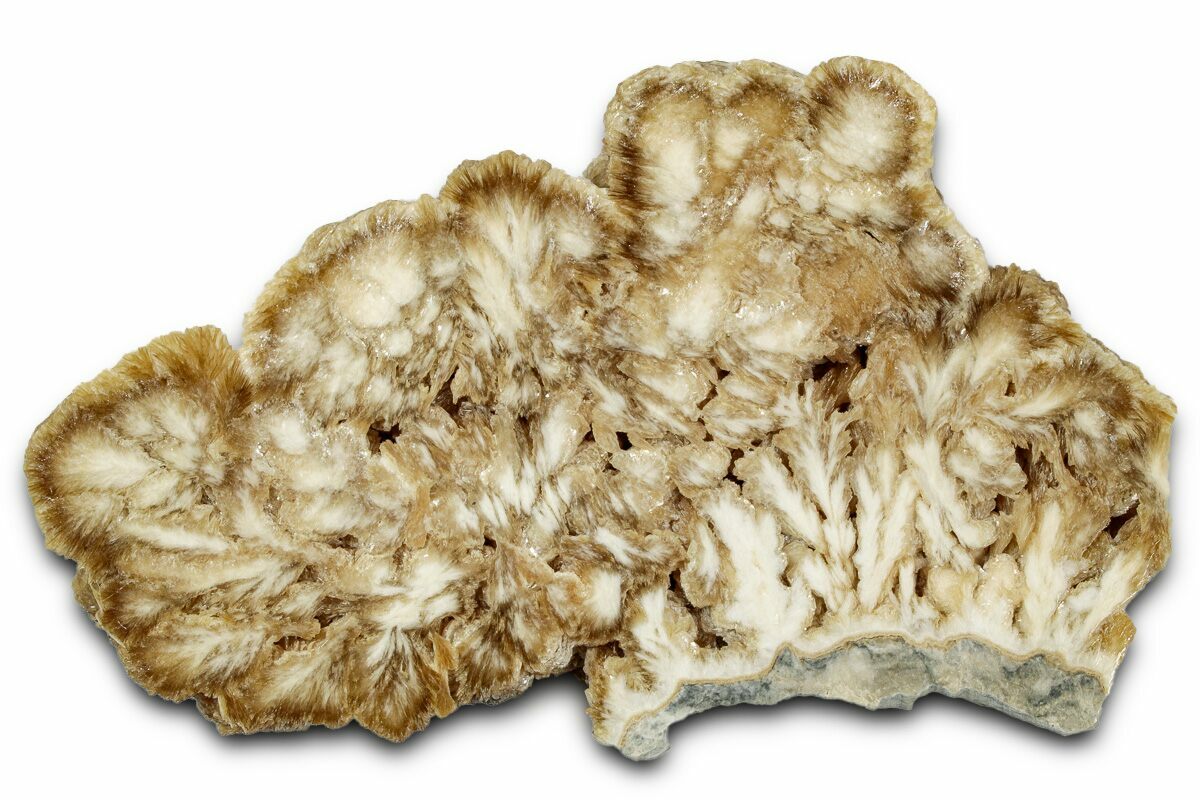
A polished slab of barite with pyrite from the Lubin Mine in Poland
The History of Barite and Its Uses
Long before barite powered modern industry, it announced itself in a much simpler way: by feeling wrong in the hand. Early mineral observers didn’t need chemical tests or microscopes to notice that certain pale crystals felt dramatically heavier than they looked. This unusual density was so striking that it ultimately gave the mineral its name.
The word barite comes from the Greek barys (βαρύς), meaning “heavy.” The name was formally introduced in 1808 by German mineralogist Dietrich Ludwig Gustav Karsten, who recognized that this sulfate mineral deserved a classification anchored in its most obvious and defining trait. Earlier references exist under descriptive or local names—sometimes confused with other white minerals—but Karsten’s naming helped establish barite as a distinct species in the growing science of mineralogy.
At the time, mineral classification was rapidly evolving. Chemists were beginning to understand elemental composition, and the discovery of barium as a distinct element (by Carl Wilhelm Scheele and later isolated by Humphry Davy) helped clarify barite’s true nature as barium sulfate (BaSO₄). What had once been simply “that heavy white stuff in the vein” now had a firm chemical identity.
From Mining Curiosity to Industrial Backbone
Throughout the 18th and 19th centuries, barite became a familiar sight in European mining districts. It was rarely the target mineral itself, but it appeared persistently alongside more economically valuable ores—especially lead and zinc sulfides. Miners learned that barite often marked productive ground, even if it was discarded as gangue. In places like England, Germany, and later the United States, barite-filled veins became geological signposts, silently recording the movement of mineral-rich fluids through fractured rock.
As the Industrial Revolution gathered momentum, barite’s role quietly shifted. Its chemical stability, brightness, and density made it useful as a pigment extender and filler. Finely ground barite found its way into paints, papers, rubber, and ceramics, where it improved opacity, durability, and weight without reacting chemically with other ingredients. Unlike many heavy minerals, barite could do its job without introducing toxicity or instability—a crucial advantage.
The Turning Point: Drilling into the Deep Earth
Barite’s most transformative chapter began in the 20th century, with the rise of deep oil and gas exploration. Drilling engineers faced a serious problem: as wells went deeper, underground pressures increased, threatening blowouts and collapses. What they needed was a way to make drilling fluids heavier—dense enough to counter subsurface pressures, yet stable and finely grindable.
Barite proved nearly perfect. Its high specific gravity allowed drillers to precisely control fluid density, while its chemical inertness meant it wouldn’t interfere with drilling chemistry. Once adopted, barite became indispensable. Today, the majority of the world’s barite production is still consumed by the energy industry, making it one of the most important “invisible” minerals supporting modern infrastructure.
Medicine, Science, and the Unseen Uses
Beyond drilling and manufacturing, barite’s identity as barium sulfate opened doors in science and medicine. Because BaSO₄ is extremely insoluble, it can be safely used where other barium compounds cannot. This property led to its use in radiographic imaging, where barium sulfate suspensions allow soft tissues to be visualized under X-rays—a striking example of a mineral bridging geology and human health.
From Industrial Mineral to Collector Favorite
Despite its industrial importance, barite never lost its aesthetic appeal. As mineral collecting grew in popularity, especially in the 20th century, collectors began to appreciate barite not just as an industrial commodity but as a crystal artist. Its ability to form razor-sharp blades, glowing honey plates, icy blue clusters, and desert-rose aggregates elevated it from “useful” to desirable.
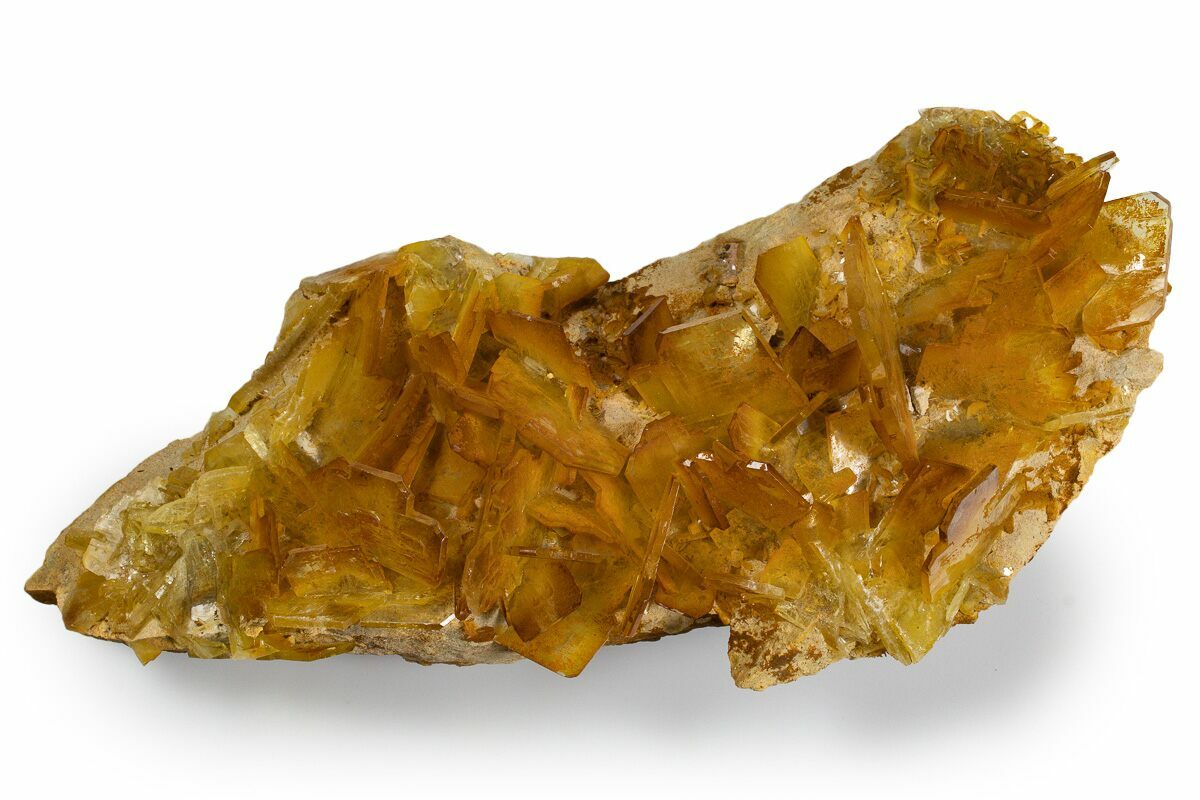
A lustrous orange bladed barite crystal cluster from Peru.


