 Reviews


This Specimen has been sold.


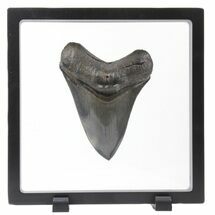
Serrated, .83" Fossil Tyrannosaur (Nanotyrannus?) Tooth - Montana


This is a .83" long tyrannosaur tooth likely of the species Nanotyrannus lancensis, collected from the Hell Creek Formation of Eastern Montana. The serrations along both edges are in excellent condition.
Comes with an acrylic display case.
Comes with an acrylic display case.
Nanotyrannus vs. T. rex
Update: New research confirms that Nanotyrannus lancensis was not a juvenile Tyrannosaurus rex but rather a distinct, fully mature tyrannosaur species.
Paleontologists debate contentiously about whether Nanotyrannus and Tyrannosaurus rex (T. rex) are really the same species, where Nanotyrannus represent juveniles. Papers going back and forth on the topic continue to be published, but even more fossil evidence under study has yet to be published. We tend to fall into the camp that Nanotyrannus is in fact a separate species.
No matter where you fall on the Nano vs T. rex debate, there are clearly two different Tyrannosaur tooth morphologies present in the Hell Creek Formation. The larger teeth, usually 2 1/2 inches or more, can confidently be labeled as Tyrannosaurus rex. For the smaller teeth, main distinguishing characteristics between the two morphologies is the shape of the base, compression of the crown/tip, and presence of a "pinch" at the base. Serration density does not appear to be a distinguishing factor since it varies based on tooth position.
We are labeling based on morphology. The longer, thinner, and more compressed teeth with a pinch at their base are labeled as Nanotyrannus. The fatter teeth with a more rounded tip and no pinch at their base are labeled as Tyrannosaurus rex.
Update: New research confirms that Nanotyrannus lancensis was not a juvenile Tyrannosaurus rex but rather a distinct, fully mature tyrannosaur species.
Paleontologists debate contentiously about whether Nanotyrannus and Tyrannosaurus rex (T. rex) are really the same species, where Nanotyrannus represent juveniles. Papers going back and forth on the topic continue to be published, but even more fossil evidence under study has yet to be published. We tend to fall into the camp that Nanotyrannus is in fact a separate species.
No matter where you fall on the Nano vs T. rex debate, there are clearly two different Tyrannosaur tooth morphologies present in the Hell Creek Formation. The larger teeth, usually 2 1/2 inches or more, can confidently be labeled as Tyrannosaurus rex. For the smaller teeth, main distinguishing characteristics between the two morphologies is the shape of the base, compression of the crown/tip, and presence of a "pinch" at the base. Serration density does not appear to be a distinguishing factor since it varies based on tooth position.
We are labeling based on morphology. The longer, thinner, and more compressed teeth with a pinch at their base are labeled as Nanotyrannus. The fatter teeth with a more rounded tip and no pinch at their base are labeled as Tyrannosaurus rex.
The Hell Creek Formation
Renowned for both its age and rich sedimentary layers, the Hell Creek Formation is one of the most intensively studied fossil-bearing regions on Earth. To date, scientists have documented 158 genera of animals and 64 genera of plants from its rocks, with new finds emerging regularly. Beyond iconic dinosaurs such as tyrannosaurs, ceratopsians, and hadrosaurs, the formation has produced an extraordinary array of life, including amphibians, reptiles, lizards, snakes, turtles, fish, sharks, birds, and early mammals. Together, these fossils provide the most complete picture of the ecosystems that thrived just before the Cretaceous–Paleogene extinction event.
Renowned for both its age and rich sedimentary layers, the Hell Creek Formation is one of the most intensively studied fossil-bearing regions on Earth. To date, scientists have documented 158 genera of animals and 64 genera of plants from its rocks, with new finds emerging regularly. Beyond iconic dinosaurs such as tyrannosaurs, ceratopsians, and hadrosaurs, the formation has produced an extraordinary array of life, including amphibians, reptiles, lizards, snakes, turtles, fish, sharks, birds, and early mammals. Together, these fossils provide the most complete picture of the ecosystems that thrived just before the Cretaceous–Paleogene extinction event.
SPECIES
Nanotyrannus lancensis?

LOCATION
Garfield County, Eastern Montana
FORMATION
Hell Creek Formation
SIZE
.83" long (straightline)
CATEGORY
SUB CATEGORY
ITEM
#315054
We guarantee the authenticity of all of our specimens.