 Reviews


This Specimen has been sold.

Two Aglaspid (Tremaglaspis) Fossils With Marrellomorphs (Furca)


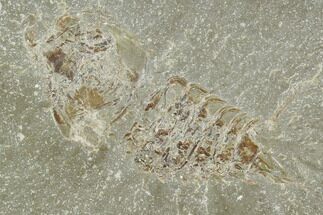
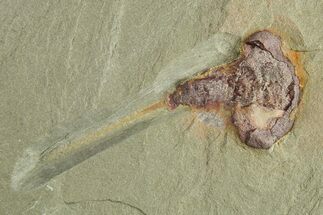
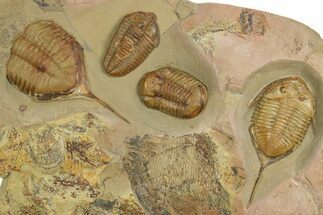
This is an awesome association of two types of Lower Ordovician soft-bodied arthropods. There are a pair of Aglaspids (Tremaglaspis) as well as a pair of faintly preserved Marrellomorphs (Furca mauretanica) on a 15.5 x 9" piece of shale.
The larger Aglaspid is a 3.4" long while the smaller one is 2.7". The larger of the Marrellomorphs is about 2" long, but they are a bit difficult to see due to the preservation.
The larger Aglaspid is a 3.4" long while the smaller one is 2.7". The larger of the Marrellomorphs is about 2" long, but they are a bit difficult to see due to the preservation.
About Aglaspids
Aglaspids are an extinct group of arthropods that lived during the Cambrian to Ordovician periods, approximately 500 to 480 million years ago. Fossil aglaspids are notable for their unique morphology, resembling a mix between horseshoe crabs and early trilobites. They had a broad, shield-like exoskeleton, often divided into three sections: a large head shield, a segmented thorax, and a narrow tail spine.
Aglaspids are believed to have been benthic, living on or near the ocean floor, where they likely scavenged or preyed on small organisms. Their fossil record is primarily concentrated in North America and Morocco, though their distribution indicates they may have inhabited various marine environments globally. Fossils of aglaspids are rare and provide valuable insights into the diversity and evolutionary history of early arthropods.
Aglaspids are an extinct group of arthropods that lived during the Cambrian to Ordovician periods, approximately 500 to 480 million years ago. Fossil aglaspids are notable for their unique morphology, resembling a mix between horseshoe crabs and early trilobites. They had a broad, shield-like exoskeleton, often divided into three sections: a large head shield, a segmented thorax, and a narrow tail spine.
Aglaspids are believed to have been benthic, living on or near the ocean floor, where they likely scavenged or preyed on small organisms. Their fossil record is primarily concentrated in North America and Morocco, though their distribution indicates they may have inhabited various marine environments globally. Fossils of aglaspids are rare and provide valuable insights into the diversity and evolutionary history of early arthropods.
About Marrellomorphs
Marrellomorphs are an extinct and unusual group of marine arthropods that lived from the Cambrian through the Early Devonian, a span of roughly 100 million years. They are best known for their distinctive body shapes, often bearing elaborate head shields and long spines, which make them some of the more striking animals of early Paleozoic seas.
Unlike many other arthropods, marrellomorphs did not possess mineralized hard parts such as calcified shells or thick exoskeletons. Their bodies were mostly soft, which meant they were far less likely to fossilize under normal conditions. As a result, marrellomorph fossils are rare and are typically only found in Lagerstätten—sites of exceptional preservation where rapid burial, low oxygen conditions, or fine sediments allowed delicate soft tissues to be preserved.
Because these extraordinary environments were uncommon, the fossil record of marrellomorphs is patchy and geographically restricted. Even though they may have been more widespread in ancient oceans, their known distribution is largely limited to a handful of well-preserved fossil deposits, making them an important but elusive window into early arthropod evolution and diversity.
Marrellomorphs are an extinct and unusual group of marine arthropods that lived from the Cambrian through the Early Devonian, a span of roughly 100 million years. They are best known for their distinctive body shapes, often bearing elaborate head shields and long spines, which make them some of the more striking animals of early Paleozoic seas.
Unlike many other arthropods, marrellomorphs did not possess mineralized hard parts such as calcified shells or thick exoskeletons. Their bodies were mostly soft, which meant they were far less likely to fossilize under normal conditions. As a result, marrellomorph fossils are rare and are typically only found in Lagerstätten—sites of exceptional preservation where rapid burial, low oxygen conditions, or fine sediments allowed delicate soft tissues to be preserved.
Because these extraordinary environments were uncommon, the fossil record of marrellomorphs is patchy and geographically restricted. Even though they may have been more widespread in ancient oceans, their known distribution is largely limited to a handful of well-preserved fossil deposits, making them an important but elusive window into early arthropod evolution and diversity.
SPECIES
Tremaglaspis sp & Furca mauretanica

LOCATION
Zagora Region, Morocco
FORMATION
Upper Fezouata Formation
SIZE
Large Aglaspid 3.4", Rock 15.5 x 9"
CATEGORY
SUB CATEGORY
ITEM
#350857
We guarantee the authenticity of all of our specimens.