 Reviews

This Specimen has been sold.


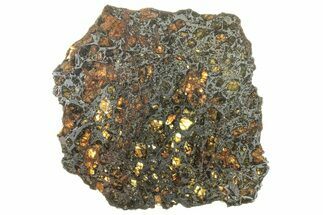
1.2" Brahin Pallasite Meteorite (10.89 g) Fragment - Belarus

This 1.2 x .85", 10.89-gram fragment of the beautiful Brahin pallasite meteorite. This piece is chock-full of yellowish olivines in nickel-iron matrix. Some of the matrix has rusted on one side, but the abundance of olivines on this specimen makes it stunning from any angle.
About The Brahin Pallasite
This stunning main group pallasite was first discovered near a village in the southeastern district of Brahin in Byelorussia (now Belarus) in 1807. Pieces were found over a 15-kilometer strewn field crossing the Dnieper River. At the time, it was only the second meteorite ever found on Soviet soil.
More pieces were recovered in 1968, and the pallasite was officially named Brahin (also Bragin). Over 800 kilograms of the meteorite have officially been recorded, but this is only an estimate: over 1,000 kilograms of material could exist, since the meteorite is a very popular specimen among collectors.
This stunning main group pallasite was first discovered near a village in the southeastern district of Brahin in Byelorussia (now Belarus) in 1807. Pieces were found over a 15-kilometer strewn field crossing the Dnieper River. At the time, it was only the second meteorite ever found on Soviet soil.
More pieces were recovered in 1968, and the pallasite was officially named Brahin (also Bragin). Over 800 kilograms of the meteorite have officially been recorded, but this is only an estimate: over 1,000 kilograms of material could exist, since the meteorite is a very popular specimen among collectors.
About Pallasites
Pallasite meteorites are a class of stony-iron meteorites. They were once believed to have originated at the core-mantle boundary of asteroids that shattered through impacts, but a recent hypothesis is that they are a mixture of core and mantle minerals.
Pallasite meteorites consist of olivine (peridot) crystals surrounded by iron-nickel matrix. Upon acid etching, some pallasites display interweaving structures known as Widmanstätten patterns (or Thomson lines) in the metallic matrix. These structures are iron-nickel alloy crystals, typically kamacite and taenite, that cooled over millions of years in the vacuum of space.
Pallasites are quite rare: only about 200 are known, and only four have had observed falls. This represents less than 0.2% of all classified meteorites!
Pallasite meteorites are a class of stony-iron meteorites. They were once believed to have originated at the core-mantle boundary of asteroids that shattered through impacts, but a recent hypothesis is that they are a mixture of core and mantle minerals.
Pallasite meteorites consist of olivine (peridot) crystals surrounded by iron-nickel matrix. Upon acid etching, some pallasites display interweaving structures known as Widmanstätten patterns (or Thomson lines) in the metallic matrix. These structures are iron-nickel alloy crystals, typically kamacite and taenite, that cooled over millions of years in the vacuum of space.
Pallasites are quite rare: only about 200 are known, and only four have had observed falls. This represents less than 0.2% of all classified meteorites!
TYPE
Pallasite (PMG)
LOCATION
Southeastern Belarus
SIZE
1.2 x .85 x .54", 10.89 g
CATEGORY
SUB CATEGORY
ITEM
#265702