 Reviews

CHAROITE FOR SALE

What Makes Charoite Special?
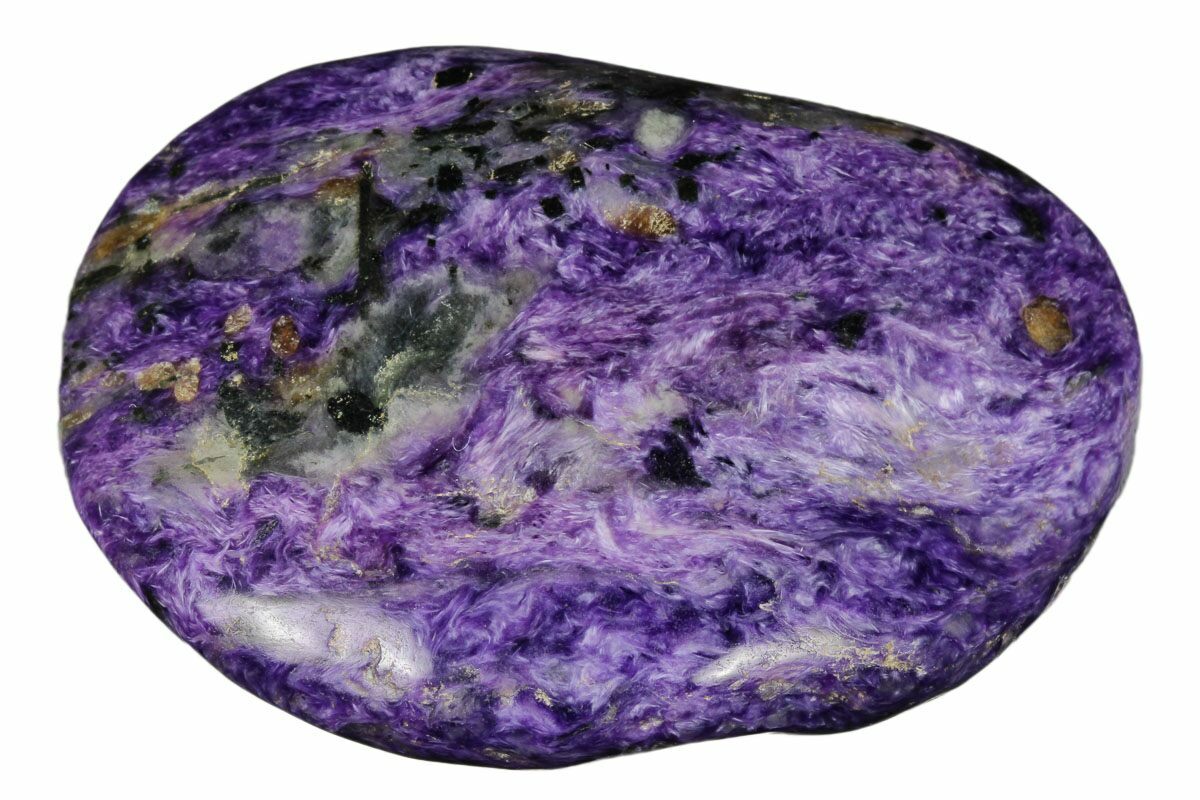
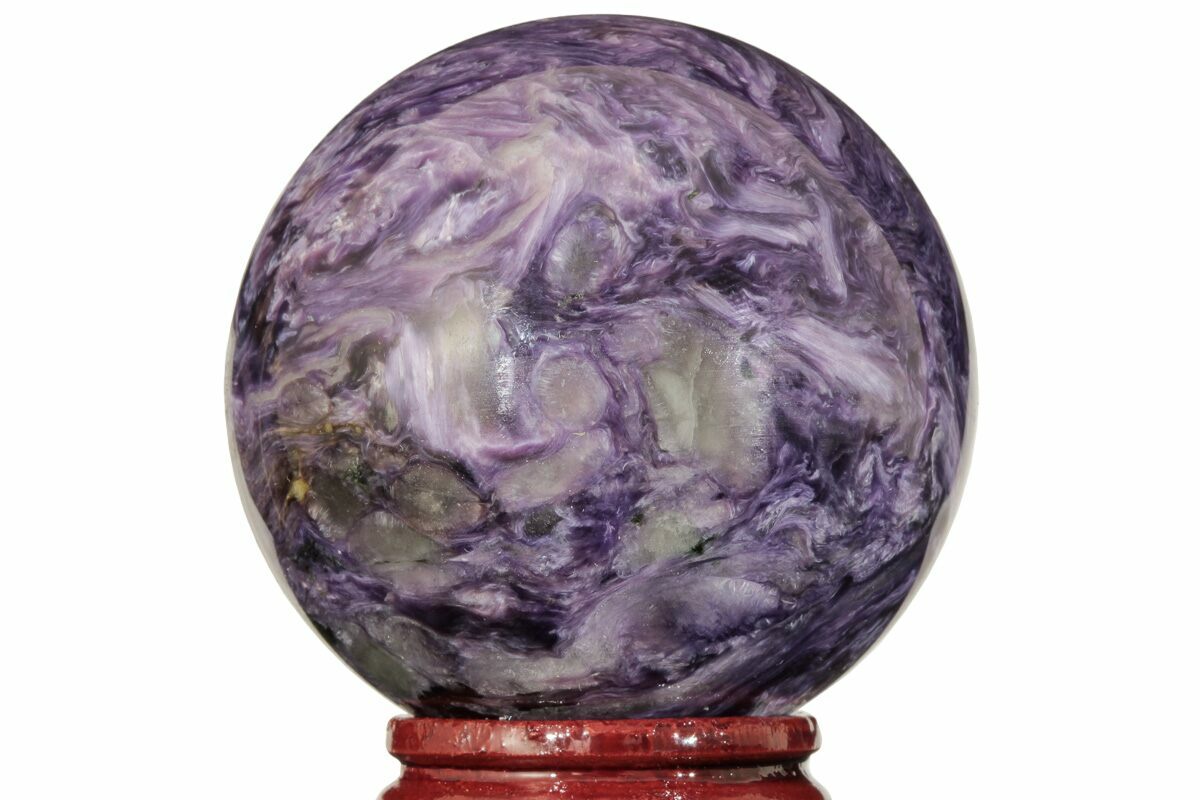
Because charoite is a mix of rare minerals it is very hard to pin down the exact chemical composition of the mineral. Different areas of collection account for differing associations of the many included minerals, thus giving rise to slightly differing chemical formulas. In addition, there haven’t been any pure charoite crystals collected, so a true composition can’t be accurately obtained. However, we do know charoite is a rare silicate that is very rich in potassium. Charoite occurs only in a few locations in Siberia at the Muranski Massif which sits at the confluence of the Chara and Tokko Rivers. The presence of charoite is considerably newer in the geological world, when it was officially recognized in 1978, adding additional rarity. In its raw form it is rather unimpressive, despite its fibrous lavender color. Once polished, the many inclusions (often aegirine, tinaksite, or fedorite) become apparent, adding to the swirls and patterning that make these specimens so attractive to collectors.
There is a whole heap of misinformation around the exact time of charoite’s discovery. Sources are all over the place, though the most reliable all point to an early discovery in late 1959 by a young Russian geologist sent deep into the Muranski Massif on assignment from his employers. While he did not officially state charoite as a new mineral, he did point the following exploratory team to the presence of a mysterious, lilac-colored stone. The following larger expedition just happened to be interested in tinaksite, a yellow mineral that formed in close association with charoite. In their rush to publish findings on tinaksite, charoite was temporarily mentioned as canasite, which is a related mineral but not quite charoite. The tinaksite paper prompted further research on charoite and after a few years charoite was classified and named in a 1976 paper and announced to the world in 1978.
Many other stories are in circulation regarding the discovery of charoite, including a myth that it was found during the construction of a railway tunnel in the 1940s. Some wildly far-fetched theories state that the Russian government has even paid foreign debts with charoite. This claim is nearly impossible, considering the relatively small size of the biggest charoite deposit and the extreme difficulty involved in getting large-scale mining equipment to the site. Additionally, since its discovery in the late 1950s and until its recognition in the late 1970s, many believed that charoite was fake!
Charoite is scarce on the gemstone market for many reasons. Mining it is very difficult since explosives can’t be used without damaging the stone, and the deposit's remote location limits the use of heavy machinery. The source is situated nearly a mile above sea level and located over 600 miles from any proper roads. While many thousands of tons of this beautiful stone may yet be in the ground, the Sakha Republic has put a limit on the amount that can be mined at just 100 tons per year, in the hope that this not only ensures a long production life for the mine but also keeps demand strong and value high. This supply constraint along with demand has flooded the market with fakes and dupes such as purple Chinese fluorite.
Where Does Charoite Get Its Name?
There is some dispute over where this stunning mineral gets its name. Many sources believe it to be named after the Chara River that flows near the charoite formation in Russia's Aldan Shield. Others speculate that this mineral derives its name from the Russian word “chary,” which translates to "charms" or “magic”. Either way, both namesakes add to the mystifying nature of the patterns and swirls that appear within the mineral. Technically, charoite is the name assigned to rock that contains many alkaline calcium silicate minerals in association with large amounts of charoite, but because of the abundance of the charoite mineral itself in this deposit the rock is most commonly referred to as charoite. This association and the lack of crystallization in charoite rock create the variety of interesting patterns revealed in polished stones.
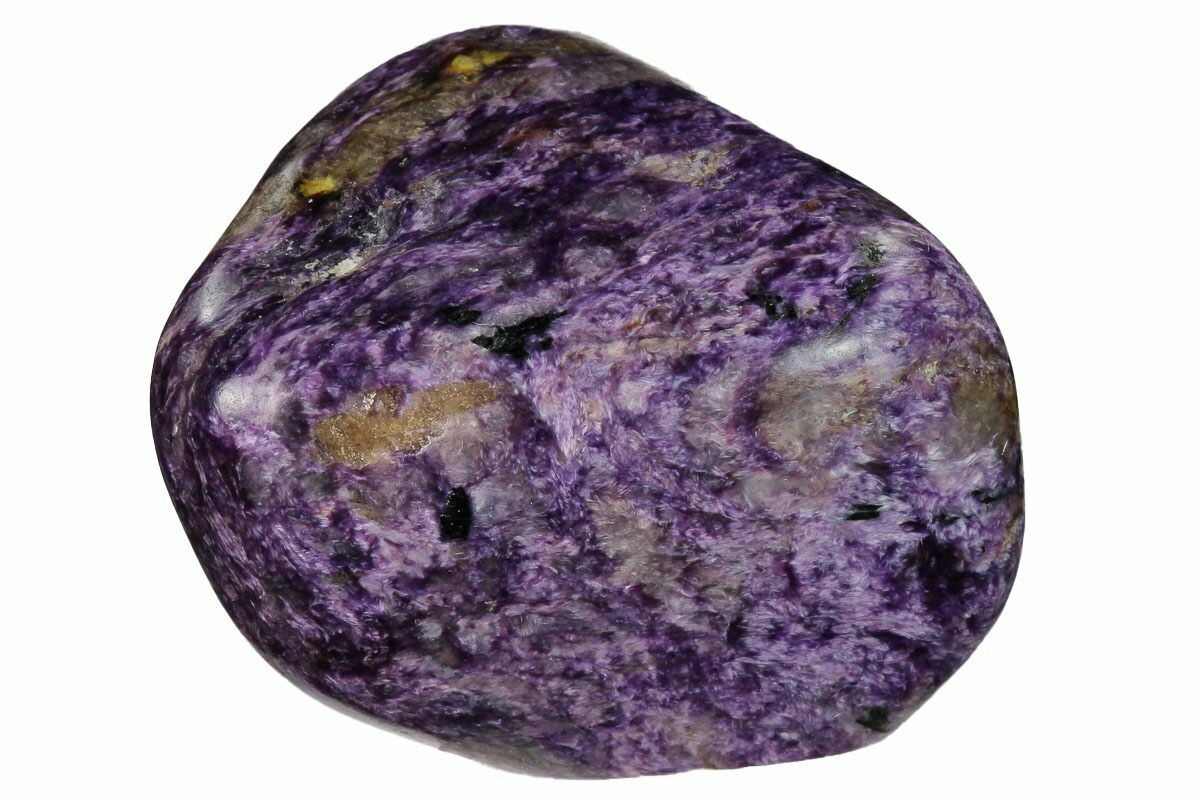
What Are The Black Spots In Charoite?
The black areas present on almost all pieces of charoite are aegirine, a sodium iron silicate mineral commonly formed in alkali-rich volcanic rock. Large dark green spots may be feldspar. Less commonly, charoite may contain lighter colored or translucent areas of canasite, or yellowish-brown areas that can be tinaksite crystals.
How Does Charoite Form?
Charoite is formed when syenite-rich mineral fluids encounter and seep into dolomite formations by way of hydrothermal metasomatism. The charoite cools around the highly clastic dolomite and creates highly complex chemical structures that are often wildly impure and mixed with a variety of microscopic particulates.
Is Charoite Radioactive And Is Charoite Dangerous?
In the most technical sense, charoite is radioactive in the same way that almost all most rocks and soil exhibit a low-level of natural radioactivity due to radionuclide decay. Even bananas which we commonly consume are radioactive because they contain potassium, which itself includes the potassium isotope K-40.
Charoite produces very weak gamma radiation because it contains 10.69% potassium, the same element that makes bananas radioactive. Charoite gamma radiation has been measured to be about 10 GRAPI (Gamma Ray American Petroleum Institute Units), which puts it in the barely detectable range, and WAY below being even the slightest health concern. For comparison limestone has a similar GRAPI of 10 to 50, most sand ranges from 30 to 80, and most clays are in the 100 to 200 range.
Some minerals that commonly associate with charoite, such as tinaksite, do produce some slightly higher levels of radiation. Tinaksite is a yellowish-brown color. It still only exhibits a GRAPI of 148, which still registers as barely detectable and isn't any cause for health concern.
Featured Photos