 Reviews

Charoite: The Royal Purple Stone of Siberia
At first glance, charoite hardly seems real. Its swirling patterns of lavender, violet, lilac, and deep royal purple resemble brushstrokes in an abstract painting rather than the structure of a mineral. Shimmering chatoyant fibers twist through its surface like silk caught in stone, while pearly flashes ripple beneath polished faces. For decades after its discovery, collectors debated whether it was dyed, enhanced, or even synthetic—its color so richly saturated that it defied expectations of what nature typically produces. Yet charoite is entirely natural, born of rare geological conditions deep in the Siberian wilderness.
Charoite is one of the world’s rarest ornamental minerals, found in only one significant locality on Earth: along the Chara River in the Sakha Republic (Yakutia), Russia. Unlike amethyst or sugilite, which may appear in multiple regions, charoite’s occurrence is astonishingly restricted. Its exclusivity has only amplified its allure. Large deposits were not recognized until the mid-20th century, and it did not enter the international gem and mineral market until the 1970s. Before that, its existence was largely unknown outside the Soviet Union.
The mineral’s intricate internal structure gives rise to its signature swirling, fibrous appearance. These patterns are caused by tightly interwoven crystals that reflect light in different directions, creating a silky luster and, in some specimens, a subtle cat’s-eye effect. Its color ranges from soft lilac to intense grape-purple, often accented by white feldspar, translucent quartz, or black aegirine crystals. Some specimens even contain golden or brownish inclusions of tinaksite, adding to their visual complexity.
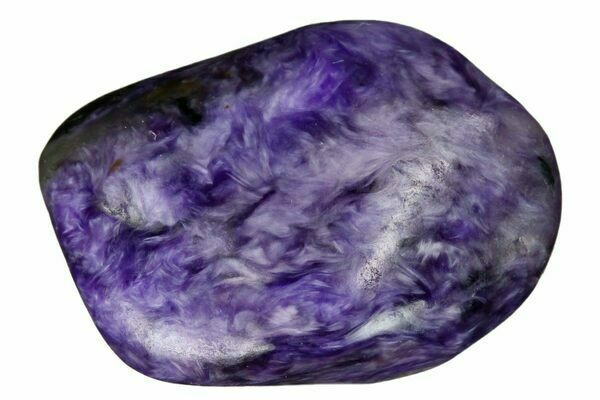
A polished charoite stone showing its distinctive, swirling patterns.
Charoite is sometimes called the “Stone of Transformation” in metaphysical circles, a modern attribution that reflects its dramatic visual character. But even without metaphysical associations, charoite commands attention. It is a mineralogical rarity, a geological anomaly, and an aesthetic marvel—one that emerged from one of the most remote and climatically extreme regions on the planet. Its story is as extraordinary as its appearance.
Chemical Formula: (K,Sr,Ba,Mn)\₁₅–₁₆(Ca,Na)\₃₂(Si₇₀O₁₈₀)(OH,F)₄·nH₂O (a complex hydrated potassium calcium sodium barium strontium silicate)
Mineral Group: Silicate (complex chain silicate)
Crystal System: Monoclinic
Crystal Habit: Massive and fibrous; rarely forms distinct crystals
Color: Lavender, lilac, violet, purple; occasionally with white, black, or orange inclusions
Luster: Vitreous to silky; pearly on cleavage surfaces
Transparency: Translucent to opaque
Hardness: 5–6 on the Mohs scale
Specific Gravity: Approximately 2.5–2.8
Cleavage: Indistinct to poor
Fracture: Uneven to splintery
Streak: White
Commonly Associated Minerals: Aegirine, microcline feldspar, quartz, tinaksite, canasite, miserite
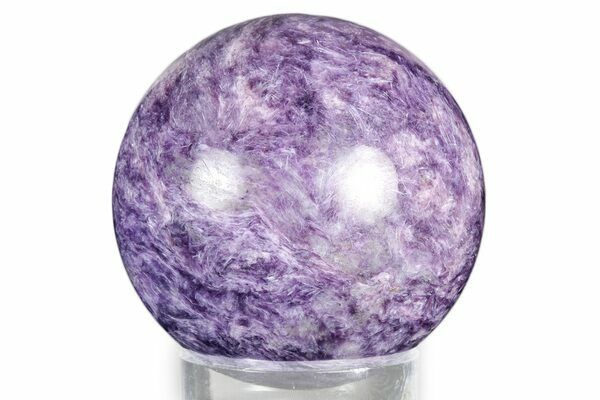
A sphere made from high quality charoite.
Charoite formed through an unusual combination of heat, pressure, and chemically rich fluids deep within the Earth. Its story begins millions of years ago in what is now eastern Siberia, when molten rock slowly pushed its way up into layers of older limestone rock underground.
As this molten material cooled, it released hot fluids filled with dissolved elements like potassium, calcium, sodium, and other minerals. These superheated fluids seeped into the surrounding limestone and essentially “cooked” and chemically altered it. Over time, this intense interaction transformed parts of the rock into entirely new minerals — including charoite.
Think of it like a natural chemical makeover. The original rock didn’t simply melt; instead, it was gradually changed by heat and mineral-rich solutions moving through it. Under just the right conditions — the right ingredients, temperature, and pressure — charoite’s distinctive purple mineral structure began to develop.
What makes charoite especially remarkable is how specific those conditions had to be. The combination of elements and geological circumstances appears to have been so rare that significant deposits have only been found in one place on Earth: the Murun Massif in Siberia. Despite geologists searching elsewhere, no comparable formation has been discovered.
The swirling, fibrous patterns seen in polished charoite formed as tiny crystals grew tightly together in twisting, interwoven bundles. As they developed, different minerals crystallized alongside them, creating the streaks of white, black, and occasionally orange seen in many specimens.
In short, charoite is the result of a rare geological event — a perfect storm of heat, chemistry, and time — preserved in vivid shades of purple stone.
Although charoite-bearing rocks were first noted in the 1940s by Soviet geologists surveying the remote Siberian terrain, the mineral was not fully studied and described until the 1960s. The region’s harsh climate—characterized by extreme cold, permafrost, and limited infrastructure—made detailed investigation slow and challenging.
The mineral was officially recognized and described in 1978 and was named after the nearby Chara River. There is sometimes confusion about whether the name relates to the Russian word chary, meaning “magic” or “charms,” but the official etymology refers to the geographic locality. The poetic coincidence, however, has only added to its mystique.
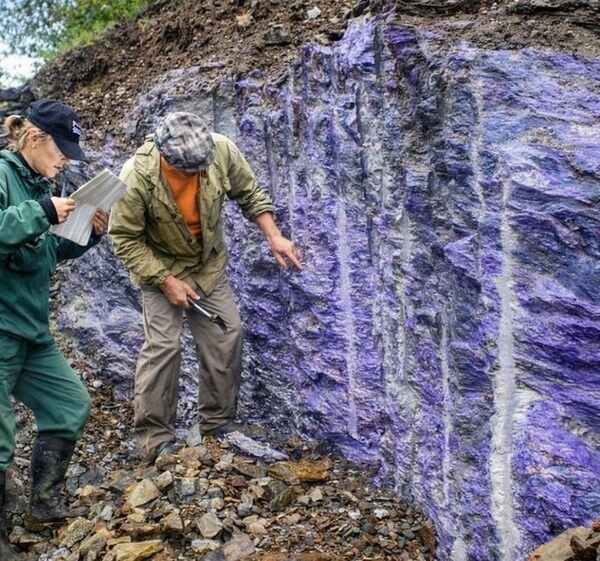
Charoite in ground where it is being mined near the Chara River in Siberia.
Mining in the Murun Massif has always been logistically difficult. The deposit lies in a remote region of Yakutia, far from major population centers. Seasonal accessibility, extreme temperatures, and the costs of transportation have limited large-scale extraction. For many years, charoite was exported in relatively small quantities, often as rough slabs or polished decorative pieces.
During the late Soviet era and into the 1980s, charoite gained international attention at mineral exhibitions. Its dramatic appearance made it an instant favorite among lapidaries and collectors. Soviet artisans used it extensively in ornamental carvings, cabochons, beads, and inlay work. Large blocks were fashioned into vases, boxes, spheres, and architectural accents. Because it takes a good polish and displays striking chatoyancy, it became particularly popular in statement jewelry.
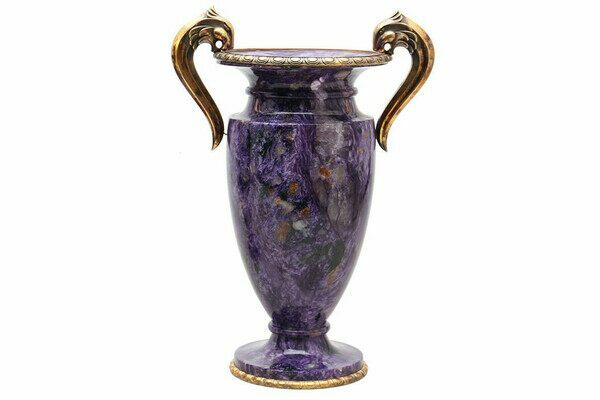
An ornamental, charoite vase with vermeil silver frame.
In jewelry, charoite is typically cut into cabochons to emphasize its swirling internal patterns. It is sometimes stabilized due to its fibrous nature, but high-quality material is solid enough for most lapidary purposes. Designers often pair it with silver to complement its cool purple tones, though it is also set in gold for high-contrast pieces.
Beyond jewelry, charoite has been used as a decorative stone in interior design, tabletops, and ornamental objects. Its rarity and singular origin give it a cachet similar to other locality-specific gemstones like tanzanite.
Today, charoite remains a relatively scarce mineral in the global market. Production levels fluctuate depending on mining conditions in Siberia, and high-grade material with strong color and dramatic patterning commands premium prices. For collectors and enthusiasts, owning a piece of charoite means possessing not just a beautiful purple stone, but a fragment of a singular geological event—one that occurred in a remote corner of the world and has yet to be duplicated anywhere else.
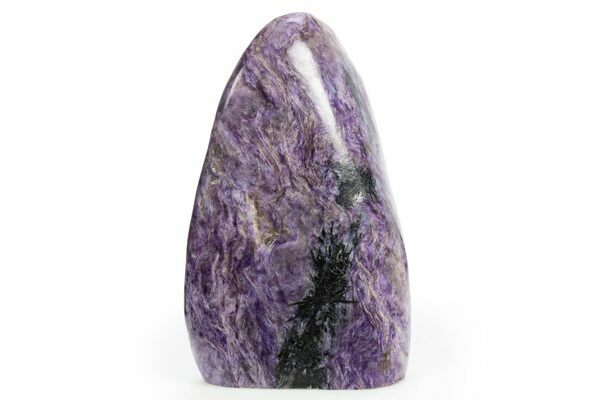
This is a beautiful polished charoite specimen from Siberia, Russia. The entire specimen has been polished to a glossy finish and the base has been cut flat for presentation.
Because charoite forms in a complex geological environment and often occurs alongside a variety of unusual minerals, a common question is whether it is radioactive. The short answer is: charoite itself is not considered radioactive and is safe to handle, wear, and display.
Charoite does not contain uranium or other strongly radioactive elements as part of its primary chemical composition. Its formula is dominated by potassium, calcium, sodium, barium, strontium, and silicon — none of which make it inherently radioactive in the way uranium- or thorium-bearing minerals are.
That said, charoite forms within the Murun Massif, an alkaline intrusion complex in Siberia that hosts a wide range of rare and sometimes chemically unusual minerals. In very rare cases, trace minerals occurring in the same geological environment may contain minor radioactive elements. However, these are not characteristic of gem-quality charoite material sold in the mineral and jewelry trade.
Extensive use of charoite in jewelry since the 1970s — including cabochons, beads, carvings, and decorative objects — has not produced safety concerns related to radiation exposure. If charoite were meaningfully radioactive, it would not be widely exported, cut, polished, and worn.

Charoite is one of the world’s rarest ornamental minerals, found in only one significant locality on Earth: along the Chara River in the Sakha Republic (Yakutia), Russia. Unlike amethyst or sugilite, which may appear in multiple regions, charoite’s occurrence is astonishingly restricted. Its exclusivity has only amplified its allure. Large deposits were not recognized until the mid-20th century, and it did not enter the international gem and mineral market until the 1970s. Before that, its existence was largely unknown outside the Soviet Union.
The mineral’s intricate internal structure gives rise to its signature swirling, fibrous appearance. These patterns are caused by tightly interwoven crystals that reflect light in different directions, creating a silky luster and, in some specimens, a subtle cat’s-eye effect. Its color ranges from soft lilac to intense grape-purple, often accented by white feldspar, translucent quartz, or black aegirine crystals. Some specimens even contain golden or brownish inclusions of tinaksite, adding to their visual complexity.
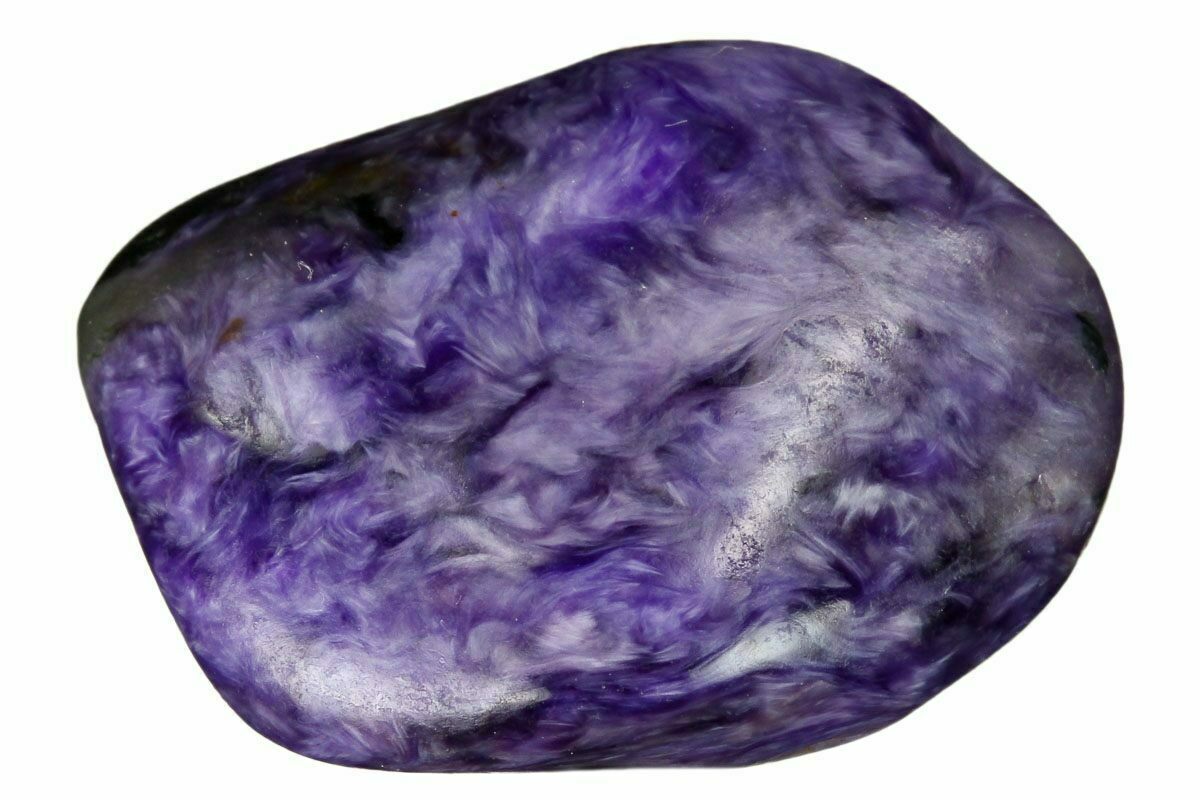
A polished charoite stone showing its distinctive, swirling patterns.
Charoite is sometimes called the “Stone of Transformation” in metaphysical circles, a modern attribution that reflects its dramatic visual character. But even without metaphysical associations, charoite commands attention. It is a mineralogical rarity, a geological anomaly, and an aesthetic marvel—one that emerged from one of the most remote and climatically extreme regions on the planet. Its story is as extraordinary as its appearance.
Charoite Properties
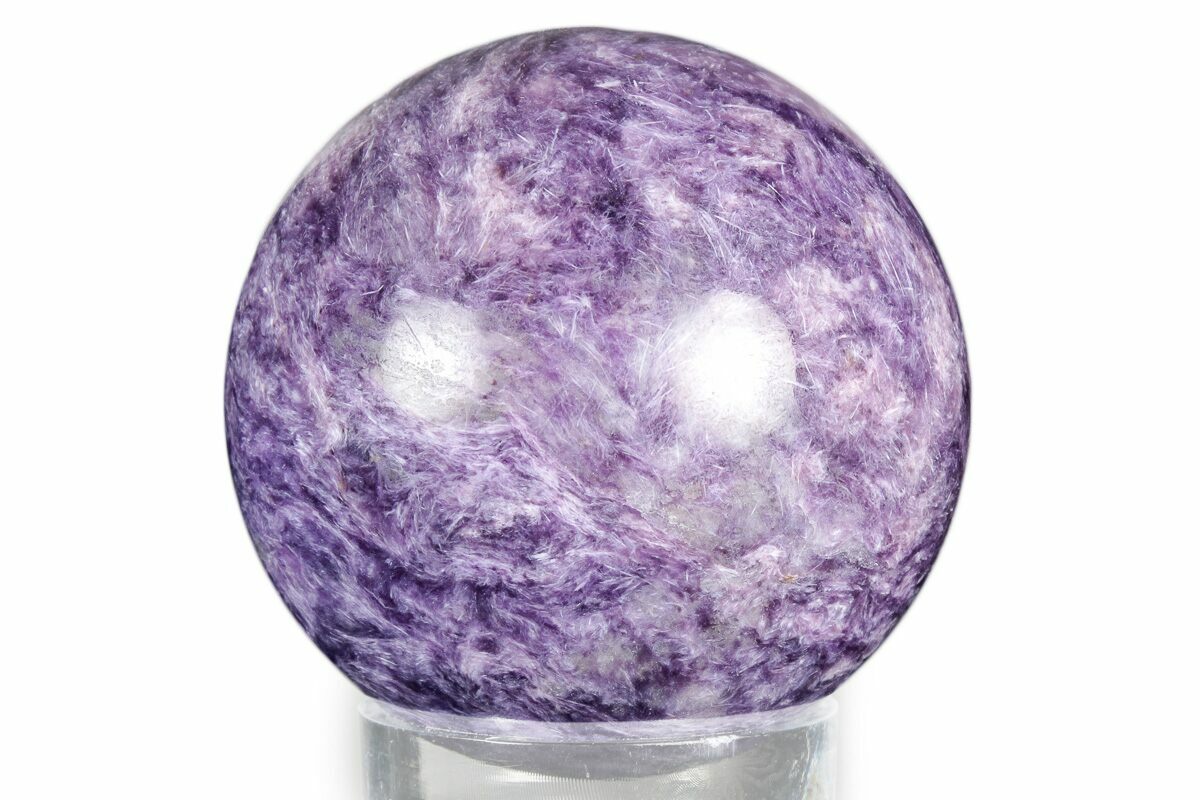
A sphere made from high quality charoite.
How Charoite Forms
Charoite formed through an unusual combination of heat, pressure, and chemically rich fluids deep within the Earth. Its story begins millions of years ago in what is now eastern Siberia, when molten rock slowly pushed its way up into layers of older limestone rock underground.
As this molten material cooled, it released hot fluids filled with dissolved elements like potassium, calcium, sodium, and other minerals. These superheated fluids seeped into the surrounding limestone and essentially “cooked” and chemically altered it. Over time, this intense interaction transformed parts of the rock into entirely new minerals — including charoite.
Think of it like a natural chemical makeover. The original rock didn’t simply melt; instead, it was gradually changed by heat and mineral-rich solutions moving through it. Under just the right conditions — the right ingredients, temperature, and pressure — charoite’s distinctive purple mineral structure began to develop.
What makes charoite especially remarkable is how specific those conditions had to be. The combination of elements and geological circumstances appears to have been so rare that significant deposits have only been found in one place on Earth: the Murun Massif in Siberia. Despite geologists searching elsewhere, no comparable formation has been discovered.
The swirling, fibrous patterns seen in polished charoite formed as tiny crystals grew tightly together in twisting, interwoven bundles. As they developed, different minerals crystallized alongside them, creating the streaks of white, black, and occasionally orange seen in many specimens.
In short, charoite is the result of a rare geological event — a perfect storm of heat, chemistry, and time — preserved in vivid shades of purple stone.
History, Discovery & Uses
Although charoite-bearing rocks were first noted in the 1940s by Soviet geologists surveying the remote Siberian terrain, the mineral was not fully studied and described until the 1960s. The region’s harsh climate—characterized by extreme cold, permafrost, and limited infrastructure—made detailed investigation slow and challenging.
The mineral was officially recognized and described in 1978 and was named after the nearby Chara River. There is sometimes confusion about whether the name relates to the Russian word chary, meaning “magic” or “charms,” but the official etymology refers to the geographic locality. The poetic coincidence, however, has only added to its mystique.
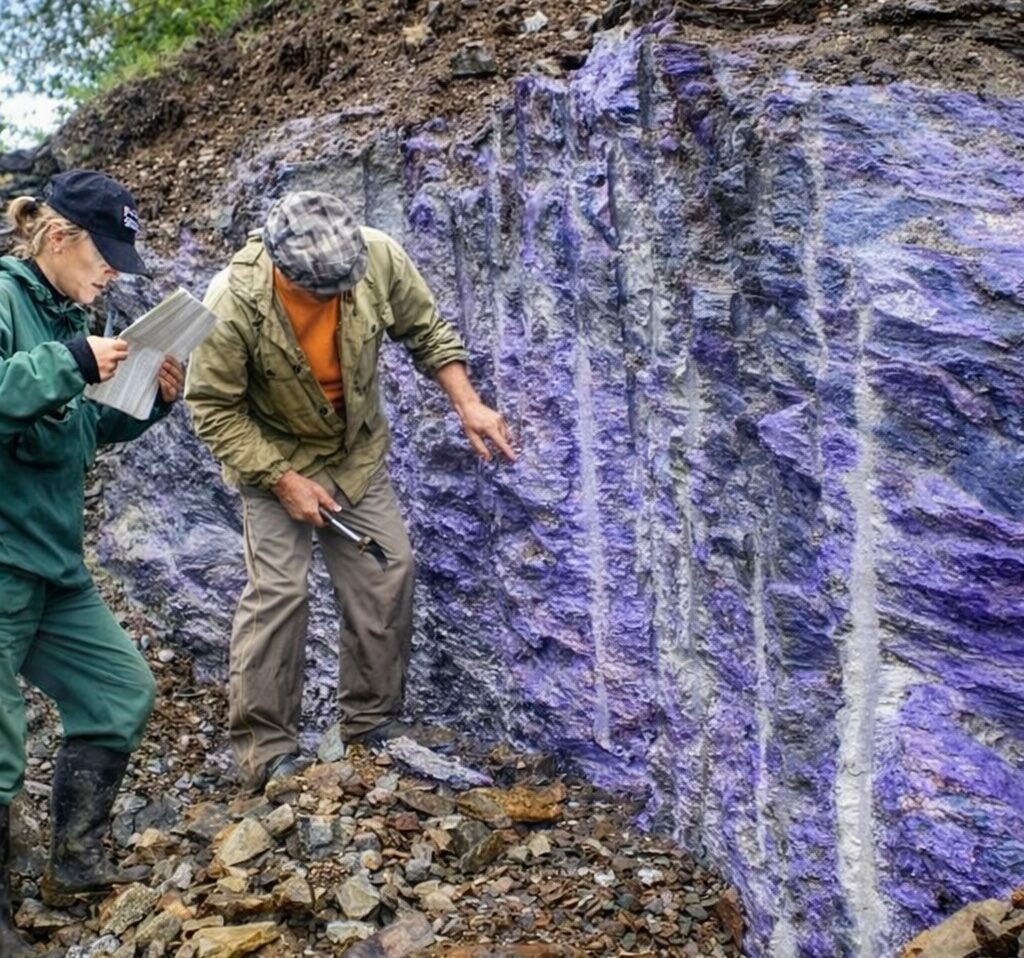
Charoite in ground where it is being mined near the Chara River in Siberia.
Mining in the Murun Massif has always been logistically difficult. The deposit lies in a remote region of Yakutia, far from major population centers. Seasonal accessibility, extreme temperatures, and the costs of transportation have limited large-scale extraction. For many years, charoite was exported in relatively small quantities, often as rough slabs or polished decorative pieces.
During the late Soviet era and into the 1980s, charoite gained international attention at mineral exhibitions. Its dramatic appearance made it an instant favorite among lapidaries and collectors. Soviet artisans used it extensively in ornamental carvings, cabochons, beads, and inlay work. Large blocks were fashioned into vases, boxes, spheres, and architectural accents. Because it takes a good polish and displays striking chatoyancy, it became particularly popular in statement jewelry.
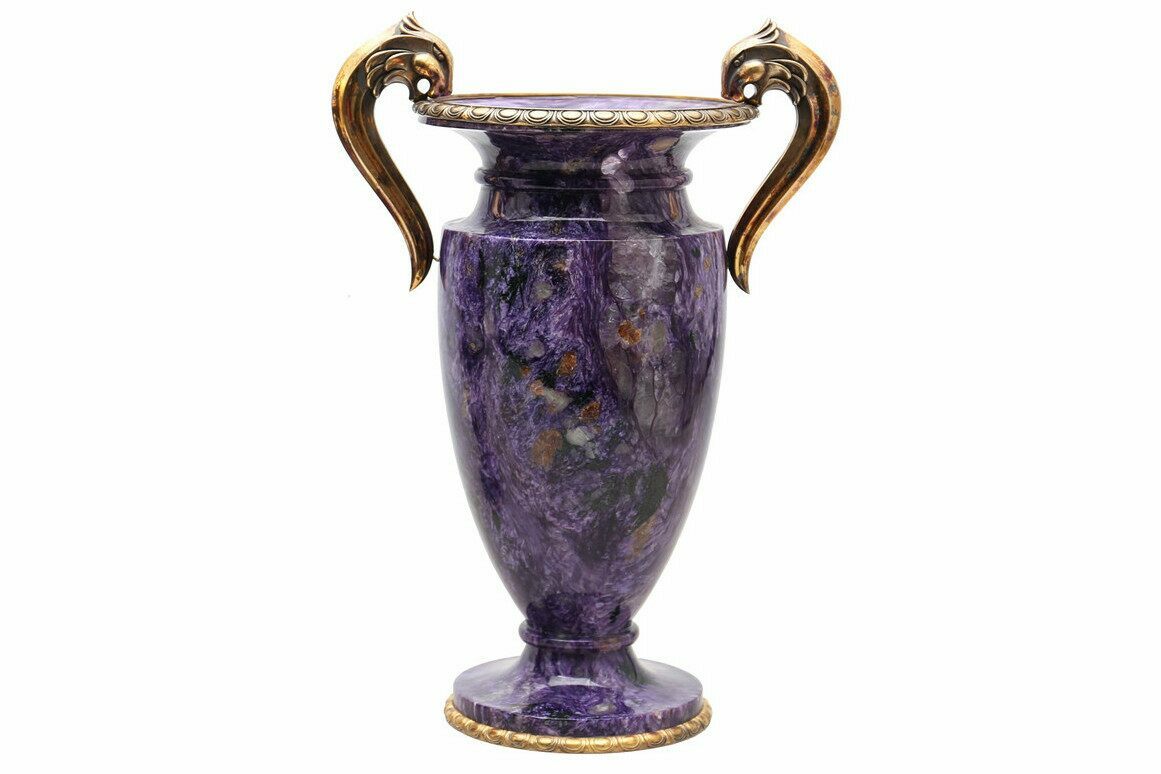
An ornamental, charoite vase with vermeil silver frame.
In jewelry, charoite is typically cut into cabochons to emphasize its swirling internal patterns. It is sometimes stabilized due to its fibrous nature, but high-quality material is solid enough for most lapidary purposes. Designers often pair it with silver to complement its cool purple tones, though it is also set in gold for high-contrast pieces.
Beyond jewelry, charoite has been used as a decorative stone in interior design, tabletops, and ornamental objects. Its rarity and singular origin give it a cachet similar to other locality-specific gemstones like tanzanite.
Today, charoite remains a relatively scarce mineral in the global market. Production levels fluctuate depending on mining conditions in Siberia, and high-grade material with strong color and dramatic patterning commands premium prices. For collectors and enthusiasts, owning a piece of charoite means possessing not just a beautiful purple stone, but a fragment of a singular geological event—one that occurred in a remote corner of the world and has yet to be duplicated anywhere else.
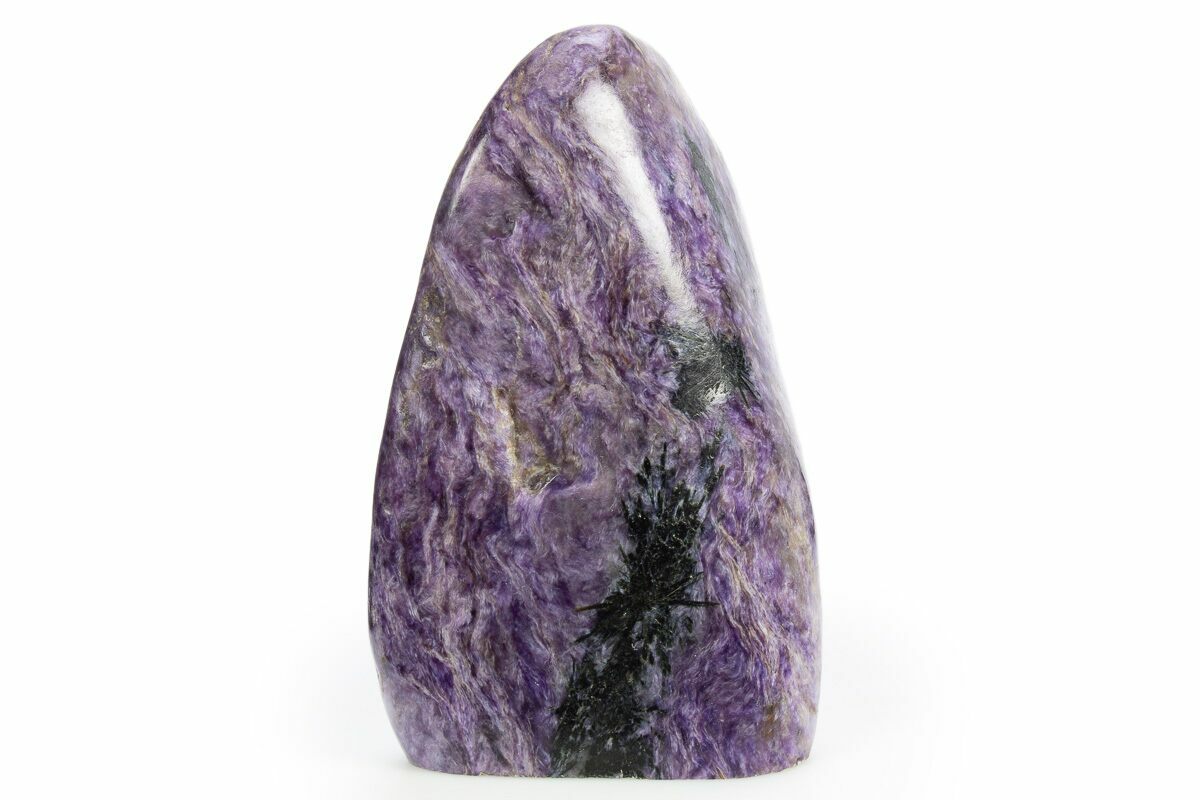
This is a beautiful polished charoite specimen from Siberia, Russia. The entire specimen has been polished to a glossy finish and the base has been cut flat for presentation.
Is Charoite Radioactive?
Because charoite forms in a complex geological environment and often occurs alongside a variety of unusual minerals, a common question is whether it is radioactive. The short answer is: charoite itself is not considered radioactive and is safe to handle, wear, and display.
Charoite does not contain uranium or other strongly radioactive elements as part of its primary chemical composition. Its formula is dominated by potassium, calcium, sodium, barium, strontium, and silicon — none of which make it inherently radioactive in the way uranium- or thorium-bearing minerals are.
That said, charoite forms within the Murun Massif, an alkaline intrusion complex in Siberia that hosts a wide range of rare and sometimes chemically unusual minerals. In very rare cases, trace minerals occurring in the same geological environment may contain minor radioactive elements. However, these are not characteristic of gem-quality charoite material sold in the mineral and jewelry trade.
Extensive use of charoite in jewelry since the 1970s — including cabochons, beads, carvings, and decorative objects — has not produced safety concerns related to radiation exposure. If charoite were meaningfully radioactive, it would not be widely exported, cut, polished, and worn.


