 Reviews

This Specimen has been sold.


2.8" Azurite and Malachite Association on Barite - Morocco
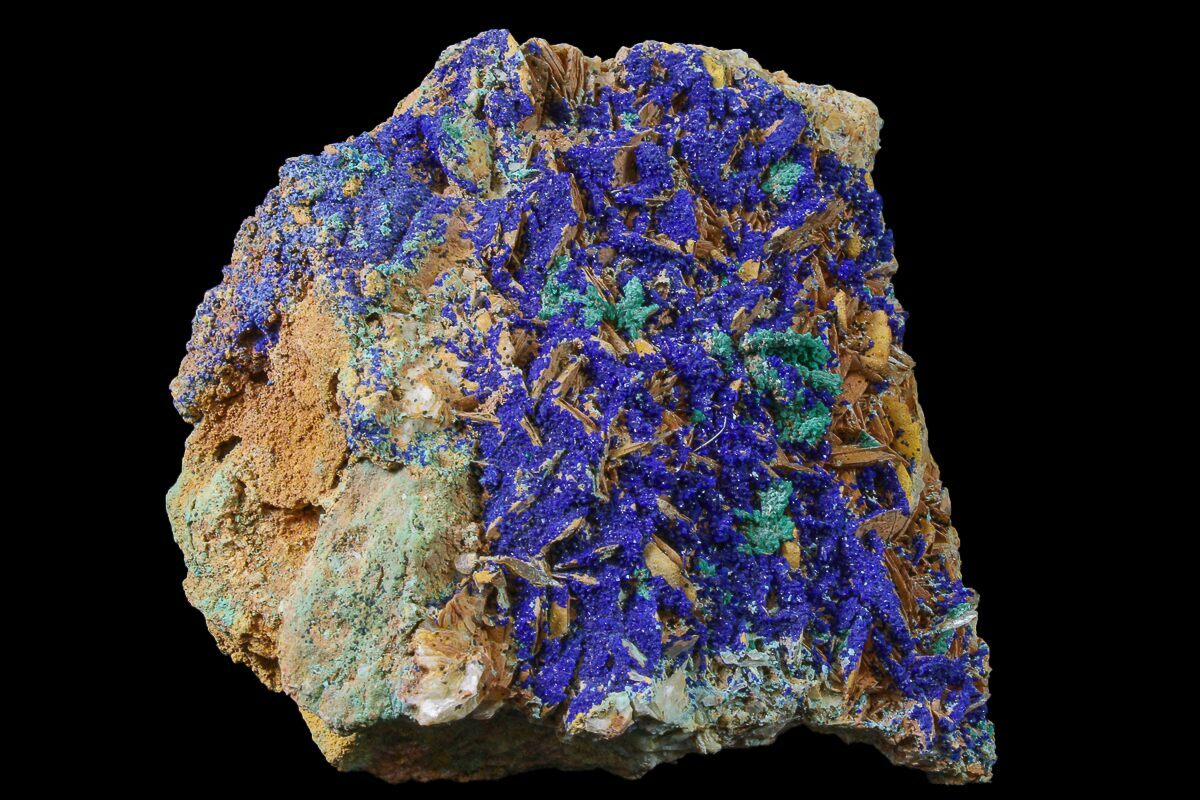
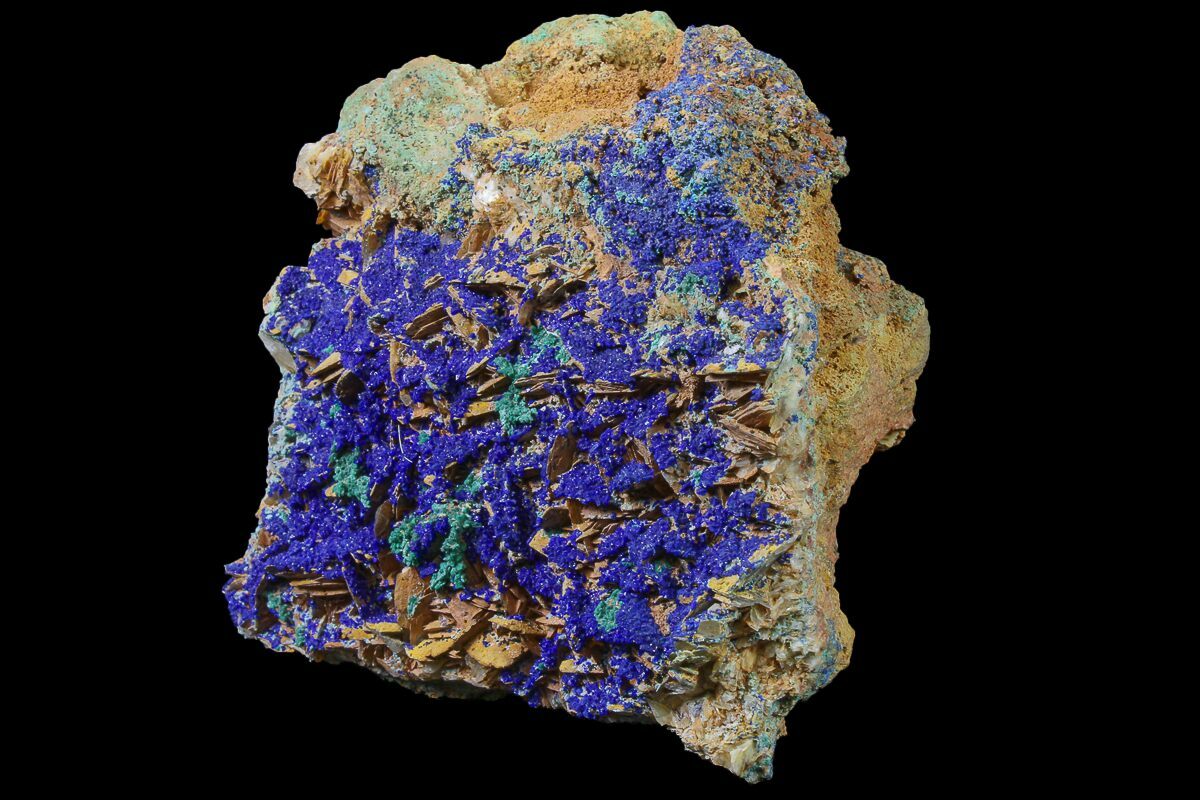
This 2.8" wide specimen features a druze of azurite that formed in association with malachite, collected from morocco. The azurite and malachite formed over pre-existing bladed barite crystals.
Azurite and malachite are known to form in union with each other since their chemical makeup is very similar. In fact, the presence of more or less water in the location of formation is enough to determine whether an abundance of malachite over azurite, or vise-versa, will accumulate.
These minerals tend to be found near copper deposits, which accounts for the vibrant colors the minerals display. This association of azurite and malachite on copper-rich, iron oxide matrix was found near M'Cissi, Alnif, Tinghir Province, Souss-Massa-Draâ Region, Morocco.
These minerals tend to be found near copper deposits, which accounts for the vibrant colors the minerals display. This association of azurite and malachite on copper-rich, iron oxide matrix was found near M'Cissi, Alnif, Tinghir Province, Souss-Massa-Draâ Region, Morocco.
About Malachite
Malachite is an intense green copper-based mineral that can be found in a wide variety of forms. Malachite can grow in botryoidal masses, stalactitic formations, and reniform formations, typically as a tight cluster of fanning fibrous needles that make up a seemingly solid mass. As layers continue to stack during formation, banded patterns can sometimes begin to take shape, explaining the rings in all shades of green seen on most polished malachite specimens.
Malachite results from the weathering of other copper ores, and is very often found associated with other copper-based minerals such as azurite and chrysocolla. It can be found in copper deposits around the world, but the Democratic Republic of the Congo is the primary source for polished malachite and mineral specimens.
Malachite has been prized since ancient times, first as a utilitarian copper ore, then as an ornamental stone. Due to its value as a decorative stone, it is rarely mined as a copper ore anymore.
Malachite is an intense green copper-based mineral that can be found in a wide variety of forms. Malachite can grow in botryoidal masses, stalactitic formations, and reniform formations, typically as a tight cluster of fanning fibrous needles that make up a seemingly solid mass. As layers continue to stack during formation, banded patterns can sometimes begin to take shape, explaining the rings in all shades of green seen on most polished malachite specimens.
Malachite results from the weathering of other copper ores, and is very often found associated with other copper-based minerals such as azurite and chrysocolla. It can be found in copper deposits around the world, but the Democratic Republic of the Congo is the primary source for polished malachite and mineral specimens.
Malachite has been prized since ancient times, first as a utilitarian copper ore, then as an ornamental stone. Due to its value as a decorative stone, it is rarely mined as a copper ore anymore.
About Barite (Baryte)
Barite is a barium sulfate mineral (BaSO₄) known for its high specific gravity, which makes it unusually heavy for a non-metallic mineral. Typically forming in tabular or bladed crystals, barite can also appear in massive, fibrous, or nodular habits. Its colors range from colorless and white to shades of blue, yellow, gray, or brown, often influenced by trace impurities. Barite commonly forms in hydrothermal veins, sedimentary rocks, and as a gangue mineral in lead-zinc ore deposits. It is widely used in industrial applications, especially as a weighting agent in drilling muds for oil and gas exploration. Its striking crystal formations and vivid hues also make it a popular mineral for collectors.
Barite is a barium sulfate mineral (BaSO₄) known for its high specific gravity, which makes it unusually heavy for a non-metallic mineral. Typically forming in tabular or bladed crystals, barite can also appear in massive, fibrous, or nodular habits. Its colors range from colorless and white to shades of blue, yellow, gray, or brown, often influenced by trace impurities. Barite commonly forms in hydrothermal veins, sedimentary rocks, and as a gangue mineral in lead-zinc ore deposits. It is widely used in industrial applications, especially as a weighting agent in drilling muds for oil and gas exploration. Its striking crystal formations and vivid hues also make it a popular mineral for collectors.


