 Reviews

Azurite - Mineral & Crystal Guide
Azurite is one of the most striking minerals ever pulled from the ground — a gemstone of pure blue so intense it seems almost painted rather than natural. Its color, often compared to a midnight sky or the richest ocean depths, has captivated humans for thousands of years. Few minerals can rival azurite’s ability to stop someone in their tracks with nothing more than its hue.
What makes azurite even more fascinating is that this dazzling blue mineral is not rare because of some exotic chemistry, but because it forms as part of the natural weathering of copper deposits. In other words, azurite is born from the slow transformation of copper-rich rock as it interacts with air, water, and time. It is a mineral that tells a story of change — a vibrant byproduct of Earth’s ongoing geological processes.
Azurite has been prized since antiquity not only as a collector’s mineral but also as one of the earliest sources of blue pigment. Long before synthetic dyes existed, powdered azurite was ground into paint, bringing brilliant blues into ancient murals, illuminated manuscripts, and sacred artwork. Even today, it remains one of the most beloved minerals among collectors for its rich coloration, dramatic crystal habits, and association with other copper minerals like malachite.
Mineral Class: Carbonate mineral
Chemical Formula: Cu₃(CO₃)₂(OH)₂
Color: Deep azure blue, often with lighter blue highlights
Luster: Vitreous to silky
Transparency: Transparent to opaque
Crystal System: Monoclinic
Hardness (Mohs): 3.5–4
Streak: Light blue
Cleavage: Perfect in one direction
Specific Gravity: ~3.7–3.9 (quite heavy for its size)
Commonly Associated Minerals: Malachite, cuprite, chrysocolla, native copper, limonite
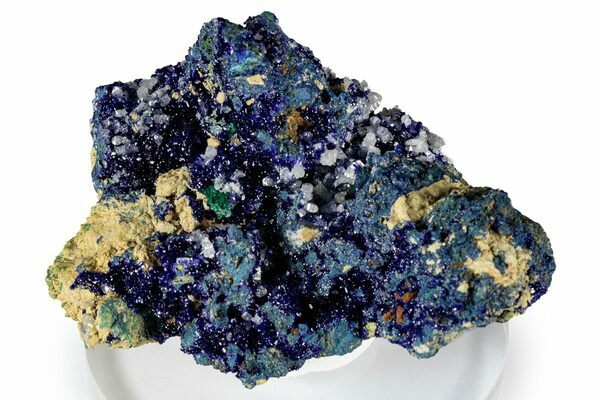
Azurite crystals with Cerussite and Malachite from the Republic of the Congo
Azurite is a secondary copper mineral, meaning it does not form deep underground from magma or high-pressure metamorphism. Instead, it develops closer to the Earth’s surface in the oxidation zones of copper ore deposits.
When copper-bearing minerals such as chalcopyrite or bornite are exposed to oxygen-rich groundwater, they begin to break down. Copper ions released during this weathering process combine with carbonate and hydroxide ions in the surrounding environment. Under the right chemical conditions — particularly when carbonate is abundant — azurite begins to crystallize.
Azurite forms best in arid to semi-arid climates, where oxidation occurs slowly and minerals have time to develop without being dissolved away too quickly. Over time, azurite may alter into malachite, especially when water becomes more plentiful. This is why many specimens show stunning intergrowths of blue azurite and green malachite, recording a mineralogical transition in progress.
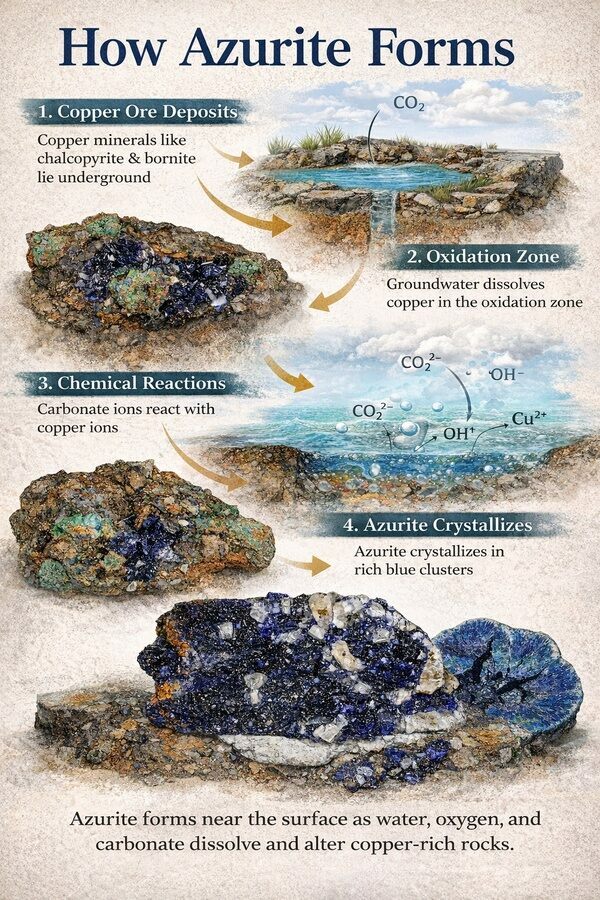
Infographic: How Azurite Forms
Azurite is famous not only for its color but also for its diverse and dramatic crystal forms. It can appear in several habits, each highly prized by collectors.
Common Crystal Forms
Prismatic Crystals: Sharp, elongated monoclinic crystals, often lustrous and deeply colored
Tabular Crystals: Flattened crystals that form in clustered groups
Rosette Aggregates: Radiating crystal sprays resembling flowers
Botryoidal Masses: Rounded, grape-like surfaces with a velvety sheen
Massive Form: Dense, compact blue material often used historically as pigment ore
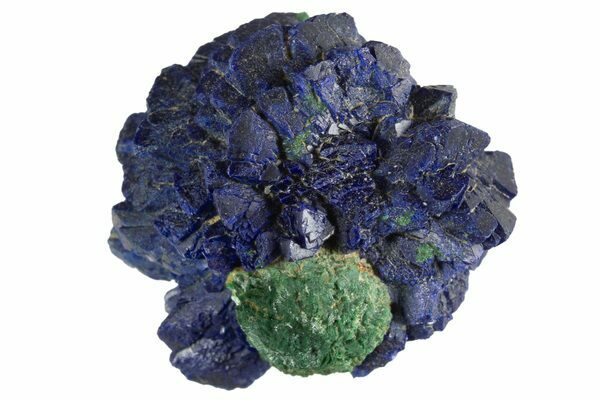
An azurite rosette aggregation with malachite from La Sal, Utah
One of the most visually distinctive and sought-after habits of azurite is the formation known as an “azurite sun.” These are radiant, disk-like crystal clusters that spread outward from a central point, resembling miniature celestial bodies frozen in stone.
Azurite suns form when thin, bladed crystals grow in a symmetrical, radiating pattern, creating a starburst or sunburst appearance. Their layered structure often gives them depth and texture, with countless tiny crystal faces catching the light like sparks.
What makes azurite suns especially notable is their geographic rarity. While azurite itself occurs worldwide, true “sun” specimens are found almost exclusively in Australia, where unique oxidation-zone conditions in major copper deposits allowed these remarkable radial growth patterns to develop.
The most famous and classic azurite suns come from Broken Hill, New South Wales, a locality legendary not only for azurite but for an extraordinary range of copper-associated minerals. Australian azurite suns have become so iconic that they are considered among the most distinctive collector forms the mineral can take.
Azurite’s story is inseparable from humanity’s long fascination with the color blue.
Long before it was understood as a copper carbonate mineral, azurite was simply a miracle of the earth — a blue stone unlike any other. In the ancient world, blue was the color of the divine, the unreachable, the eternal. The sky itself was blue, and so were the robes of gods, the ceilings of temples, and the painted symbols of power. Azurite, pulled from the ground in brilliant fragments, seemed like a piece of heaven buried in rock.
The ancient Egyptians were among the first to make use of azurite’s color. Along the Nile, artisans ground the mineral into fine powder and used it to decorate tombs and sacred spaces, believing the color carried spiritual significance and protection into the afterlife. To paint in blue was not merely decorative — it was symbolic, a connection to immortality and cosmic order.
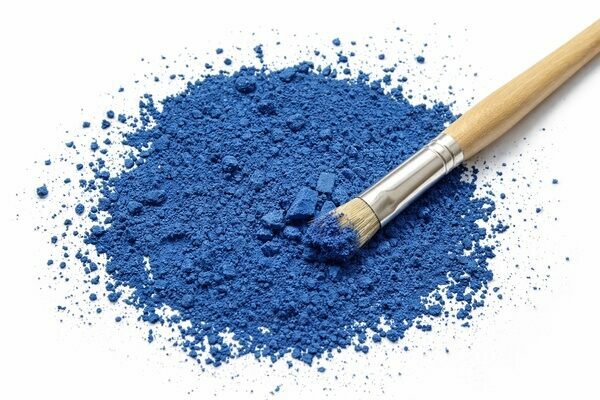
Azurite was one of history’s most prized blue pigments, ground into powder and used by ancient and Renaissance artists to paint brilliant skies, robes, and sacred works long before synthetic colors existed.
As trade routes expanded, azurite traveled across the Mediterranean world. The Greeks and Romans mined and used the mineral both as an ornamental stone and as a pigment. In those times it was sometimes referred to simply as “mountain blue,” distinguished from lapis lazuli, which was rarer and more costly. Azurite offered a more accessible source of deep color, and its presence in mines often hinted at hidden copper wealth beneath the surface.
During the Middle Ages, azurite became one of the most important pigments in Europe. Monks illuminating manuscripts used it to paint robes, skies, and decorative borders, its vivid blue standing out against gold leaf and parchment. In Renaissance workshops, azurite was a treasured material of painters who sought rich blues before ultramarine became widely available. Ground azurite was sometimes layered into paints to achieve luminous depth, though artists knew it could darken with age, especially in damp conditions.
The mineral’s name itself reflects its legacy. The word azurite is rooted in ancient Persian and Arabic terms for blue, eventually giving rise to the modern word azure. For centuries, the mineral was also known as chessylite, named after the famous deposits at Chessy-les-Mines in France, which produced exceptional specimens and helped bring scientific attention to the mineral.
By the 18th and 19th centuries, as mineralogy matured into a formal science, azurite was recognized as its own distinct species. Its chemical relationship to malachite became clear, and collectors began to prize it not just for pigment, but for its crystal beauty.
In the modern era, azurite is no longer an important industrial pigment, replaced by stable synthetic blues. Yet its allure has not faded. Today, azurite is treasured in a different way: as one of the great collector minerals of the copper world. Fine crystals from Namibia, the American Southwest, and Australia are displayed in museums and private collections, admired for their depth of color and sculptural forms.
Azurite is also still valued as a geological indicator. To a geologist, a seam of azurite staining the rock is a signpost — evidence that copper-rich fluids once moved through the earth, and that valuable ore may lie deeper below.
In this way, azurite continues to bridge worlds: ancient and modern, art and science, beauty and industry — a mineral whose blue has carried meaning across civilizations.
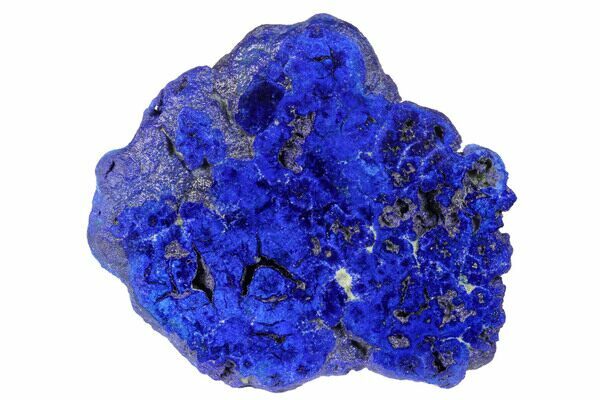
A vivid blue, cut and polished azurite nodule from the Poteryaevskoe Mine in Russia.
Azurite occurs in copper deposits across the world, but only a handful of regions have produced specimens so beautiful or historically significant that they have become legendary among collectors. Each major locality offers azurite with its own distinct character — from sharp, glassy crystals to iconic sunburst formations.
Broken Hill is perhaps the most famous azurite locality on Earth, not only for the richness of its copper mineralization but for producing the extraordinary formations known as azurite suns. These radiant, disk-like clusters are found almost exclusively in Australia and have become one of the most iconic crystal habits in the mineral world. Specimens from Broken Hill often display deep, saturated blue color and dramatic radial geometry, making them highly prized by collectors. The district itself is one of the world’s great classic mining regions, renowned for an exceptional variety of secondary copper minerals.
Mexico has produced azurite specimens notable for their rich associations with malachite and other secondary copper minerals. Mexican azurite is often found in attractive crystalline clusters or colorful mixed specimens where blue and green minerals intertwine in vivid patterns. These pieces are especially popular in lapidary and ornamental use, as they capture the full palette of copper’s oxidation-zone transformation.
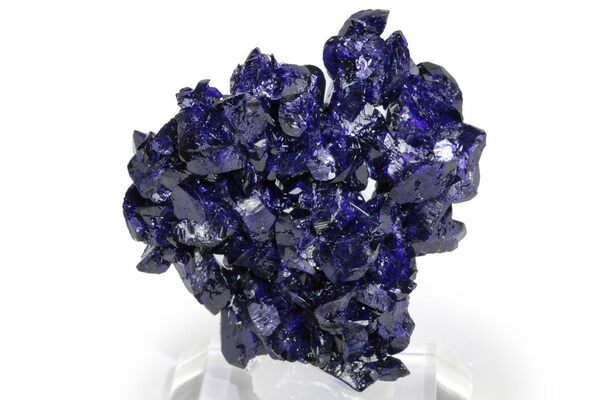
A vibrant blue azurite specimen from the Milpillas Mine in Mexico
The legendary Tsumeb Mine in Namibia is widely regarded as one of the finest mineral localities ever discovered. Azurite from Tsumeb is celebrated for its intensely rich blue crystals, often sharply formed and sometimes associated with malachite, cuprite, or other rare species. What makes Tsumeb specimens so remarkable is their combination of color, luster, and complexity — crystals can appear almost gem-like, perched in stunning contrast against pale matrix rock. For many collectors, a fine Tsumeb azurite represents the pinnacle of the species.
Chessy-les-Mines, near Lyon, France, holds an important place in azurite history. The locality gave rise to the old mineral name “chessylite,” once commonly used for azurite before modern mineralogical classification became standardized. While the mine is long closed, its specimens were historically significant in shaping early scientific understanding of copper carbonates. Chessy azurite is a reminder of the mineral’s role not only in art and ornament, but also in the development of mineralogy as a formal science.
Bisbee, Arizona is one of the most famous American sources of azurite, producing specimens that often occur alongside malachite and other vivid copper minerals. Azurite from Bisbee can range from deep crystalline clusters to richly colored massive material. The historic copper mines of the region yielded some of the most aesthetically striking mineral combinations in the United States, and Bisbee specimens remain classics of Southwestern mineral collecting.
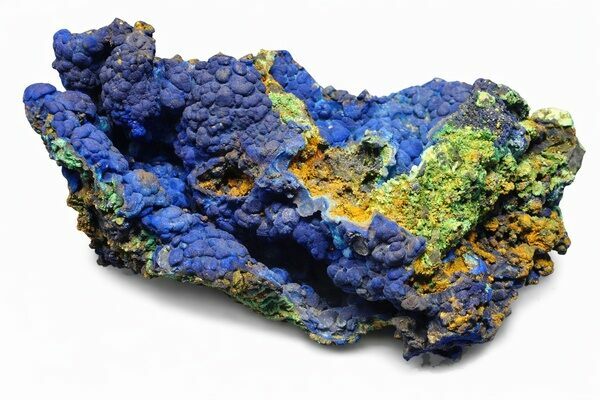
A spectacular specimen on azurite with malachite from the Copper Queen mine in Bisbee, Arizona
The Morenci Mine, one of North America’s largest copper operations, has also produced notable azurite specimens from its oxidation zones. While much of the locality’s output is known for industrial copper rather than collector minerals, Morenci azurite can occur in attractive blue crystalline coatings and clusters, often accompanied by malachite or chrysocolla. Specimens from this region reflect the immense copper-rich systems that make Arizona one of the world’s great centers of secondary copper mineral formation.
New Mexico’s copper deposits have produced azurite in a wide variety of forms, from small brilliant crystals to massive blue material intergrown with malachite. The state’s oxidation-zone minerals are especially valued for their vibrant color contrasts, and azurite from New Mexico often serves as a classic example of secondary mineral development in desert environments. These deposits demonstrate how the slow interaction of copper ores and groundwater can create extraordinary mineral beauty.
Morocco is one of the world’s most important modern producers of fine azurite crystals. The Touissit mining district is especially known for sharp, lustrous deep-blue specimens, often forming striking prismatic clusters with excellent luster. While Morocco is not known for classic azurite suns, it has become a premier source for collectors seeking dramatic, high-quality crystal groups. Moroccan azurite is among the most visually impressive material on today’s mineral market.
In recent decades, China has emerged as an increasingly important source of bright, well-crystallized azurite specimens. Chinese material often features vivid coloration and fine crystal development, contributing significantly to the modern collector market. As exploration continues, new deposits have expanded the global availability of azurite, ensuring that this ancient mineral continues to captivate new generations of collectors and enthusiasts.
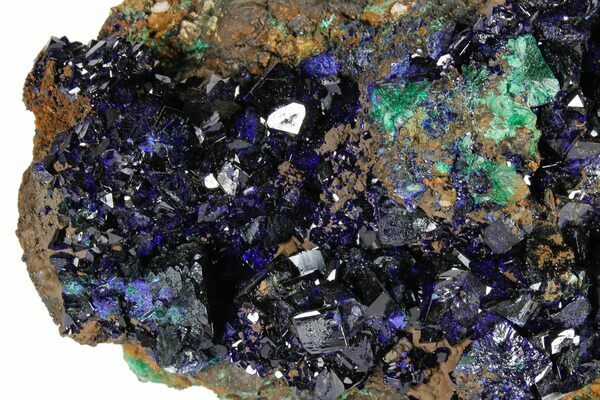
Gemmy, deep-blue azurite crystals with malachite from China.
What makes azurite even more fascinating is that this dazzling blue mineral is not rare because of some exotic chemistry, but because it forms as part of the natural weathering of copper deposits. In other words, azurite is born from the slow transformation of copper-rich rock as it interacts with air, water, and time. It is a mineral that tells a story of change — a vibrant byproduct of Earth’s ongoing geological processes.

Azurite has been prized since antiquity not only as a collector’s mineral but also as one of the earliest sources of blue pigment. Long before synthetic dyes existed, powdered azurite was ground into paint, bringing brilliant blues into ancient murals, illuminated manuscripts, and sacred artwork. Even today, it remains one of the most beloved minerals among collectors for its rich coloration, dramatic crystal habits, and association with other copper minerals like malachite.
Azurite Properties
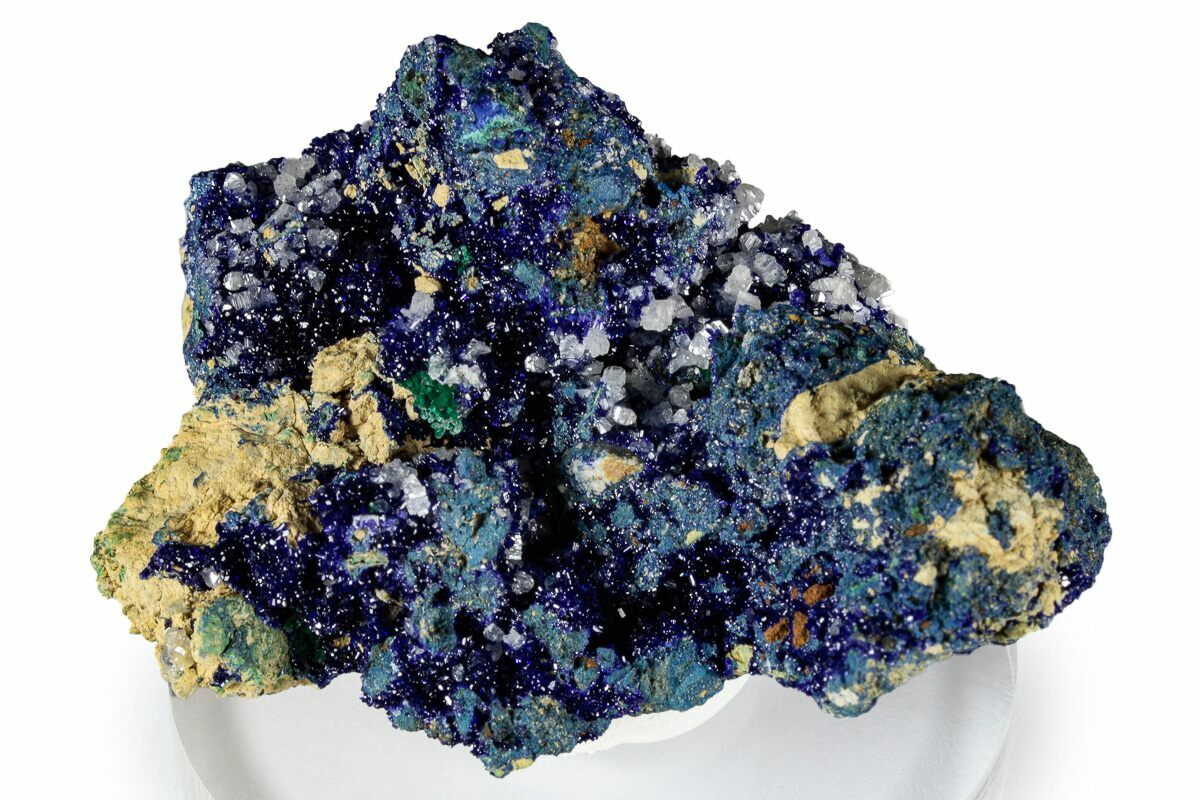
Azurite crystals with Cerussite and Malachite from the Republic of the Congo
How Azurite Forms
Azurite is a secondary copper mineral, meaning it does not form deep underground from magma or high-pressure metamorphism. Instead, it develops closer to the Earth’s surface in the oxidation zones of copper ore deposits.
When copper-bearing minerals such as chalcopyrite or bornite are exposed to oxygen-rich groundwater, they begin to break down. Copper ions released during this weathering process combine with carbonate and hydroxide ions in the surrounding environment. Under the right chemical conditions — particularly when carbonate is abundant — azurite begins to crystallize.
Azurite forms best in arid to semi-arid climates, where oxidation occurs slowly and minerals have time to develop without being dissolved away too quickly. Over time, azurite may alter into malachite, especially when water becomes more plentiful. This is why many specimens show stunning intergrowths of blue azurite and green malachite, recording a mineralogical transition in progress.
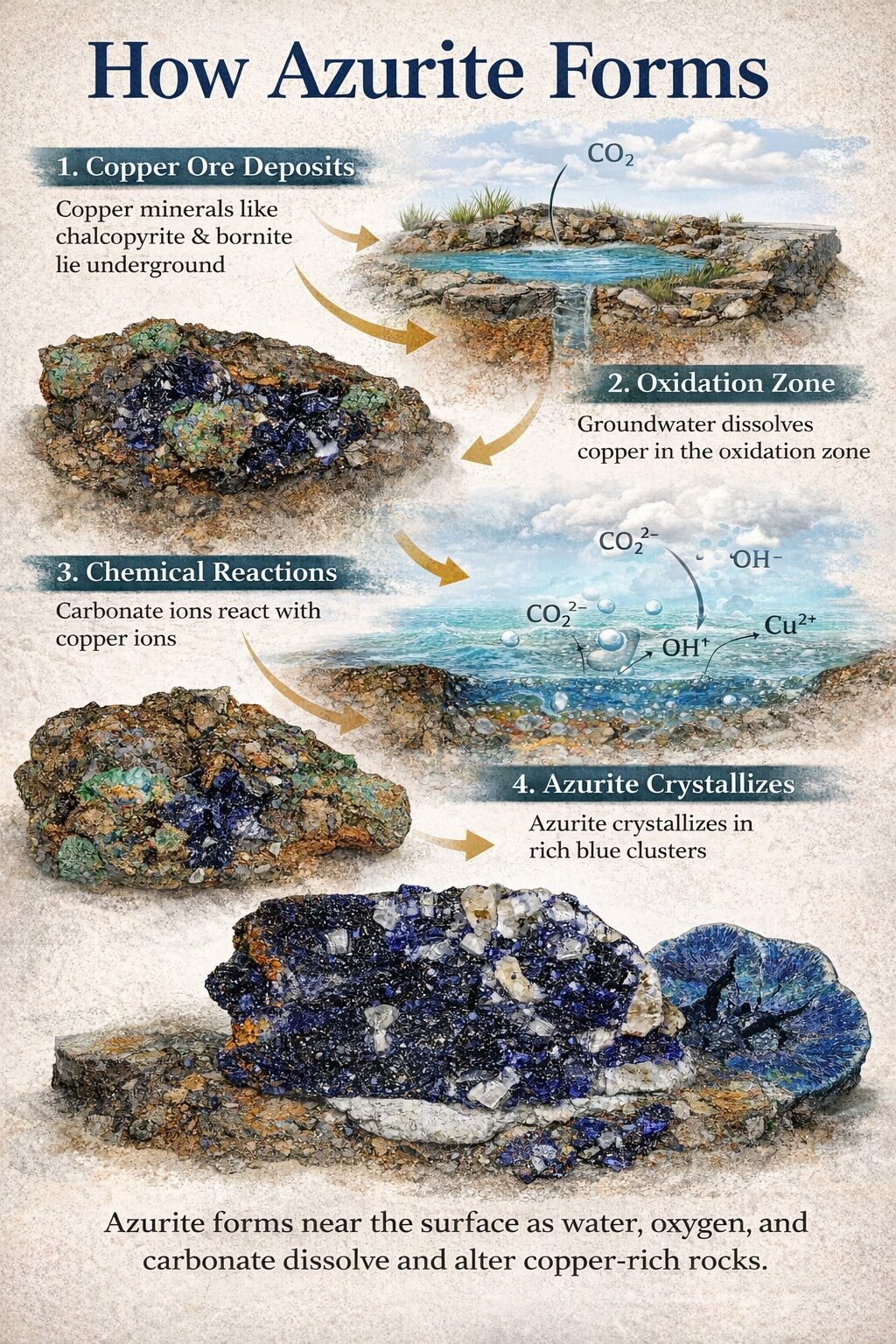
Infographic: How Azurite Forms
Crystal Types and Habits
Azurite is famous not only for its color but also for its diverse and dramatic crystal forms. It can appear in several habits, each highly prized by collectors.
Common Crystal Forms
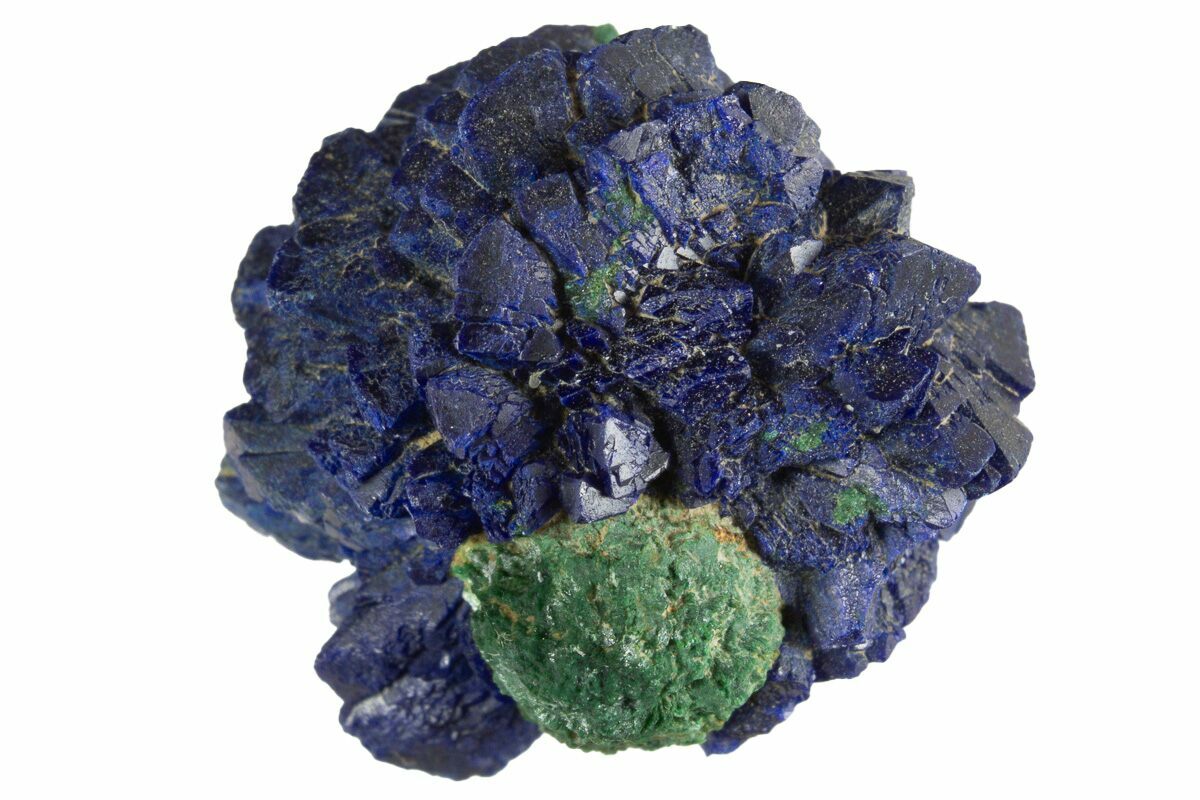
An azurite rosette aggregation with malachite from La Sal, Utah
Azurite Suns
One of the most visually distinctive and sought-after habits of azurite is the formation known as an “azurite sun.” These are radiant, disk-like crystal clusters that spread outward from a central point, resembling miniature celestial bodies frozen in stone.
Azurite suns form when thin, bladed crystals grow in a symmetrical, radiating pattern, creating a starburst or sunburst appearance. Their layered structure often gives them depth and texture, with countless tiny crystal faces catching the light like sparks.

What makes azurite suns especially notable is their geographic rarity. While azurite itself occurs worldwide, true “sun” specimens are found almost exclusively in Australia, where unique oxidation-zone conditions in major copper deposits allowed these remarkable radial growth patterns to develop.
The most famous and classic azurite suns come from Broken Hill, New South Wales, a locality legendary not only for azurite but for an extraordinary range of copper-associated minerals. Australian azurite suns have become so iconic that they are considered among the most distinctive collector forms the mineral can take.
History, Discovery, and Uses
Azurite’s story is inseparable from humanity’s long fascination with the color blue.
Long before it was understood as a copper carbonate mineral, azurite was simply a miracle of the earth — a blue stone unlike any other. In the ancient world, blue was the color of the divine, the unreachable, the eternal. The sky itself was blue, and so were the robes of gods, the ceilings of temples, and the painted symbols of power. Azurite, pulled from the ground in brilliant fragments, seemed like a piece of heaven buried in rock.
The ancient Egyptians were among the first to make use of azurite’s color. Along the Nile, artisans ground the mineral into fine powder and used it to decorate tombs and sacred spaces, believing the color carried spiritual significance and protection into the afterlife. To paint in blue was not merely decorative — it was symbolic, a connection to immortality and cosmic order.
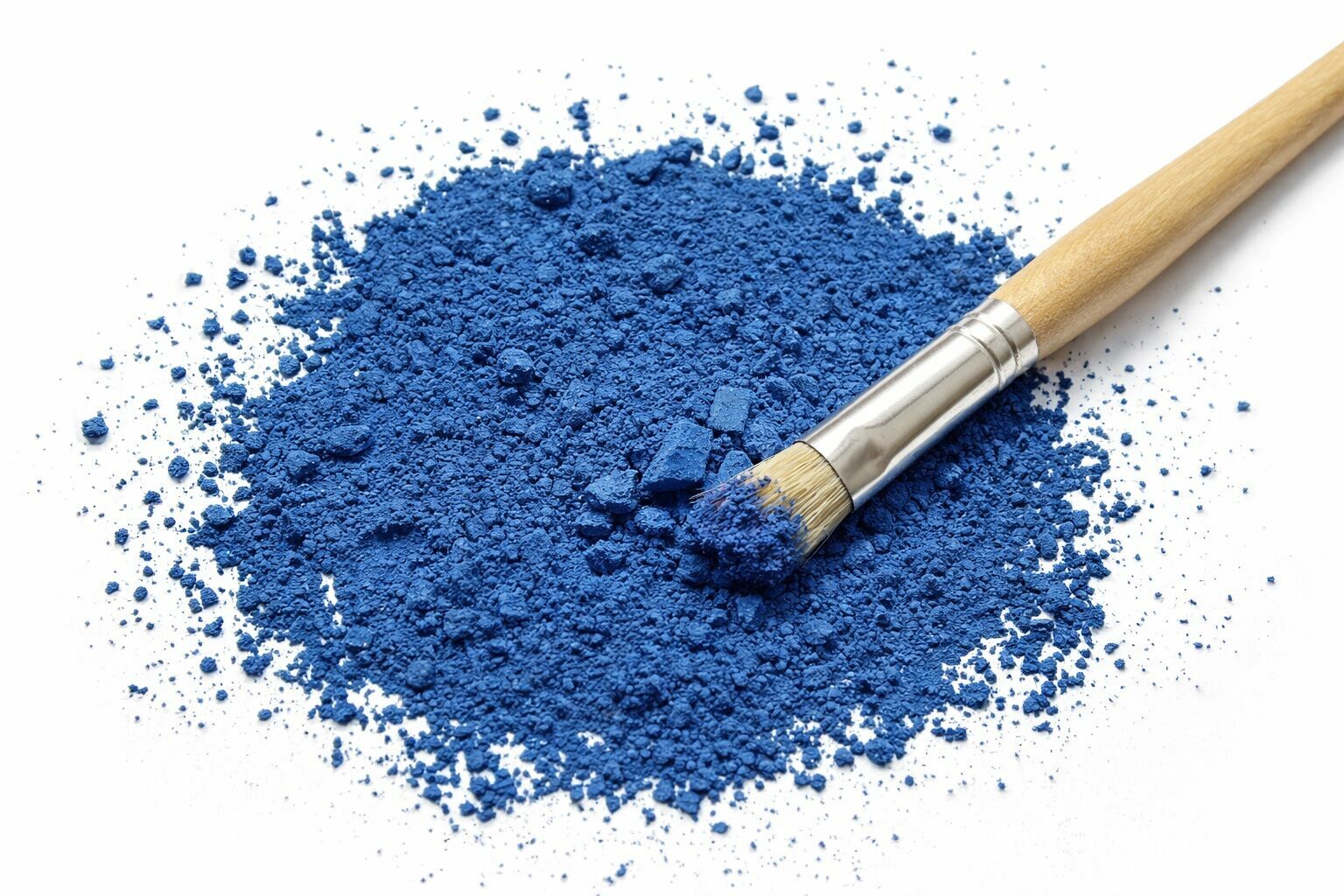
Azurite was one of history’s most prized blue pigments, ground into powder and used by ancient and Renaissance artists to paint brilliant skies, robes, and sacred works long before synthetic colors existed.
As trade routes expanded, azurite traveled across the Mediterranean world. The Greeks and Romans mined and used the mineral both as an ornamental stone and as a pigment. In those times it was sometimes referred to simply as “mountain blue,” distinguished from lapis lazuli, which was rarer and more costly. Azurite offered a more accessible source of deep color, and its presence in mines often hinted at hidden copper wealth beneath the surface.
During the Middle Ages, azurite became one of the most important pigments in Europe. Monks illuminating manuscripts used it to paint robes, skies, and decorative borders, its vivid blue standing out against gold leaf and parchment. In Renaissance workshops, azurite was a treasured material of painters who sought rich blues before ultramarine became widely available. Ground azurite was sometimes layered into paints to achieve luminous depth, though artists knew it could darken with age, especially in damp conditions.
The mineral’s name itself reflects its legacy. The word azurite is rooted in ancient Persian and Arabic terms for blue, eventually giving rise to the modern word azure. For centuries, the mineral was also known as chessylite, named after the famous deposits at Chessy-les-Mines in France, which produced exceptional specimens and helped bring scientific attention to the mineral.
By the 18th and 19th centuries, as mineralogy matured into a formal science, azurite was recognized as its own distinct species. Its chemical relationship to malachite became clear, and collectors began to prize it not just for pigment, but for its crystal beauty.
In the modern era, azurite is no longer an important industrial pigment, replaced by stable synthetic blues. Yet its allure has not faded. Today, azurite is treasured in a different way: as one of the great collector minerals of the copper world. Fine crystals from Namibia, the American Southwest, and Australia are displayed in museums and private collections, admired for their depth of color and sculptural forms.
Azurite is also still valued as a geological indicator. To a geologist, a seam of azurite staining the rock is a signpost — evidence that copper-rich fluids once moved through the earth, and that valuable ore may lie deeper below.
In this way, azurite continues to bridge worlds: ancient and modern, art and science, beauty and industry — a mineral whose blue has carried meaning across civilizations.
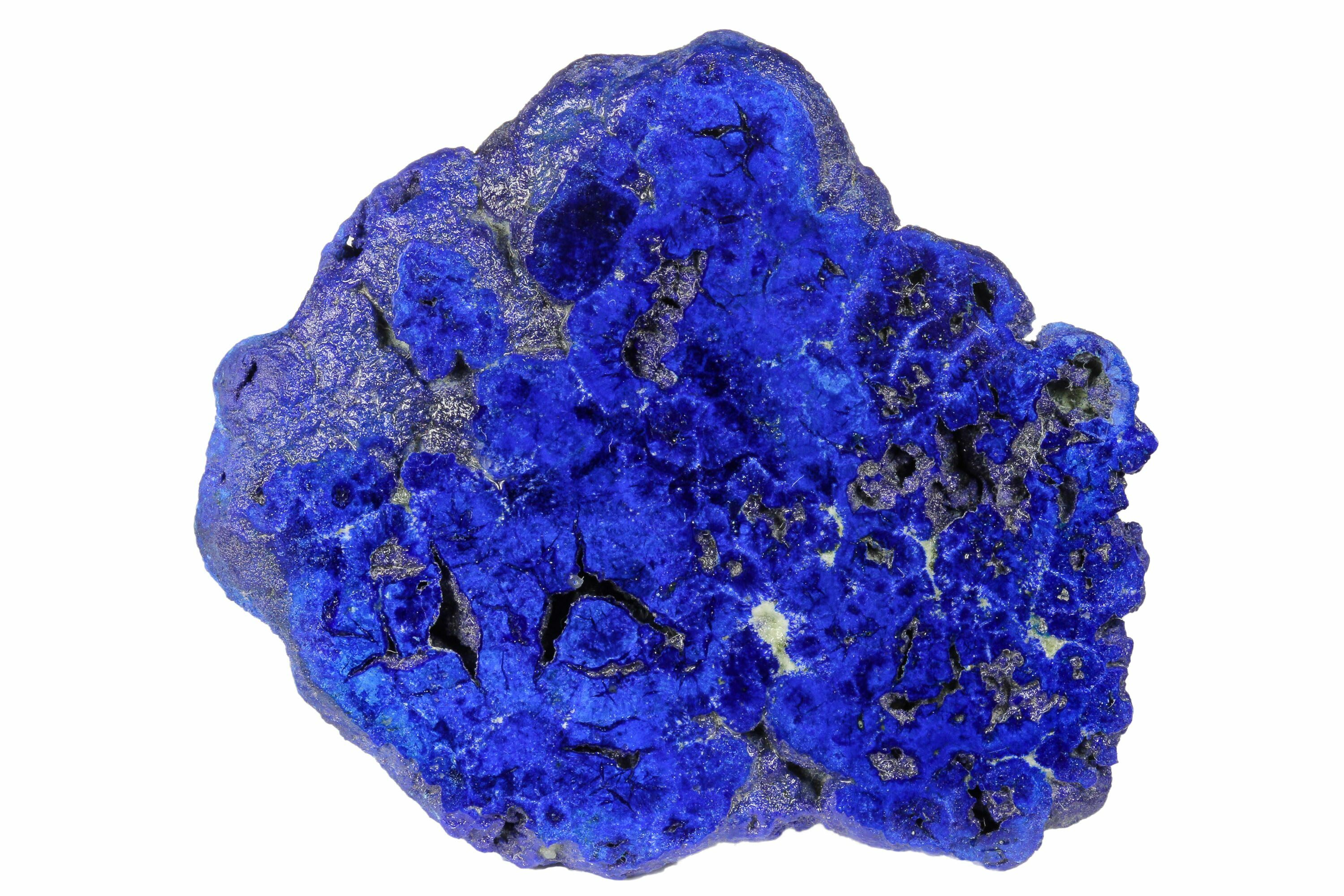
A vivid blue, cut and polished azurite nodule from the Poteryaevskoe Mine in Russia.
Key Localities
Azurite occurs in copper deposits across the world, but only a handful of regions have produced specimens so beautiful or historically significant that they have become legendary among collectors. Each major locality offers azurite with its own distinct character — from sharp, glassy crystals to iconic sunburst formations.
Australia (Broken Hill, New South Wales)
Broken Hill is perhaps the most famous azurite locality on Earth, not only for the richness of its copper mineralization but for producing the extraordinary formations known as azurite suns. These radiant, disk-like clusters are found almost exclusively in Australia and have become one of the most iconic crystal habits in the mineral world. Specimens from Broken Hill often display deep, saturated blue color and dramatic radial geometry, making them highly prized by collectors. The district itself is one of the world’s great classic mining regions, renowned for an exceptional variety of secondary copper minerals.
Mexico (Various Copper Deposits)
Mexico has produced azurite specimens notable for their rich associations with malachite and other secondary copper minerals. Mexican azurite is often found in attractive crystalline clusters or colorful mixed specimens where blue and green minerals intertwine in vivid patterns. These pieces are especially popular in lapidary and ornamental use, as they capture the full palette of copper’s oxidation-zone transformation.
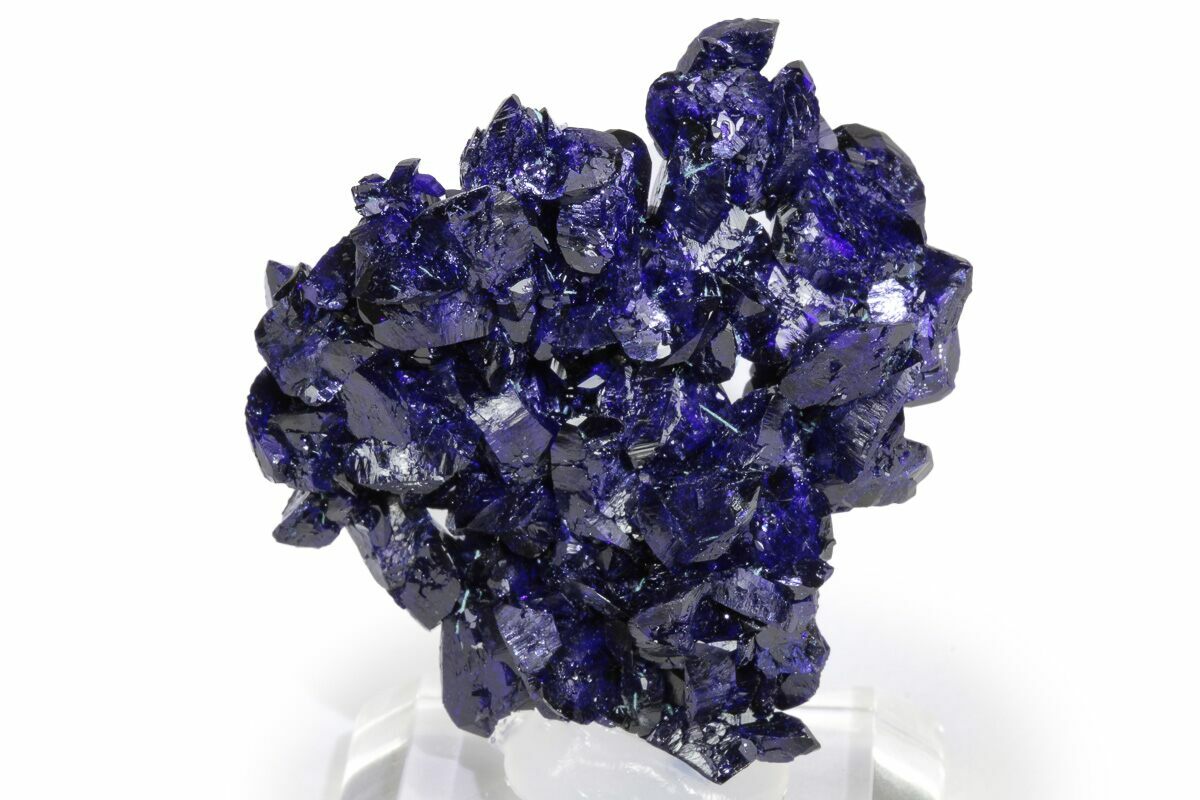
A vibrant blue azurite specimen from the Milpillas Mine in Mexico
Namibia (Tsumeb Mine)
The legendary Tsumeb Mine in Namibia is widely regarded as one of the finest mineral localities ever discovered. Azurite from Tsumeb is celebrated for its intensely rich blue crystals, often sharply formed and sometimes associated with malachite, cuprite, or other rare species. What makes Tsumeb specimens so remarkable is their combination of color, luster, and complexity — crystals can appear almost gem-like, perched in stunning contrast against pale matrix rock. For many collectors, a fine Tsumeb azurite represents the pinnacle of the species.
France (Chessy-les-Mines)
Chessy-les-Mines, near Lyon, France, holds an important place in azurite history. The locality gave rise to the old mineral name “chessylite,” once commonly used for azurite before modern mineralogical classification became standardized. While the mine is long closed, its specimens were historically significant in shaping early scientific understanding of copper carbonates. Chessy azurite is a reminder of the mineral’s role not only in art and ornament, but also in the development of mineralogy as a formal science.
United States (Bisbee, Arizona)
Bisbee, Arizona is one of the most famous American sources of azurite, producing specimens that often occur alongside malachite and other vivid copper minerals. Azurite from Bisbee can range from deep crystalline clusters to richly colored massive material. The historic copper mines of the region yielded some of the most aesthetically striking mineral combinations in the United States, and Bisbee specimens remain classics of Southwestern mineral collecting.
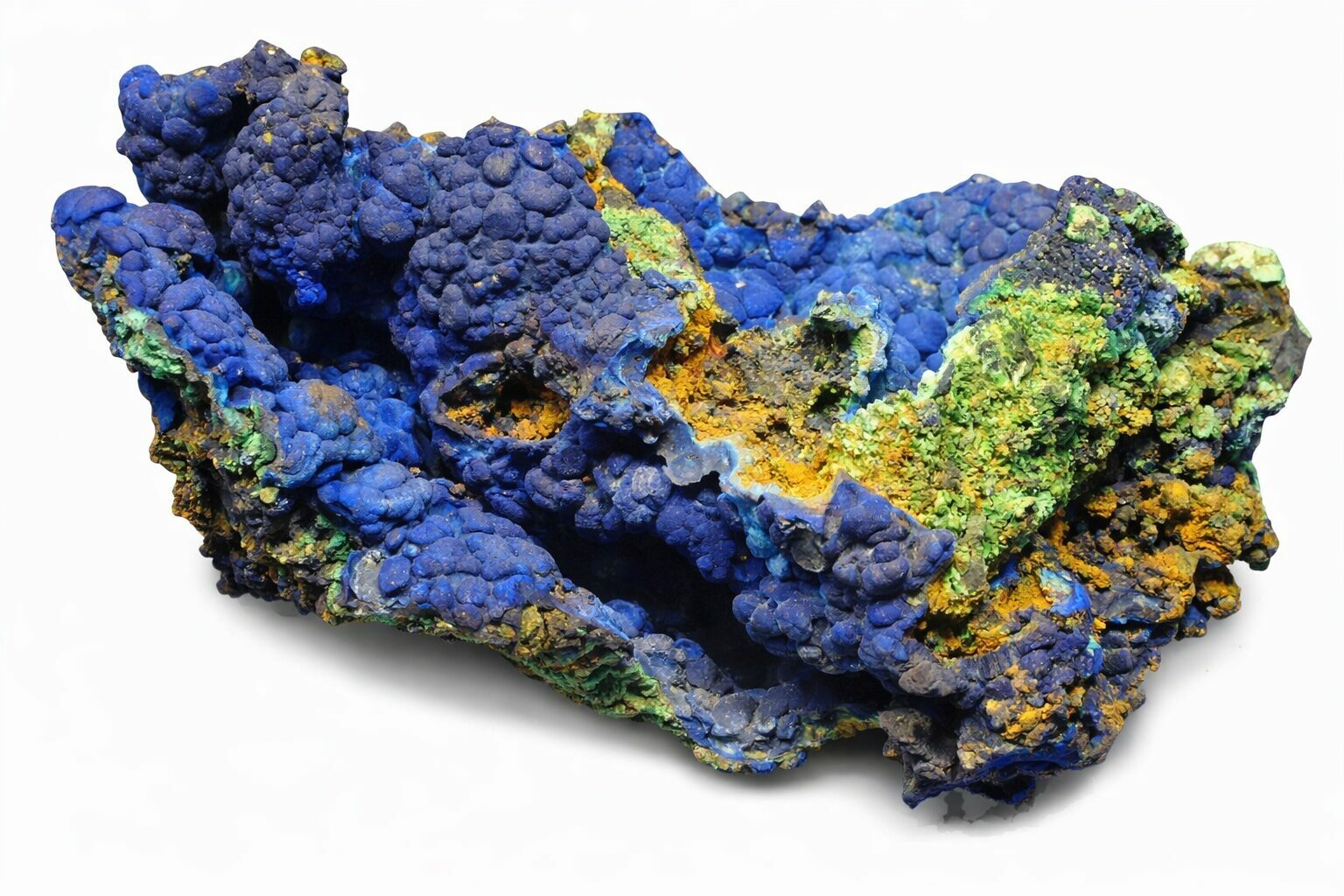
A spectacular specimen on azurite with malachite from the Copper Queen mine in Bisbee, Arizona
United States (Morenci Mine, Arizona)
The Morenci Mine, one of North America’s largest copper operations, has also produced notable azurite specimens from its oxidation zones. While much of the locality’s output is known for industrial copper rather than collector minerals, Morenci azurite can occur in attractive blue crystalline coatings and clusters, often accompanied by malachite or chrysocolla. Specimens from this region reflect the immense copper-rich systems that make Arizona one of the world’s great centers of secondary copper mineral formation.
United States (New Mexico Copper Districts)
New Mexico’s copper deposits have produced azurite in a wide variety of forms, from small brilliant crystals to massive blue material intergrown with malachite. The state’s oxidation-zone minerals are especially valued for their vibrant color contrasts, and azurite from New Mexico often serves as a classic example of secondary mineral development in desert environments. These deposits demonstrate how the slow interaction of copper ores and groundwater can create extraordinary mineral beauty.
Morocco (Touissit District)
Morocco is one of the world’s most important modern producers of fine azurite crystals. The Touissit mining district is especially known for sharp, lustrous deep-blue specimens, often forming striking prismatic clusters with excellent luster. While Morocco is not known for classic azurite suns, it has become a premier source for collectors seeking dramatic, high-quality crystal groups. Moroccan azurite is among the most visually impressive material on today’s mineral market.
China (Modern Localities)
In recent decades, China has emerged as an increasingly important source of bright, well-crystallized azurite specimens. Chinese material often features vivid coloration and fine crystal development, contributing significantly to the modern collector market. As exploration continues, new deposits have expanded the global availability of azurite, ensuring that this ancient mineral continues to captivate new generations of collectors and enthusiasts.
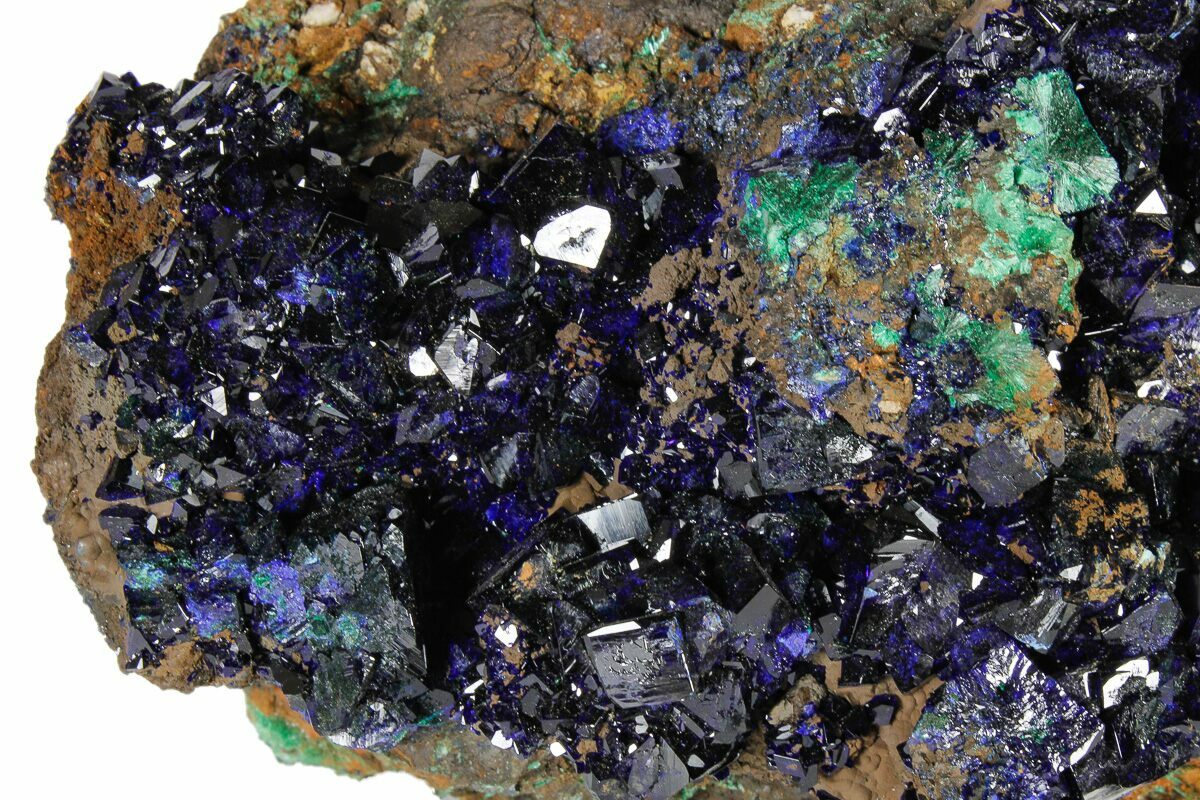
Gemmy, deep-blue azurite crystals with malachite from China.


