 Reviews

This Specimen has been sold.


3.4" Sphalerite, Marcasite & Dolomite Association - Missouri
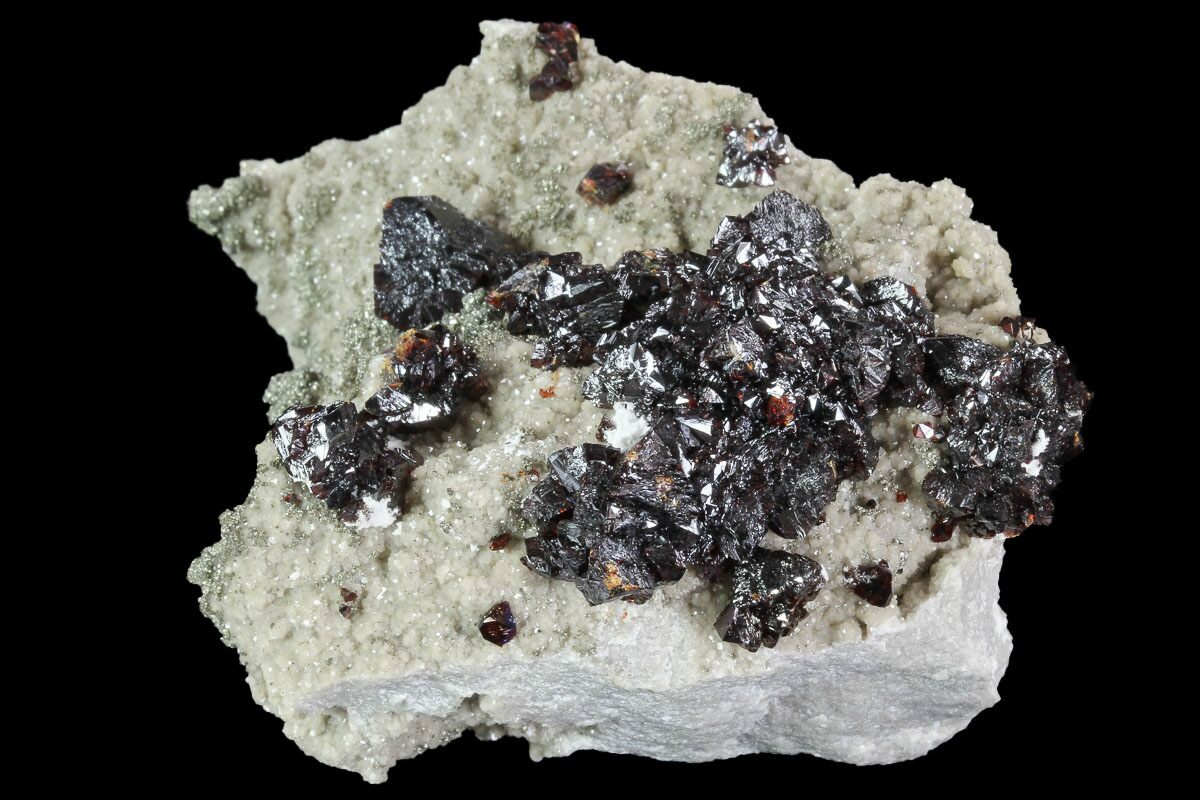
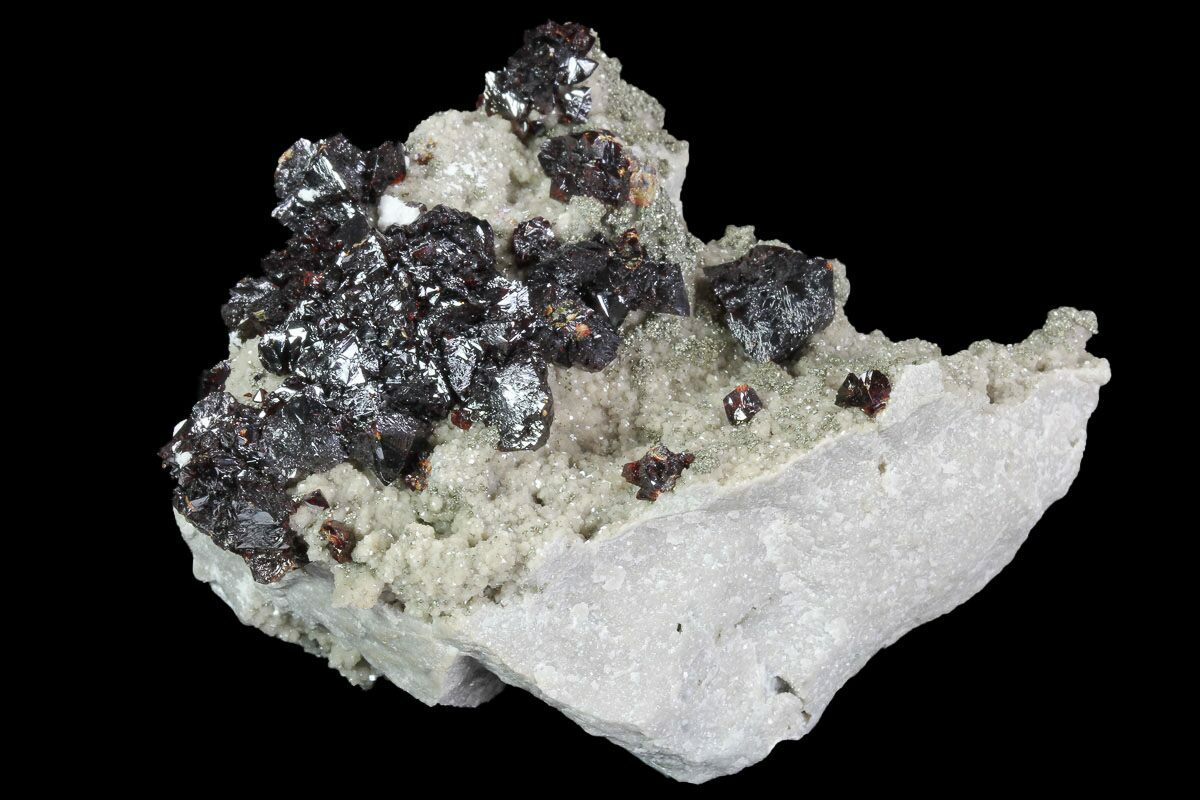
This beautiful specimen contains an association of a deep red sphalerite crystals, marcasite crystal druze and a druzy dolomite crystal encrusted matrix. It comes from the Washington County Aggregates Quarry in the Potosi Barite District of Missouri. It comes with an acrylic display stand.
About Sphalerite
Sphalerite is the most important ore of zinc and a striking mineral prized for its brilliant luster and wide range of colors. Composed of zinc sulfide (ZnS), it commonly forms in cubic or tetrahedral crystals and is found in hydrothermal veins, sedimentary deposits, and metamorphic environments around the world.
Although often brown to black, sphalerite can also occur in shades of honey-yellow, red, orange, and even green. Lighter-colored varieties are sometimes transparent to translucent and can display exceptional dispersion—meaning they separate light into spectral colors more intensely than diamond—giving well-cut specimens a fiery, eye-catching sparkle. Darker specimens are typically opaque with a resinous to submetallic luster.
Sphalerite is the most important ore of zinc and a striking mineral prized for its brilliant luster and wide range of colors. Composed of zinc sulfide (ZnS), it commonly forms in cubic or tetrahedral crystals and is found in hydrothermal veins, sedimentary deposits, and metamorphic environments around the world.
Although often brown to black, sphalerite can also occur in shades of honey-yellow, red, orange, and even green. Lighter-colored varieties are sometimes transparent to translucent and can display exceptional dispersion—meaning they separate light into spectral colors more intensely than diamond—giving well-cut specimens a fiery, eye-catching sparkle. Darker specimens are typically opaque with a resinous to submetallic luster.
Dolomite is an anhydrous carbonate mineral composed of calcium magnesium carbonate (CaMg(CO3)2).
The mineral dolomite crystallizes in the trigonal-rhombohedral system. It forms white, tan, gray, or pink crystals. Dolomite is a double carbonate, having an alternating structural arrangement of calcium and magnesium ions. It does not rapidly dissolve in dilute hydrochloric acid as calcite does. Crystal twinning is common.
Dolomite was first described by Carl Linnaeus in 1768, and in 1791 it was described as a rock by the French naturalist and geologist Déodat Gratet de Dolomieu. He first recognized the material in buildings of the old city of Rome, and later as samples collected in the mountains known as the Dolomite Alps of northern Italy.
The mineral dolomite crystallizes in the trigonal-rhombohedral system. It forms white, tan, gray, or pink crystals. Dolomite is a double carbonate, having an alternating structural arrangement of calcium and magnesium ions. It does not rapidly dissolve in dilute hydrochloric acid as calcite does. Crystal twinning is common.
Dolomite was first described by Carl Linnaeus in 1768, and in 1791 it was described as a rock by the French naturalist and geologist Déodat Gratet de Dolomieu. He first recognized the material in buildings of the old city of Rome, and later as samples collected in the mountains known as the Dolomite Alps of northern Italy.
SPECIES
Sphalerite, Marcasite & Dolomite
LOCATION
Washington County Aggregates Quarry, Potosi Barite District, Washington County, Missouri
SIZE
3.4 x 2.8"
CATEGORY
ITEM
#96383