 Reviews

This Specimen has been sold.
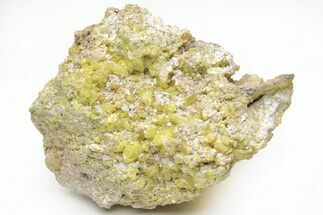


4.2" Sulfur Crystals on Matrix - Steamboat Springs, Nevada


This specimen contains a lustrous aggregation of lemon-yellow sulfur crystals with occasional sprays of scarlet red metastibnite on a rock matrix, from Washoe County, Nevada.
About Sulfur Crystals
Sulfur is a striking and instantly recognizable mineral, prized by collectors for its vivid yellow coloration and its distinctive crystal habits. Chemically, sulfur occurs as S₈—ring-shaped molecules composed of eight sulfur atoms—which give rise to its characteristic resinous luster and translucent glow. In nature, well-formed sulfur crystals typically develop as sharp dipyramids or blocky, tabular shapes. These specimens most often originate in volcanic or sedimentary environments, where sulfur precipitates from sulfur-rich gases or hydrothermal fluids. Many classic localities, such as Sicily or the salt domes of Texas and Louisiana, produce crystals perched on matrixes of gypsum, aragonite, or limestone, creating visually dramatic contrasts.
In the context of mineral specimens, sulfur requires a bit of care. The crystals are relatively soft and brittle, and can fracture if subjected to sudden temperature changes. Because of this thermal sensitivity, sulfur is best stored in a stable environment away from heat sources, bright sunlight, or rapid fluctuations in temperature. With proper handling, however, these luminous yellow crystals remain some of the most eye-catching and iconic mineral specimens in the collecting world.
Sulfur is a striking and instantly recognizable mineral, prized by collectors for its vivid yellow coloration and its distinctive crystal habits. Chemically, sulfur occurs as S₈—ring-shaped molecules composed of eight sulfur atoms—which give rise to its characteristic resinous luster and translucent glow. In nature, well-formed sulfur crystals typically develop as sharp dipyramids or blocky, tabular shapes. These specimens most often originate in volcanic or sedimentary environments, where sulfur precipitates from sulfur-rich gases or hydrothermal fluids. Many classic localities, such as Sicily or the salt domes of Texas and Louisiana, produce crystals perched on matrixes of gypsum, aragonite, or limestone, creating visually dramatic contrasts.
In the context of mineral specimens, sulfur requires a bit of care. The crystals are relatively soft and brittle, and can fracture if subjected to sudden temperature changes. Because of this thermal sensitivity, sulfur is best stored in a stable environment away from heat sources, bright sunlight, or rapid fluctuations in temperature. With proper handling, however, these luminous yellow crystals remain some of the most eye-catching and iconic mineral specimens in the collecting world.
About Stibnite
Stibnite is a striking mineral composed of antimony sulfide and is best known for its metallic luster and dramatic, elongated crystal formations. It often forms slender, prismatic crystals that can cluster into stunning radiating or parallel groups. Its color ranges from silvery-gray to steel-blue, with a reflective sheen that enhances its visual appeal. Stibnite is relatively soft, with a Mohs hardness of 2, making it easy to scratch but still prized for its aesthetic qualities.
This mineral has been historically significant as a primary source of antimony, a metal used in alloys, flame retardants, and batteries. Stibnite specimens are highly sought after by collectors due to their unique appearance and rarity. Major localities include China, Japan, and the United States, with some of the finest examples originating from the Wuning Mine in Jiangxi Province, China. Despite its beauty, stibnite contains toxic antimony and should be handled with care.
Toxicity Warning: Stibnite (antimony) is toxic and can be harmful if inhaled or swallowed. Most of the risk is long-term, chronic exposure to its dust. While a crystal sitting on your shelf doesn't pose a health risk, you should wash your hands after handling, keep out of reach of children, and please don't lick the stibnites.
Stibnite is a striking mineral composed of antimony sulfide and is best known for its metallic luster and dramatic, elongated crystal formations. It often forms slender, prismatic crystals that can cluster into stunning radiating or parallel groups. Its color ranges from silvery-gray to steel-blue, with a reflective sheen that enhances its visual appeal. Stibnite is relatively soft, with a Mohs hardness of 2, making it easy to scratch but still prized for its aesthetic qualities.
This mineral has been historically significant as a primary source of antimony, a metal used in alloys, flame retardants, and batteries. Stibnite specimens are highly sought after by collectors due to their unique appearance and rarity. Major localities include China, Japan, and the United States, with some of the finest examples originating from the Wuning Mine in Jiangxi Province, China. Despite its beauty, stibnite contains toxic antimony and should be handled with care.
Toxicity Warning: Stibnite (antimony) is toxic and can be harmful if inhaled or swallowed. Most of the risk is long-term, chronic exposure to its dust. While a crystal sitting on your shelf doesn't pose a health risk, you should wash your hands after handling, keep out of reach of children, and please don't lick the stibnites.
SPECIES
Sulfur & Metastibnite
LOCATION
Steamboat Springs (area), Washoe County, Nevada
SIZE
4.2 x 3.6 x 3.0"
CATEGORY
ITEM
#284372