 Reviews

This Specimen has been sold.


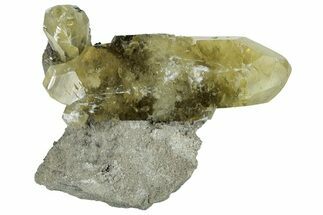
4" Gleaming Yellow Calcite Crystals on Matrix - Missouri

This is a gorgeous, 4" wide cluster of yellow calcite crystals on their natural matrix. The calcites show exceptional luster, color saturation, and clarity. This mineral specimen was collected from the Sweetwater Mine in Reynolds County, Missouri, a site known for its stunning mineral associations.
Comes with an acrylic display stand.
Comes with an acrylic display stand.
About Calcite Crystals
Calcite crystals are a form of calcium carbonate (CaCO₃) known for their diverse shapes, transparency, and vibrant range of colors. They typically form in rhombohedral, scalenohedral, or prismatic shapes, often with well-defined, sharp edges and glossy surfaces. Calcite crystals are often translucent or transparent, sometimes displaying a double refraction effect where objects viewed through the crystal appear doubled. They can appear in various colors—white, clear, yellow, pink, blue, green, and orange—depending on impurities or trace minerals.
A notable characteristic of calcite is its reaction with weak acids like vinegar, which causes it to effervesce, or fizz, as it releases carbon dioxide. This property makes calcite crystals a key tool in geological identification and studies. Calcite forms in many environments, from sedimentary rocks like limestone and marble to hydrothermal veins.
Calcite crystals are a form of calcium carbonate (CaCO₃) known for their diverse shapes, transparency, and vibrant range of colors. They typically form in rhombohedral, scalenohedral, or prismatic shapes, often with well-defined, sharp edges and glossy surfaces. Calcite crystals are often translucent or transparent, sometimes displaying a double refraction effect where objects viewed through the crystal appear doubled. They can appear in various colors—white, clear, yellow, pink, blue, green, and orange—depending on impurities or trace minerals.
A notable characteristic of calcite is its reaction with weak acids like vinegar, which causes it to effervesce, or fizz, as it releases carbon dioxide. This property makes calcite crystals a key tool in geological identification and studies. Calcite forms in many environments, from sedimentary rocks like limestone and marble to hydrothermal veins.
About the Sweetwater Mine
The Sweetwater Mine in southeastern Missouri is one of the major lead and zinc mines in the Viburnum Trend, a mineral-rich region known for its large deposits of lead ore. Located near Ellington in Reynolds County, the underground mine was discovered in 1962 and began production in 1968 under the Ozark Lead Company, a division of Kennecott Corporation. After lead prices declined in the early 1980s, operations were temporarily halted before ASARCO purchased and reopened the mine in 1987. Today, the mine is operated by the Doe Run Company and continues to play an important role in Missouri’s mining industry. The Sweetwater Mine has been recognized for producing high-grade lead ore as well as collectable mineral specimens such as galena, chalcopyrite, sphalerite, calcite, and more.
The mine has also had a significant economic and environmental impact on the surrounding Ozark region. It provides jobs and supports local communities through mining and milling operations, helping sustain the economy of Reynolds County and nearby towns. However, like many large mining operations, Sweetwater Mine has faced environmental scrutiny over the handling of waste materials and the potential spread of mining-related sediment into nearby waterways. Government agencies and environmental organizations have conducted studies and monitoring efforts in the area to address concerns related to water quality and ecosystem health. Despite these challenges, the mine remains an important part of Missouri’s long history of lead mining, which dates back more than 300 years and has made the state one of the nation’s leading lead producers
The Sweetwater Mine in southeastern Missouri is one of the major lead and zinc mines in the Viburnum Trend, a mineral-rich region known for its large deposits of lead ore. Located near Ellington in Reynolds County, the underground mine was discovered in 1962 and began production in 1968 under the Ozark Lead Company, a division of Kennecott Corporation. After lead prices declined in the early 1980s, operations were temporarily halted before ASARCO purchased and reopened the mine in 1987. Today, the mine is operated by the Doe Run Company and continues to play an important role in Missouri’s mining industry. The Sweetwater Mine has been recognized for producing high-grade lead ore as well as collectable mineral specimens such as galena, chalcopyrite, sphalerite, calcite, and more.
The mine has also had a significant economic and environmental impact on the surrounding Ozark region. It provides jobs and supports local communities through mining and milling operations, helping sustain the economy of Reynolds County and nearby towns. However, like many large mining operations, Sweetwater Mine has faced environmental scrutiny over the handling of waste materials and the potential spread of mining-related sediment into nearby waterways. Government agencies and environmental organizations have conducted studies and monitoring efforts in the area to address concerns related to water quality and ecosystem health. Despite these challenges, the mine remains an important part of Missouri’s long history of lead mining, which dates back more than 300 years and has made the state one of the nation’s leading lead producers
SPECIES
Calcite
LOCATION
Sweetwater Mine, Viburnum Trend, Reynolds County, Missouri
SIZE
Entire specimen: 4 x 3.5"
CATEGORY
ITEM
#363376