 Reviews


This Specimen has been sold.
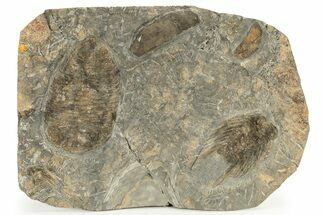


1.5" Pelagic Trilobite (Cyclopyge) Fossil - Exceptional Specimen


This is an exceptional, 1.5" long example of an unusual pelagic trilobite (Cyclopyge) from El Kaid Rami, Morocco. Nearly all of the Cyclopyge you see from Morocco are flattened on shale and not 3D like this specimen. The right eye on this one is incredible, though the left does not preserve much detail. It has some restoration along repaired cracks.
About Cyclopyge
Cyclopyge is a distinctive genus of trilobite from the Middle Ordovician period, known for its unusually large, crescent-shaped eyes that inspired its name—meaning “round eye.” Fossils of this genus are found in marine deposits across Europe, North Africa, and parts of Asia, often preserved in fine-grained limestones or shales that once formed on the floors of ancient seas.
Adapted for life in deeper or dimly lit waters, Cyclopyge possessed enormous compound eyes that provided a nearly panoramic field of vision—an evolutionary advantage for detecting predators or prey in low light. Its streamlined, oval body and reduced spines suggest it was a free-swimming, pelagic trilobite rather than a bottom-dweller. The cephalon (head) was broad, the thorax composed of relatively few segments, and the pygidium (tail) was small and rounded.
These features make Cyclopyge one of the most recognizable and specialized trilobites, offering fascinating insight into how some Ordovician trilobites adapted to open-water habitats rather than the seafloor environments typical of most of their relatives.
Cyclopyge is a distinctive genus of trilobite from the Middle Ordovician period, known for its unusually large, crescent-shaped eyes that inspired its name—meaning “round eye.” Fossils of this genus are found in marine deposits across Europe, North Africa, and parts of Asia, often preserved in fine-grained limestones or shales that once formed on the floors of ancient seas.
Adapted for life in deeper or dimly lit waters, Cyclopyge possessed enormous compound eyes that provided a nearly panoramic field of vision—an evolutionary advantage for detecting predators or prey in low light. Its streamlined, oval body and reduced spines suggest it was a free-swimming, pelagic trilobite rather than a bottom-dweller. The cephalon (head) was broad, the thorax composed of relatively few segments, and the pygidium (tail) was small and rounded.
These features make Cyclopyge one of the most recognizable and specialized trilobites, offering fascinating insight into how some Ordovician trilobites adapted to open-water habitats rather than the seafloor environments typical of most of their relatives.
SPECIES
Cyclopyge sibilla

LOCATION
El Kaid Rami, Morocco
FORMATION
Lower Ktaoua Formation
SIZE
Trilobite: 1.5" long (if outstretched)
CATEGORY
SUB CATEGORY
ITEM
#255355
We guarantee the authenticity of all of our specimens.


