 Reviews


2" Tower-Eyed Spiny Erbenochile Trilobite - Jbel Ou Driss, Morocco


This is a 2" long tower-eyed Erbenochile trilobite from a very unusual location. Nearly all of them come from near Foum Zguid, but this one was quarried near Jbel Ou Driss, Morocco. The rock is much harder at this location and more time-consuming to prepare.
The detail is stunning, with some eye facet preservation in both eyes, not to mention the free-standing axial spines; the dozens of tiny spines covering the thorax and tail are preserved. There is about 2% shell restoration along repaired cracks on the left side of the tail.
The detail is stunning, with some eye facet preservation in both eyes, not to mention the free-standing axial spines; the dozens of tiny spines covering the thorax and tail are preserved. There is about 2% shell restoration along repaired cracks on the left side of the tail.
About Erbenochile
Trilobites of the genus Erbenochile are among the most visually striking arthropods of the Devonian, famed for their extraordinary compound eyes. Each eye tower is composed of more than 400 individual facets, forming a sweeping dome that granted the animal an unmatched field of view. These massive optical structures provided full 360° horizontal coverage, and were tall enough to allow the trilobite to peer backward over its own thorax—a remarkable evolutionary advantage in the predator-rich seafloor ecosystems of the time.
Only two species of this remarkable genus are known: Erbenochile erbeni and Erbenochile issoumourensis, both discovered in the Devonian strata of Morocco’s Issoumour area. While they share the same iconic eye towers and elegant, spiny profiles, they can be distinguished by several key morphological traits. E. issoumourensis possesses fewer eye facets than the type species, lacks the distinctive lateral “eye shade” or visor that extends from the top of the eyes in E. erbeni, and features shorter, more subdued spines. Its cephalon is more rounded-triangular in outline and notably lacks the tubercles commonly seen in E. erbeni.
Trilobites of the genus Erbenochile are among the most visually striking arthropods of the Devonian, famed for their extraordinary compound eyes. Each eye tower is composed of more than 400 individual facets, forming a sweeping dome that granted the animal an unmatched field of view. These massive optical structures provided full 360° horizontal coverage, and were tall enough to allow the trilobite to peer backward over its own thorax—a remarkable evolutionary advantage in the predator-rich seafloor ecosystems of the time.
Only two species of this remarkable genus are known: Erbenochile erbeni and Erbenochile issoumourensis, both discovered in the Devonian strata of Morocco’s Issoumour area. While they share the same iconic eye towers and elegant, spiny profiles, they can be distinguished by several key morphological traits. E. issoumourensis possesses fewer eye facets than the type species, lacks the distinctive lateral “eye shade” or visor that extends from the top of the eyes in E. erbeni, and features shorter, more subdued spines. Its cephalon is more rounded-triangular in outline and notably lacks the tubercles commonly seen in E. erbeni.
About Trilobites
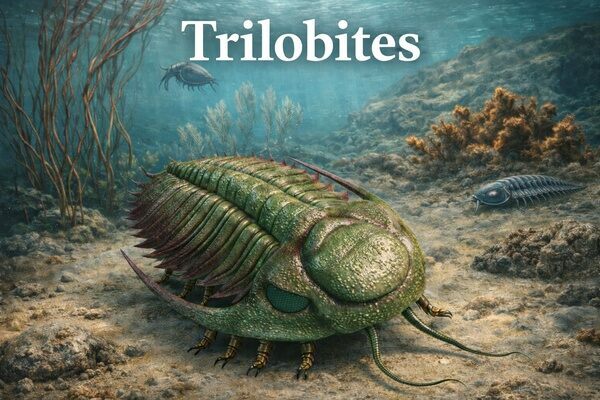
Trilobites were a very diverse group of extinct marine arthropods. They first appeared in the fossil record in the Early Cambrian (521 million years ago) and went extinct during the Permian mass extinction (250 million years ago). They were one of the most successful of the early animals on our planet: over 25,000 species have been described, filling nearly every evolutionary niche. Due in large part to their hard exoskeletons (shells), they left an excellent fossil record.
Trilobites were a very diverse group of extinct marine arthropods. They first appeared in the fossil record in the Early Cambrian (521 million years ago) and went extinct during the Permian mass extinction (250 million years ago). They were one of the most successful of the early animals on our planet: over 25,000 species have been described, filling nearly every evolutionary niche. Due in large part to their hard exoskeletons (shells), they left an excellent fossil record.
$1,250 $950
SPECIES
Erbenochile issoumourensis?
AGE

LOCATION
Jbel Ou Driss, Morocco
SIZE
2" long
CATEGORY
SUB CATEGORY
ITEM
#125175
We guarantee the authenticity of all of our specimens.


