 Reviews


This Specimen has been sold.


16.8" Spectacularly Preserved Acadoparadoxides Trilobite


The Middle Cambrian deposits of Morocco are famous for yielding large specimens of Acadoparadoxides trilobites, though most are poorly preserved. For decades, thousands of these fossils have been extracted from rust-colored limonite layers, often requiring heavy restoration—or, in some cases, being entirely fabricated.
A recently discovered locality, however, has produced a very limited number of Acadoparadoxides with exceptional preservation. These rare examples exhibit a rich, dark brown shell rather than the typical orange “rusted” appearance.
This giant, 16.8" long specimen is one of only a few we've been able to acquire and the largest I'm aware of from the location. The preservation is superb, with only a few repaired cracks and a total of about 2% shell restoration along the crack repairs.
A recently discovered locality, however, has produced a very limited number of Acadoparadoxides with exceptional preservation. These rare examples exhibit a rich, dark brown shell rather than the typical orange “rusted” appearance.
This giant, 16.8" long specimen is one of only a few we've been able to acquire and the largest I'm aware of from the location. The preservation is superb, with only a few repaired cracks and a total of about 2% shell restoration along the crack repairs.
About Trilobites
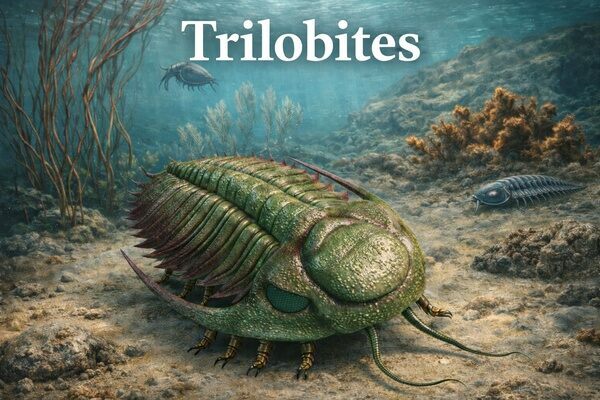
Trilobites were a very diverse group of extinct marine arthropods. They first appeared in the fossil record in the Early Cambrian (521 million years ago) and went extinct during the Permian mass extinction (250 million years ago). They were one of the most successful of the early animals on our planet: over 25,000 species have been described, filling nearly every evolutionary niche. Due in large part to their hard exoskeletons (shells), they left an excellent fossil record.
Trilobites were a very diverse group of extinct marine arthropods. They first appeared in the fossil record in the Early Cambrian (521 million years ago) and went extinct during the Permian mass extinction (250 million years ago). They were one of the most successful of the early animals on our planet: over 25,000 species have been described, filling nearly every evolutionary niche. Due in large part to their hard exoskeletons (shells), they left an excellent fossil record.
SPECIES
Acadoparadoxides sp.
AGE

LOCATION
Morocco
FORMATION
Jbel Wawrmast Formation
SIZE
16.8" long on 26 x 18" limestone
CATEGORY
SUB CATEGORY
ITEM
#349231
We guarantee the authenticity of all of our specimens.


