 Reviews


This Specimen has been sold.


3.35" Plate of Fossil Trepostome Bryozoans on Brachiopods - Kentucky


This is a 3.35" wide plate of fossil trepostome bryozoan colonies growing on brackiopods, collected from the Upper Ordovician-aged Liberty Formation in Preble County, Ohio. The two brachiopod genera include Hevertella and Sowerbyella.. The fossils have been meticulously exposed from the rock they were found in.
This specimen is accompanied by a display stand.
This specimen is accompanied by a display stand.
Brachiopods are members of the phylum Brachiopoda. They are clam-like with wide shells composed of two halves called valves. They are filter feeders that live fixed to rocks or on the seafloor. Brachiopods first appeared in the early Cambrian as simple forms with non-articulating shells. Their diversity peaked during the Devonian, and there are currently 12,000 described fossil species of Brachiopoda from 5,000 genera. Most species of brachiopod died out during the Permian-Triassic Extinction but about 450 species still live today. They live in cold marine environments like polar seas or continental shelves and slopes. The largest fossil Brachiopod found is 7.9 inches (200 mm), but most are 2-4 inches (3-8 cm). Living Brachiopods also fall into this range.
Brachiopods are more closely related to Bryozoans than Mollusks. The easiest differences to identify are in the shells of clams, part of the mollusk family, and Brachiopods. Mollusk shells are divided into left and right while brachiopod shells are divided top (dorsal) and bottom (ventral). Mollusk shells are usually equal on the right and left. In brachiopods, the bottom shell is larger than the top. The other big difference is in how they feed: both are filter feeders, but mollusks extend their filter into the water and pull food into their shells. Brachiopods have internal feeding structures: water is drawn into the shell where the food is filtered out before expelling it out.
Brachiopods are more closely related to Bryozoans than Mollusks. The easiest differences to identify are in the shells of clams, part of the mollusk family, and Brachiopods. Mollusk shells are divided into left and right while brachiopod shells are divided top (dorsal) and bottom (ventral). Mollusk shells are usually equal on the right and left. In brachiopods, the bottom shell is larger than the top. The other big difference is in how they feed: both are filter feeders, but mollusks extend their filter into the water and pull food into their shells. Brachiopods have internal feeding structures: water is drawn into the shell where the food is filtered out before expelling it out.
About Bryozoans
Bryozoans are microscopic aquatic invertebrates that live in colonies, forming skeletal structures similar to corals. Each skeletal structure has a form unique to each particular species. The individual byrozoans forming these colonies are filter feeders called zooids, straining nutrients from the surrounding water.
Bryozoans are microscopic aquatic invertebrates that live in colonies, forming skeletal structures similar to corals. Each skeletal structure has a form unique to each particular species. The individual byrozoans forming these colonies are filter feeders called zooids, straining nutrients from the surrounding water.
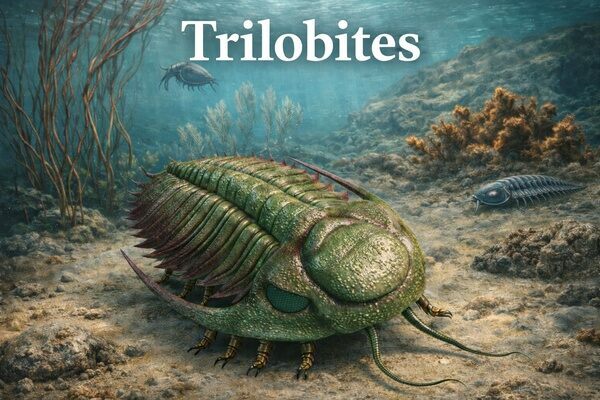
About Trilobites
Trilobites were a very diverse group of extinct marine arthropods. They first appeared in the fossil record in the Early Cambrian (521 million years ago) and went extinct during the Permian mass extinction (250 million years ago). They were one of the most successful of the early animals on our planet: over 25,000 species have been described, filling nearly every evolutionary niche. Due in large part to their hard exoskeletons (shells), they left an excellent fossil record.
Trilobites were a very diverse group of extinct marine arthropods. They first appeared in the fossil record in the Early Cambrian (521 million years ago) and went extinct during the Permian mass extinction (250 million years ago). They were one of the most successful of the early animals on our planet: over 25,000 species have been described, filling nearly every evolutionary niche. Due in large part to their hard exoskeletons (shells), they left an excellent fossil record.
SPECIES
Hevertella sp. & Sowerbyella sp.
AGE

LOCATION
Bracken County, Kentucky
FORMATION
Fairview Formation
SIZE
3.35 x 2.45"
CATEGORY
ITEM
#325715
We guarantee the authenticity of all of our specimens.


