 Reviews


Extraordinary Fossil Baby Turtle (Axestemys) - Green River Formation


This extraordinary fossil represents one of the rarest and most remarkable turtle discoveries from Wyoming's famous Green River Formation. Preserved in exquisite detail, this 52-million-year-old baby Axestemys byssina measures just 5 inches long and offers an exceptionally rare glimpse into the earliest stages of life of the largest freshwater turtle species known.
Adult Axestemys byssina could reach lengths exceeding 6 feet, making these enormous soft-shelled turtles formidable inhabitants of the subtropical lakes and waterways of Eocene North America. Unlike hard-shelled turtles, Axestemys possessed a relatively flat, leathery shell supported by an underlying bony framework. These turtles were well adapted to an aquatic lifestyle, with broad, flattened bodies and powerful, paddle-like limbs.
What makes this specimen particularly fascinating is its remarkably early stage of development. The turtle's shell had not yet fully formed or ossified, leaving much of the developing skeletal structure beautifully exposed. The delicate arrangement of bones, partially developed shell, and tiny limbs provides an extraordinary view of juvenile anatomy that would be concealed or substantially altered in a mature individual. The exceptional preservation of these fragile structures is especially noteworthy, as such delicate remains would ordinarily be susceptible to destruction or disarticulation before fossilization.
While fossils of adult Axestemys are themselves exceedingly rare, juvenile specimens are among the greatest rarities of the Green River Formation. Despite more than a century of extensive commercial fossil collecting, only a handful of baby Axestemys have reportedly been recovered. With its outstanding completeness, remarkable anatomical detail, and beautiful presentation, this may be the finest-preserved example of a baby Axestemys ever discovered.
This specimen was unearthed during the summer of 2026 from the lower half of the renowned 18-inch layer at the Lindgren North Ridge Quarry, near Kemmerer, Wyoming. It was painstakingly prepared under a microscope using only fine hand tools, allowing the delicate bones and intricate anatomical features to be revealed with extraordinary precision.
The fossil is beautifully presented on a 12" x 9.5" rectangularly cut limestone plate, providing an elegant, natural display that showcases its exceptional preservation.
A true museum-caliber fossil of extraordinary scientific significance and rarity. This is the kind of discovery that may occur only a few times in a century of collecting, and an opportunity to acquire a comparable specimen may never arise again.
Adult Axestemys byssina could reach lengths exceeding 6 feet, making these enormous soft-shelled turtles formidable inhabitants of the subtropical lakes and waterways of Eocene North America. Unlike hard-shelled turtles, Axestemys possessed a relatively flat, leathery shell supported by an underlying bony framework. These turtles were well adapted to an aquatic lifestyle, with broad, flattened bodies and powerful, paddle-like limbs.
What makes this specimen particularly fascinating is its remarkably early stage of development. The turtle's shell had not yet fully formed or ossified, leaving much of the developing skeletal structure beautifully exposed. The delicate arrangement of bones, partially developed shell, and tiny limbs provides an extraordinary view of juvenile anatomy that would be concealed or substantially altered in a mature individual. The exceptional preservation of these fragile structures is especially noteworthy, as such delicate remains would ordinarily be susceptible to destruction or disarticulation before fossilization.
While fossils of adult Axestemys are themselves exceedingly rare, juvenile specimens are among the greatest rarities of the Green River Formation. Despite more than a century of extensive commercial fossil collecting, only a handful of baby Axestemys have reportedly been recovered. With its outstanding completeness, remarkable anatomical detail, and beautiful presentation, this may be the finest-preserved example of a baby Axestemys ever discovered.
This specimen was unearthed during the summer of 2026 from the lower half of the renowned 18-inch layer at the Lindgren North Ridge Quarry, near Kemmerer, Wyoming. It was painstakingly prepared under a microscope using only fine hand tools, allowing the delicate bones and intricate anatomical features to be revealed with extraordinary precision.
The fossil is beautifully presented on a 12" x 9.5" rectangularly cut limestone plate, providing an elegant, natural display that showcases its exceptional preservation.
A true museum-caliber fossil of extraordinary scientific significance and rarity. This is the kind of discovery that may occur only a few times in a century of collecting, and an opportunity to acquire a comparable specimen may never arise again.
About The 18 Inch Layer Of Fossil Lake
Specimens of this quality come from the coveted 18-inch layer of the Green River Formation, a horizon renowned for producing exceptionally dark, detailed, and well-preserved fossil fish. The limestone from this layer is significantly harder and more durable than that found in many other parts of the formation, likely a result of the deep-water conditions under which it was originally deposited.
These conditions helped preserve fish in remarkable completeness, allowing exceptional specimens to be recovered largely intact. Locating them is a specialized process. The layer is often worked at night using low-angle lighting, which reveals the subtle raised contours created by a fossil fish—particularly the backbone—hidden beneath the surface of the limestone.
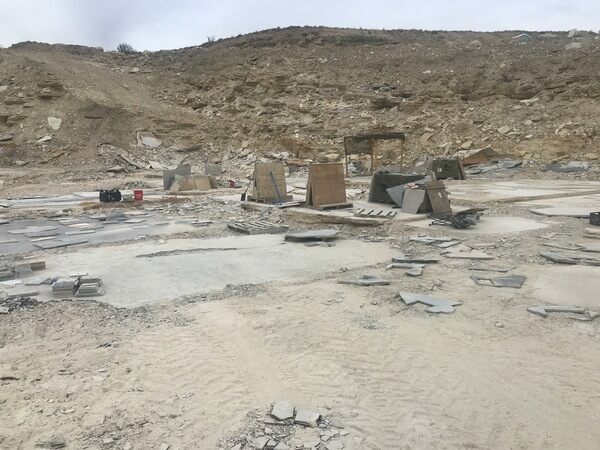
A view of the 18 inch layer of the Green River Formation at the Lindgren quarry near Kemmerer, Wyoming.
Once identified, the surrounding rock is carefully cut away and the specimen is transported to a preparation laboratory. Because the fossil may lie as much as an inch beneath the surface, exposing it requires painstaking work under magnification. Skilled preparators use fine hand tools to gradually remove the overlying limestone, revealing the fossil in extraordinary detail while preserving the delicate bones beneath.
Specimens of this quality come from the coveted 18-inch layer of the Green River Formation, a horizon renowned for producing exceptionally dark, detailed, and well-preserved fossil fish. The limestone from this layer is significantly harder and more durable than that found in many other parts of the formation, likely a result of the deep-water conditions under which it was originally deposited.
These conditions helped preserve fish in remarkable completeness, allowing exceptional specimens to be recovered largely intact. Locating them is a specialized process. The layer is often worked at night using low-angle lighting, which reveals the subtle raised contours created by a fossil fish—particularly the backbone—hidden beneath the surface of the limestone.
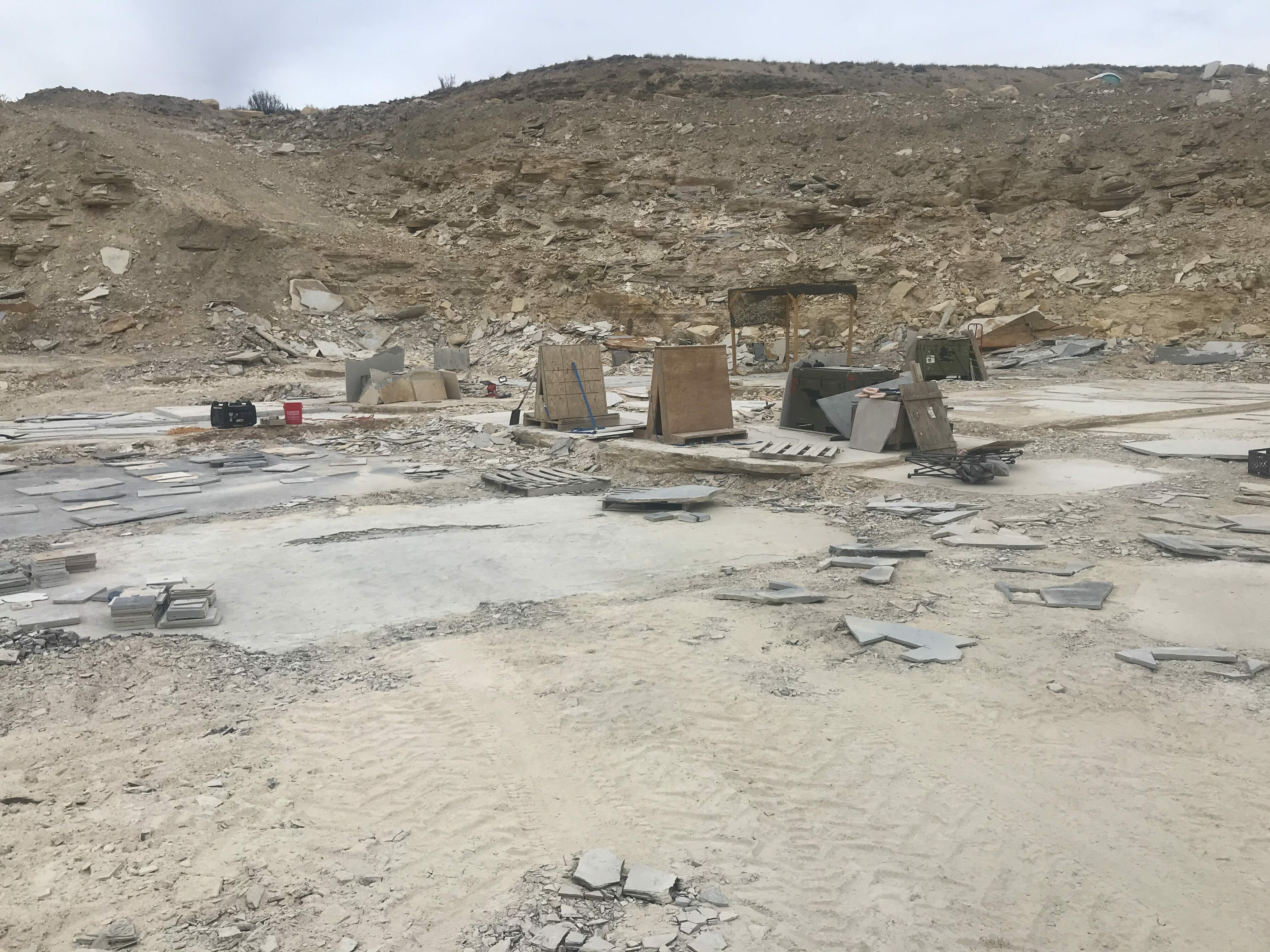
A view of the 18 inch layer of the Green River Formation at the Lindgren quarry near Kemmerer, Wyoming.
Once identified, the surrounding rock is carefully cut away and the specimen is transported to a preparation laboratory. Because the fossil may lie as much as an inch beneath the surface, exposing it requires painstaking work under magnification. Skilled preparators use fine hand tools to gradually remove the overlying limestone, revealing the fossil in extraordinary detail while preserving the delicate bones beneath.
$45,000
SPECIES
Axestemys byssina

LOCATION
Lindgren North Ridge Quarry, Kemmerer, Wyoming
FORMATION
Green River Formation - 18 Inch Layer
SIZE
5" long on 12 x 9.5" limestone
CATEGORY
SUB CATEGORY
ITEM
#380899
We guarantee the authenticity of all of our specimens.


