 Reviews


Two Large Longianda Trilobite Fossils - Issafen, Morocco


This is a fascinating and visually striking association of three Longianda termieri trilobites from the Lower Cambrian Issafen Formation of Morocco, beautifully illustrating the dramatic geological deformation found in this deposit. Two large trilobites are prominently exposed, with a third partially concealed beneath them. Although both are similarly sized examples of the same species, one appears remarkably broad and compact, while the other is long and slender. This striking contrast is the result of tectonic deformation, which stretched and distorted the surrounding shale and its enclosed fossils over millions of years.
The longer trilobite measures 5.3" long, while the attractive, greenish shale matrix measures 8 x 6.3". Both specimens exhibit distinctive rust-colored preservation along their margins and delicate, free-standing terminal axial spines. The preparation is excellent, highlighting the intricate details of each fossil while preserving their unusual geological presentation. Total restoration is approximately 1%. This exceptional display piece comes with a display stand.
The longer trilobite measures 5.3" long, while the attractive, greenish shale matrix measures 8 x 6.3". Both specimens exhibit distinctive rust-colored preservation along their margins and delicate, free-standing terminal axial spines. The preparation is excellent, highlighting the intricate details of each fossil while preserving their unusual geological presentation. Total restoration is approximately 1%. This exceptional display piece comes with a display stand.
About Issafen Trilobites
In recent years, fossil-bearing deposits near Issafen, Morocco, have begun producing an extraordinary diversity of Early Cambrian trilobites. This newly recognized assemblage includes representatives of several distinctive trilobite groups, including ellipsocephalids, chengkouiids, gigantopygids, holmiids, neltneriids, saukiandids, and some of the latest surviving fallotaspids. The remarkable diversity of this fauna, combined with the unusual morphology of many of its species, has made the Issafen Formation an increasingly fascinating source of specimens for collectors and researchers alike.
The trilobites are preserved in fine-grained shale that typically exhibits a greenish to pale yellow coloration when freshly split. With prolonged exposure to the elements, the shale weathers to a light gray. Many specimens preserve intricate details of the exoskeleton, including delicate spines, distinct segmentation, and other diagnostic features. Careful preparation can reveal these structures in impressive relief against the surrounding matrix.
One particularly interesting characteristic of the Issafen Formation is the extensive geological deformation that has affected portions of its fossil-bearing strata. Over millions of years, tectonic forces compressed and distorted the rock, producing directional stretching and shortening of the fossils preserved within it. As a result, trilobites of the same species can exhibit dramatically different proportions depending on their original orientation within the sediment relative to the direction of deformation.
A trilobite aligned with the direction of stretching may appear unusually long and narrow, while another specimen of the very same species, oriented differently, may appear remarkably short and broad. In some cases, this distortion is so pronounced that two specimens of the same species can look superficially like entirely different trilobites.
This geological deformation presents a significant challenge when identifying and classifying Issafen trilobites. Overall body shape and proportions alone can be misleading, making it important to examine more reliable anatomical characteristics, such as the structure of the cephalon, glabella, thoracic segmentation, pygidium, and arrangement of spines. Even these features can be affected by deformation, requiring careful comparisons between specimens.
About Trilobites
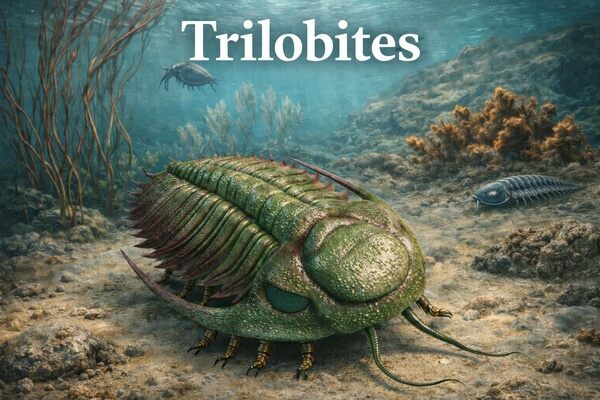
Trilobites were a very diverse group of extinct marine arthropods. They first appeared in the fossil record in the Early Cambrian (521 million years ago) and went extinct during the Permian mass extinction (250 million years ago). They were one of the most successful of the early animals on our planet: over 25,000 species have been described, filling nearly every evolutionary niche. Due in large part to their hard exoskeletons (shells), they left an excellent fossil record.
Trilobites were a very diverse group of extinct marine arthropods. They first appeared in the fossil record in the Early Cambrian (521 million years ago) and went extinct during the Permian mass extinction (250 million years ago). They were one of the most successful of the early animals on our planet: over 25,000 species have been described, filling nearly every evolutionary niche. Due in large part to their hard exoskeletons (shells), they left an excellent fossil record.
$2,450
SPECIES
Longianda termieri (Neltner & Poctey, 1950)

LOCATION
Issafen, Morocco
FORMATION
Issafen Formation
SIZE
Rock 8 x 6.3" Larger Trilobite 5.3" long
CATEGORY
SUB CATEGORY
ITEM
#381635
We guarantee the authenticity of all of our specimens.


