Reviews

Citrine Imitated - Burnt Amethyst, Golden Marketing
Citrine has long carried a quiet mystique. Unlike its purple sibling amethyst—abundant, showy, and familiar—natural citrine is a genuine geological rarity. Yet today, the global crystal market tells a different story. Online listings overflow with fiery orange citrine points, citrine clusters by the kilo, and massive citrine “cathedral” geodes taller than a toddler. The sheer volume alone raises an uncomfortable question for anyone who understands quartz chemistry: How could something rare be this common?
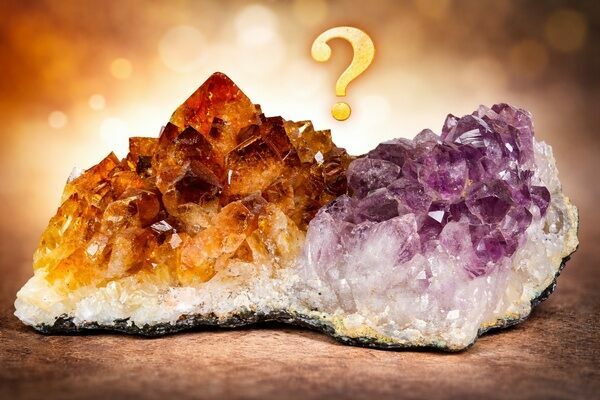
An amethyst cluster where one side has been heated in a furnace to produce artificial "citrine"
The answer is less magical than marketing copy suggests. Most commercial citrine on the market did not form golden in the earth. It began life as amethyst, later transformed by human intervention. When heated to temperatures typically between 400–560 °C, the iron-linked color centers that once produced purple rearrange, oxidize, and shift. The result is quartz that turns shades of yellow, amber, orange, or brown—often stunning, often dramatic, and almost always misidentified in the retail trade. While heat-treated quartz is widely accepted in the gem world when disclosed honestly, the mineral specimen market has been far less disciplined. In many cases, heat-treated amethyst is not merely recolored, but relabeled entirely—sold as “natural citrine,” most frequently tied to Brazil, where amethyst deposits are among the largest on the planet.
Brazil produces so much amethyst that entire export industries grew around slicing, polishing, and selling geodes and crystal clusters at scale. But Brazil is not a major source of naturally yellow quartz. Instead, amethyst from these basalt-hosted cavities is routinely loaded into industrial kilns, baked until the interior shifts color, cooled, and then reintroduced to the market with a new identity. Because both amethyst and citrine are quartz (SiO₂), laboratories can confirm the mineral species but cannot always prove whether the yellow color is geologic or thermal in origin without advanced spectroscopic work. That ambiguity became oxygen for mislabeling, and the market inflated around it.
To understand citrine’s scarcity, you have to rewind to the moment quartz crystallizes. Quartz is born colorless. Its personality—purple, smoky, or yellow—comes later, determined by trace elements, irradiation, and the thermal history locked into its atomic structure. Amethyst forms when iron impurities interact with natural radiation in the host rock, creating stable purple color centers. Smoky quartz forms under slightly different defect structures, producing gray-brown tones. Natural citrine forms only when those iron centers evolve along a very specific pathway, often involving mild natural heating or prolonged exposure to low-dose radiation that favors yellow coloration without tipping into the amethyst or smoky quartz spectrum.
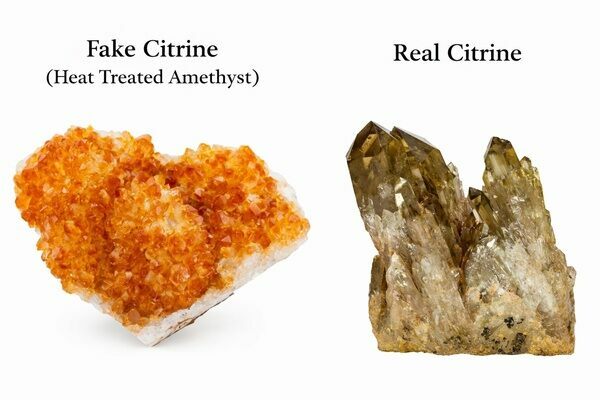
Fake Citrine On The Left, Real Citrine Crystals On The Right
The geological environments that create that balance are uncommon. They lack the enormous basalt-geode infrastructure that mass-produces amethyst. They also require slower, steadier iron oxidation states and color center stability. And even when citrine does form naturally, it often does so with restraint—soft lemon, pale gold, or gentle champagne hues rather than the vivid orange flames the commercial market has conditioned consumers to expect. The brightest oranges that people associate with citrine are, ironically, the least common colors for citrine to form as in nature.
Once you know what to look for, heat-treated amethyst is difficult to unsee. The color tends to look cooked—not merely saturated, but singed, like crystalized honey taken too far on the stove. Many points show a stark gradient: milky white or clear at the base, turning abruptly orange or reddish-brown near the tips. The transformation isn’t random. In amethyst, the iron concentration is often stronger toward the terminations, so those areas shift most dramatically when heated. The result mimics a dip-dyed effect that rarely appears in natural citrine.
Clusters reveal similar clues. The pieces interlock like typical amethyst growth habits, but carry colors that look caramel-toasted rather than naturally golden. And the most misleading form of all—the towering citrine cathedrals seen in metaphysical shops—are almost never citrine. They are amethyst geodes that have been heated until their interiors glow amber-orange, sometimes so uniformly that the original purple is erased entirely. True citrine geodes of that scale do exist, but they are niche collector pieces, not commercial staples, and they do not fill warehouses by the pallet.
The science of identification blends mineral literacy with color realism. Natural citrine’s palette is typically quieter and more uniform, even when smoky tones are present. It lacks the burnt-orange harshness and abrupt tip zoning common in heat-treated points. Natural crystals also tend to appear in limited quantities, with prices that reflect their rarity, especially when clarity and saturation are high.
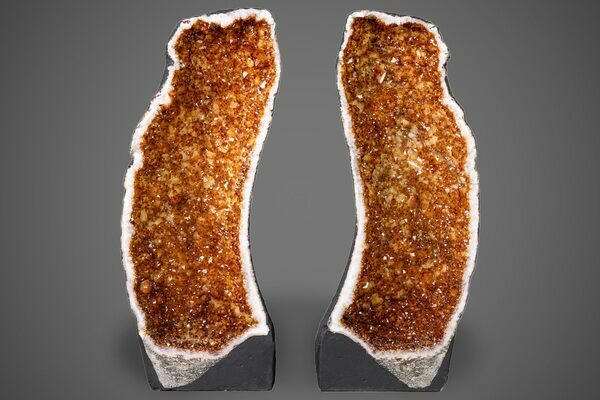
A heat-treated amethyst "Citrine" cathedral geode from Brazil. We sold this a few years ago, but it was properly disclosed.
Treated amethyst, on the other hand, is marked by excess—excess availability, excess consistency, and excess color intensity. The tones often drift toward reddish-brown, brick orange, or dark tea colors that the earth almost never produces in quartz without heat. And because the material is plentiful, pricing frequently undercuts what natural citrine should command in the mineral trade.
Ethics ultimately draw the hardest line. A seller who knows their material should disclose treatment clearly. Honest labeling doesn’t diminish beauty—it preserves trust. Heat-treated amethyst can be sold proudly as citrine-colored quartz, appreciated for what it is: a controlled transformation of a common mineral into a color the market adores. The problem was never the heating. It was the storytelling. The market simply told the wrong one.
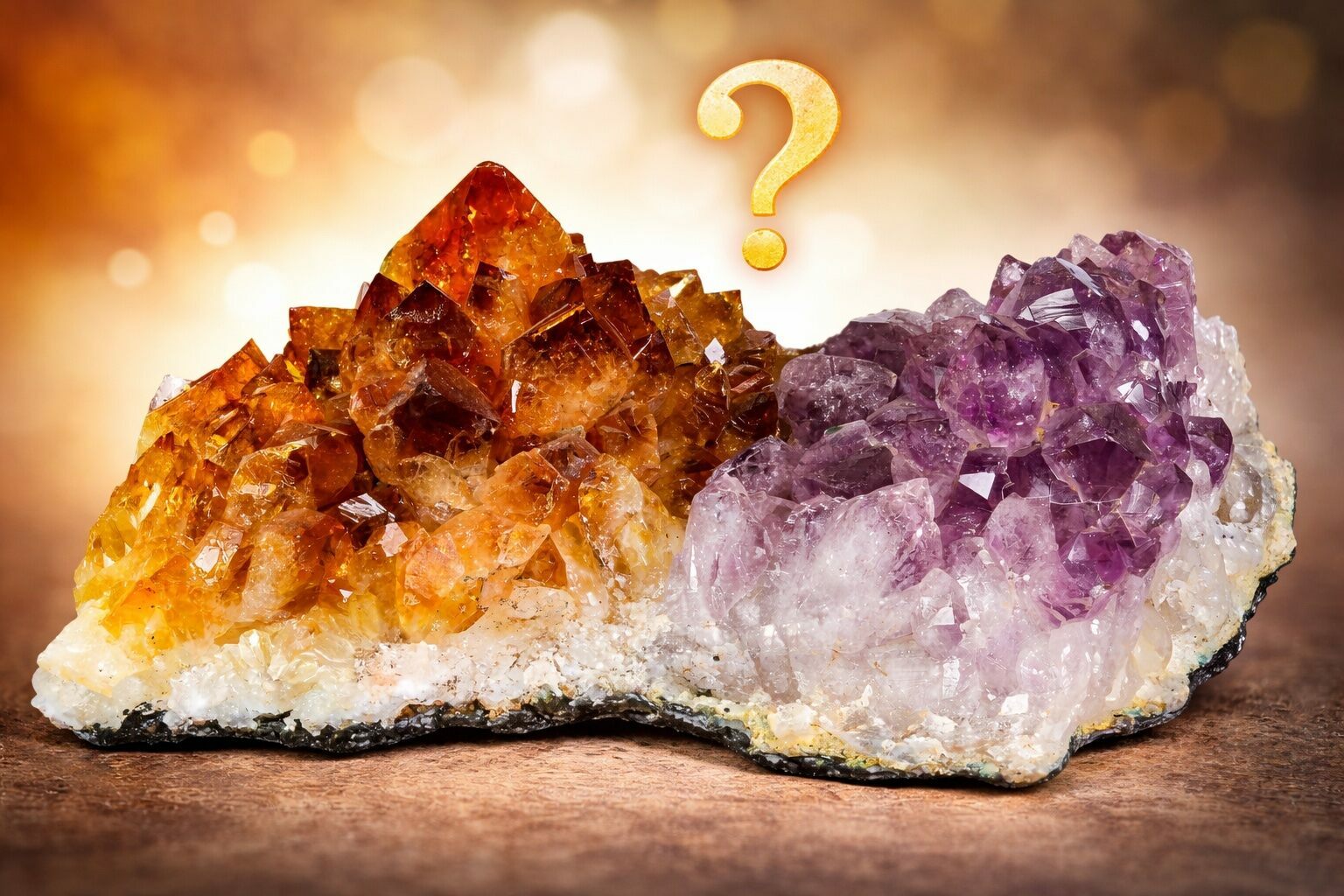
An amethyst cluster where one side has been heated in a furnace to produce artificial "citrine"
The answer is less magical than marketing copy suggests. Most commercial citrine on the market did not form golden in the earth. It began life as amethyst, later transformed by human intervention. When heated to temperatures typically between 400–560 °C, the iron-linked color centers that once produced purple rearrange, oxidize, and shift. The result is quartz that turns shades of yellow, amber, orange, or brown—often stunning, often dramatic, and almost always misidentified in the retail trade. While heat-treated quartz is widely accepted in the gem world when disclosed honestly, the mineral specimen market has been far less disciplined. In many cases, heat-treated amethyst is not merely recolored, but relabeled entirely—sold as “natural citrine,” most frequently tied to Brazil, where amethyst deposits are among the largest on the planet.
Brazil produces so much amethyst that entire export industries grew around slicing, polishing, and selling geodes and crystal clusters at scale. But Brazil is not a major source of naturally yellow quartz. Instead, amethyst from these basalt-hosted cavities is routinely loaded into industrial kilns, baked until the interior shifts color, cooled, and then reintroduced to the market with a new identity. Because both amethyst and citrine are quartz (SiO₂), laboratories can confirm the mineral species but cannot always prove whether the yellow color is geologic or thermal in origin without advanced spectroscopic work. That ambiguity became oxygen for mislabeling, and the market inflated around it.
Why Natural Citrine Forms So Differently From Amethyst
To understand citrine’s scarcity, you have to rewind to the moment quartz crystallizes. Quartz is born colorless. Its personality—purple, smoky, or yellow—comes later, determined by trace elements, irradiation, and the thermal history locked into its atomic structure. Amethyst forms when iron impurities interact with natural radiation in the host rock, creating stable purple color centers. Smoky quartz forms under slightly different defect structures, producing gray-brown tones. Natural citrine forms only when those iron centers evolve along a very specific pathway, often involving mild natural heating or prolonged exposure to low-dose radiation that favors yellow coloration without tipping into the amethyst or smoky quartz spectrum.
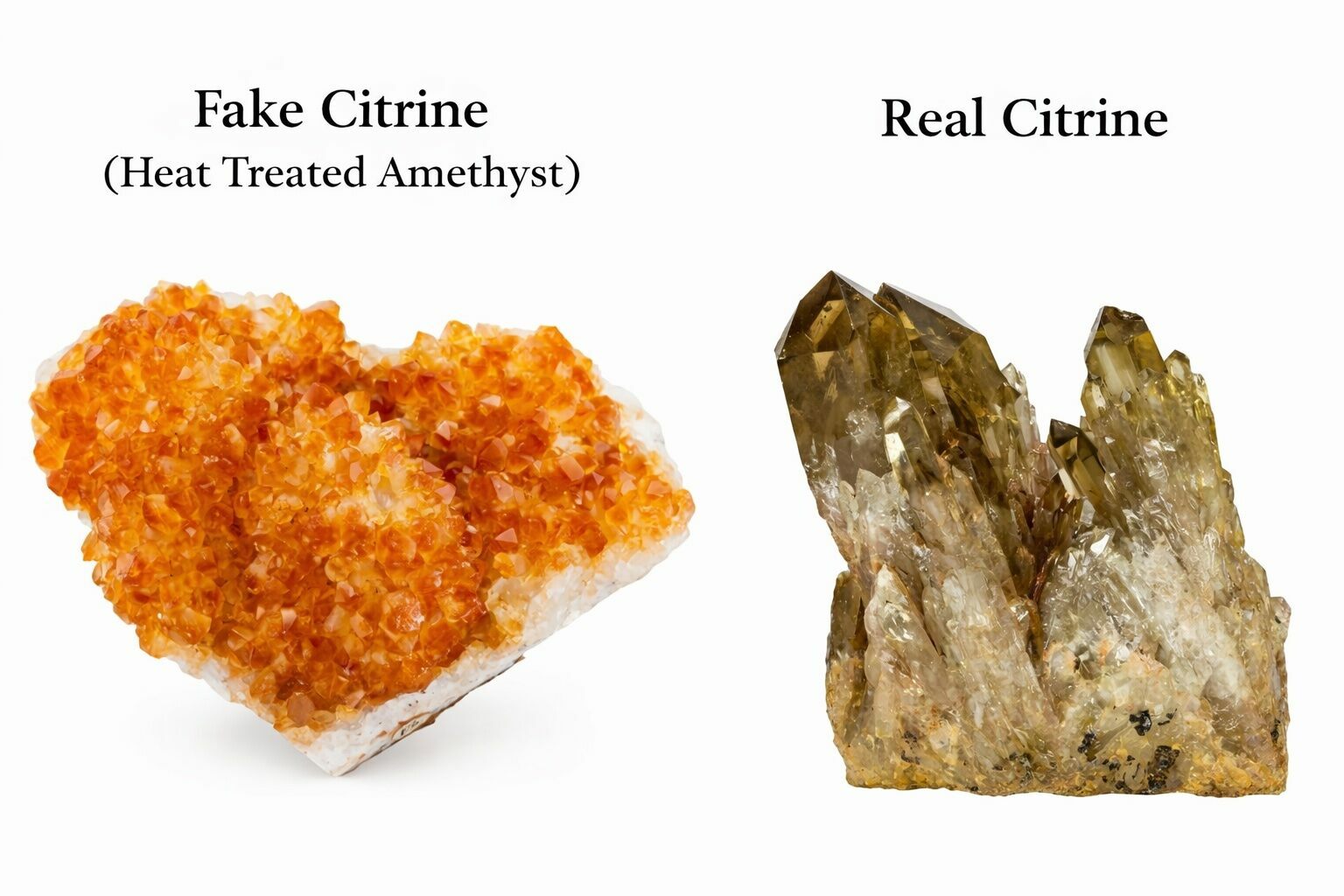
Fake Citrine On The Left, Real Citrine Crystals On The Right
The geological environments that create that balance are uncommon. They lack the enormous basalt-geode infrastructure that mass-produces amethyst. They also require slower, steadier iron oxidation states and color center stability. And even when citrine does form naturally, it often does so with restraint—soft lemon, pale gold, or gentle champagne hues rather than the vivid orange flames the commercial market has conditioned consumers to expect. The brightest oranges that people associate with citrine are, ironically, the least common colors for citrine to form as in nature.
The Visual Signature of Heat-Treated Amethyst
Once you know what to look for, heat-treated amethyst is difficult to unsee. The color tends to look cooked—not merely saturated, but singed, like crystalized honey taken too far on the stove. Many points show a stark gradient: milky white or clear at the base, turning abruptly orange or reddish-brown near the tips. The transformation isn’t random. In amethyst, the iron concentration is often stronger toward the terminations, so those areas shift most dramatically when heated. The result mimics a dip-dyed effect that rarely appears in natural citrine.
Clusters reveal similar clues. The pieces interlock like typical amethyst growth habits, but carry colors that look caramel-toasted rather than naturally golden. And the most misleading form of all—the towering citrine cathedrals seen in metaphysical shops—are almost never citrine. They are amethyst geodes that have been heated until their interiors glow amber-orange, sometimes so uniformly that the original purple is erased entirely. True citrine geodes of that scale do exist, but they are niche collector pieces, not commercial staples, and they do not fill warehouses by the pallet.
How to Tell the Difference
The science of identification blends mineral literacy with color realism. Natural citrine’s palette is typically quieter and more uniform, even when smoky tones are present. It lacks the burnt-orange harshness and abrupt tip zoning common in heat-treated points. Natural crystals also tend to appear in limited quantities, with prices that reflect their rarity, especially when clarity and saturation are high.
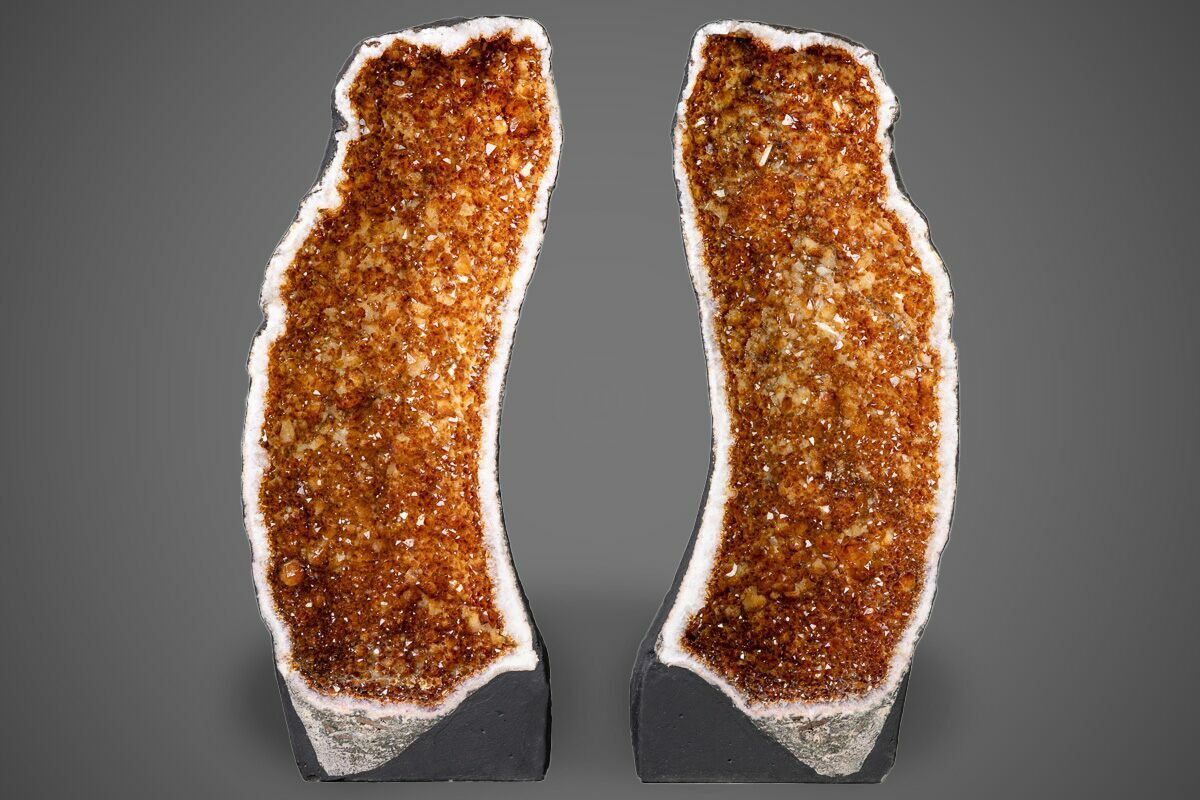
A heat-treated amethyst "Citrine" cathedral geode from Brazil. We sold this a few years ago, but it was properly disclosed.
Treated amethyst, on the other hand, is marked by excess—excess availability, excess consistency, and excess color intensity. The tones often drift toward reddish-brown, brick orange, or dark tea colors that the earth almost never produces in quartz without heat. And because the material is plentiful, pricing frequently undercuts what natural citrine should command in the mineral trade.
Ethics ultimately draw the hardest line. A seller who knows their material should disclose treatment clearly. Honest labeling doesn’t diminish beauty—it preserves trust. Heat-treated amethyst can be sold proudly as citrine-colored quartz, appreciated for what it is: a controlled transformation of a common mineral into a color the market adores. The problem was never the heating. It was the storytelling. The market simply told the wrong one.