 Reviews

Citrine: Mineral & Crystal Guide
Citrine is one of those minerals almost everyone recognizes—warm golden color, glassy luster, and that unmistakable “honey” glow—yet almost everyone has unknowingly seen it misrepresented. It’s the yellow-to-orange variety of quartz (SiO₂), and it’s famous for being one of the few gemstones whose color naturally sits in the “sunlight” part of the spectrum rather than blues/greens/purples. But here’s the twist: natural citrine is relatively uncommon compared to how much “citrine” is sold worldwide. Most of the bright orange material in jewelry cases didn’t form that way in the Earth—it was heated on purpose, usually starting life as amethyst.
Citrine also has a “geologic personality” that’s easy to overlook. Quartz is everywhere, but citrine’s color is picky: it depends on trace iron and how that iron is arranged in the crystal lattice (and how it’s been altered by heat and radiation over time). That’s why truly natural citrine tends to appear in more restrained tones—pale champagne, smoky yellow, or gentle honey—while the loud, burnt-orange stuff often has a more artificial origin story.
And despite its modern popularity, citrine’s appeal is ancient: the stone’s name comes from the French citron (“lemon”), and it has cycled through eras as an ornamental gem, a durable signet stone, and later a mass-market jewelry favorite once large quartz deposits became globally traded.
Citrine mineral properties
Mineral group: Quartz (silicate)
Chemical formula: SiO₂
Color: Pale yellow to golden, honey, orange-yellow; sometimes brownish (“Madeira” tones)
Crystal system: Trigonal (hexagonal-looking crystals are common)
Luster: Vitreous (glassy)
Transparency: Transparent to translucent
Hardness: 7 (Mohs)
Streak: White
Common habits: Prismatic hexagonal crystals; drusy linings; massive quartz in veins
Common associations: Amethyst, smoky quartz, rock crystal; chalcedony; fluorite, calcite, feldspar in some vein systems
The defining feature of citrine is not how quartz grows, but how its color survives. Quartz crystallizes easily in the Earth; yellow quartz does not. Citrine’s coloration comes from trace amounts of iron incorporated into the quartz lattice and, more importantly, from how that iron is altered by natural radiation and long-term geologic heating. The balance is delicate. Too little iron and the crystal remains colorless; too much, or arranged differently, and the quartz becomes smoky or amethyst instead. Citrine represents a narrow window where iron-related color centers absorb just enough of the visible spectrum to produce yellow and golden tones without drifting into brown or purple.
This narrow chemical and physical window is why natural citrine is far rarer than other quartz varieties. Amethyst forms readily when iron-bearing quartz is exposed to certain radiation conditions, while smoky quartz develops under different radiation regimes. Citrine requires iron in a specific oxidation state, combined with a thermal history that partially modifies those color centers naturally over geologic time, not suddenly or artificially. Many quartz crystals pass through temperature or radiation conditions that destroy or alter yellow coloration before it can stabilize, preventing citrine from forming or preserving its color.
When citrine does form, it grows through the same processes as other quartz—most commonly from silica-rich hydrothermal fluids circulating through fractures, veins, and cavities in rock. These fluids deposit quartz as they cool, sometimes producing well-formed prismatic crystals or drusy linings. In rare cases, the growing quartz experiences just the right chemical environment and slow, natural heating to develop and retain its yellow color. Pegmatites and granite-related hydrothermal systems can also host citrine, especially where iron is present but not abundant enough to favor darker quartz varieties.
Because these conditions are so restrictive, truly natural citrine tends to occur in subtle, restrained colors—pale champagne, soft honey, or light golden hues—rather than vivid orange. This rarity is the underlying reason most bright “citrine” on the market is actually heat-treated amethyst: nature simply does not produce large quantities of intensely colored citrine under normal geological conditions.
Because citrine is a variety of quartz, it appears worldwide—but not all sources produce the same look.
Brazil (Minas Gerais, Rio Grande do Sul): Major producer of quartz varieties; a significant amount of commercial citrine on the market is either natural or treated material sourced from Brazilian quartz deposits.
Madagascar: Known for attractive, often cleaner quartz crystals and gem rough; natural citrine is reported from multiple regions.
Zambia: Produces notable quartz varieties; African citrine often shows pleasant honey tones.
Russia (Ural region): Historically important for quartz gemstones, including yellow quartz varieties.
Spain: The name “citrine” has long European roots, and yellow quartz has been collected and traded in Europe for centuries.
Practical collector note: locality “citrine” is often muddied by treatment. If locality matters, buy from sellers who explicitly disclose natural vs. heat-treated citrine.
Citrine’s story is tied to the long human habit of valuing materials that look like sunlight. In early gem trade, “citrine” wasn’t always a strictly scientific label; it was a color description applied to yellowish transparent stones—sometimes quartz, sometimes other minerals—because pre-modern classification cared more about appearance than chemistry. As mineralogy matured and quartz varieties became better defined, citrine settled into its modern identity: yellow quartz, distinct from amethyst and smoky quartz, but related by structure and chemistry.
In jewelry, citrine has always had an advantage that has nothing to do with rarity: it’s tough. A hardness of 7 and lack of cleavage make it forgiving to wear compared with many more delicate gems. That durability helped it thrive as a practical stone for rings, pendants, and carved items. It also takes a polish beautifully, so it became a favorite for faceted stones, cabochons, and decorative carvings.
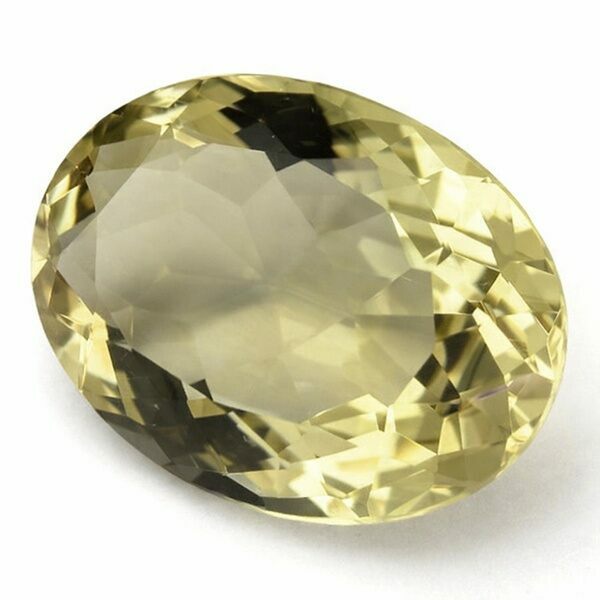
A faceted, natural citrine gemstone.
By the 19th and early 20th centuries, citrine found a strong footing in Western jewelry fashion—often set in gold to amplify its warmth. The Art Deco period loved clean geometry and strong color contrasts; citrine, with its bright “golden glass” look, fit right in. In the modern era, citrine became a staple “friendly luxury” gem: affordable compared to many precious stones, available in large sizes, and instantly legible to a casual buyer (“that’s the golden one”). It’s also widely used in beads, tumbled stones, and decorative crystal displays—thanks to quartz’s abundance and the ease of cutting and shaping it.
One of the most important things to understand about citrine is that a large percentage of what is sold under that name did not form as citrine in nature. Instead, it began as amethyst, the purple variety of quartz, which was later heated—usually to several hundred degrees Celsius—to change its color from purple to yellow or orange-brown. The result is still genuine quartz, but the color is artificial in the sense that it was produced intentionally and rapidly, rather than developing slowly through natural geological processes. Because natural citrine is relatively uncommon, this treatment has become widespread and is largely responsible for the abundance of intensely colored “citrine” seen in jewelry stores and crystal shops.
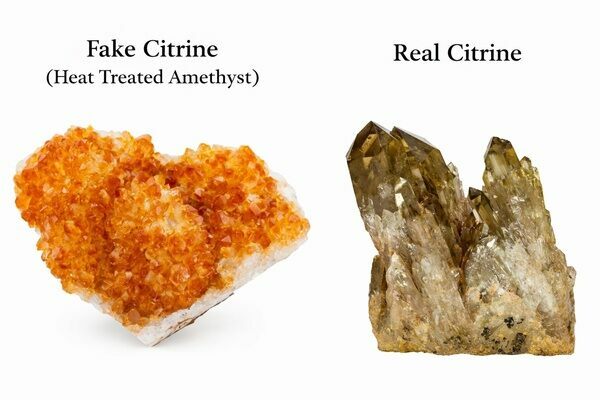
Heat-Treated Amethyst On The Left, Natural Citrine On The Right
Heat-treated amethyst often has a noticeably different appearance from natural citrine. The color is commonly a strong burnt orange, reddish-brown, or toasted tone rather than the softer champagne and honey hues typical of natural material. In crystal clusters and geodes, the color may appear concentrated toward the tips of the crystals or uneven across the specimen. This is especially evident in many so-called citrine cathedrals, which are frequently amethyst geodes that have been heated after mining. While attractive, these pieces do not reflect how citrine normally occurs in the Earth.
This distinction matters most in how the material is described and sold. There is nothing inherently wrong with heat-treated quartz, but it should be disclosed honestly as heated amethyst or treated quartz, not simply labeled as natural citrine. Collectors and informed buyers value transparency, particularly because true natural citrine tends to show subtler coloration and is far less common. Understanding this difference helps explain why pale, naturally colored citrine is scarcer and often more prized than the vividly orange material that dominates the commercial market.

Citrine also has a “geologic personality” that’s easy to overlook. Quartz is everywhere, but citrine’s color is picky: it depends on trace iron and how that iron is arranged in the crystal lattice (and how it’s been altered by heat and radiation over time). That’s why truly natural citrine tends to appear in more restrained tones—pale champagne, smoky yellow, or gentle honey—while the loud, burnt-orange stuff often has a more artificial origin story.
And despite its modern popularity, citrine’s appeal is ancient: the stone’s name comes from the French citron (“lemon”), and it has cycled through eras as an ornamental gem, a durable signet stone, and later a mass-market jewelry favorite once large quartz deposits became globally traded.
Citrine mineral properties
Mineral group: Quartz (silicate)
Chemical formula: SiO₂
Color: Pale yellow to golden, honey, orange-yellow; sometimes brownish (“Madeira” tones)
Crystal system: Trigonal (hexagonal-looking crystals are common)
Luster: Vitreous (glassy)
Transparency: Transparent to translucent
Hardness: 7 (Mohs)
Streak: White
Common habits: Prismatic hexagonal crystals; drusy linings; massive quartz in veins
Common associations: Amethyst, smoky quartz, rock crystal; chalcedony; fluorite, calcite, feldspar in some vein systems
How Citrine Forms — Why Natural Citrine Is Uncommon
The defining feature of citrine is not how quartz grows, but how its color survives. Quartz crystallizes easily in the Earth; yellow quartz does not. Citrine’s coloration comes from trace amounts of iron incorporated into the quartz lattice and, more importantly, from how that iron is altered by natural radiation and long-term geologic heating. The balance is delicate. Too little iron and the crystal remains colorless; too much, or arranged differently, and the quartz becomes smoky or amethyst instead. Citrine represents a narrow window where iron-related color centers absorb just enough of the visible spectrum to produce yellow and golden tones without drifting into brown or purple.
This narrow chemical and physical window is why natural citrine is far rarer than other quartz varieties. Amethyst forms readily when iron-bearing quartz is exposed to certain radiation conditions, while smoky quartz develops under different radiation regimes. Citrine requires iron in a specific oxidation state, combined with a thermal history that partially modifies those color centers naturally over geologic time, not suddenly or artificially. Many quartz crystals pass through temperature or radiation conditions that destroy or alter yellow coloration before it can stabilize, preventing citrine from forming or preserving its color.
When citrine does form, it grows through the same processes as other quartz—most commonly from silica-rich hydrothermal fluids circulating through fractures, veins, and cavities in rock. These fluids deposit quartz as they cool, sometimes producing well-formed prismatic crystals or drusy linings. In rare cases, the growing quartz experiences just the right chemical environment and slow, natural heating to develop and retain its yellow color. Pegmatites and granite-related hydrothermal systems can also host citrine, especially where iron is present but not abundant enough to favor darker quartz varieties.
Because these conditions are so restrictive, truly natural citrine tends to occur in subtle, restrained colors—pale champagne, soft honey, or light golden hues—rather than vivid orange. This rarity is the underlying reason most bright “citrine” on the market is actually heat-treated amethyst: nature simply does not produce large quantities of intensely colored citrine under normal geological conditions.
Key lLcalities
Because citrine is a variety of quartz, it appears worldwide—but not all sources produce the same look.
Brazil (Minas Gerais, Rio Grande do Sul): Major producer of quartz varieties; a significant amount of commercial citrine on the market is either natural or treated material sourced from Brazilian quartz deposits.
Madagascar: Known for attractive, often cleaner quartz crystals and gem rough; natural citrine is reported from multiple regions.
Zambia: Produces notable quartz varieties; African citrine often shows pleasant honey tones.
Russia (Ural region): Historically important for quartz gemstones, including yellow quartz varieties.
Spain: The name “citrine” has long European roots, and yellow quartz has been collected and traded in Europe for centuries.
Practical collector note: locality “citrine” is often muddied by treatment. If locality matters, buy from sellers who explicitly disclose natural vs. heat-treated citrine.
History And Uses
Citrine’s story is tied to the long human habit of valuing materials that look like sunlight. In early gem trade, “citrine” wasn’t always a strictly scientific label; it was a color description applied to yellowish transparent stones—sometimes quartz, sometimes other minerals—because pre-modern classification cared more about appearance than chemistry. As mineralogy matured and quartz varieties became better defined, citrine settled into its modern identity: yellow quartz, distinct from amethyst and smoky quartz, but related by structure and chemistry.
In jewelry, citrine has always had an advantage that has nothing to do with rarity: it’s tough. A hardness of 7 and lack of cleavage make it forgiving to wear compared with many more delicate gems. That durability helped it thrive as a practical stone for rings, pendants, and carved items. It also takes a polish beautifully, so it became a favorite for faceted stones, cabochons, and decorative carvings.
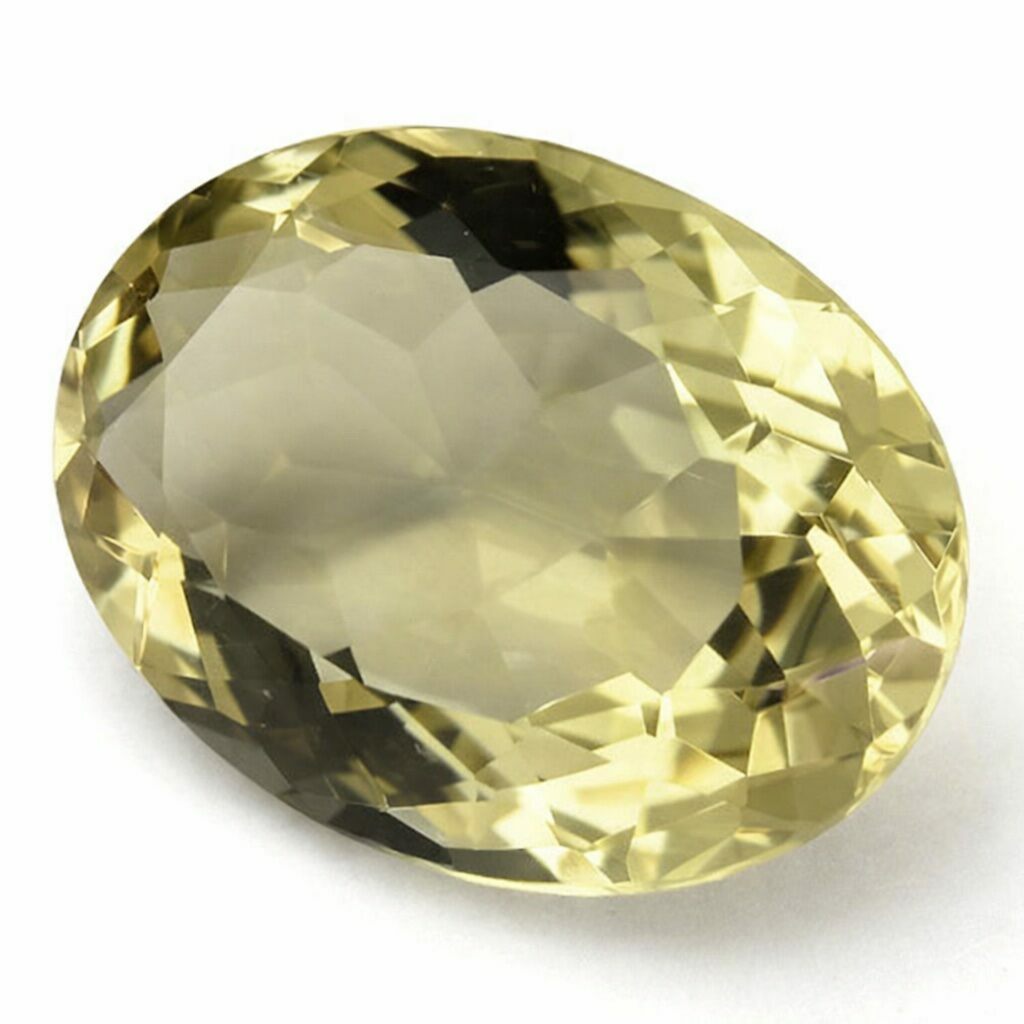
A faceted, natural citrine gemstone.
By the 19th and early 20th centuries, citrine found a strong footing in Western jewelry fashion—often set in gold to amplify its warmth. The Art Deco period loved clean geometry and strong color contrasts; citrine, with its bright “golden glass” look, fit right in. In the modern era, citrine became a staple “friendly luxury” gem: affordable compared to many precious stones, available in large sizes, and instantly legible to a casual buyer (“that’s the golden one”). It’s also widely used in beads, tumbled stones, and decorative crystal displays—thanks to quartz’s abundance and the ease of cutting and shaping it.
Natural Citrine Vs. Heat-Treated Amethyst
One of the most important things to understand about citrine is that a large percentage of what is sold under that name did not form as citrine in nature. Instead, it began as amethyst, the purple variety of quartz, which was later heated—usually to several hundred degrees Celsius—to change its color from purple to yellow or orange-brown. The result is still genuine quartz, but the color is artificial in the sense that it was produced intentionally and rapidly, rather than developing slowly through natural geological processes. Because natural citrine is relatively uncommon, this treatment has become widespread and is largely responsible for the abundance of intensely colored “citrine” seen in jewelry stores and crystal shops.
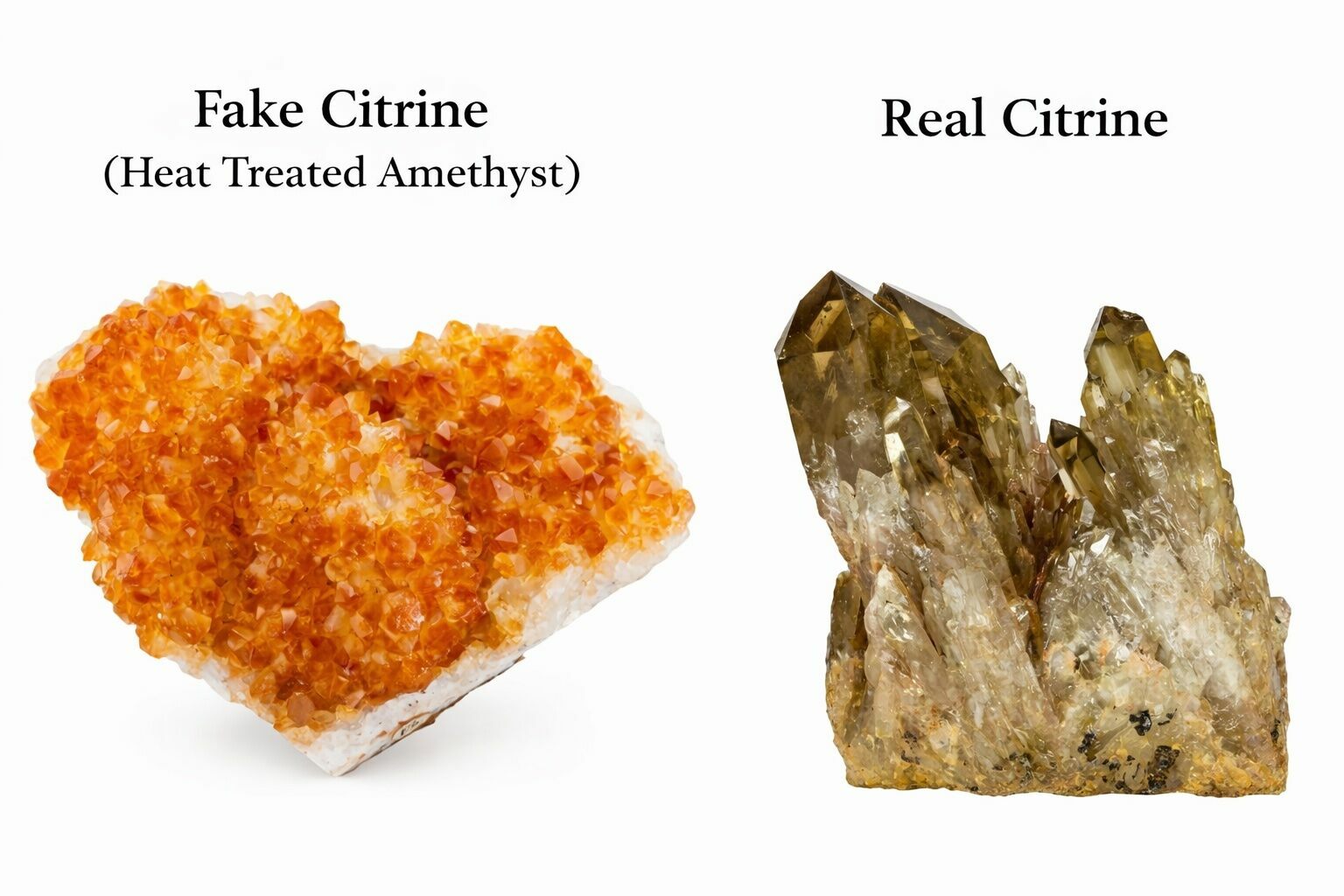
Heat-Treated Amethyst On The Left, Natural Citrine On The Right
Heat-treated amethyst often has a noticeably different appearance from natural citrine. The color is commonly a strong burnt orange, reddish-brown, or toasted tone rather than the softer champagne and honey hues typical of natural material. In crystal clusters and geodes, the color may appear concentrated toward the tips of the crystals or uneven across the specimen. This is especially evident in many so-called citrine cathedrals, which are frequently amethyst geodes that have been heated after mining. While attractive, these pieces do not reflect how citrine normally occurs in the Earth.
This distinction matters most in how the material is described and sold. There is nothing inherently wrong with heat-treated quartz, but it should be disclosed honestly as heated amethyst or treated quartz, not simply labeled as natural citrine. Collectors and informed buyers value transparency, particularly because true natural citrine tends to show subtler coloration and is far less common. Understanding this difference helps explain why pale, naturally colored citrine is scarcer and often more prized than the vividly orange material that dominates the commercial market.