 Reviews

Uruguay’s Giant Amethyst Geodes: A New Origin Story
In the rolling basaltic landscapes of northern Uruguay, ancient stones hold a story that spans continents and millions of years. These are the famed amethyst geodes—some standing taller than a person, others the size of a small room—lined with rich violet quartz crystals that have captivated gem lovers, miners, and scientists alike. For generations, miners and rockhounds have known where some of these treasures lie, but the why and how of their formation remained elusive… until now.
The volcanic rocks hosting Uruguay’s amethyst geodes are not recent. They formed roughly 134 million years ago, during the breakup of the ancient supercontinent Gondwana, when massive lava flows covered what is now parts of Brazil, Uruguay, and beyond. As the lava poured out and cooled into basalt, countless gas bubbles and cavities were trapped within the dark rock. These hollow spaces would give rise, much later, to the geodes that now fetch premium prices and scientific fascination.
But the leap from an ordinary lava rock to a cavern full of shimmering purple crystals is not a simple one. For years, geologists debated whether these crystals formed from hot magmatic fluids expelled from cooling lava or from much cooler, circulating groundwater. The debate was, in part, fueled by the remarkable size of some geodes—evidence that they collected an astonishing volume of mineral-rich fluids over time.
The breakthrough came when scientists from the University of Göttingen and collaborators applied cutting-edge analytical techniques to study not just the crystals themselves, but the fluids trapped inside microscopic inclusions in the minerals and the chemical signatures left behind. By sampling fluid inclusions—the tiny pockets of liquid that were sealed in as the crystals grew—and measuring oxygen isotopes and salinity, researchers could effectively read a record of the water that once flowed through these rocks.
To their surprise, the results told a story quite unlike classic models of high-temperature hydrothermal activity. Instead of forming from hot, steam-like fluids escaping from cooling magma, the data showed that the amethyst crystals precipitated from relatively cool, freshwater-like solutions at temperatures between about 15 °C and 60 °C—temperatures closer to modern groundwater than deep-buried volcanic systems.
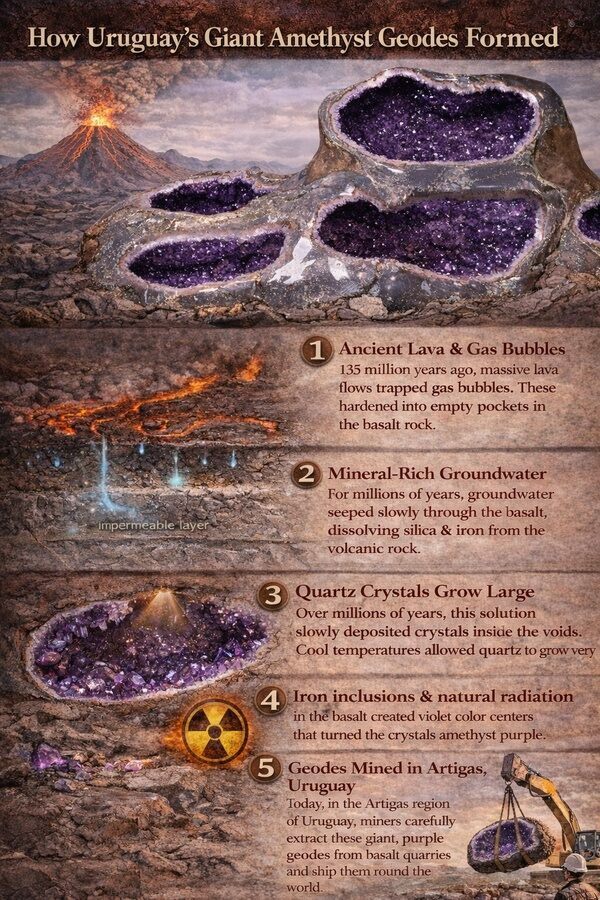
Infographic - Uruguay Amethyst Geode Formation
So how did this groundwater get inside the solid basalt and then enrich itself enough to grow crystals? The proposed model suggests a process that is patient rather than explosive—a slow and steady percolation of meteoric water (ancient rain and surface water) through cracks, fractures, and pore spaces in the volcanic rock over millions of years. As this groundwater circulated, it gradually dissolved silica and trace iron from the surrounding basalt. The iron, though present in tiny amounts, is crucial because its oxidation state and incorporation into quartz gives amethyst its signature violet hue.
An impermeable layer in the subsurface—a sort of geological dam—forced these silica-rich, iron-bearing waters into pre-existing cavities. Within these sheltered voids, shielded from high heat and pressure, the conditions were just right for quartz to begin crystallizing on the cavity walls. Over time, as more water flowed in and conditions remained relatively stable, layers of chalcedony, calcite, and finally amethyst built up, forming the large, glittering crystals that draw attention today.
One of the most striking findings of this research is just how cool the formation environment was. For decades, models of mineral crystallization in volcanic rocks assumed relatively high temperatures—hundreds of degrees Celsius at least. But the new evidence points to low-temperature crystallization, a scenario more consistent with groundwater flow than with deep magmatic plumbing. These cooler conditions would allow large, well-formed crystals to grow more slowly and with fewer defects, contributing to the remarkable clarity and color quality that Uruguayan amethysts are known for.
Amethyst still gets its color from trace iron inclusions incorporated during quartz growth, but the coloration process itself was secondary to the real geological marvel: the crystals’ formation environment. While basalt radiation contributed to color activation over geological time, the defining story of Uruguay’s geodes is not their irradiation—it is their low-temperature, slow-flow birth from cool groundwater, preserved inside volcanic cavities that never experienced the thermal violence of classic hydrothermal gem systems.
Long after the geodes formed in their quiet volcanic tombs, the story shifts from natural history to human industry. Northern Uruguay’s amethyst deposits are concentrated primarily in the Artigas region, near the Brazilian border, where the same ancient basalt flows of the Paraná volcanic province extend across modern political boundaries. The first commercial geode discoveries were almost accidental—revealed when basalt was quarried for road metal, agriculture, and construction. Workers splitting dense volcanic rock began encountering hollow pockets lined with quartz. Most were unremarkable at first, but some cavities held crystals of extraordinary size and color, signaling the birth of a new mining economy.
Modern geode mining in Uruguay is now a hybrid of basalt quarrying and gemstone extraction. Miners do not tunnel underground like classic hard-rock gem operations. Instead, they remove massive sections of basalt from open pits using excavators, hydraulic breakers, controlled expansion wedges, and occasionally small, highly strategic explosive charges designed to fracture rock without shattering the cavities inside. This is a delicate balance—because while basalt is one of the toughest rocks to mine, geodes are by nature voids, making them structurally fragile. Experienced quarry operators learn to “read” subtle geological clues: discoloration zones, silica-sealed fractures, minor vesicle alignments, and thin calcite horizons that sometimes indicate proximity to geode-rich pockets.
When a large cavity is intercepted, work slows dramatically. The rock around the geode is not immediately broken apart. Instead, miners carve out a protective perimeter, extracting the entire geode still encased in its host rock when possible. Smaller geodes can be removed intact, but the giant cathedral-style geodes—some weighing hundreds of kilograms to multiple tons—often require extraction in reinforced basalt shells, then transported out of the quarry using cranes, loaders, or forklifts fitted with suspension harnesses. Once removed, geodes are wrapped, braced, or crated on site to survive transport. In many cases, the surrounding basalt later becomes part of the display base for the geode itself, adding stability and aesthetic contrast between the black volcanic rock and purple crystal interior.
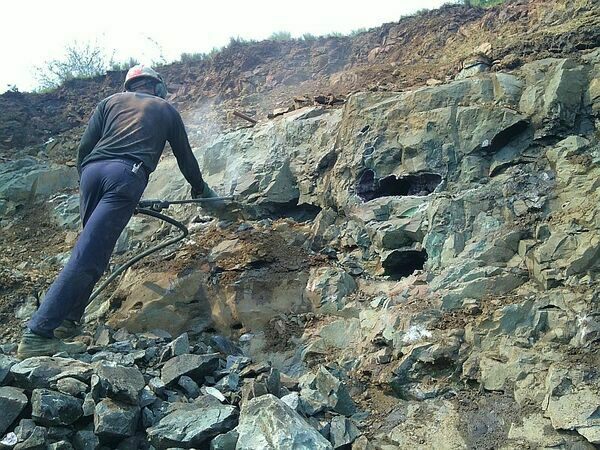
Amethyst geodes being mined near Artigas. Uruguay
Unlike mass-market amethyst from large industrial crystal mines, Uruguay’s giant geodes are mined in relatively low annual volumes, not due to lack of demand, but due to rarity and preservation difficulty. The cavities capable of producing cathedral geodes are unevenly distributed and unpredictable, meaning most mining is still opportunistic rather than fully deterministic. Once extracted, geodes move through several commercial stages:
Stabilization & cutting — Many giant geodes are sliced open using diamond-tipped rock saws, often off-site, because the cutting process itself can induce vibration fractures if not done with slow precision.
Preparation & cleaning — Interiors are cleared of clay, calcite debris, or secondary mineral overgrowth. Some crystals may be left natural; others are lightly prepared to remove distracting matrix without altering the geode’s authenticity.
Export & distribution — Uruguay has become a key global supplier to the premium specimen market, shipping geodes to North America, Europe, the Middle East, and Asia. Artigas-mined geodes frequently enter international markets via Brazilian export hubs, mineral shows, or direct contracts with retailers and collectors.
The amethyst trade has become a major commercial identity for Artigas. Local mining companies often operate as family-owned quarry enterprises, some expanding into geode tourism, factory prep workshops, and direct-to-collector sales. Uruguay’s mining sector benefits not just from the geodes themselves, but from the value-added ecosystem surrounding them—preparation, international trade, logistics, and marketing of Uruguay as a source of world-class purple quartz. This has allowed the country to compete in a gemstone category typically dominated by Brazil, by specializing in a niche Brazil does not reliably supply: giant, display-grade amethyst geodes with deep color and dramatic architecture.

A Volcanic Time Capsule Preserved In Basalt
The volcanic rocks hosting Uruguay’s amethyst geodes are not recent. They formed roughly 134 million years ago, during the breakup of the ancient supercontinent Gondwana, when massive lava flows covered what is now parts of Brazil, Uruguay, and beyond. As the lava poured out and cooled into basalt, countless gas bubbles and cavities were trapped within the dark rock. These hollow spaces would give rise, much later, to the geodes that now fetch premium prices and scientific fascination.
But the leap from an ordinary lava rock to a cavern full of shimmering purple crystals is not a simple one. For years, geologists debated whether these crystals formed from hot magmatic fluids expelled from cooling lava or from much cooler, circulating groundwater. The debate was, in part, fueled by the remarkable size of some geodes—evidence that they collected an astonishing volume of mineral-rich fluids over time.
Peering Into Ancient Waters: The New Evidence
The breakthrough came when scientists from the University of Göttingen and collaborators applied cutting-edge analytical techniques to study not just the crystals themselves, but the fluids trapped inside microscopic inclusions in the minerals and the chemical signatures left behind. By sampling fluid inclusions—the tiny pockets of liquid that were sealed in as the crystals grew—and measuring oxygen isotopes and salinity, researchers could effectively read a record of the water that once flowed through these rocks.
To their surprise, the results told a story quite unlike classic models of high-temperature hydrothermal activity. Instead of forming from hot, steam-like fluids escaping from cooling magma, the data showed that the amethyst crystals precipitated from relatively cool, freshwater-like solutions at temperatures between about 15 °C and 60 °C—temperatures closer to modern groundwater than deep-buried volcanic systems.
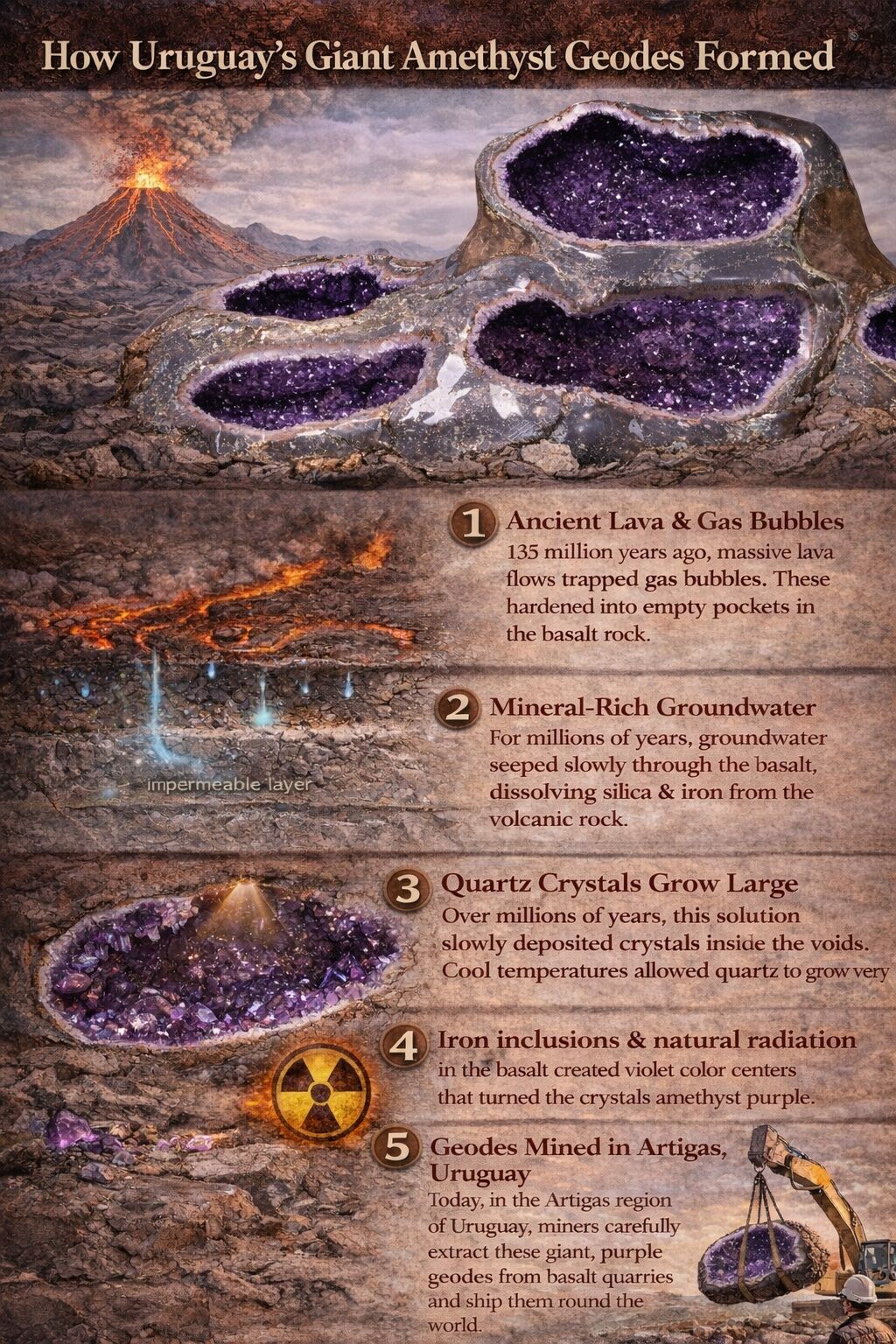
Infographic - Uruguay Amethyst Geode Formation
Rainwater’s Long Journey Underground
So how did this groundwater get inside the solid basalt and then enrich itself enough to grow crystals? The proposed model suggests a process that is patient rather than explosive—a slow and steady percolation of meteoric water (ancient rain and surface water) through cracks, fractures, and pore spaces in the volcanic rock over millions of years. As this groundwater circulated, it gradually dissolved silica and trace iron from the surrounding basalt. The iron, though present in tiny amounts, is crucial because its oxidation state and incorporation into quartz gives amethyst its signature violet hue.
An impermeable layer in the subsurface—a sort of geological dam—forced these silica-rich, iron-bearing waters into pre-existing cavities. Within these sheltered voids, shielded from high heat and pressure, the conditions were just right for quartz to begin crystallizing on the cavity walls. Over time, as more water flowed in and conditions remained relatively stable, layers of chalcedony, calcite, and finally amethyst built up, forming the large, glittering crystals that draw attention today.
Low Temperatures, High Rewards
One of the most striking findings of this research is just how cool the formation environment was. For decades, models of mineral crystallization in volcanic rocks assumed relatively high temperatures—hundreds of degrees Celsius at least. But the new evidence points to low-temperature crystallization, a scenario more consistent with groundwater flow than with deep magmatic plumbing. These cooler conditions would allow large, well-formed crystals to grow more slowly and with fewer defects, contributing to the remarkable clarity and color quality that Uruguayan amethysts are known for.
Amethyst still gets its color from trace iron inclusions incorporated during quartz growth, but the coloration process itself was secondary to the real geological marvel: the crystals’ formation environment. While basalt radiation contributed to color activation over geological time, the defining story of Uruguay’s geodes is not their irradiation—it is their low-temperature, slow-flow birth from cool groundwater, preserved inside volcanic cavities that never experienced the thermal violence of classic hydrothermal gem systems.
The Human Chapter: Mining Giant Amethyst Geodes from the Basalt
Long after the geodes formed in their quiet volcanic tombs, the story shifts from natural history to human industry. Northern Uruguay’s amethyst deposits are concentrated primarily in the Artigas region, near the Brazilian border, where the same ancient basalt flows of the Paraná volcanic province extend across modern political boundaries. The first commercial geode discoveries were almost accidental—revealed when basalt was quarried for road metal, agriculture, and construction. Workers splitting dense volcanic rock began encountering hollow pockets lined with quartz. Most were unremarkable at first, but some cavities held crystals of extraordinary size and color, signaling the birth of a new mining economy.
Modern geode mining in Uruguay is now a hybrid of basalt quarrying and gemstone extraction. Miners do not tunnel underground like classic hard-rock gem operations. Instead, they remove massive sections of basalt from open pits using excavators, hydraulic breakers, controlled expansion wedges, and occasionally small, highly strategic explosive charges designed to fracture rock without shattering the cavities inside. This is a delicate balance—because while basalt is one of the toughest rocks to mine, geodes are by nature voids, making them structurally fragile. Experienced quarry operators learn to “read” subtle geological clues: discoloration zones, silica-sealed fractures, minor vesicle alignments, and thin calcite horizons that sometimes indicate proximity to geode-rich pockets.
When a large cavity is intercepted, work slows dramatically. The rock around the geode is not immediately broken apart. Instead, miners carve out a protective perimeter, extracting the entire geode still encased in its host rock when possible. Smaller geodes can be removed intact, but the giant cathedral-style geodes—some weighing hundreds of kilograms to multiple tons—often require extraction in reinforced basalt shells, then transported out of the quarry using cranes, loaders, or forklifts fitted with suspension harnesses. Once removed, geodes are wrapped, braced, or crated on site to survive transport. In many cases, the surrounding basalt later becomes part of the display base for the geode itself, adding stability and aesthetic contrast between the black volcanic rock and purple crystal interior.
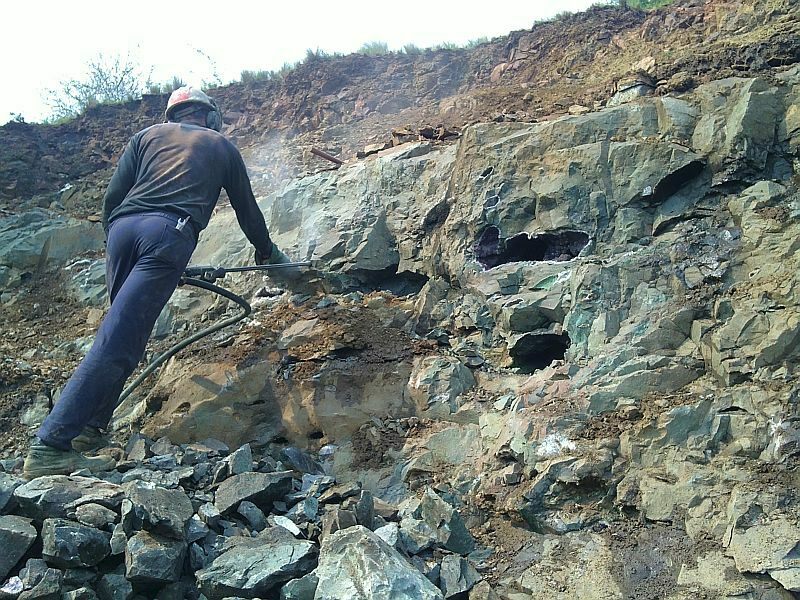
Amethyst geodes being mined near Artigas. Uruguay
A Specialized Supply Chain
Unlike mass-market amethyst from large industrial crystal mines, Uruguay’s giant geodes are mined in relatively low annual volumes, not due to lack of demand, but due to rarity and preservation difficulty. The cavities capable of producing cathedral geodes are unevenly distributed and unpredictable, meaning most mining is still opportunistic rather than fully deterministic. Once extracted, geodes move through several commercial stages:
The amethyst trade has become a major commercial identity for Artigas. Local mining companies often operate as family-owned quarry enterprises, some expanding into geode tourism, factory prep workshops, and direct-to-collector sales. Uruguay’s mining sector benefits not just from the geodes themselves, but from the value-added ecosystem surrounding them—preparation, international trade, logistics, and marketing of Uruguay as a source of world-class purple quartz. This has allowed the country to compete in a gemstone category typically dominated by Brazil, by specializing in a niche Brazil does not reliably supply: giant, display-grade amethyst geodes with deep color and dramatic architecture.


