 Reviews

Mutant Minerals: Nature’s Radiation-Colored Crystals
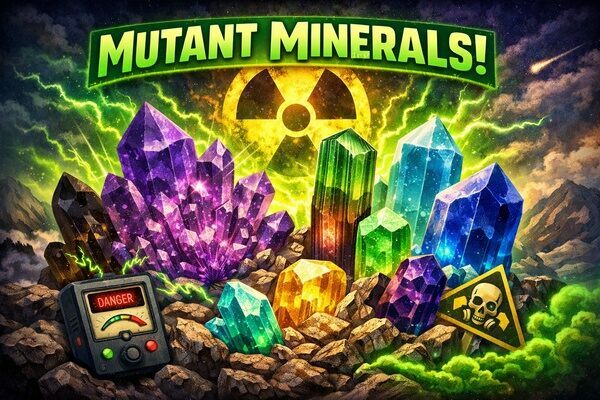
Deep within the Earth, far from lab coats and warning labels, nature has been running its own long-term radiation experiments for billions of years. Trace amounts of naturally radioactive elements like uranium, thorium, and potassium quietly release energy as they decay, bombarding nearby crystals with radiation. Over immense spans of time, that radiation subtly rearranges atomic structures, creates defects in crystal lattices, and flips electrons into new configurations. The result? Minerals that look like they’ve been zapped by a geological superpower.
Mutant Minerals: Nature’s Radiation-Colored Crystals
These minerals are not radioactive themselves and safe to handle, but they are geological mutants in the best possible way. Their colors didn’t come from dyes or surface coatings—they’re locked into the crystal structure itself, forged by radiation and time. From royal purple amethyst to neon-blue fluorite and radiation-born amazonite, these stones tell stories of invisible forces shaping visible beauty. Below are ten of the most famous and fascinating minerals whose appearance owes everything to natural irradiation.
Amethyst is the classic example of a mineral whose color is literally written by radiation. Chemically, it is ordinary quartz (SiO₂), but trace amounts of iron become incorporated into the crystal lattice as it grows. On its own, iron does not automatically produce the purple color. Instead, natural radiation emitted by nearby radioactive elements such as uranium, thorium, or potassium in surrounding rocks interacts with the iron atoms after the crystal has formed. This radiation knocks electrons into new positions, changing the oxidation state of the iron and creating stable defects in the crystal lattice known as color centers. These color centers selectively absorb parts of the visible spectrum, giving amethyst its characteristic purple hues, which can range from soft lilac to deep, saturated violet depending on iron content and radiation exposure.
The color of amethyst is surprisingly delicate despite its dramatic appearance. Heat disrupts the radiation-induced color centers, allowing the crystal lattice to reorganize and causing the purple color to fade or transform. When amethyst is heated—naturally through geothermal processes or artificially in kilns—it often turns yellow, orange, or brown as the iron changes oxidation state again, producing what is commonly sold as citrine. Prolonged exposure to strong sunlight can also weaken amethyst’s color over time. Without the slow, persistent influence of natural irradiation, quartz remains colorless, making amethyst a striking reminder that some of nature’s most iconic colors are the result of invisible energy working patiently over millions of years.
Fluorite is famously sensitive to radiation, earning it a reputation as one of the most color-responsive minerals on Earth. Although pure fluorite (CaF₂) is colorless, even small amounts of natural radiation from nearby uranium-, thorium-, or potassium-bearing rocks can dramatically alter its appearance. As fluorite crystals are exposed to this radiation, electrons are displaced within the crystal lattice, creating defects known as color centers. These trapped electrons selectively absorb certain wavelengths of light, producing fluorite’s remarkable spectrum of colors—purple, blue, green, yellow, and sometimes multiple colors within a single crystal. In some specimens, fluctuating radiation levels or changes in growth conditions even create striking color zoning or rare color-change effects.
Unlike pigments or chemical impurities alone, fluorite’s radiation-induced colors are inherently unstable. Heating the mineral can release the trapped electrons, allowing the crystal lattice to relax back toward its original state and causing colors to fade, shift, or disappear entirely. This sensitivity makes fluorite especially valuable to scientists, who use it as a natural recorder of radiation exposure and thermal history within rocks. For collectors, it also means fluorite offers a vivid snapshot of its geological environment—capturing the invisible influence of radiation in crystal form, even if that beauty can be fleeting under heat or prolonged light exposure.
Amazonite’s serene green color hides a surprisingly chaotic origin rooted deep in its crystal chemistry. Although amazonite is a variety of potassium feldspar (microcline), its signature blue-green hue does not come from copper or simple impurities, as was once believed. Instead, trace amounts of lead substitute for potassium within the feldspar lattice, distorting the crystal structure at an atomic level. On their own, these lead atoms remain invisible. It is only when the crystal is exposed to natural irradiation—typically from radioactive elements like potassium-40, uranium, or thorium in surrounding rocks—that electrons are displaced and trapped within the lattice, forming color centers that selectively absorb light and produce amazonite’s distinctive color.
This radiation-activated coloration makes amazonite fundamentally different from pigment-based minerals. Without irradiation, the same crystal chemistry would yield ordinary white or gray feldspar, indistinguishable from countless other granitic minerals. Because the color depends on delicate, metastable defects in the crystal structure, it can be sensitive to environmental conditions. Prolonged exposure to strong sunlight or heat may cause some amazonite to fade or lose saturation as these color centers break down. This vulnerability is a visible reminder that amazonite’s beauty is not fixed, but the product of a finely balanced geological process involving trace elements, time, and natural radiation acting together deep within the Earth.
Smoky quartz owes its smoky brown to nearly black coloration to the interaction between natural radiation and trace aluminum impurities within the quartz crystal lattice. When aluminum substitutes for silicon in quartz, it creates an electrical imbalance that is normally invisible. Natural radiation from nearby radioactive minerals—often uranium- or thorium-bearing granites—dislodges electrons and traps them at these aluminum-related defects. These trapped electrons form radiation-induced color centers that selectively absorb portions of visible light, producing the characteristic smoky tones. Without irradiation, smoky quartz would be colorless or only faintly tinted, indistinguishable from ordinary clear quartz.
The intensity of smoky quartz coloration is closely tied to the duration and strength of radiation exposure over geological time. Pale smoky quartz reflects relatively mild or brief irradiation, while deep brown to jet-black crystals indicate prolonged exposure or formation in especially radioactive environments. The darkest variety, known as morion, often forms adjacent to uranium-rich granitic intrusions, where radiation levels remain elevated for millions of years. Like other irradiation-colored minerals, smoky quartz’s color is not permanent—heating the crystal can release trapped electrons, destroying the color centers and returning the quartz to a clear or milky state. This sensitivity makes smoky quartz a natural record of both its chemical impurities and the invisible radiation history of its geological surroundings.
Apatite is one of the most color-diverse minerals on Earth, appearing in nearly every hue imaginable, but some of its most vivid blue and green varieties owe their intensity to natural irradiation. During crystal growth, apatite can incorporate trace amounts of rare earth elements and other impurities into its structure. When exposed to natural radiation from nearby radioactive minerals, electrons associated with these elements are displaced and trapped in new configurations. These radiation-induced color centers alter how the crystal absorbs and transmits light, amplifying colors that might otherwise appear pale or dull. The result is the striking neon blues and greens seen in certain apatite specimens, particularly those formed in radiation-rich geological environments.
Apatite’s responsiveness to radiation extends beyond aesthetics and into scientific importance. Because its crystal lattice readily records radiation damage and can be partially reset by heat, apatite is widely used in geochronology and thermal history studies. Techniques such as fission-track dating and (U–Th)/He dating rely on radiation-induced features within apatite to reconstruct the timing of geological events and the temperatures a rock has experienced over millions of years. In this way, apatite serves as both a colorful gemstone and a sensitive geological archive, preserving a record of radiation exposure, heat, and deep-time processes within its atomic structure.
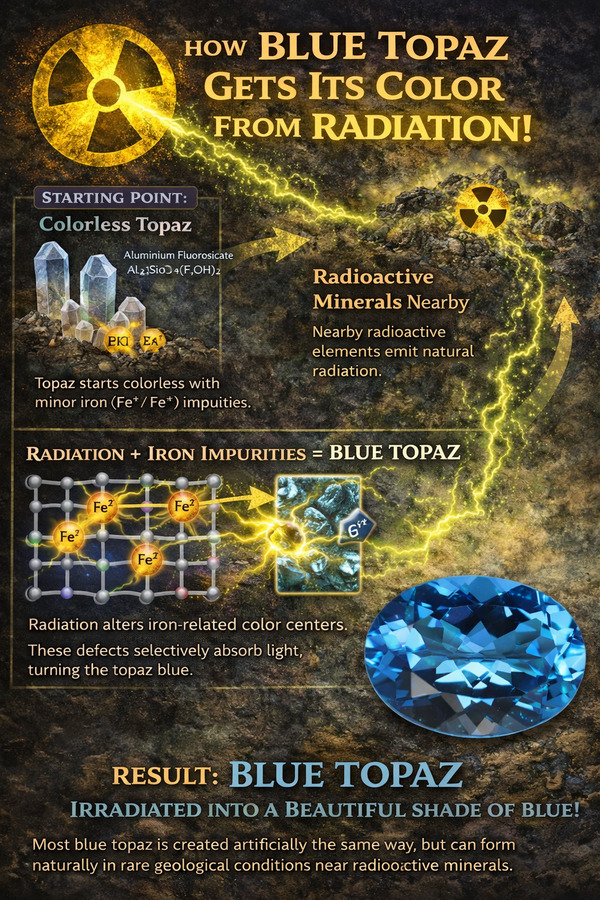
Nearly all blue topaz begins its life as colorless topaz, composed of aluminum fluorosilicate (Al₂SiO₄(F,OH)₂) with only trace impurities. On its own, topaz is typically clear, but when exposed to natural radiation from nearby radioactive minerals, subtle changes occur within its crystal lattice. Radiation displaces electrons and creates stable color centers associated with trace amounts of iron or chromium. These defects selectively absorb light, producing blue hues that can range from pale sky blue to deep, inky tones. In some natural settings, mild geothermal heating follows irradiation, further stabilizing or modifying the color centers and refining the blue color.
Infographic: How Blue Topaz Gets Its Color Through Radiation
In nature, this process unfolds extremely slowly, often over millions of years, in environments where topaz crystals sit near uranium- or thorium-bearing rocks. Because these conditions are relatively uncommon, naturally blue topaz is rare. Modern gem treatment replicates the same physical mechanism by using controlled irradiation and heating to create the desired blue colors more efficiently. While the timescale is vastly shorter, the underlying science is identical to what occurs underground: radiation creates color centers, and heat fine-tunes their stability. Blue topaz is therefore a clear example of how human technology has learned to mimic—and accelerate—one of nature’s most subtle and elegant coloring processes.
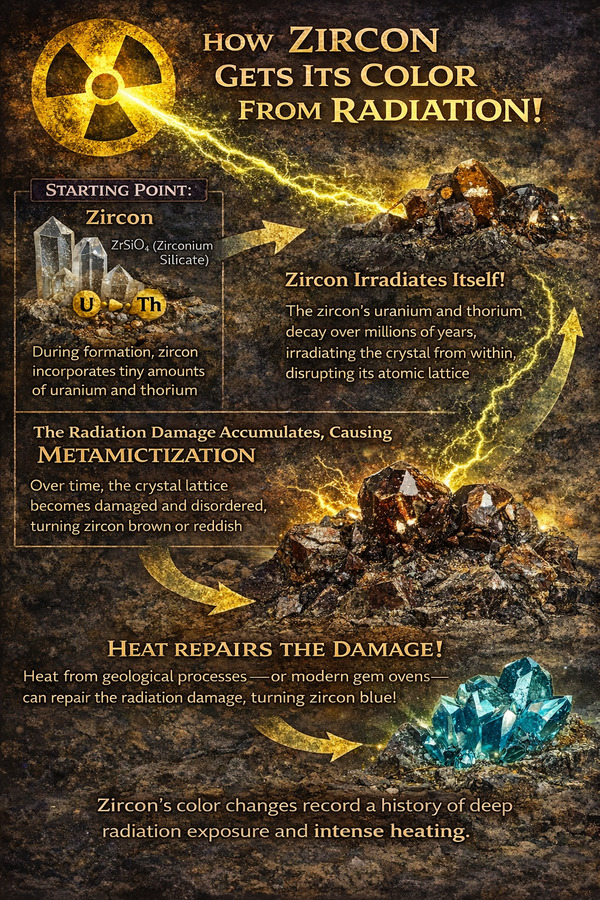
Zircon is unique among gemstones because it commonly incorporates trace amounts of uranium and thorium directly into its crystal structure during growth. These elements are radioactive, and as they decay, they emit radiation that slowly damages the zircon from within. Over millions to billions of years, this self-irradiation disrupts the orderly arrangement of atoms in the crystal lattice in a process known as metamictization. As the lattice becomes increasingly damaged, zircon often changes color, developing brown, reddish, or dull tones and losing some of its original clarity. In extreme cases, heavily metamict zircons can even become partially amorphous while still retaining their external crystal shape.
Infographic: How Zircon Gets Its Color Through Radiation
This radiation damage is not permanent. When zircon is exposed to sufficient heat—either naturally during geological events such as metamorphism or volcanism, or artificially in modern gem treatment—the crystal lattice can partially or fully reorganize. This “annealing” process repairs the radiation damage, restores transparency, and produces the brilliant blue hues for which zircon is famous. Natural blue zircon forms where heat has reset the radiation damage deep within the Earth, while gem ovens achieve the same effect in a controlled setting. Because zircon records both radiation exposure and thermal history, it serves not only as a gemstone but also as one of geology’s most powerful timekeepers, preserving evidence of Earth’s earliest crust and long-term radioactive processes.
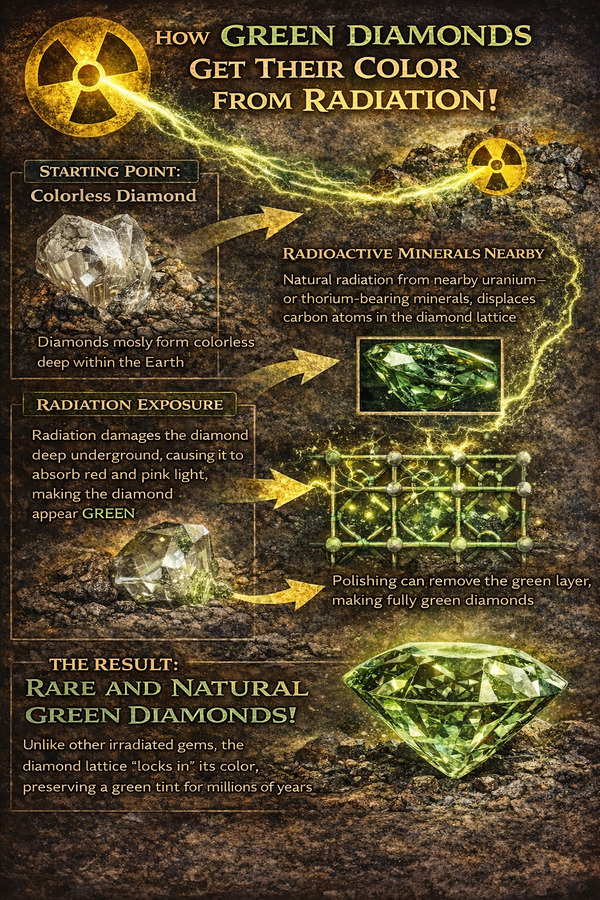
Green diamonds are among the rarest naturally colored diamonds, and their color is one of the clearest examples of radiation physically altering a crystal’s structure. Unlike minerals colored by impurities, green diamonds owe their color to damage within the carbon lattice itself. Natural radiation from nearby radioactive minerals displaces carbon atoms and creates defects in the crystal structure, changing how the diamond absorbs and transmits light. This damage selectively filters wavelengths, producing green tones that can range from pale mint to deep forest green. In many cases, the radiation only penetrates the outer portion of the diamond, forming a thin green surface layer known as a “radiation skin.”
Infographic: How Green Diamonds Get Their Color Through Radiation
These green skins provide direct physical evidence of a diamond’s exposure to natural radiation during its long geological journey. When cut and polished, the green layer is often partially or completely removed, which is why fully green faceted diamonds are exceptionally rare. What makes diamond unique among irradiation-colored minerals is the stability of its color centers. Diamond’s rigid carbon lattice locks radiation damage permanently in place, making its color highly resistant to heat, light, or chemical alteration. Unlike amethyst or smoky quartz, which can lose their color when heated, green diamonds preserve their radiation history indefinitely—effectively recording a snapshot of radioactive conditions deep within the Earth that may be hundreds of millions of years old.
Kunzite, the pink to lilac variety of spodumene, owes its delicate color to a combination of trace manganese impurities and the effects of natural irradiation. While manganese provides the chemical foundation for kunzite’s hue, radiation is responsible for activating and stabilizing the color centers within the crystal lattice. As radiation interacts with manganese-related defects, electrons are displaced and trapped in specific positions, allowing the crystal to absorb certain wavelengths of light and produce its characteristic soft pink tones. The exact shade of kunzite depends on both the concentration of manganese and the intensity of radiation exposure during its geological history.
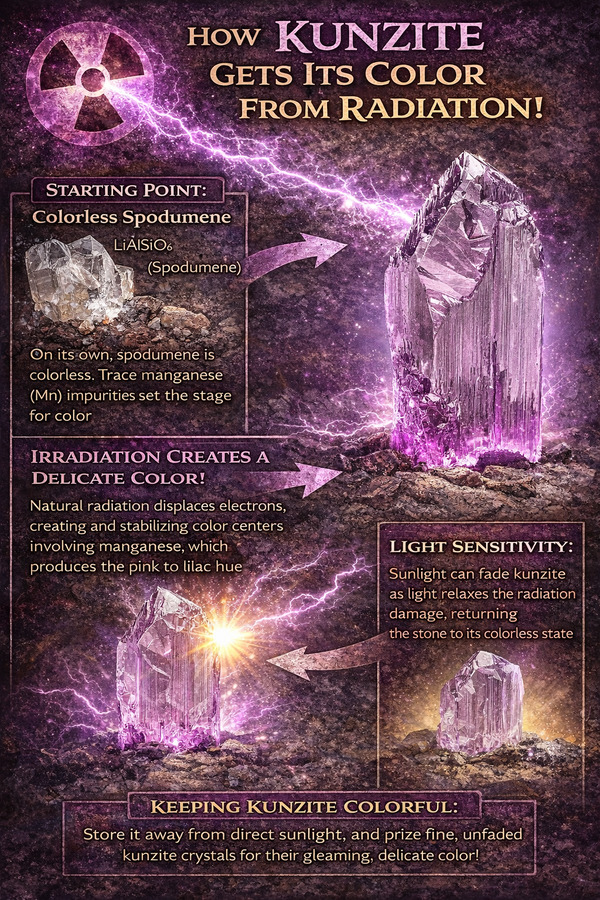
Infographic: How Kunzite Gets Its Color Through Radiation
Despite its beauty, kunzite’s color is surprisingly fragile. The radiation-induced color centers that give kunzite its pink and lilac hues can slowly break down when exposed to sunlight, especially ultraviolet light. As these defects relax back to a lower-energy state, the crystal gradually fades toward a pale or colorless appearance. This sensitivity means kunzite is best stored away from prolonged light exposure, and it also explains why deeply colored, unfaded specimens are highly prized by collectors. Kunzite’s tendency to change over time serves as a reminder that some irradiation-colored minerals are not static objects, but dynamic records of delicate atomic processes frozen in crystal form.
Maxixe beryl is a rare and unusual variety of beryl whose intense, electric blue color sets it apart from its more familiar cousin, aquamarine. While aquamarine’s blue hues are produced primarily by iron in specific oxidation states, maxixe beryl owes its dramatic coloration to natural irradiation interacting with iron-related defects in the beryl crystal lattice. Radiation displaces electrons and creates unstable color centers that absorb light differently than those in aquamarine, resulting in a much darker and more saturated blue. This process typically occurs in environments where beryl crystals are exposed to elevated levels of natural radiation over long periods of geological time.
What truly distinguishes maxixe beryl is the instability of its color. The radiation-induced color centers that produce its deep blue hue are easily destroyed by exposure to sunlight or heat, causing the crystal to fade to pale blue or even colorless in a relatively short time. Because of this sensitivity, natural maxixe beryl is rarely preserved in its original state, and many specimens lose their color shortly after being unearthed. This ephemeral quality has given maxixe beryl an almost legendary reputation among mineral collectors, as fine, naturally colored examples represent a fleeting moment in geological history—captured only briefly before the crystal’s radiation signature disappears.
These so-called “mutant minerals” are proof that radiation isn’t just destructive—it can be creative. Over millions to billions of years, invisible energy reshapes crystal lattices into colors no artist could invent. Every irradiated mineral is a snapshot of its geological environment, preserving evidence of radioactive neighbors, tectonic stability, and deep-time chemistry. They aren’t accidents—they’re masterpieces forged by nature’s quietest force.
Mutant Minerals: Nature’s Radiation-Colored Crystals
These minerals are not radioactive themselves and safe to handle, but they are geological mutants in the best possible way. Their colors didn’t come from dyes or surface coatings—they’re locked into the crystal structure itself, forged by radiation and time. From royal purple amethyst to neon-blue fluorite and radiation-born amazonite, these stones tell stories of invisible forces shaping visible beauty. Below are ten of the most famous and fascinating minerals whose appearance owes everything to natural irradiation.
Amethyst (Quartz)
Amethyst is the classic example of a mineral whose color is literally written by radiation. Chemically, it is ordinary quartz (SiO₂), but trace amounts of iron become incorporated into the crystal lattice as it grows. On its own, iron does not automatically produce the purple color. Instead, natural radiation emitted by nearby radioactive elements such as uranium, thorium, or potassium in surrounding rocks interacts with the iron atoms after the crystal has formed. This radiation knocks electrons into new positions, changing the oxidation state of the iron and creating stable defects in the crystal lattice known as color centers. These color centers selectively absorb parts of the visible spectrum, giving amethyst its characteristic purple hues, which can range from soft lilac to deep, saturated violet depending on iron content and radiation exposure.

The color of amethyst is surprisingly delicate despite its dramatic appearance. Heat disrupts the radiation-induced color centers, allowing the crystal lattice to reorganize and causing the purple color to fade or transform. When amethyst is heated—naturally through geothermal processes or artificially in kilns—it often turns yellow, orange, or brown as the iron changes oxidation state again, producing what is commonly sold as citrine. Prolonged exposure to strong sunlight can also weaken amethyst’s color over time. Without the slow, persistent influence of natural irradiation, quartz remains colorless, making amethyst a striking reminder that some of nature’s most iconic colors are the result of invisible energy working patiently over millions of years.
Fluorite
Fluorite is famously sensitive to radiation, earning it a reputation as one of the most color-responsive minerals on Earth. Although pure fluorite (CaF₂) is colorless, even small amounts of natural radiation from nearby uranium-, thorium-, or potassium-bearing rocks can dramatically alter its appearance. As fluorite crystals are exposed to this radiation, electrons are displaced within the crystal lattice, creating defects known as color centers. These trapped electrons selectively absorb certain wavelengths of light, producing fluorite’s remarkable spectrum of colors—purple, blue, green, yellow, and sometimes multiple colors within a single crystal. In some specimens, fluctuating radiation levels or changes in growth conditions even create striking color zoning or rare color-change effects.

Unlike pigments or chemical impurities alone, fluorite’s radiation-induced colors are inherently unstable. Heating the mineral can release the trapped electrons, allowing the crystal lattice to relax back toward its original state and causing colors to fade, shift, or disappear entirely. This sensitivity makes fluorite especially valuable to scientists, who use it as a natural recorder of radiation exposure and thermal history within rocks. For collectors, it also means fluorite offers a vivid snapshot of its geological environment—capturing the invisible influence of radiation in crystal form, even if that beauty can be fleeting under heat or prolonged light exposure.
Amazonite (Microcline Feldspar)
Amazonite’s serene green color hides a surprisingly chaotic origin rooted deep in its crystal chemistry. Although amazonite is a variety of potassium feldspar (microcline), its signature blue-green hue does not come from copper or simple impurities, as was once believed. Instead, trace amounts of lead substitute for potassium within the feldspar lattice, distorting the crystal structure at an atomic level. On their own, these lead atoms remain invisible. It is only when the crystal is exposed to natural irradiation—typically from radioactive elements like potassium-40, uranium, or thorium in surrounding rocks—that electrons are displaced and trapped within the lattice, forming color centers that selectively absorb light and produce amazonite’s distinctive color.

This radiation-activated coloration makes amazonite fundamentally different from pigment-based minerals. Without irradiation, the same crystal chemistry would yield ordinary white or gray feldspar, indistinguishable from countless other granitic minerals. Because the color depends on delicate, metastable defects in the crystal structure, it can be sensitive to environmental conditions. Prolonged exposure to strong sunlight or heat may cause some amazonite to fade or lose saturation as these color centers break down. This vulnerability is a visible reminder that amazonite’s beauty is not fixed, but the product of a finely balanced geological process involving trace elements, time, and natural radiation acting together deep within the Earth.
Smoky Quartz (Quartz)
Smoky quartz owes its smoky brown to nearly black coloration to the interaction between natural radiation and trace aluminum impurities within the quartz crystal lattice. When aluminum substitutes for silicon in quartz, it creates an electrical imbalance that is normally invisible. Natural radiation from nearby radioactive minerals—often uranium- or thorium-bearing granites—dislodges electrons and traps them at these aluminum-related defects. These trapped electrons form radiation-induced color centers that selectively absorb portions of visible light, producing the characteristic smoky tones. Without irradiation, smoky quartz would be colorless or only faintly tinted, indistinguishable from ordinary clear quartz.

The intensity of smoky quartz coloration is closely tied to the duration and strength of radiation exposure over geological time. Pale smoky quartz reflects relatively mild or brief irradiation, while deep brown to jet-black crystals indicate prolonged exposure or formation in especially radioactive environments. The darkest variety, known as morion, often forms adjacent to uranium-rich granitic intrusions, where radiation levels remain elevated for millions of years. Like other irradiation-colored minerals, smoky quartz’s color is not permanent—heating the crystal can release trapped electrons, destroying the color centers and returning the quartz to a clear or milky state. This sensitivity makes smoky quartz a natural record of both its chemical impurities and the invisible radiation history of its geological surroundings.
Apatite
Apatite is one of the most color-diverse minerals on Earth, appearing in nearly every hue imaginable, but some of its most vivid blue and green varieties owe their intensity to natural irradiation. During crystal growth, apatite can incorporate trace amounts of rare earth elements and other impurities into its structure. When exposed to natural radiation from nearby radioactive minerals, electrons associated with these elements are displaced and trapped in new configurations. These radiation-induced color centers alter how the crystal absorbs and transmits light, amplifying colors that might otherwise appear pale or dull. The result is the striking neon blues and greens seen in certain apatite specimens, particularly those formed in radiation-rich geological environments.

Apatite’s responsiveness to radiation extends beyond aesthetics and into scientific importance. Because its crystal lattice readily records radiation damage and can be partially reset by heat, apatite is widely used in geochronology and thermal history studies. Techniques such as fission-track dating and (U–Th)/He dating rely on radiation-induced features within apatite to reconstruct the timing of geological events and the temperatures a rock has experienced over millions of years. In this way, apatite serves as both a colorful gemstone and a sensitive geological archive, preserving a record of radiation exposure, heat, and deep-time processes within its atomic structure.
Blue Topaz
Nearly all blue topaz begins its life as colorless topaz, composed of aluminum fluorosilicate (Al₂SiO₄(F,OH)₂) with only trace impurities. On its own, topaz is typically clear, but when exposed to natural radiation from nearby radioactive minerals, subtle changes occur within its crystal lattice. Radiation displaces electrons and creates stable color centers associated with trace amounts of iron or chromium. These defects selectively absorb light, producing blue hues that can range from pale sky blue to deep, inky tones. In some natural settings, mild geothermal heating follows irradiation, further stabilizing or modifying the color centers and refining the blue color.
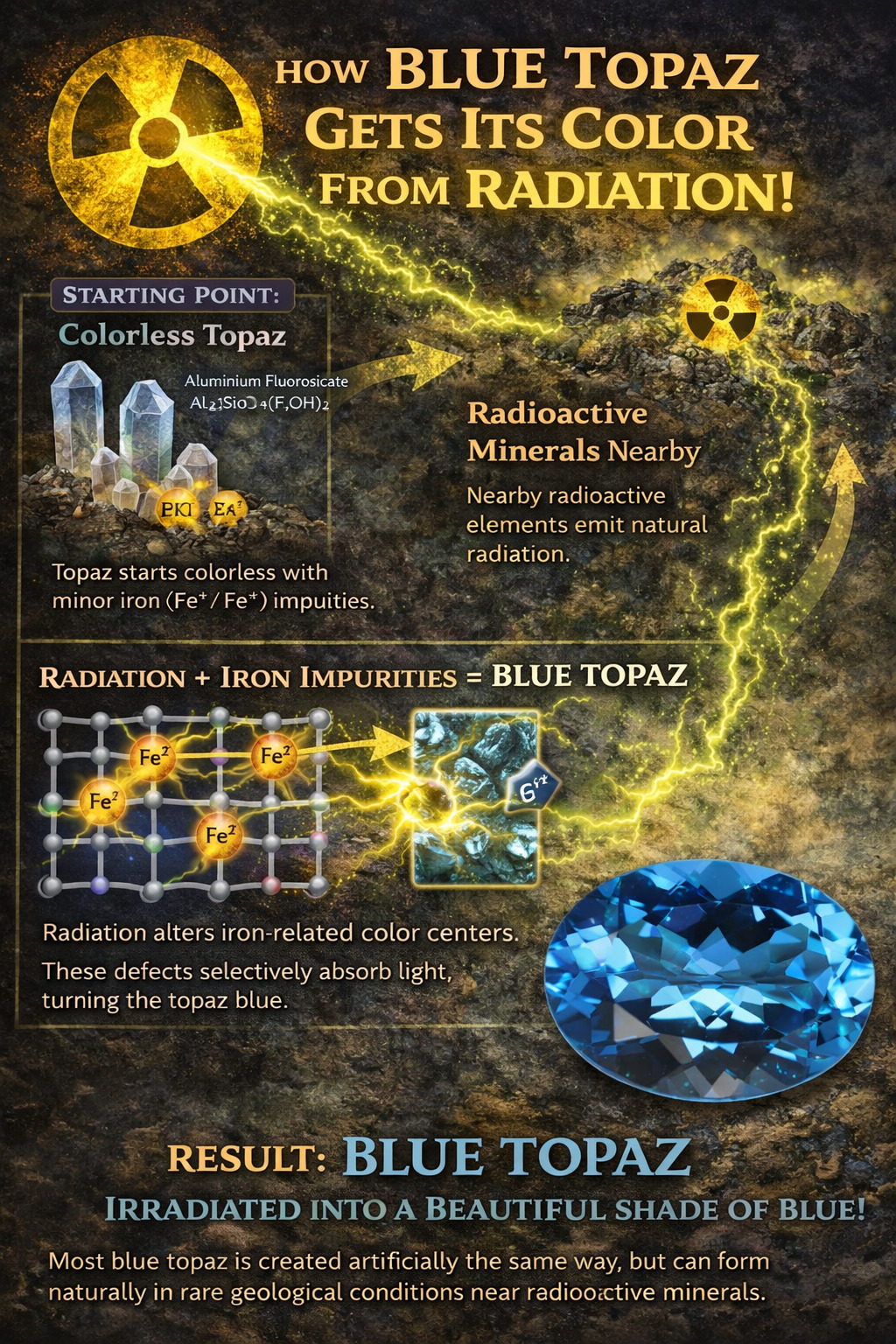
Infographic: How Blue Topaz Gets Its Color Through Radiation
In nature, this process unfolds extremely slowly, often over millions of years, in environments where topaz crystals sit near uranium- or thorium-bearing rocks. Because these conditions are relatively uncommon, naturally blue topaz is rare. Modern gem treatment replicates the same physical mechanism by using controlled irradiation and heating to create the desired blue colors more efficiently. While the timescale is vastly shorter, the underlying science is identical to what occurs underground: radiation creates color centers, and heat fine-tunes their stability. Blue topaz is therefore a clear example of how human technology has learned to mimic—and accelerate—one of nature’s most subtle and elegant coloring processes.
Zircon
Zircon is unique among gemstones because it commonly incorporates trace amounts of uranium and thorium directly into its crystal structure during growth. These elements are radioactive, and as they decay, they emit radiation that slowly damages the zircon from within. Over millions to billions of years, this self-irradiation disrupts the orderly arrangement of atoms in the crystal lattice in a process known as metamictization. As the lattice becomes increasingly damaged, zircon often changes color, developing brown, reddish, or dull tones and losing some of its original clarity. In extreme cases, heavily metamict zircons can even become partially amorphous while still retaining their external crystal shape.
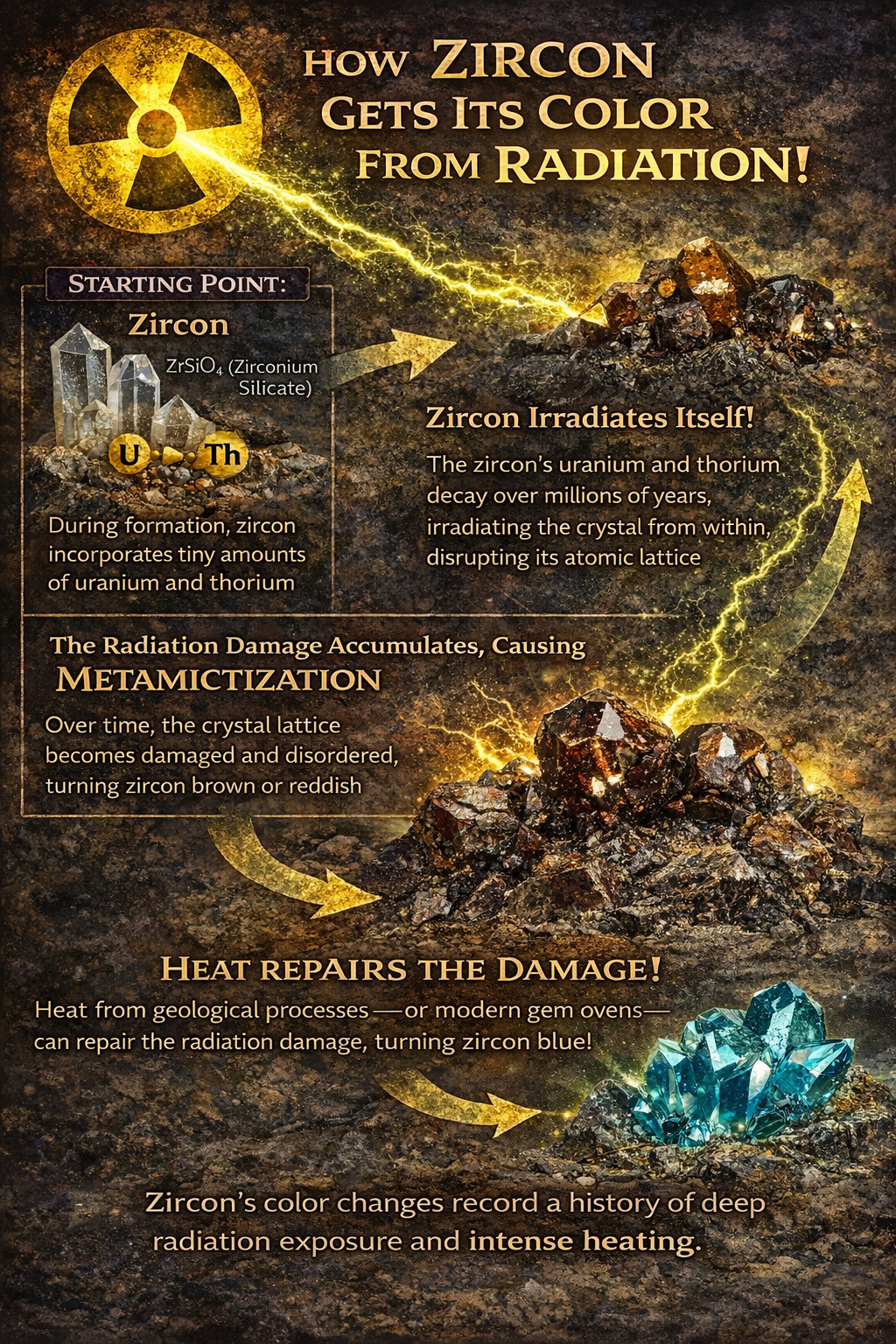
Infographic: How Zircon Gets Its Color Through Radiation
This radiation damage is not permanent. When zircon is exposed to sufficient heat—either naturally during geological events such as metamorphism or volcanism, or artificially in modern gem treatment—the crystal lattice can partially or fully reorganize. This “annealing” process repairs the radiation damage, restores transparency, and produces the brilliant blue hues for which zircon is famous. Natural blue zircon forms where heat has reset the radiation damage deep within the Earth, while gem ovens achieve the same effect in a controlled setting. Because zircon records both radiation exposure and thermal history, it serves not only as a gemstone but also as one of geology’s most powerful timekeepers, preserving evidence of Earth’s earliest crust and long-term radioactive processes.
Diamond (Green Diamonds)
Green diamonds are among the rarest naturally colored diamonds, and their color is one of the clearest examples of radiation physically altering a crystal’s structure. Unlike minerals colored by impurities, green diamonds owe their color to damage within the carbon lattice itself. Natural radiation from nearby radioactive minerals displaces carbon atoms and creates defects in the crystal structure, changing how the diamond absorbs and transmits light. This damage selectively filters wavelengths, producing green tones that can range from pale mint to deep forest green. In many cases, the radiation only penetrates the outer portion of the diamond, forming a thin green surface layer known as a “radiation skin.”
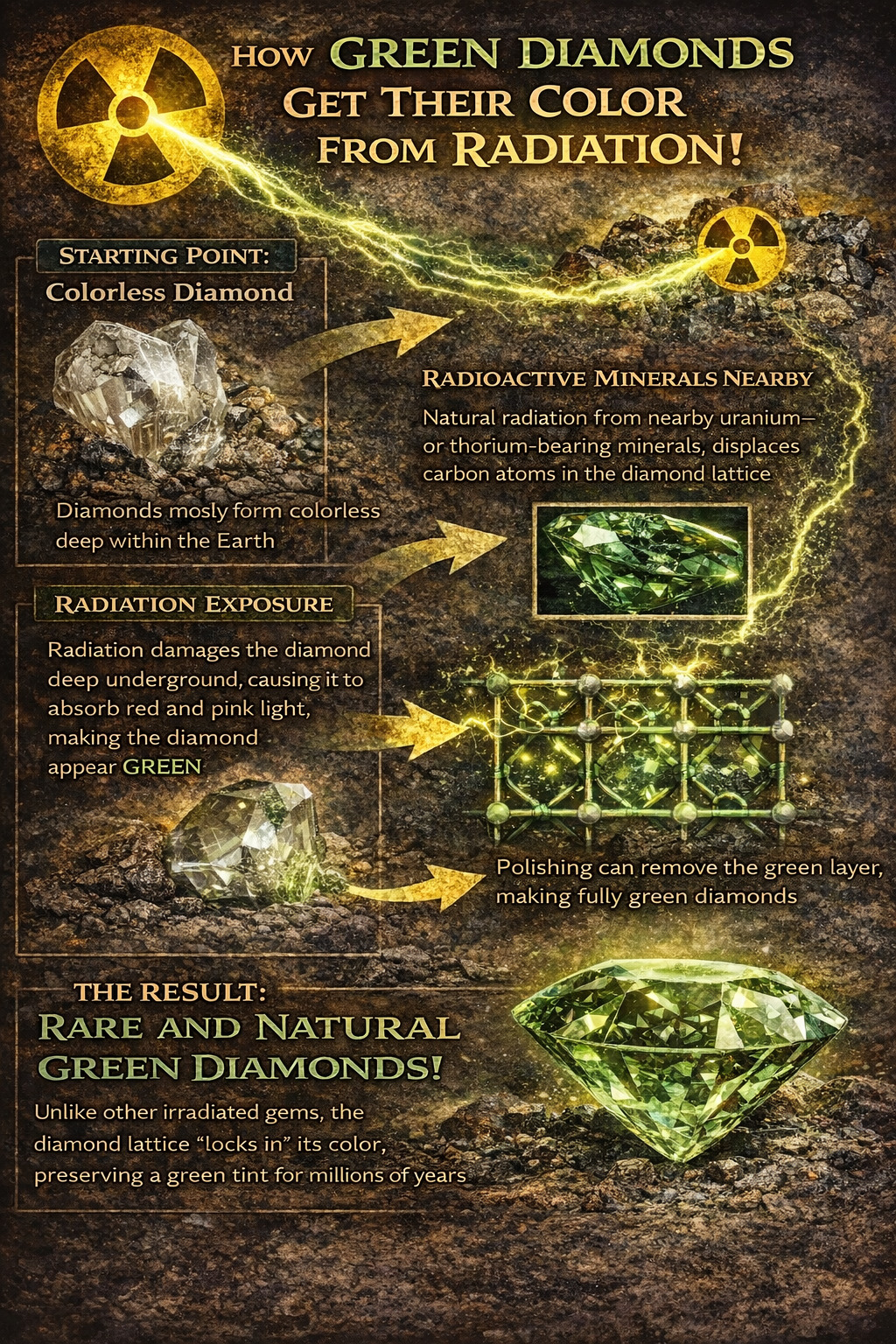
Infographic: How Green Diamonds Get Their Color Through Radiation
These green skins provide direct physical evidence of a diamond’s exposure to natural radiation during its long geological journey. When cut and polished, the green layer is often partially or completely removed, which is why fully green faceted diamonds are exceptionally rare. What makes diamond unique among irradiation-colored minerals is the stability of its color centers. Diamond’s rigid carbon lattice locks radiation damage permanently in place, making its color highly resistant to heat, light, or chemical alteration. Unlike amethyst or smoky quartz, which can lose their color when heated, green diamonds preserve their radiation history indefinitely—effectively recording a snapshot of radioactive conditions deep within the Earth that may be hundreds of millions of years old.
Kunzite (Spodumene)
Kunzite, the pink to lilac variety of spodumene, owes its delicate color to a combination of trace manganese impurities and the effects of natural irradiation. While manganese provides the chemical foundation for kunzite’s hue, radiation is responsible for activating and stabilizing the color centers within the crystal lattice. As radiation interacts with manganese-related defects, electrons are displaced and trapped in specific positions, allowing the crystal to absorb certain wavelengths of light and produce its characteristic soft pink tones. The exact shade of kunzite depends on both the concentration of manganese and the intensity of radiation exposure during its geological history.
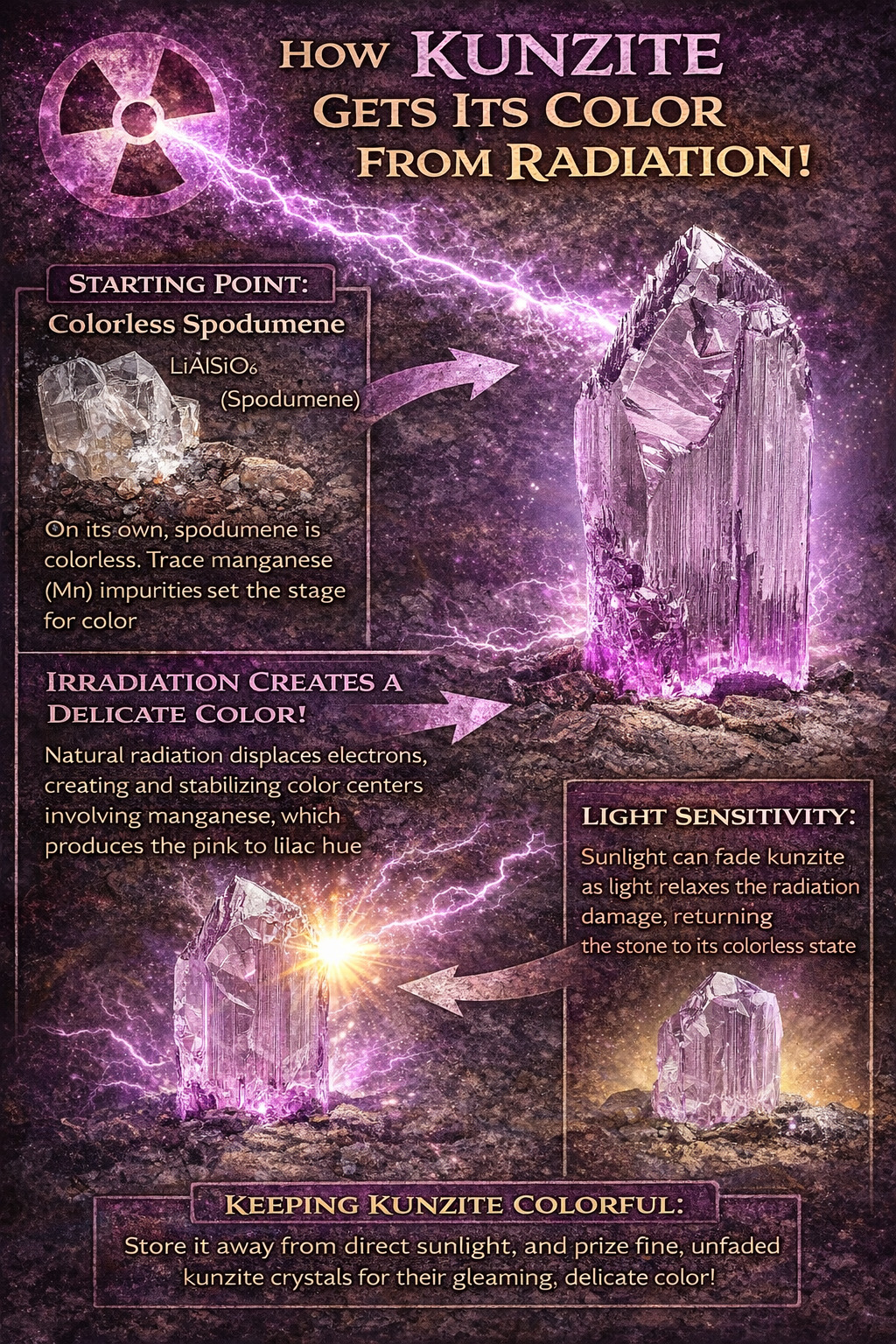
Infographic: How Kunzite Gets Its Color Through Radiation
Despite its beauty, kunzite’s color is surprisingly fragile. The radiation-induced color centers that give kunzite its pink and lilac hues can slowly break down when exposed to sunlight, especially ultraviolet light. As these defects relax back to a lower-energy state, the crystal gradually fades toward a pale or colorless appearance. This sensitivity means kunzite is best stored away from prolonged light exposure, and it also explains why deeply colored, unfaded specimens are highly prized by collectors. Kunzite’s tendency to change over time serves as a reminder that some irradiation-colored minerals are not static objects, but dynamic records of delicate atomic processes frozen in crystal form.
Maxixe Beryl
Maxixe beryl is a rare and unusual variety of beryl whose intense, electric blue color sets it apart from its more familiar cousin, aquamarine. While aquamarine’s blue hues are produced primarily by iron in specific oxidation states, maxixe beryl owes its dramatic coloration to natural irradiation interacting with iron-related defects in the beryl crystal lattice. Radiation displaces electrons and creates unstable color centers that absorb light differently than those in aquamarine, resulting in a much darker and more saturated blue. This process typically occurs in environments where beryl crystals are exposed to elevated levels of natural radiation over long periods of geological time.
What truly distinguishes maxixe beryl is the instability of its color. The radiation-induced color centers that produce its deep blue hue are easily destroyed by exposure to sunlight or heat, causing the crystal to fade to pale blue or even colorless in a relatively short time. Because of this sensitivity, natural maxixe beryl is rarely preserved in its original state, and many specimens lose their color shortly after being unearthed. This ephemeral quality has given maxixe beryl an almost legendary reputation among mineral collectors, as fine, naturally colored examples represent a fleeting moment in geological history—captured only briefly before the crystal’s radiation signature disappears.
Nature’s Longest-Running Experiment
These so-called “mutant minerals” are proof that radiation isn’t just destructive—it can be creative. Over millions to billions of years, invisible energy reshapes crystal lattices into colors no artist could invent. Every irradiated mineral is a snapshot of its geological environment, preserving evidence of radioactive neighbors, tectonic stability, and deep-time chemistry. They aren’t accidents—they’re masterpieces forged by nature’s quietest force.


