 Reviews

Rose Quartz — Mineral & Crystal Guide
Few minerals carry the quiet emotional gravity of rose quartz, a gemstone that looks less like it was mined from rock and more like it was coaxed out of a sunset. Its color is soft, but its story is anything but. Behind that gentle pink translucence is a mineral that helped shape civilizations, inspired mythology, influenced modern science, and even continues to puzzle geologists.
Unlike most gemstones defined by dramatic crystal faces or blazing refractive fire, rose quartz built its legacy on mood rather than sparkle. Its appeal is emotional, visual, and cultural. The mineral belongs to the quartz family (SiO₂), one of Earth’s most abundant mineral groups, yet rose quartz itself is surprisingly uncommon in well-formed crystals. Most of what is mined occurs in massive form, meaning it grows in large interlocking mineral blocks rather than individual crystal points. The rare occurrences of terminated rose quartz crystals are so coveted that many are found in museum collections rather than jewelry boxes.
For over a century, scientists believed the pink hue came from trace amounts of manganese, iron, or titanium, as is common in many pink minerals. But rose quartz had other plans. Modern studies using spectroscopy revealed that the color is actually caused by microscopic inclusions of a mineral related to dumortierite, often referred to as pink silicate fibers, trapped within the crystal structure. This discovery dramatically changed how mineralogists understood rose quartz and helped explain why it fades in sunlight — the inclusions themselves are photosensitive.
Rose quartz was arguably the world’s first gemstone associated with personal identity and appearance. Long before diamonds symbolized status, rose quartz symbolized beauty, vanity, and love. Ancient civilizations carved it into mirrors, cosmetic palettes, and facial massage tools. The Egyptians believed it prevented aging, while the Romans used it as a seal stone to signify ownership and authenticity. Many ancient signet rings were made from rose quartz for this purpose.
Unlike amethyst or smoky quartz, which retain color for millions of years, rose quartz has a notorious sensitivity to UV radiation. Extended sunlight exposure can fade its color to a pale washed pink or even nearly white — a phenomenon gem dealers often call “bleaching.” Ironically, this trait has made it one of the few gemstones that must be stored carefully, like fine art or vintage paper, rather than displayed in direct light.
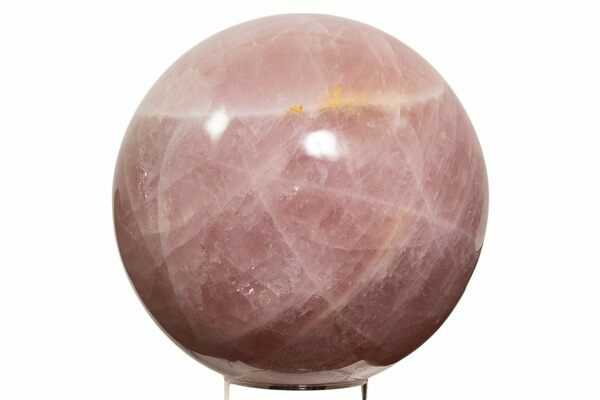
A large sphere made from Madagascar rose quartz
The Science of the Pink Glow
The pink color is caused by structural inclusions, not trace element impurities
The inclusions can be aligned, giving some rose quartz specimens a 6-ray star asterism when cut into cabochons
It can fade above 575°F (302°C) or with prolonged UV exposure
Its color can range from barely pink to cotton candy to lavender-leaning rose tones
Unlike most quartz varieties, rose quartz rarely forms in well-shaped crystals
Rose Quartz Properties
Chemical Formula: SiO₂ (Silicon Dioxide)
Crystal System: Trigonal (hexagonal lattice structure)
Hardness: 7 on the Mohs scale
Luster: Vitreous (glass-like)
Transparency: Transparent to translucent
Cleavage: None (breaks with conchoidal fracture)
Fluorescence: Usually none, occasionally very weak
A Slow Crystallization in Silica-Rich Pegmatites
Rose quartz forms primarily in granitic pegmatites — intrusive igneous rock bodies that cool extremely slowly, allowing large crystals to grow. These environments are rich in silica, aluminum, and volatile elements, creating a mineral nursery where quartz can develop massive intergrown structures. During crystallization, fibrous silicate minerals become trapped in the cooling quartz, scattering light and producing the signature rose coloration.
Not a Hydrothermal Quartz
Unlike amethyst or citrine, which often form in hydrothermal veins or gas cavities, rose quartz is predominantly a pegmatitic quartz, forming deep underground in large melt pockets. This is part of why it seldom forms in clean crystal points — the inclusion density that gives it color often disrupts the formation of sharp crystal faces.
Color Mechanism
The pink coloration is caused by microscopic silicate fibers that become trapped inside the quartz as it crystallizes, and these internal inclusions scatter visible light, producing the soft, diffuse, and gently glowing pink tone that defines rose quartz. Unlike quartz varieties colored by chemical impurities, this hue is structural, created by light interacting with the embedded fibers rather than trace elements in the lattice, and because those silicate inclusions are UV reactive, prolonged sunlight exposure can gradually fade the color, a process often referred to as natural “bleaching” or “bleaching.”
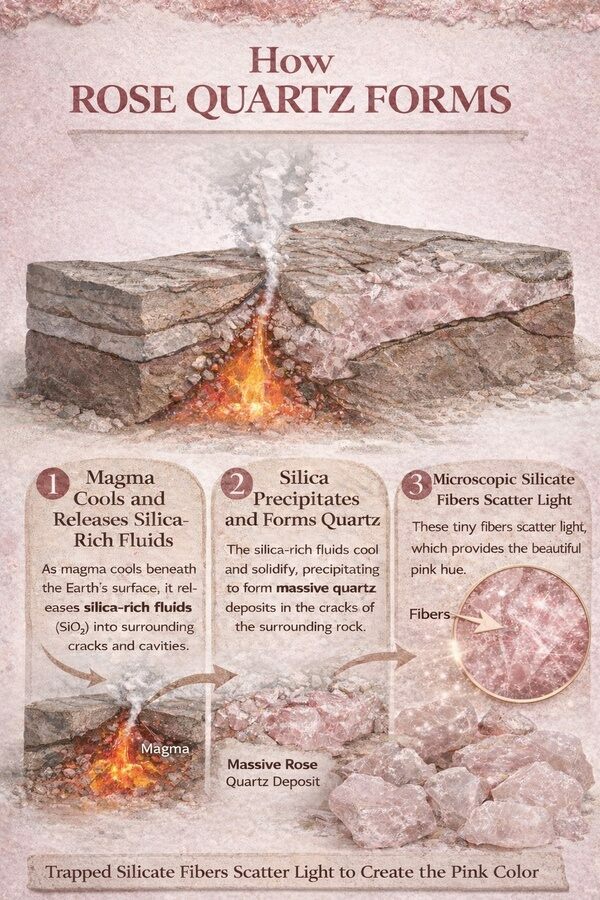
Infographic: How Rose Quartz Forms
Brazil - The world’s largest producer; famous for deep pink massive material
Madagascar - High-quality material; occasional crystal specimens
India - Major commercial source; massive form
USA (South Dakota, Maine, Colorado, California) - South Dakota produces some of the finest color
Sri Lanka - Historically important source
Namibia - Rare crystal specimens
Afghanistan - Occasional gem material
Brazil’s Dominance
Brazil doesn’t just produce rose quartz — it floods the world market with it. The mineral often occurs in pegmatite bodies alongside tourmaline, beryl, feldspar, lepidolite, and spodumene, minerals that share similar formation environments.
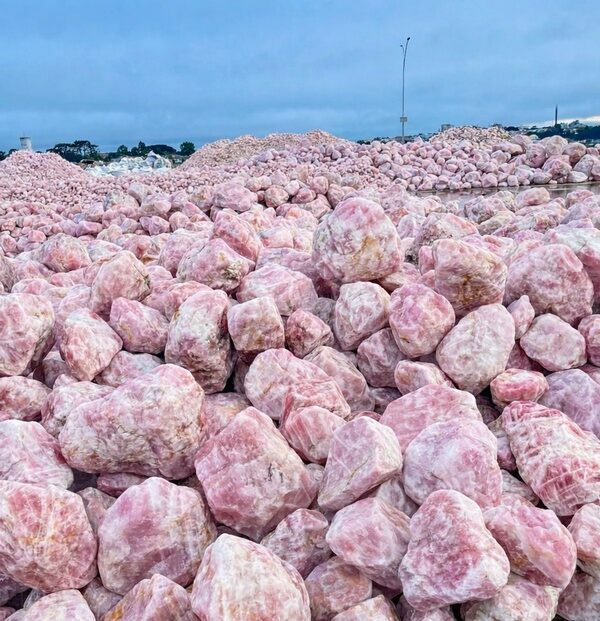
Piles of rose quartz boulders that have been mined in Brazil
Rose quartz carries one of the oldest and most culturally layered gemstone legacies in human history, valued not for brilliance, but for beauty, symbolism, and human connection. The earliest known use of rose-tinted quartz traces back more than 7,000 years to ancient Mesopotamia, where artisans shaped it into beads, amulets, and decorative inlays for ceremonial objects. Early Akkadian, Sumerian, and Assyrian cultures prized pink stones as talismans of protection and divine favor, embedding them into jewelry, cylinder seals, and temple offerings.
By 800–600 BCE, rose quartz adornments were widespread across the Assyrian Empire, particularly among nobility and priestly classes. In ancient Egypt, the stone took on a more personal and ritualistic role. It became associated with Isis, the goddess of magic and life, and was carved into cosmetic palettes, facial massage tools, and ceremonial masks. Egyptians believed the stone preserved youth and protected the skin from aging, making it one of the earliest known gemstones linked directly to beauty rituals — a tradition that survives today in quartz facial rollers and gua sha tools.
Greek mythology romanticized the mineral’s origin, claiming it was created when Ares and Aphrodite bled onto white quartz during a tragic moment, staining the stone pink and turning it into a symbol of love, passion, and reconciliation. The Greeks also dedicated rose quartz to Aphrodite alone, believing it could inspire affection, mend fractured relationships, and soften hearts hardened by anger.
The Romans inherited much of this symbolism but applied it in more practical and political ways. Rose quartz was frequently carved into intaglio gems and set into signet rings used to press wax seals on documents, marking ownership, identity, and authenticity. The stone’s association with Venus (the Roman counterpart to Aphrodite) also made it a diplomatic gift, symbolizing trust, affection, and unity between allies, lovers, and families.
Despite its deep ancient roots, rose quartz was not always a commercial gemstone. Until the 1800s, it was more commonly a carver’s mineral and collector’s specimen than a mainstream gem. That changed when enormous pegmatite deposits were discovered in Brazil, shifting it into global markets. By the early 20th century, Brazilian mining scaled rapidly, transforming rose quartz into one of the world’s most recognizable ornamental gemstones used for beads, cabochons, carvings, and luxury décor.
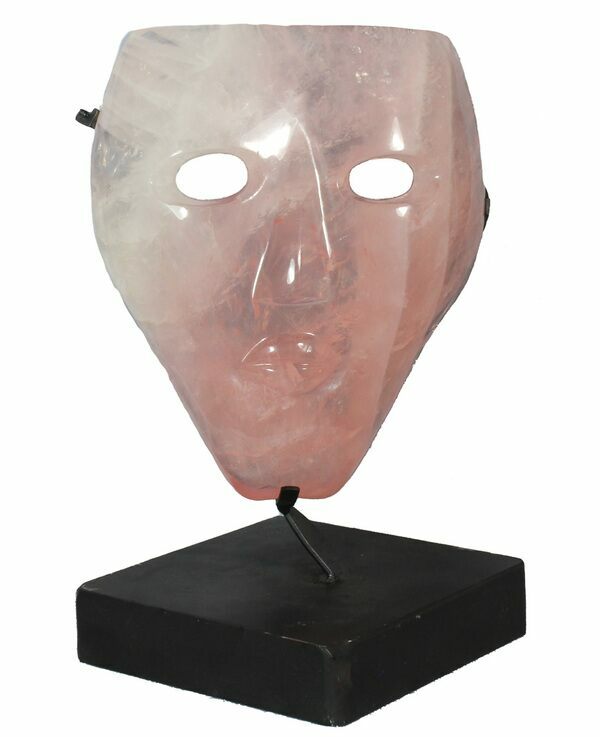
A decorative mask carved from Brazilian rose quartz
Today, rose quartz remains a stone of emotional resonance and functional versatility. It is worn in jewelry as polished beads, cabochons, and pendants; carved into hearts, spheres, figurines, and artistic lapidary objects; displayed in luxury home décor; and used in modern wellness tools that echo ancient Egyptian beauty traditions. While industrial quartz applications rarely use rose quartz due to its inclusion density and color sensitivity, its cultural identity has endured for millennia — representing love, beauty, emotional healing, authenticity, reconciliation, and the timeless human desire to find meaning in something soft, ancient, and enduring.
South Dakota is legendary for star rose quartz not because of volume, but because it produced the most visually dramatic material ever found—stones that elevated quartz from a common mineral to a world-class gem prized for optical presence rather than fire. The finest examples proved that rose quartz’s pink color and its rare ability to display a six-ray star are created by microscopic fibrous silicate inclusions (linked to the dumortierite mineral group), which scatter and reflect light in intersecting radial patterns. When polished into a smooth cabochon, those reflections resolve into a natural 6-ray asterism, an inclusion-driven effect distinct from the rutile-based stars of sapphire or the fire of faceted quartz gems.
The most important deposits occur in the Black Hills near Harney Peak (Black Elk Peak), formed from Proterozoic granite and pegmatites that crystallized over a billion years ago. Three stones defined the mineral’s fame: the Davis Star, the Carlson Star, and the Harney Peak Star. The 1,475-carat Davis Star (1960) remains the largest, with a vivid, centered 6-ray star, while the Harney Peak Star became the most famous for its deep rose color and flawless star symmetry, still regarded as the finest example ever cut. These iconic stones helped shape mineral science by confirming that both rose quartz’s color and its star effect stem from inclusion-controlled optical physics, not chemical impurities.
Mining star rose quartz in South Dakota has always been unpredictable, occurring in isolated pockets rather than continuous seams. Modern material is typically lighter in color with weaker or off-center stars, and the spectacular mid-century discoveries are considered unrepeatable. Even so, the Black Hills remain the most historically significant source, and rough rose quartz showing strong star potential continues to be highly valued by lapidaries and collectors, prized for rarity and optical character even if stones of the original caliber are no longer expected to exist.
Unlike most gemstones defined by dramatic crystal faces or blazing refractive fire, rose quartz built its legacy on mood rather than sparkle. Its appeal is emotional, visual, and cultural. The mineral belongs to the quartz family (SiO₂), one of Earth’s most abundant mineral groups, yet rose quartz itself is surprisingly uncommon in well-formed crystals. Most of what is mined occurs in massive form, meaning it grows in large interlocking mineral blocks rather than individual crystal points. The rare occurrences of terminated rose quartz crystals are so coveted that many are found in museum collections rather than jewelry boxes.

For over a century, scientists believed the pink hue came from trace amounts of manganese, iron, or titanium, as is common in many pink minerals. But rose quartz had other plans. Modern studies using spectroscopy revealed that the color is actually caused by microscopic inclusions of a mineral related to dumortierite, often referred to as pink silicate fibers, trapped within the crystal structure. This discovery dramatically changed how mineralogists understood rose quartz and helped explain why it fades in sunlight — the inclusions themselves are photosensitive.
Rose quartz was arguably the world’s first gemstone associated with personal identity and appearance. Long before diamonds symbolized status, rose quartz symbolized beauty, vanity, and love. Ancient civilizations carved it into mirrors, cosmetic palettes, and facial massage tools. The Egyptians believed it prevented aging, while the Romans used it as a seal stone to signify ownership and authenticity. Many ancient signet rings were made from rose quartz for this purpose.
Unlike amethyst or smoky quartz, which retain color for millions of years, rose quartz has a notorious sensitivity to UV radiation. Extended sunlight exposure can fade its color to a pale washed pink or even nearly white — a phenomenon gem dealers often call “bleaching.” Ironically, this trait has made it one of the few gemstones that must be stored carefully, like fine art or vintage paper, rather than displayed in direct light.
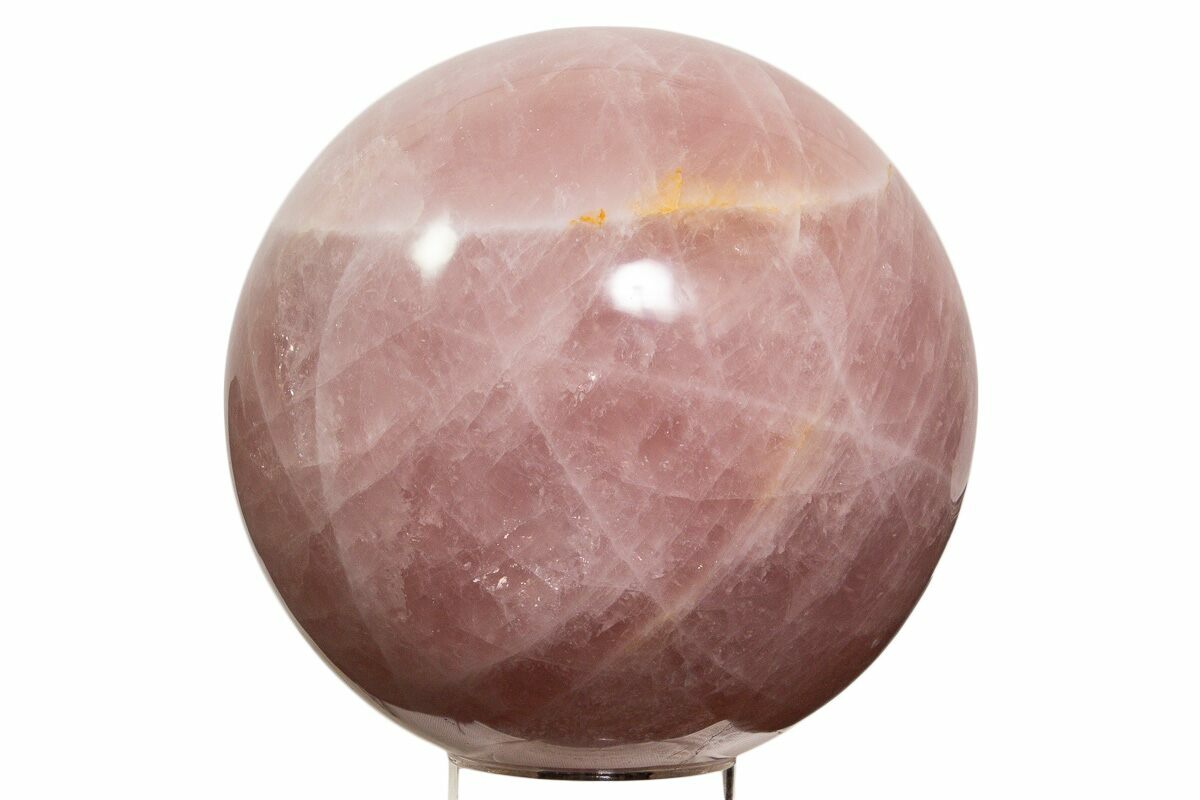
A large sphere made from Madagascar rose quartz
The Science of the Pink Glow
Rose Quartz Properties
Chemical Formula: SiO₂ (Silicon Dioxide)
Crystal System: Trigonal (hexagonal lattice structure)
Hardness: 7 on the Mohs scale
Luster: Vitreous (glass-like)
Transparency: Transparent to translucent
Cleavage: None (breaks with conchoidal fracture)
Fluorescence: Usually none, occasionally very weak
How Rose Quartz Forms
A Slow Crystallization in Silica-Rich Pegmatites
Rose quartz forms primarily in granitic pegmatites — intrusive igneous rock bodies that cool extremely slowly, allowing large crystals to grow. These environments are rich in silica, aluminum, and volatile elements, creating a mineral nursery where quartz can develop massive intergrown structures. During crystallization, fibrous silicate minerals become trapped in the cooling quartz, scattering light and producing the signature rose coloration.
Not a Hydrothermal Quartz
Unlike amethyst or citrine, which often form in hydrothermal veins or gas cavities, rose quartz is predominantly a pegmatitic quartz, forming deep underground in large melt pockets. This is part of why it seldom forms in clean crystal points — the inclusion density that gives it color often disrupts the formation of sharp crystal faces.
Color Mechanism
The pink coloration is caused by microscopic silicate fibers that become trapped inside the quartz as it crystallizes, and these internal inclusions scatter visible light, producing the soft, diffuse, and gently glowing pink tone that defines rose quartz. Unlike quartz varieties colored by chemical impurities, this hue is structural, created by light interacting with the embedded fibers rather than trace elements in the lattice, and because those silicate inclusions are UV reactive, prolonged sunlight exposure can gradually fade the color, a process often referred to as natural “bleaching” or “bleaching.”
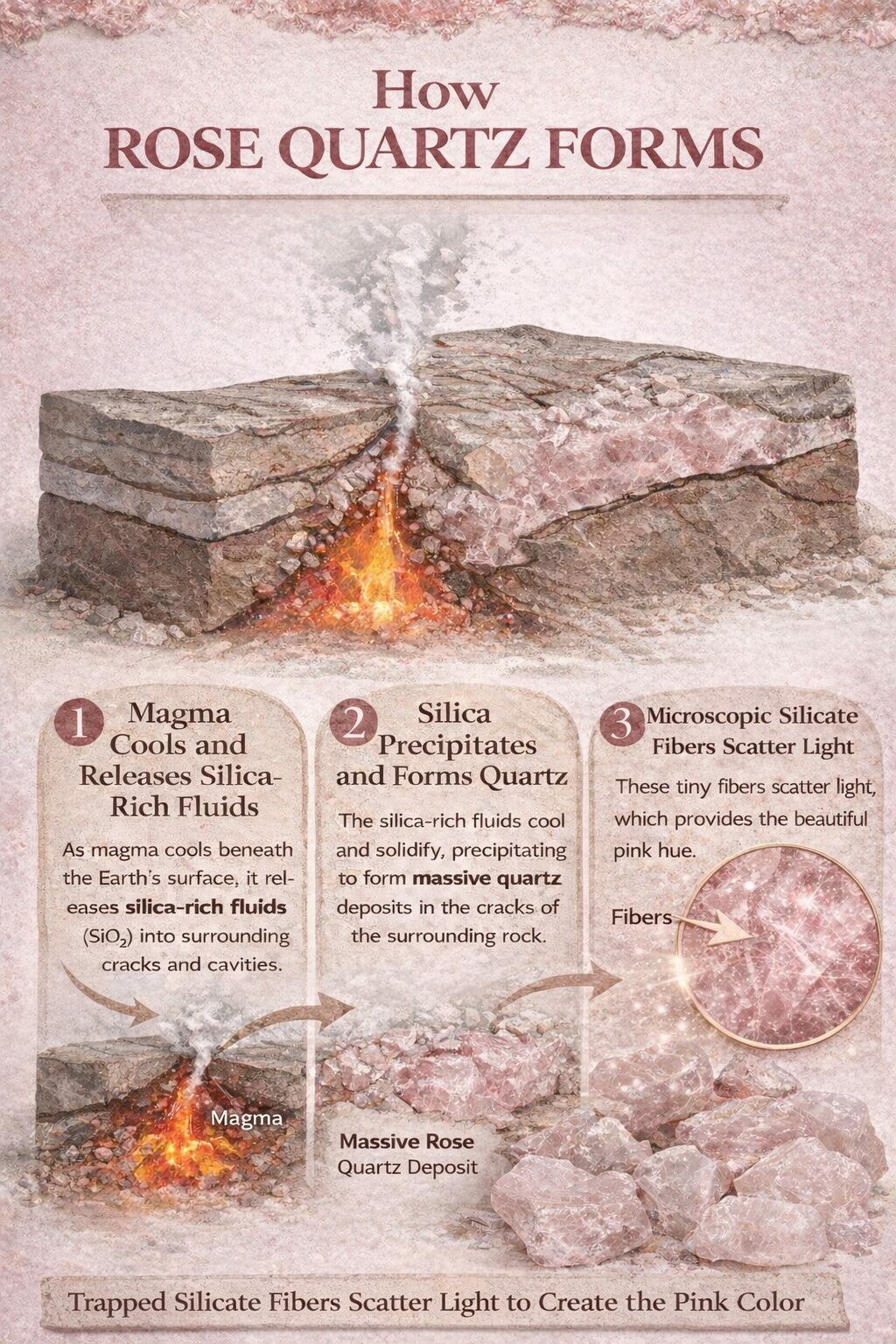
Infographic: How Rose Quartz Forms
Where Rose Quartz is Found
Brazil - The world’s largest producer; famous for deep pink massive material
Madagascar - High-quality material; occasional crystal specimens
India - Major commercial source; massive form
USA (South Dakota, Maine, Colorado, California) - South Dakota produces some of the finest color
Sri Lanka - Historically important source
Namibia - Rare crystal specimens
Afghanistan - Occasional gem material
Brazil’s Dominance
Brazil doesn’t just produce rose quartz — it floods the world market with it. The mineral often occurs in pegmatite bodies alongside tourmaline, beryl, feldspar, lepidolite, and spodumene, minerals that share similar formation environments.
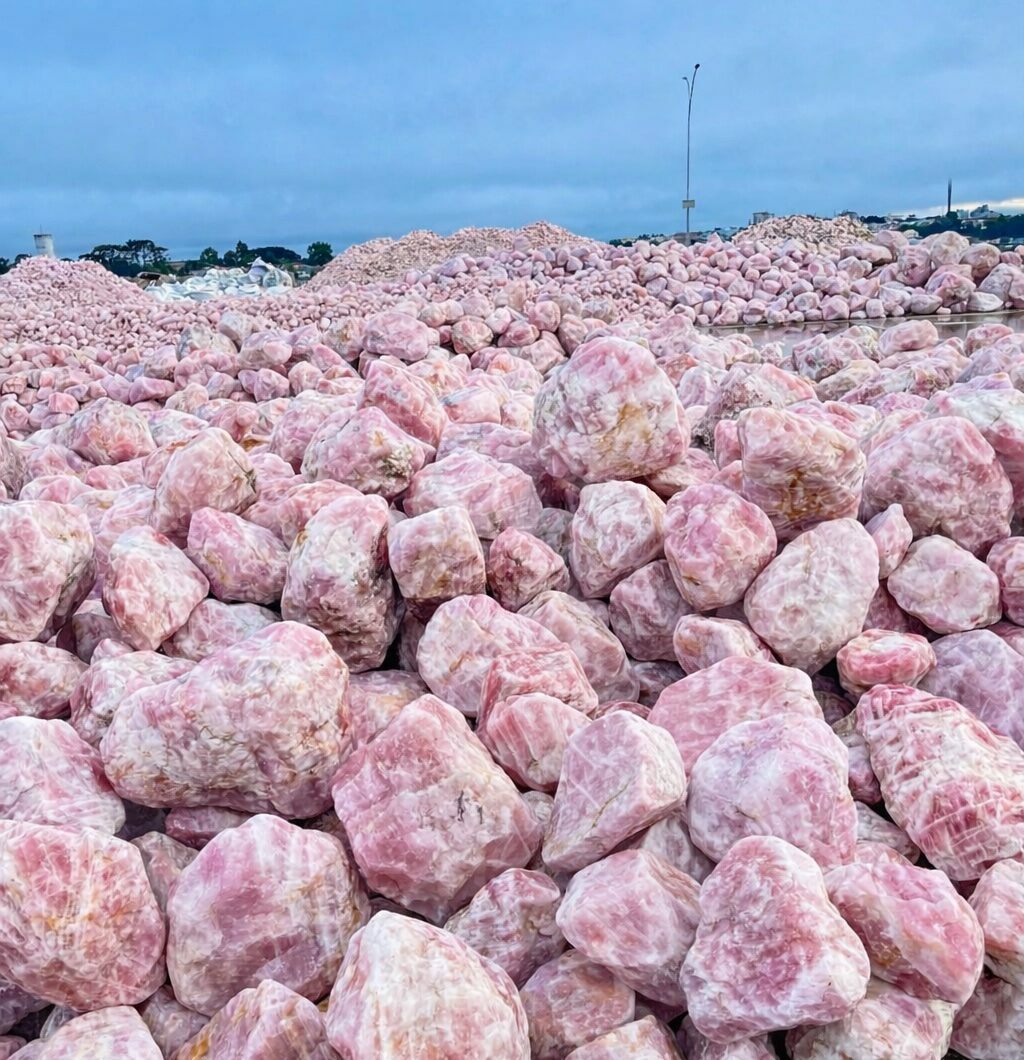
Piles of rose quartz boulders that have been mined in Brazil
Rose Quartz History & Uses
Rose quartz carries one of the oldest and most culturally layered gemstone legacies in human history, valued not for brilliance, but for beauty, symbolism, and human connection. The earliest known use of rose-tinted quartz traces back more than 7,000 years to ancient Mesopotamia, where artisans shaped it into beads, amulets, and decorative inlays for ceremonial objects. Early Akkadian, Sumerian, and Assyrian cultures prized pink stones as talismans of protection and divine favor, embedding them into jewelry, cylinder seals, and temple offerings.
By 800–600 BCE, rose quartz adornments were widespread across the Assyrian Empire, particularly among nobility and priestly classes. In ancient Egypt, the stone took on a more personal and ritualistic role. It became associated with Isis, the goddess of magic and life, and was carved into cosmetic palettes, facial massage tools, and ceremonial masks. Egyptians believed the stone preserved youth and protected the skin from aging, making it one of the earliest known gemstones linked directly to beauty rituals — a tradition that survives today in quartz facial rollers and gua sha tools.
Greek mythology romanticized the mineral’s origin, claiming it was created when Ares and Aphrodite bled onto white quartz during a tragic moment, staining the stone pink and turning it into a symbol of love, passion, and reconciliation. The Greeks also dedicated rose quartz to Aphrodite alone, believing it could inspire affection, mend fractured relationships, and soften hearts hardened by anger.
The Romans inherited much of this symbolism but applied it in more practical and political ways. Rose quartz was frequently carved into intaglio gems and set into signet rings used to press wax seals on documents, marking ownership, identity, and authenticity. The stone’s association with Venus (the Roman counterpart to Aphrodite) also made it a diplomatic gift, symbolizing trust, affection, and unity between allies, lovers, and families.
Despite its deep ancient roots, rose quartz was not always a commercial gemstone. Until the 1800s, it was more commonly a carver’s mineral and collector’s specimen than a mainstream gem. That changed when enormous pegmatite deposits were discovered in Brazil, shifting it into global markets. By the early 20th century, Brazilian mining scaled rapidly, transforming rose quartz into one of the world’s most recognizable ornamental gemstones used for beads, cabochons, carvings, and luxury décor.
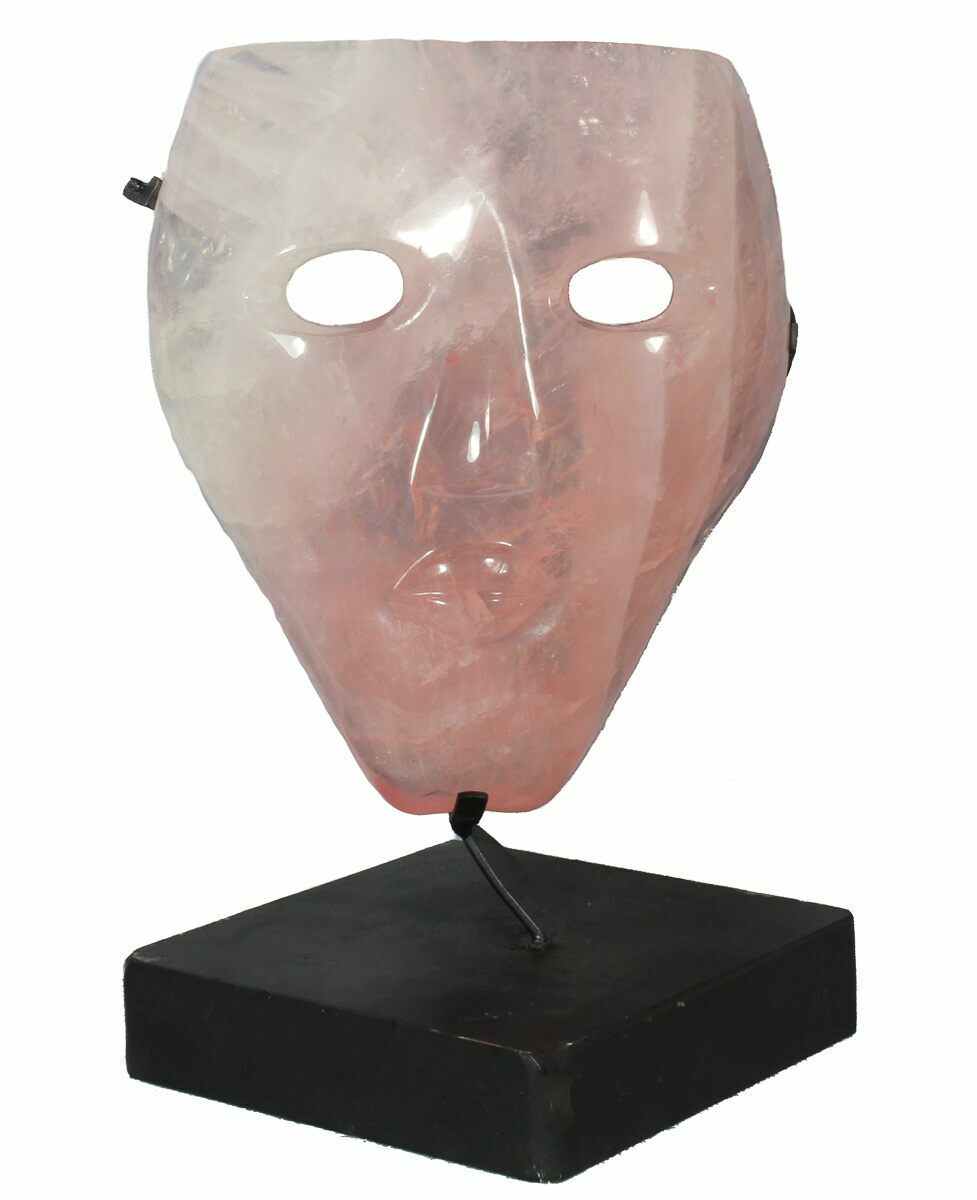
A decorative mask carved from Brazilian rose quartz
Today, rose quartz remains a stone of emotional resonance and functional versatility. It is worn in jewelry as polished beads, cabochons, and pendants; carved into hearts, spheres, figurines, and artistic lapidary objects; displayed in luxury home décor; and used in modern wellness tools that echo ancient Egyptian beauty traditions. While industrial quartz applications rarely use rose quartz due to its inclusion density and color sensitivity, its cultural identity has endured for millennia — representing love, beauty, emotional healing, authenticity, reconciliation, and the timeless human desire to find meaning in something soft, ancient, and enduring.
The Legendary Star Rose Quartz of South Dakota
South Dakota is legendary for star rose quartz not because of volume, but because it produced the most visually dramatic material ever found—stones that elevated quartz from a common mineral to a world-class gem prized for optical presence rather than fire. The finest examples proved that rose quartz’s pink color and its rare ability to display a six-ray star are created by microscopic fibrous silicate inclusions (linked to the dumortierite mineral group), which scatter and reflect light in intersecting radial patterns. When polished into a smooth cabochon, those reflections resolve into a natural 6-ray asterism, an inclusion-driven effect distinct from the rutile-based stars of sapphire or the fire of faceted quartz gems.
The most important deposits occur in the Black Hills near Harney Peak (Black Elk Peak), formed from Proterozoic granite and pegmatites that crystallized over a billion years ago. Three stones defined the mineral’s fame: the Davis Star, the Carlson Star, and the Harney Peak Star. The 1,475-carat Davis Star (1960) remains the largest, with a vivid, centered 6-ray star, while the Harney Peak Star became the most famous for its deep rose color and flawless star symmetry, still regarded as the finest example ever cut. These iconic stones helped shape mineral science by confirming that both rose quartz’s color and its star effect stem from inclusion-controlled optical physics, not chemical impurities.
Mining star rose quartz in South Dakota has always been unpredictable, occurring in isolated pockets rather than continuous seams. Modern material is typically lighter in color with weaker or off-center stars, and the spectacular mid-century discoveries are considered unrepeatable. Even so, the Black Hills remain the most historically significant source, and rough rose quartz showing strong star potential continues to be highly valued by lapidaries and collectors, prized for rarity and optical character even if stones of the original caliber are no longer expected to exist.


