 Reviews

Mookaite Jasper: A Vibrant Record of Ancient Seas
Mookaite jasper is one of those rare stones that looks almost painted rather than formed by geology. Its swirling bands of mustard yellow, burgundy red, cream, white, and muted purple are entirely natural, yet they resemble brushstrokes frozen in stone. Despite being marketed as a “jasper,” mookaite is actually a complex sedimentary rock with a biological origin—built from the remains of microscopic life that lived hundreds of millions of years ago. Every piece of mookaite is essentially a snapshot of an ancient seafloor turned solid.
One of the most fascinating facts about mookaite is that its color has nothing to do with dyes or surface staining. The palette comes from iron-rich minerals incorporated during silica deposition, with variations in oxidation state creating yellows, reds, and browns. Creams and whites represent purer silica, while deeper reds reflect higher iron content. These colors formed layer by layer as ocean chemistry shifted over time, meaning the patterns you see are a direct record of changing ancient environments.
Geologically speaking, mookaite sits at the intersection of several rock definitions. It is commonly described as jasper, but it can also be classified as chert, chalcedony, opalite, or a mixture of all three. This confusion isn’t marketing hype—it reflects the stone’s real complexity. At its core, mookaite is a siliceous sedimentary rock composed primarily of microcrystalline quartz, formed from the accumulation of radiolarian skeletons.
Radiolarians are microscopic, plankton-like organisms that live in marine environments and build intricate silica skeletons. When they die, these skeletons rain down onto the seafloor as siliceous ooze. Over immense spans of time, this ooze compacts, dewaters, and recrystallizes into solid silica-rich rock. Mookaite represents sections of this radiolarian-rich sediment that later experienced mineral replacement and cementation, locking the structure into stone.
Some mookaite nodules also preserve natural fossil molds and casts, including impressions left by organisms like ammonites and belemnites, created when their shells or hard parts were encased in silica sediment and later dissolved, leaving behind hollow forms that were filled and preserved as internal casts.
Mookaite formed during the Cretaceous period, roughly 70–120 million years ago, when much of what is now inland Australia lay beneath a shallow inland sea. In these quiet marine conditions, radiolarians thrived, producing vast quantities of silica. As sediments accumulated, iron-bearing fluids moved through the layers, introducing the elements responsible for mookaite’s signature colors.
Over time, tectonic uplift and erosion exposed these silica-rich layers. Weathering broke the rock into nodules and blocks, often concentrating the most colorful material. Unlike many jaspers that form through volcanic or hydrothermal processes, mookaite’s origin is primarily biological and sedimentary—making it closer in spirit to fossiliferous rock than to igneous gemstone material.
Mookaite is found almost exclusively in the Kennedy Ranges region near Gascoyne Junction in Western Australia. The material occurs within the Windalia Radiolarite, a geological formation famous for its radiolarian-rich siliceous sediments. This extreme locality restriction is one reason mookaite is so recognizable and collectible—there is no true equivalent found anywhere else in the world.
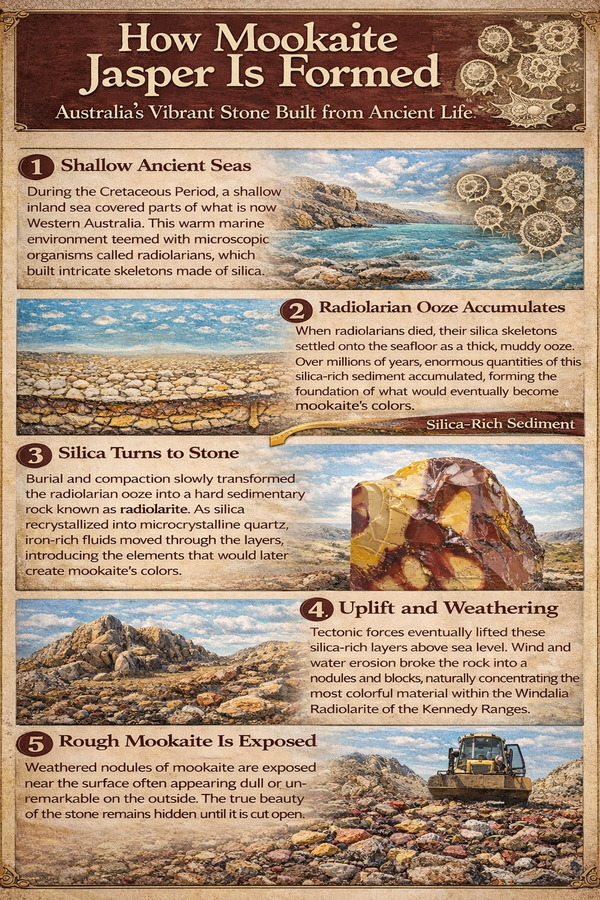
The process of forming mookaite.
The stone is typically recovered as nodules, slabs, or fractured blocks weathered out of the surrounding host rock. Because the best colors often occur in irregular internal bands, the true beauty of mookaite is usually revealed only after cutting and polishing.
Mookaite has been known to Indigenous Australians for thousands of years and was traditionally used as a tool stone due to its hardness and ability to fracture predictably. The name “mookaite” itself is derived from a local Aboriginal term referencing nearby water sources, sometimes translated as “running waters.” Modern lapidary interest in mookaite began in the mid–20th century, when rockhounds and cutters recognized its exceptional color range and polish quality. Most mookaite is collected through small-scale quarrying or surface recovery rather than large industrial mining operations. This keeps production limited and ensures that high-quality material remains desirable and increasingly scarce.
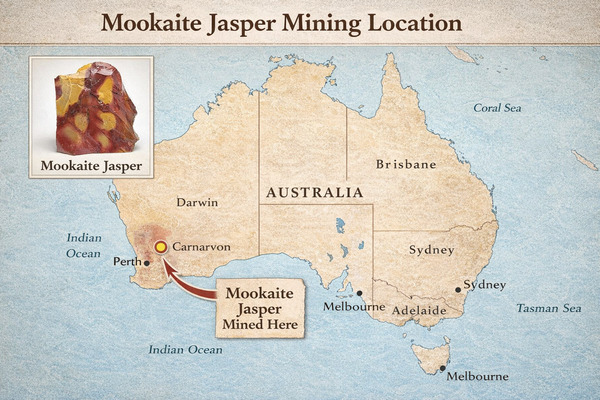
Location of Mookaite mining in Australia.
Mookaite is composed mainly of microcrystalline quartz, giving it a Mohs hardness of about 6.5–7. This makes it durable enough for jewelry, cabochons, carvings, and polished display stones. It takes an excellent polish, often developing a soft, waxy to vitreous luster that enhances its natural color contrasts. Because the patterns vary dramatically even within a single nodule, mookaite is especially prized by lapidaries who enjoy revealing hidden designs through careful cutting. No two pieces are ever alike, and orientation during cutting can dramatically change the final appearance.
What sets mookaite apart from other jaspers is not just its color, but its origin story. It is a gemstone literally built from microscopic fossils, shaped by ancient seas, and colored by subtle geochemical changes over millions of years. Each band, swirl, and patch records a moment in Earth’s deep past, preserved in stone and polished for modern hands. For collectors, jewelers, and geology enthusiasts alike, mookaite jasper is a reminder that some of the most beautiful stones on Earth are born not from fire or pressure alone, but from life itself settling slowly onto the ocean floor.

One of the most fascinating facts about mookaite is that its color has nothing to do with dyes or surface staining. The palette comes from iron-rich minerals incorporated during silica deposition, with variations in oxidation state creating yellows, reds, and browns. Creams and whites represent purer silica, while deeper reds reflect higher iron content. These colors formed layer by layer as ocean chemistry shifted over time, meaning the patterns you see are a direct record of changing ancient environments.
What Exactly Is Mookaite?
Geologically speaking, mookaite sits at the intersection of several rock definitions. It is commonly described as jasper, but it can also be classified as chert, chalcedony, opalite, or a mixture of all three. This confusion isn’t marketing hype—it reflects the stone’s real complexity. At its core, mookaite is a siliceous sedimentary rock composed primarily of microcrystalline quartz, formed from the accumulation of radiolarian skeletons.
Radiolarians are microscopic, plankton-like organisms that live in marine environments and build intricate silica skeletons. When they die, these skeletons rain down onto the seafloor as siliceous ooze. Over immense spans of time, this ooze compacts, dewaters, and recrystallizes into solid silica-rich rock. Mookaite represents sections of this radiolarian-rich sediment that later experienced mineral replacement and cementation, locking the structure into stone.
Some mookaite nodules also preserve natural fossil molds and casts, including impressions left by organisms like ammonites and belemnites, created when their shells or hard parts were encased in silica sediment and later dissolved, leaving behind hollow forms that were filled and preserved as internal casts.
Formation: From Seafloor Ooze to Polished Stone
Mookaite formed during the Cretaceous period, roughly 70–120 million years ago, when much of what is now inland Australia lay beneath a shallow inland sea. In these quiet marine conditions, radiolarians thrived, producing vast quantities of silica. As sediments accumulated, iron-bearing fluids moved through the layers, introducing the elements responsible for mookaite’s signature colors.
Over time, tectonic uplift and erosion exposed these silica-rich layers. Weathering broke the rock into nodules and blocks, often concentrating the most colorful material. Unlike many jaspers that form through volcanic or hydrothermal processes, mookaite’s origin is primarily biological and sedimentary—making it closer in spirit to fossiliferous rock than to igneous gemstone material.
Mookaite is found almost exclusively in the Kennedy Ranges region near Gascoyne Junction in Western Australia. The material occurs within the Windalia Radiolarite, a geological formation famous for its radiolarian-rich siliceous sediments. This extreme locality restriction is one reason mookaite is so recognizable and collectible—there is no true equivalent found anywhere else in the world.
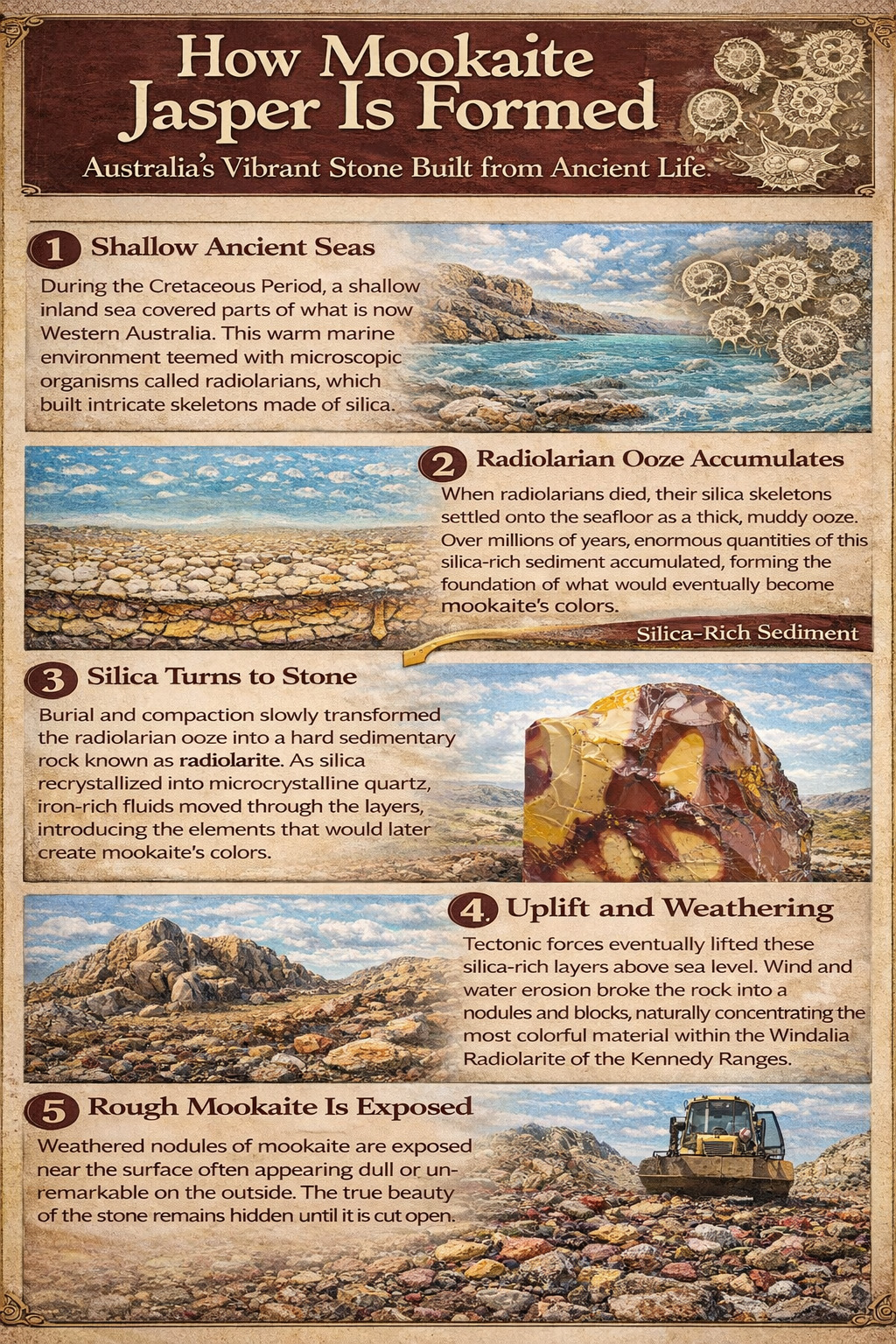
The process of forming mookaite.
The stone is typically recovered as nodules, slabs, or fractured blocks weathered out of the surrounding host rock. Because the best colors often occur in irregular internal bands, the true beauty of mookaite is usually revealed only after cutting and polishing.
Mining and Collection History
Mookaite has been known to Indigenous Australians for thousands of years and was traditionally used as a tool stone due to its hardness and ability to fracture predictably. The name “mookaite” itself is derived from a local Aboriginal term referencing nearby water sources, sometimes translated as “running waters.” Modern lapidary interest in mookaite began in the mid–20th century, when rockhounds and cutters recognized its exceptional color range and polish quality. Most mookaite is collected through small-scale quarrying or surface recovery rather than large industrial mining operations. This keeps production limited and ensures that high-quality material remains desirable and increasingly scarce.
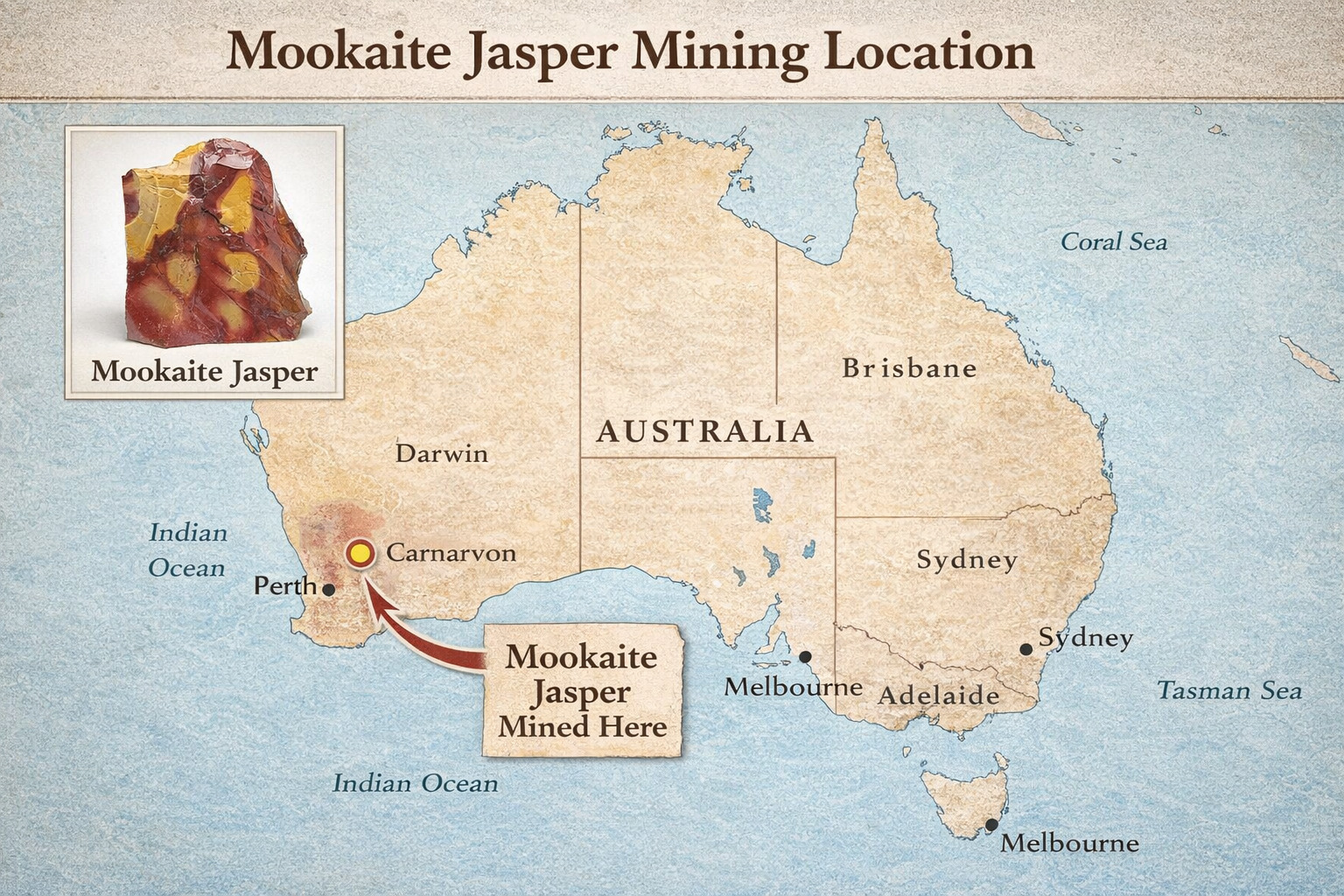
Location of Mookaite mining in Australia.
Physical Properties and Lapidary Use
Mookaite is composed mainly of microcrystalline quartz, giving it a Mohs hardness of about 6.5–7. This makes it durable enough for jewelry, cabochons, carvings, and polished display stones. It takes an excellent polish, often developing a soft, waxy to vitreous luster that enhances its natural color contrasts. Because the patterns vary dramatically even within a single nodule, mookaite is especially prized by lapidaries who enjoy revealing hidden designs through careful cutting. No two pieces are ever alike, and orientation during cutting can dramatically change the final appearance.
What sets mookaite apart from other jaspers is not just its color, but its origin story. It is a gemstone literally built from microscopic fossils, shaped by ancient seas, and colored by subtle geochemical changes over millions of years. Each band, swirl, and patch records a moment in Earth’s deep past, preserved in stone and polished for modern hands. For collectors, jewelers, and geology enthusiasts alike, mookaite jasper is a reminder that some of the most beautiful stones on Earth are born not from fire or pressure alone, but from life itself settling slowly onto the ocean floor.


