 Reviews

Magnetite: Earth’s Natural Magnet
Magnetite is one of the most remarkable minerals on Earth—so much so that it quite literally helped humans find their way across the planet. Known for its ability to attract iron and generate a magnetic field, magnetite is the strongest naturally occurring magnetic mineral and one of the few minerals capable of acting as a permanent magnet. Long before electricity or modern physics, magnetite quietly shaped navigation, metallurgy, and scientific understanding.
Chemically, magnetite is an iron oxide with the formula Fe₃O₄, containing both ferrous (Fe²⁺) and ferric (Fe³⁺) iron within the same crystal structure. This dual oxidation state is what gives magnetite many of its unusual physical properties, including electrical conductivity and magnetism. It is one of the most abundant iron minerals on Earth and a major component of the planet’s crust, mantle, and even meteorites.
Magnetite has been found on every continent and on other planetary bodies, including Mars. Tiny crystals of magnetite have even been discovered inside living organisms—ranging from bacteria to birds and humans—where they are believed to play a role in sensing Earth’s magnetic field. Few minerals can claim such an extraordinary reach, from deep planetary interiors to biological systems.
Magnetite typically appears black to dark gray with a metallic to dull luster. Well-formed crystals are commonly octahedral, though dodecahedral crystals and massive granular forms are also widespread. One of magnetite’s most distinctive traits is its density—pieces feel noticeably heavy for their size. Magnetite has a black streak, a Mohs hardness of about 5.5–6.5, and is often found associated with other iron minerals such as hematite, ilmenite, and pyrite.
The most reliable diagnostic feature of magnetite is, of course, magnetism. Many specimens will attract iron filings, steel objects, or even small nails. Some magnetite specimens, known as lodestone, are naturally magnetized and can attract iron without any external magnetic field.
Magnetite forms through a wide range of geological processes, making it one of the most geologically versatile minerals known.
Igneous Formation
One of the most common ways magnetite forms is during the cooling and crystallization of magma. As molten rock cools, magnetite may crystallize early due to its high melting point. It is especially common in mafic and ultramafic igneous rocks such as basalt, gabbro, and peridotite. In some layered intrusions, magnetite can accumulate in thick, economically valuable bands.
Metamorphic Processes
Magnetite also forms during metamorphism, particularly when iron-rich rocks are subjected to heat and pressure. Contact metamorphism near intrusive bodies can convert iron-bearing minerals into magnetite, often forming coarse crystalline masses.
Hydrothermal Activity
Iron-rich hydrothermal fluids can precipitate magnetite as they cool and react with surrounding rock. These deposits are often associated with skarns and can produce exceptionally pure and massive magnetite bodies.
Sedimentary and Chemical Formation
In sedimentary environments, magnetite can form through chemical precipitation or diagenetic processes. Tiny magnetite grains are common in sandstones and marine sediments, where they can preserve records of Earth’s ancient magnetic field.
Biological Formation
One of the most fascinating formation pathways is biological. Certain bacteria produce microscopic magnetite crystals inside their cells, arranged in chains that act like internal compasses. These “magnetotactic bacteria” use magnetite to navigate along Earth’s magnetic field lines, helping them find optimal living conditions in aquatic environments.
Magnetite plays a crucial role in paleomagnetism—the study of Earth’s ancient magnetic field. As magnetite crystals form and settle in sediments or cool in volcanic rocks, they align themselves with the direction of the planet’s magnetic field at that time. Once locked into place, these crystals preserve a record of magnetic orientation that can last hundreds of millions of years.
By studying magnetite in rocks, geologists have been able to confirm continental drift, plate tectonics, and even map reversals of Earth’s magnetic poles. Few minerals have contributed as much to our understanding of planetary motion and deep time.
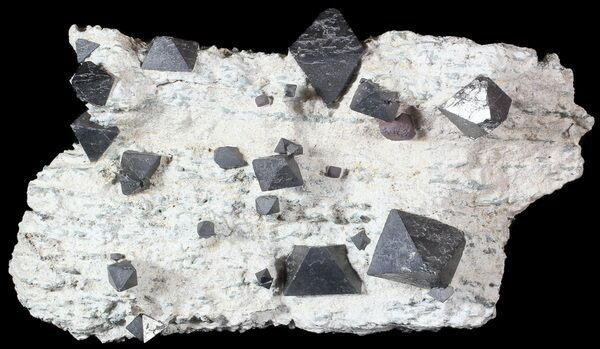
Octahedral magnetite crystals from the Tomkap Magnetite Mine in Western Australia.
Magnetite has played a foundational role in human civilization, bridging the gap between ancient discovery and modern technology. As one of the richest naturally occurring iron ores, magnetite has been mined and processed for thousands of years and remains a cornerstone of global metallurgy. Its high iron content and relatively low impurity levels make it especially efficient for producing steel, and some of the world’s most significant iron ore deposits—such as those in Sweden’s Kiruna district, Australia’s Pilbara region, and large portions of North America—are dominated by magnetite-rich formations. The widespread availability of magnetite has directly influenced the rise of iron tools, weapons, infrastructure, and ultimately industrial society itself.
Long before its value as an industrial resource was understood, magnetite’s most mysterious property—its magnetism—captured human attention. Naturally magnetized magnetite, known as lodestone, was the first material ever observed to exert an invisible attractive force. Ancient Chinese scholars recognized that suspended pieces of lodestone would consistently align in a north–south direction, leading to the development of the earliest magnetic compasses more than two thousand years ago. This discovery transformed navigation, allowing mariners to travel beyond familiar coastlines and paving the way for long-distance trade, exploration, and cultural exchange across oceans.
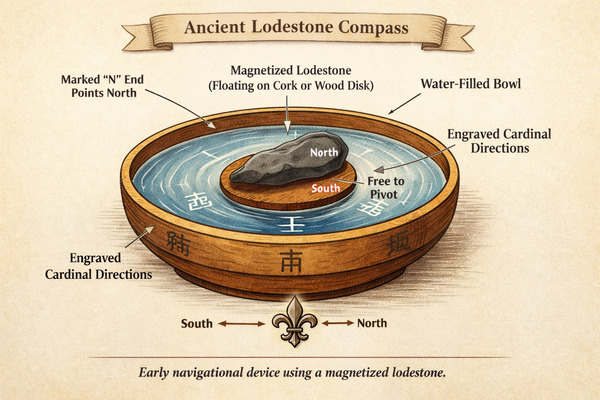
Diagram of an ancient loadstone compass.
In the modern world, magnetite continues to be indispensable across a wide range of industrial and technological applications. Its density and magnetic properties make it ideal for dense media separation in coal processing and mineral beneficiation, where it helps separate valuable materials from waste. Magnetite is also widely used in water treatment and wastewater purification, where it can bind contaminants and be magnetically removed. Finely ground magnetite serves as a pigment in coatings and paints, while specialized forms are used in magnetic recording media and electronic components. Due to its high density and stability, magnetite is also incorporated into concrete for radiation shielding in medical and nuclear facilities.
Scientific and medical research has opened yet another chapter in magnetite’s long history of usefulness. At the nanoscale, engineered magnetite particles are now used in advanced medical technologies, including targeted drug delivery systems, MRI contrast agents, and experimental cancer therapies such as magnetic hyperthermia, where controlled heating destroys tumor cells. Remarkably, these applications mirror magnetite’s natural role in biology—tiny magnetite crystals occur in certain bacteria, animals, and even the human brain, where they are thought to assist in magnetic field detection and spatial orientation.
Magnetite’s cultural and philosophical significance is just as deep as its practical importance. The mineral takes its name from Magnesia, an ancient region of what is now Turkey, where magnetic stones were first described by Greek scholars. Early philosophers struggled to explain how a stone could exert force without physical contact, and magnetite became a symbol of hidden powers and natural mysteries. During the Middle Ages, it was believed to possess healing properties and was used in folk medicine, while alchemists saw magnetite as a metaphor for attraction, balance, and unseen cosmic forces.
By the Renaissance, systematic studies of magnetite and magnetism helped lay the groundwork for modern physics, eventually leading to breakthroughs in electricity, electromagnetism, and engineering that underpin today’s technological world. Few minerals can claim such an unbroken thread of influence—from ancient superstition and navigation to steel production, medical science, and our understanding of planetary forces.
Magnetite stands as a rare example of a mineral whose significance extends far beyond geology, shaping human history, technology, and our perception of the invisible forces that govern the natural world.

Chemically, magnetite is an iron oxide with the formula Fe₃O₄, containing both ferrous (Fe²⁺) and ferric (Fe³⁺) iron within the same crystal structure. This dual oxidation state is what gives magnetite many of its unusual physical properties, including electrical conductivity and magnetism. It is one of the most abundant iron minerals on Earth and a major component of the planet’s crust, mantle, and even meteorites.
Magnetite has been found on every continent and on other planetary bodies, including Mars. Tiny crystals of magnetite have even been discovered inside living organisms—ranging from bacteria to birds and humans—where they are believed to play a role in sensing Earth’s magnetic field. Few minerals can claim such an extraordinary reach, from deep planetary interiors to biological systems.
Physical and Identifying Characteristics
Magnetite typically appears black to dark gray with a metallic to dull luster. Well-formed crystals are commonly octahedral, though dodecahedral crystals and massive granular forms are also widespread. One of magnetite’s most distinctive traits is its density—pieces feel noticeably heavy for their size. Magnetite has a black streak, a Mohs hardness of about 5.5–6.5, and is often found associated with other iron minerals such as hematite, ilmenite, and pyrite.
The most reliable diagnostic feature of magnetite is, of course, magnetism. Many specimens will attract iron filings, steel objects, or even small nails. Some magnetite specimens, known as lodestone, are naturally magnetized and can attract iron without any external magnetic field.
How Magnetite Forms
Magnetite forms through a wide range of geological processes, making it one of the most geologically versatile minerals known.
Igneous Formation
One of the most common ways magnetite forms is during the cooling and crystallization of magma. As molten rock cools, magnetite may crystallize early due to its high melting point. It is especially common in mafic and ultramafic igneous rocks such as basalt, gabbro, and peridotite. In some layered intrusions, magnetite can accumulate in thick, economically valuable bands.
Metamorphic Processes
Magnetite also forms during metamorphism, particularly when iron-rich rocks are subjected to heat and pressure. Contact metamorphism near intrusive bodies can convert iron-bearing minerals into magnetite, often forming coarse crystalline masses.
Hydrothermal Activity
Iron-rich hydrothermal fluids can precipitate magnetite as they cool and react with surrounding rock. These deposits are often associated with skarns and can produce exceptionally pure and massive magnetite bodies.
Sedimentary and Chemical Formation
In sedimentary environments, magnetite can form through chemical precipitation or diagenetic processes. Tiny magnetite grains are common in sandstones and marine sediments, where they can preserve records of Earth’s ancient magnetic field.
Biological Formation
One of the most fascinating formation pathways is biological. Certain bacteria produce microscopic magnetite crystals inside their cells, arranged in chains that act like internal compasses. These “magnetotactic bacteria” use magnetite to navigate along Earth’s magnetic field lines, helping them find optimal living conditions in aquatic environments.
Magnetite and Earth’s Magnetic History
Magnetite plays a crucial role in paleomagnetism—the study of Earth’s ancient magnetic field. As magnetite crystals form and settle in sediments or cool in volcanic rocks, they align themselves with the direction of the planet’s magnetic field at that time. Once locked into place, these crystals preserve a record of magnetic orientation that can last hundreds of millions of years.
By studying magnetite in rocks, geologists have been able to confirm continental drift, plate tectonics, and even map reversals of Earth’s magnetic poles. Few minerals have contributed as much to our understanding of planetary motion and deep time.
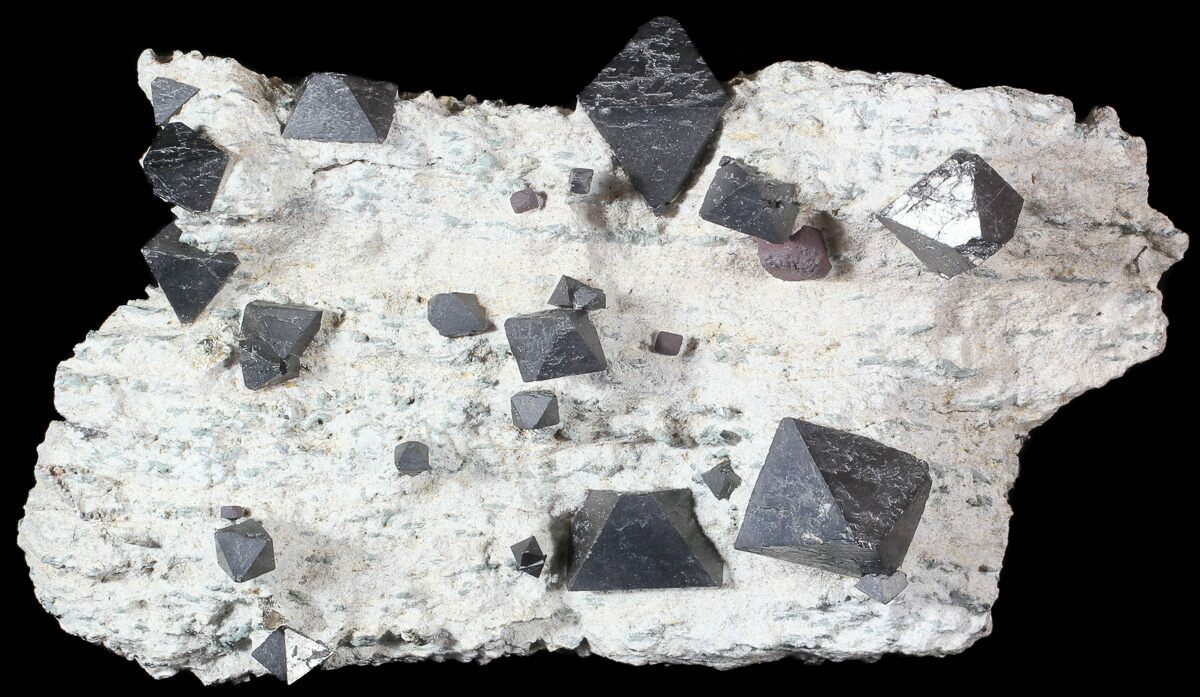
Octahedral magnetite crystals from the Tomkap Magnetite Mine in Western Australia.
Uses of Magnetite and Its Role in Human History
Magnetite has played a foundational role in human civilization, bridging the gap between ancient discovery and modern technology. As one of the richest naturally occurring iron ores, magnetite has been mined and processed for thousands of years and remains a cornerstone of global metallurgy. Its high iron content and relatively low impurity levels make it especially efficient for producing steel, and some of the world’s most significant iron ore deposits—such as those in Sweden’s Kiruna district, Australia’s Pilbara region, and large portions of North America—are dominated by magnetite-rich formations. The widespread availability of magnetite has directly influenced the rise of iron tools, weapons, infrastructure, and ultimately industrial society itself.
Long before its value as an industrial resource was understood, magnetite’s most mysterious property—its magnetism—captured human attention. Naturally magnetized magnetite, known as lodestone, was the first material ever observed to exert an invisible attractive force. Ancient Chinese scholars recognized that suspended pieces of lodestone would consistently align in a north–south direction, leading to the development of the earliest magnetic compasses more than two thousand years ago. This discovery transformed navigation, allowing mariners to travel beyond familiar coastlines and paving the way for long-distance trade, exploration, and cultural exchange across oceans.
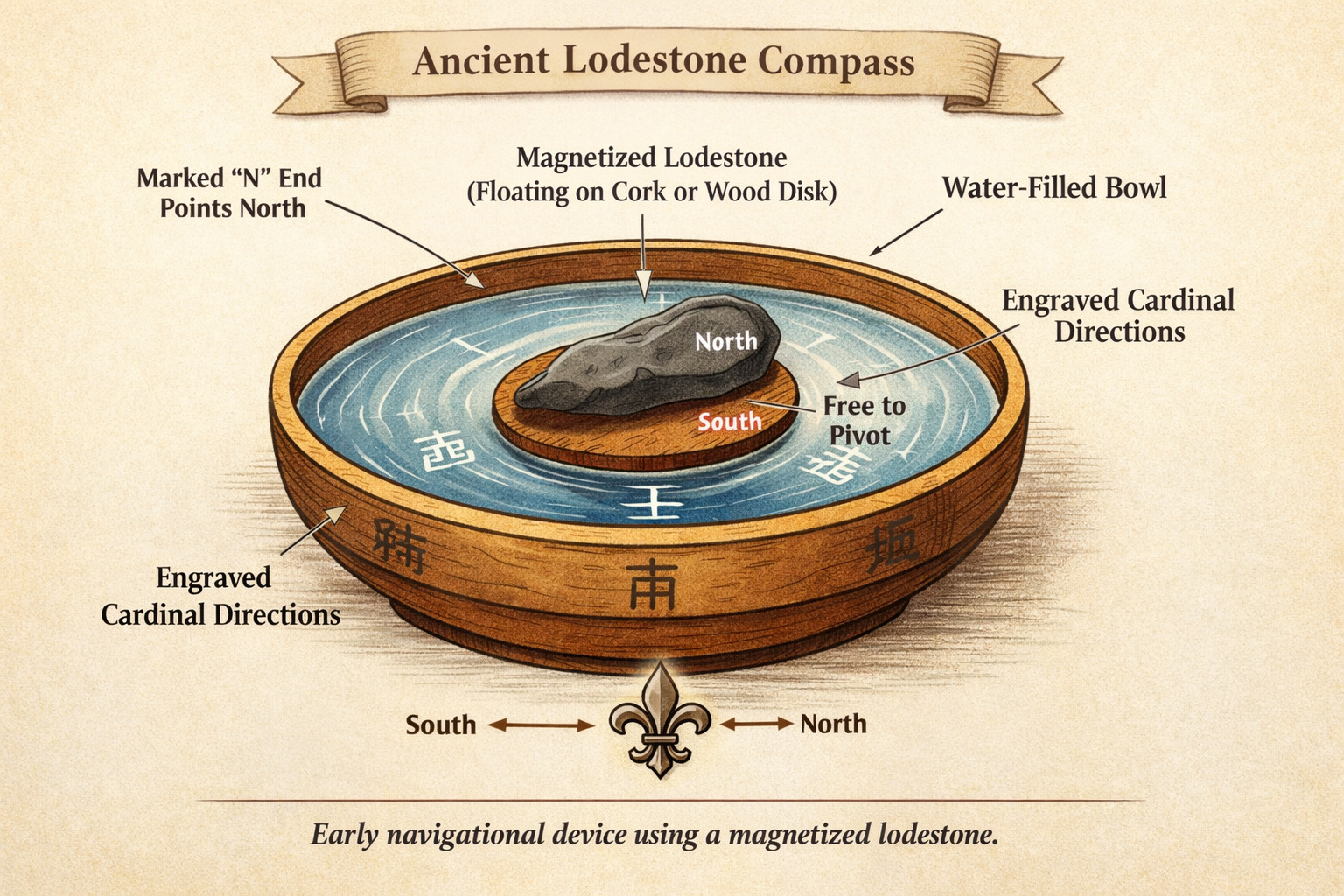
Diagram of an ancient loadstone compass.
In the modern world, magnetite continues to be indispensable across a wide range of industrial and technological applications. Its density and magnetic properties make it ideal for dense media separation in coal processing and mineral beneficiation, where it helps separate valuable materials from waste. Magnetite is also widely used in water treatment and wastewater purification, where it can bind contaminants and be magnetically removed. Finely ground magnetite serves as a pigment in coatings and paints, while specialized forms are used in magnetic recording media and electronic components. Due to its high density and stability, magnetite is also incorporated into concrete for radiation shielding in medical and nuclear facilities.
Scientific and medical research has opened yet another chapter in magnetite’s long history of usefulness. At the nanoscale, engineered magnetite particles are now used in advanced medical technologies, including targeted drug delivery systems, MRI contrast agents, and experimental cancer therapies such as magnetic hyperthermia, where controlled heating destroys tumor cells. Remarkably, these applications mirror magnetite’s natural role in biology—tiny magnetite crystals occur in certain bacteria, animals, and even the human brain, where they are thought to assist in magnetic field detection and spatial orientation.
Magnetite’s cultural and philosophical significance is just as deep as its practical importance. The mineral takes its name from Magnesia, an ancient region of what is now Turkey, where magnetic stones were first described by Greek scholars. Early philosophers struggled to explain how a stone could exert force without physical contact, and magnetite became a symbol of hidden powers and natural mysteries. During the Middle Ages, it was believed to possess healing properties and was used in folk medicine, while alchemists saw magnetite as a metaphor for attraction, balance, and unseen cosmic forces.
By the Renaissance, systematic studies of magnetite and magnetism helped lay the groundwork for modern physics, eventually leading to breakthroughs in electricity, electromagnetism, and engineering that underpin today’s technological world. Few minerals can claim such an unbroken thread of influence—from ancient superstition and navigation to steel production, medical science, and our understanding of planetary forces.
Magnetite stands as a rare example of a mineral whose significance extends far beyond geology, shaping human history, technology, and our perception of the invisible forces that govern the natural world.


