 Reviews

Celestite: The Sky-Blue Mineral of Ancient Seas
Celestite—also spelled celestine—is one of the most visually striking sulfate minerals found on Earth, instantly recognized by its delicate, sky-blue crystals. Despite its soft, serene appearance, celestite has a geological story filled with dramatic processes, ancient oceans, and surprising scientific significance. The mineral was first described in the late 1700s and was named for its celestial blue color. Today it is beloved by mineral collectors, fossil hunters, and geologists alike.
What makes celestite especially fascinating is how rare true blue minerals are. Very few substances in nature consistently produce a pure, soft blue hue, yet celestite does so through trace amounts of impurities and unique structural characteristics. It also forms in a wide range of environments—from the voids of ancient marine sediments to volcanic fumaroles—making it one of the most geologically diverse sulfate minerals known. Some celestite geodes from Madagascar contain crystal-lined cavities weighing hundreds of pounds, and in Ohio’s famous Crystal Cave, celestite crystals reach staggering sizes of up to three feet long, among the largest mineral crystals ever found on Earth.
Celestite also plays a role in the natural world beyond geology: the internal skeletons (sclerites) of certain marine animals like Acantharea radiolarians are made entirely of celestite, meaning parts of our modern oceans are literally building microscopic creatures out of this mineral. And on a global scale, celestite is the world’s primary source of strontium, an element used in fireworks, metal alloys, scientific instruments, and even to help reveal secrets of Earth’s historic climate.
Celestite’s famous blue coloration is unusual because it does not come from copper, cobalt, or other metals that typically create blue minerals. Instead, the color arises from very slight structural irregularities and trace impurities that subtly affect how the crystal absorbs and scatters light. This delicate mechanism is why celestite’s blue shades are typically pastel rather than intense, and why truly vivid sky-blue celestite is highly prized by collectors.
Most celestite originates in sedimentary environments created by the slow evaporation of ancient seawater. As the water evaporated, sulfate-rich layers accumulated, and mineral-laden groundwater later moved through these layers and precipitated celestite. It can also form in volcanic and hydrothermal settings, though these occurrences are less common. Some of the most spectacular formations occur in large geodes from Madagascar, where mineral-rich fluids filled cavities and allowed vast clusters of crystals to grow undisturbed.
Common formation settings include:
Ancient marine sediments such as limestone and dolomite
Evaporite deposits left behind by drying seas or lagoons
Hydrothermal veins
Volcanic fumaroles
Large geodes, especially those from Madagascar
Celestite is found on almost every continent, but only a handful of localities produce specimens of exceptional size, color, and clarity. The most famous modern source is Madagascar, particularly near the village of Sakoany along the northwest coast. Here, enormous nodules formed within ancient sedimentary deposits, and when split open they reveal chambers lined with brilliant sky-blue crystals. Many of these geodes weigh between 50 and 300 pounds, and some even larger examples are known. Madagascar celestite has become the standard by which most collectors judge fine blue celestite due to its intense color and well-formed crystal clusters.
In the United States, Ohio holds a special place in celestite history. The deposits at Put-in-Bay on South Bass Island produced some of the largest celestite crystals ever found. The walls of the region’s famous Crystal Cave are completely lined with massive, three-dimensional celestite crystals, some reaching several feet in length. Although commercial mining ended long ago, the site remains one of the most dramatic demonstrations of celestite’s ability to form colossal crystals under the right geological conditions.
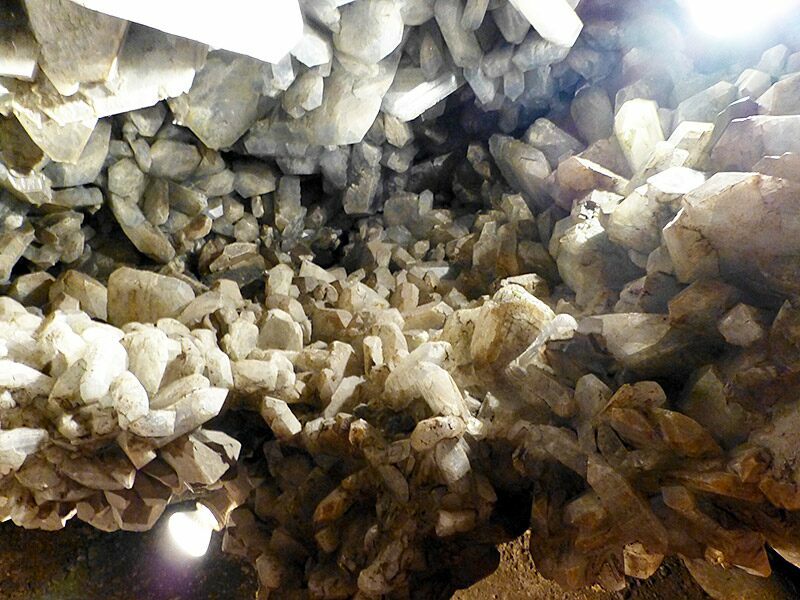
Canada is also known for high-quality celestite. Ontario has produced attractive colorless to pale blue crystals in well-defined tabular forms. These specimens tend to be less massive than those from Madagascar or Ohio but are admired for their clarity and sharp crystal faces. Mexico yields celestite in a very different geological context, often linked to volcanic activity. Mexican specimens can show excellent crystal form, sometimes associated with sulfur or other fumarolic minerals, giving them a distinctive appearance compared to their sedimentary counterparts.
Historically, Spain was one of the earliest European sources of celestite, with deposits in the regions of Murcia and the Balearic Islands. These localities supplied mineral collectors during the 19th century and played an important role in early geological studies of sulfate minerals. In the United Kingdom, the Bristol area became a major celestite-producing district during the industrial era and was once one of the world’s leading sources of strontium ore. While large-scale extraction has ceased, these historic mines remain culturally significant and occasionally yield fine specimens.
Additional celestite occurrences are scattered across the globe—Germany, Italy, Turkey, Russia, Tunisia, Iran, and Egypt all produce celestite to varying degrees. Some localities yield superb crystal groups, while others consist mainly of industrial-grade material mined for strontium production. Regardless of location, celestite deposits almost always reflect environments shaped by evaporating seawater, sulfate-rich sediments, or hydrothermal activity, making them valuable windows into the geological past.
Overall, celestite’s global distribution underscores its remarkable versatility as a mineral. Whether forming cathedral-like chambers in Ohio, giant geodes in Madagascar, or delicate tabular crystals in Canada, each locality tells a different chapter of the mineral’s complex geological history.
Celestite is the most important natural source of strontium, a metallic element with a wide range of industrial and scientific uses. Strontium compounds are responsible for producing the vivid red colors in fireworks and flares, and they help strengthen certain types of glass and ceramics. The element also plays a role in metal refining and is used in specialized scientific instruments and research.
One of the most valuable scientific applications involves strontium isotopes preserved within celestite deposits. These isotopes allow researchers to reconstruct the chemistry of ancient seawater, providing insight into long-term climate cycles, ocean circulation patterns, and environmental changes over millions of years. As a result, celestite is not only a striking mineral but also an important tool for understanding Earth’s deep history.
One of celestite’s most surprising roles is its biological significance. Certain planktonic organisms, such as acantharian radiolarians, build their internal skeletons entirely out of celestite. When these organisms die, their crystalline skeletons sink to the seafloor, influencing marine sediment chemistry. Celestite also occasionally fills or replaces the shells of ancient marine creatures, forming fossils lined with delicate blue crystals.
Celestite stands out not just for its beauty but for the remarkable geological and biological roles it plays. It records the story of ancient oceans, volcanic activity, and deep-time environmental changes. Its crystals can grow to extraordinary sizes, fill massive geodes, and even form the skeletal frameworks of living organisms. For collectors and geologists alike, celestite remains one of the most fascinating and meaningful minerals found anywhere in the natural world.

What makes celestite especially fascinating is how rare true blue minerals are. Very few substances in nature consistently produce a pure, soft blue hue, yet celestite does so through trace amounts of impurities and unique structural characteristics. It also forms in a wide range of environments—from the voids of ancient marine sediments to volcanic fumaroles—making it one of the most geologically diverse sulfate minerals known. Some celestite geodes from Madagascar contain crystal-lined cavities weighing hundreds of pounds, and in Ohio’s famous Crystal Cave, celestite crystals reach staggering sizes of up to three feet long, among the largest mineral crystals ever found on Earth.
Celestite also plays a role in the natural world beyond geology: the internal skeletons (sclerites) of certain marine animals like Acantharea radiolarians are made entirely of celestite, meaning parts of our modern oceans are literally building microscopic creatures out of this mineral. And on a global scale, celestite is the world’s primary source of strontium, an element used in fireworks, metal alloys, scientific instruments, and even to help reveal secrets of Earth’s historic climate.
Celestite’s famous blue coloration is unusual because it does not come from copper, cobalt, or other metals that typically create blue minerals. Instead, the color arises from very slight structural irregularities and trace impurities that subtly affect how the crystal absorbs and scatters light. This delicate mechanism is why celestite’s blue shades are typically pastel rather than intense, and why truly vivid sky-blue celestite is highly prized by collectors.
How Celestite Forms
Most celestite originates in sedimentary environments created by the slow evaporation of ancient seawater. As the water evaporated, sulfate-rich layers accumulated, and mineral-laden groundwater later moved through these layers and precipitated celestite. It can also form in volcanic and hydrothermal settings, though these occurrences are less common. Some of the most spectacular formations occur in large geodes from Madagascar, where mineral-rich fluids filled cavities and allowed vast clusters of crystals to grow undisturbed.
Common formation settings include:
Where Celestite Is Found
Celestite is found on almost every continent, but only a handful of localities produce specimens of exceptional size, color, and clarity. The most famous modern source is Madagascar, particularly near the village of Sakoany along the northwest coast. Here, enormous nodules formed within ancient sedimentary deposits, and when split open they reveal chambers lined with brilliant sky-blue crystals. Many of these geodes weigh between 50 and 300 pounds, and some even larger examples are known. Madagascar celestite has become the standard by which most collectors judge fine blue celestite due to its intense color and well-formed crystal clusters.
In the United States, Ohio holds a special place in celestite history. The deposits at Put-in-Bay on South Bass Island produced some of the largest celestite crystals ever found. The walls of the region’s famous Crystal Cave are completely lined with massive, three-dimensional celestite crystals, some reaching several feet in length. Although commercial mining ended long ago, the site remains one of the most dramatic demonstrations of celestite’s ability to form colossal crystals under the right geological conditions.
Canada is also known for high-quality celestite. Ontario has produced attractive colorless to pale blue crystals in well-defined tabular forms. These specimens tend to be less massive than those from Madagascar or Ohio but are admired for their clarity and sharp crystal faces. Mexico yields celestite in a very different geological context, often linked to volcanic activity. Mexican specimens can show excellent crystal form, sometimes associated with sulfur or other fumarolic minerals, giving them a distinctive appearance compared to their sedimentary counterparts.
Historically, Spain was one of the earliest European sources of celestite, with deposits in the regions of Murcia and the Balearic Islands. These localities supplied mineral collectors during the 19th century and played an important role in early geological studies of sulfate minerals. In the United Kingdom, the Bristol area became a major celestite-producing district during the industrial era and was once one of the world’s leading sources of strontium ore. While large-scale extraction has ceased, these historic mines remain culturally significant and occasionally yield fine specimens.
Additional celestite occurrences are scattered across the globe—Germany, Italy, Turkey, Russia, Tunisia, Iran, and Egypt all produce celestite to varying degrees. Some localities yield superb crystal groups, while others consist mainly of industrial-grade material mined for strontium production. Regardless of location, celestite deposits almost always reflect environments shaped by evaporating seawater, sulfate-rich sediments, or hydrothermal activity, making them valuable windows into the geological past.
Overall, celestite’s global distribution underscores its remarkable versatility as a mineral. Whether forming cathedral-like chambers in Ohio, giant geodes in Madagascar, or delicate tabular crystals in Canada, each locality tells a different chapter of the mineral’s complex geological history.
Celestite and Strontium
Celestite is the most important natural source of strontium, a metallic element with a wide range of industrial and scientific uses. Strontium compounds are responsible for producing the vivid red colors in fireworks and flares, and they help strengthen certain types of glass and ceramics. The element also plays a role in metal refining and is used in specialized scientific instruments and research.
One of the most valuable scientific applications involves strontium isotopes preserved within celestite deposits. These isotopes allow researchers to reconstruct the chemistry of ancient seawater, providing insight into long-term climate cycles, ocean circulation patterns, and environmental changes over millions of years. As a result, celestite is not only a striking mineral but also an important tool for understanding Earth’s deep history.
Celestite in the Natural World
One of celestite’s most surprising roles is its biological significance. Certain planktonic organisms, such as acantharian radiolarians, build their internal skeletons entirely out of celestite. When these organisms die, their crystalline skeletons sink to the seafloor, influencing marine sediment chemistry. Celestite also occasionally fills or replaces the shells of ancient marine creatures, forming fossils lined with delicate blue crystals.
Celestite stands out not just for its beauty but for the remarkable geological and biological roles it plays. It records the story of ancient oceans, volcanic activity, and deep-time environmental changes. Its crystals can grow to extraordinary sizes, fill massive geodes, and even form the skeletal frameworks of living organisms. For collectors and geologists alike, celestite remains one of the most fascinating and meaningful minerals found anywhere in the natural world.


