 Reviews

Obsidian — Nature’s Volcanic Glass
Obsidian is not born from quiet geologic time like most minerals—it is forged in fire, quenched in an instant, and cools so fast that atoms have no time to organize into crystals. The result is one of Earth’s most fascinating natural materials: a mineraloid that behaves like a rock, forms like a melt, and breaks like glass.
Long before humans understood volcanoes, they understood obsidian’s edge. Archaeological evidence shows that obsidian tools predate recorded history, appearing in some of the earliest human settlements. Unlike steel or flint, obsidian can fracture into edges only a few nanometers wide—so sharp that modern surgeons have experimented with obsidian scalpels for precision incisions. Some blades crafted today are sharper than high-grade surgical steel.

A piece of natural obsidian from Oregon.
Despite being called a “mineral,” obsidian technically is not one—because it lacks a crystalline structure. It is classified as a volcanic glass mineraloid, composed mostly of silicon dioxide (typically 70–75%), along with variable amounts of magnesium, iron, calcium, and alkali metals. Its glassy nature gives it a smooth, lustrous surface, while its chemical impurities contribute to the dramatic variety of colors and patterns that make it a favorite among collectors.
Obsidian also holds a strange connection to space. Some impact events create tektites, glassy materials similar in appearance to obsidian but formed when meteorite impacts melt terrestrial rock. While not true obsidian, these objects—such as moldavite—are often mistaken for it. Conversely, real obsidian has been found embedded in ancient trade routes spanning continents, proving it was one of the first globally valued geologic commodities.
Even more curious: because obsidian forms from rapid cooling, it can trap microscopic bubbles, minerals, and flow banding patterns that act like a frozen record of a volcanic moment. Each specimen is a geological snapshot, a volcanic photograph in stone.
Obsidian forms when felsic (silica-rich) lava cools extremely rapidly, preventing atoms from arranging into a crystalline lattice. This typically occurs at the margins of a lava flow, where molten rock meets air or water and is chilled almost instantly. For obsidian to form, several specific environmental and chemical conditions must align:

Obsidian Formation Requires Very Rapid Cooling Of High Silica Magma
High Silica Content - The parent magma must be enriched in silica. Obsidian is most commonly associated with rhyolitic and dacitic lavas, which are silica-saturated volcanic melts.
Rapid Cooling Environment - Cooling happens too fast for crystals to form, essentially “freezing” the melt into natural glass. This can occur when lava meets the sudden chill of a lake or ocean, collides with groundwater or rain-soaked earth, or erupts into cold, high-elevation air. It can also form during violent explosions, when lava depressurizes so rapidly that it shatters into glass before crystals ever have a chance to grow.
Viscous Lava Flows - Because silica-rich lava is highly viscous, it tends to form thick, slow-moving flows, domes, and volcanic plugs, creating ideal environments for glassy margins to quench into obsidian.
Low Water Content in Melt (Optional but Helpful) - While obsidian can form in both wet and dry magmas, melts with lower water content are more likely to remain glassy instead of crystallizing into fine-grained rock.
Obsidian is commonly found in:
Volcanic domes
Lava flow margins
Ignimbrite sheets (volcanic ash flow deposits)
Caldera complexes
Subglacial eruptions, where lava is rapidly chilled by ice
Important obsidian-forming regions include volcanic belts along tectonic subduction zones, continental rift environments, and hotspots. This is why major deposits occur in places like Mexico, the United States (especially Oregon, Utah and California), Iceland, Turkey, Japan, and Indonesia.
Obsidian entered the human story long before metal did. The first time someone struck it, it split into a blade finer than any edge nature had offered before, and civilization quietly changed. In the Old Stone Age, long before pottery or farming, obsidian was already a technological marvel. Early humans learned that it broke predictably, smoothly, and wickedly sharp, and they shaped it into knives, scrapers, and spear points. Some of the oldest known obsidian tools, found in the Rift Valley of Ethiopia, date back hundreds of thousands of years, carrying fingerprints of a world where survival depended on stone and ingenuity.
But obsidian was never just a tool—it was one of humanity’s first luxury materials. Because it was tied to volcanoes, and volcanoes were tied to gods, obsidian took on mythic significance. In ancient Mesoamerica, the Aztecs revered it as the stone of Tezcatlipoca, the Smoking Mirror, a deity of night, sorcery, and reflection. The name itself was literal—obsidian mirrors were polished to such a high sheen that they became instruments of ritual, prophecy, and status. Priests gazed into them seeking visions, warriors carried obsidian blades into ceremony, and nobility wore carved obsidian ear spools and ornaments as symbols of rank. The Maya, too, valued obsidian, not only for blades but for commerce, moving the glass along established trade corridors that stitched together city-states across the Yucatán.

An ancient obsidian spear point. National Parks Service Gallery
Half a world away, obsidian followed different roads, but for the same reasons. In Neolithic Europe, it moved through Mediterranean exchange networks like a black currency. The most famous source was Anatolia, in what is now Turkey, where vast obsidian flows supplied the ancient world. From there it traveled south into the Levant, west into Greece and Italy, and across islands by canoe and caravan. Its presence in archaeological sites far from volcanoes became one of the first ways scientists reconstructed prehistoric trade patterns. Long before coins or contracts, obsidian was proof of connection, negotiation, and value.
When metallurgy eventually rose, obsidian didn’t fall—it adapted. Metal could replace its function, but never its aesthetic or symbolic appeal. In many cultures it remained a talisman of sharpness, clarity, and protection. Even today, traditional knappers continue crafting arrowheads and ceremonial blades, preserving techniques passed down through generations. And in lapidary workshops, obsidian found new purpose as cabochons, spheres, and carved art pieces, where its fluid surface and deep colors could be appreciated without needing to pierce or cut anything at all.
Modern science eventually rediscovered obsidian’s edge in a surprising place—medicine. Because obsidian can fracture into an edge thinner than a wavelength of visible light, experimental obsidian scalpels have been tested for microsurgical procedures. These blades are not mass-produced, but hand-knapped, shaped by impact instead of machining. The irony is poetic: one of the sharpest instruments in modern medicine is made the same way it was 7,000 years ago.
Industry also found obsidian useful, though indirectly. Its glassy structure made it an ideal material for studying conchoidal fracture mechanics, influencing material sciences and even aerospace engineering. Meanwhile, geologists use obsidian hydration dating, a method that measures the microscopic water absorption layer on its surface, to determine the age of volcanic flows—one of the few cases where a material that forms too fast for crystals can still record time with remarkable reliability.
Obsidian isn’t a single look—it’s a spectrum of volcanic instants preserved in glass, each shaped by chemistry, cooling speed, and the trace minerals caught in the melt.
Snowflake Obsidian
Snowflake obsidian is marked by white, radial “snowflake” patterns—crystal clusters of cristobalite, a high-temperature form of silica that nucleates after the surrounding melt has already quenched into glass. Its formation requires a rare two-stage cooling history: lava must first chill rapidly enough to become obsidian, then linger at temperatures around 700–900 °C long enough for cristobalite to begin growing in spherulitic bursts before the entire flow finally solidifies. These snowflakes are a signature of partial devitrification, a process triggered when silica-rich, highly viscous rhyolitic or dacitic lava cools slowly at depth or within the thick interiors of volcanic domes and flow centers, where heat dissipates unevenly and the glass remains plastic for a short but critical window.
Notable snowflake obsidian deposits occur in young volcanic provinces around the world, but some of the most commercially important sources include the United States, Mexico, Turkey, and Japan. In the U.S., it is famously collected from volcanic fields in Utah, Oregon, and Colorado, where silica-saturated flows and domes provided the ideal thermal pause needed for spherulites to form.
Mahogany Obsidian
Mahogany obsidian is a bold, banded volcanic glass defined by swirls and stripes of deep reddish-brown to nearly black, colored by iron-rich mineral inclusions and oxidation within a silica-saturated melt. Unlike the pure jet-black variety that forms when lava quenches instantly at the surface, mahogany obsidian captures a more dynamic moment inside the flow—one where lava was still stretching, folding, and shearing like molten taffy just before it froze into glass. The brown bands come from iron-bearing particles (commonly magnetite or hematite-leaning nanoinclusions) that oxidize in localized zones while the lava is still hot and mobile. The “special circumstance” for this variety is not just speed, but motion + uneven oxidation—it typically forms in viscous rhyolitic or dacitic flows, volcanic domes, and conduit margins where portions of the melt experience brief oxygen exposure, temperature gradients, and internal flow alignment before quenching halts crystal growth entirely.
Mahogany obsidian is found in many of the same volcanic provinces that produce other silica-rich glasses, but major and well-known sources include Mexico, Iceland, Indonesia, Turkey, and the western United States. In the U.S., it is widely collected from volcanic regions in Oregon, Arizona, California, Nevada, Colorado, and Utah, where slow-moving felsic lava bodies provided the internal flow dynamics and iron chemistry needed to paint obsidian in earth-toned bands.
Rainbow Obsidian
Rainbow obsidian is a rare and mesmerizing form of natural volcanic glass that displays shifting bands of green, gold, purple, and sometimes blue, created by thin-film optical interference rather than pigments or crystal impurities. Its colors come from microscopic, layered bubble horizons—ultra-thin zones filled with flattened gas vesicles that formed as silica-rich lava continued flowing internally after its outer rind had already quenched into obsidian. When light enters these nano-scale layers, it reflects and refracts across bubble surfaces spaced at near-wavelength distances, producing iridescent color flashes that change as the stone is tilted, much like the physics behind soap-film rainbows or oil-slick shimmer.
The special circumstance for rainbow obsidian is a precise combination of very high-silica, highly viscous rhyolitic melt, continued internal flow after glass formation, and a thermal pause just long enough for gas bubbles to stretch into ordered, parallel planes before final quenching locks them in place. Too fast, and the bubbles remain random and non-iridescent; too slow, and the glass devitrifies into stone. The finest rainbow obsidian forms in thick flow interiors and dome conduits where pressure gradients create stratified gas escape layers. Notable deposits are found in volcanic provinces of Mexico (especially Jalisco), the western United States, and parts of Asia. In the U.S., rainbow material is most famously associated with volcanic glass localities in Oregon and California, where ancient flow centers preserved the optical architecture needed to generate obsidian’s most colorful light effect.
Obsidian’s smooth black surface and glassy luster make it easy to imitate, and the market is filled with convincing stand-ins that range from harmless look-alikes to intentional fakes. The most common material passed off as obsidian is dyed industrial glass, which may look nearly identical to natural obsidian when polished, but often contains perfectly round air bubbles that reveal its manufactured origin. Another widespread impostor is black slag glass (sometimes called “slag obsidian”), a waste product of metal smelting. Slag can appear glossy and dark, but its internal flow textures tend to look unnatural and chaotic compared to the silky, volcanic stretching seen in real obsidian. Dyed black onyx is also frequently misrepresented as obsidian in jewelry—onyx is a real mineral, but it is microcrystalline quartz, heavier, waxier in polish, and shows parallel banding under magnification rather than a glassy fracture. The cheapest imitations are resin and plastic, which mimic the color but not the density, warmth, or fracture behavior of natural volcanic glass. Less common but still encountered are painted ceramics, dyed chalcedony, and even glass-based “spiritual market” carvings sold without disclosure.
How to Identify Fake Obsidian
Obsidian is dense and glass-like in weight; resin or plastic fakes feel unusually light
Real obsidian has a cold glassy surface at first touch, while resin warms rapidly in the hand
Obsidian fractures in smooth, curved conchoidal shells; resin and ceramics chip irregularly
Industrial glass fakes may show perfect spherical bubbles; obsidian bubbles, if present, appear stretched or layered
It can scratch softer glass but will not scratch quartz or steel
A streak test produces no powder or mineral streak (unlike dyed onyx or chalcedony)
Plastic/resin may release a faint chemical smell when rubbed; obsidian will not
Under magnification, obsidian lacks crystal faces and shows frozen flow textures, not granular mineral structure
Long before humans understood volcanoes, they understood obsidian’s edge. Archaeological evidence shows that obsidian tools predate recorded history, appearing in some of the earliest human settlements. Unlike steel or flint, obsidian can fracture into edges only a few nanometers wide—so sharp that modern surgeons have experimented with obsidian scalpels for precision incisions. Some blades crafted today are sharper than high-grade surgical steel.
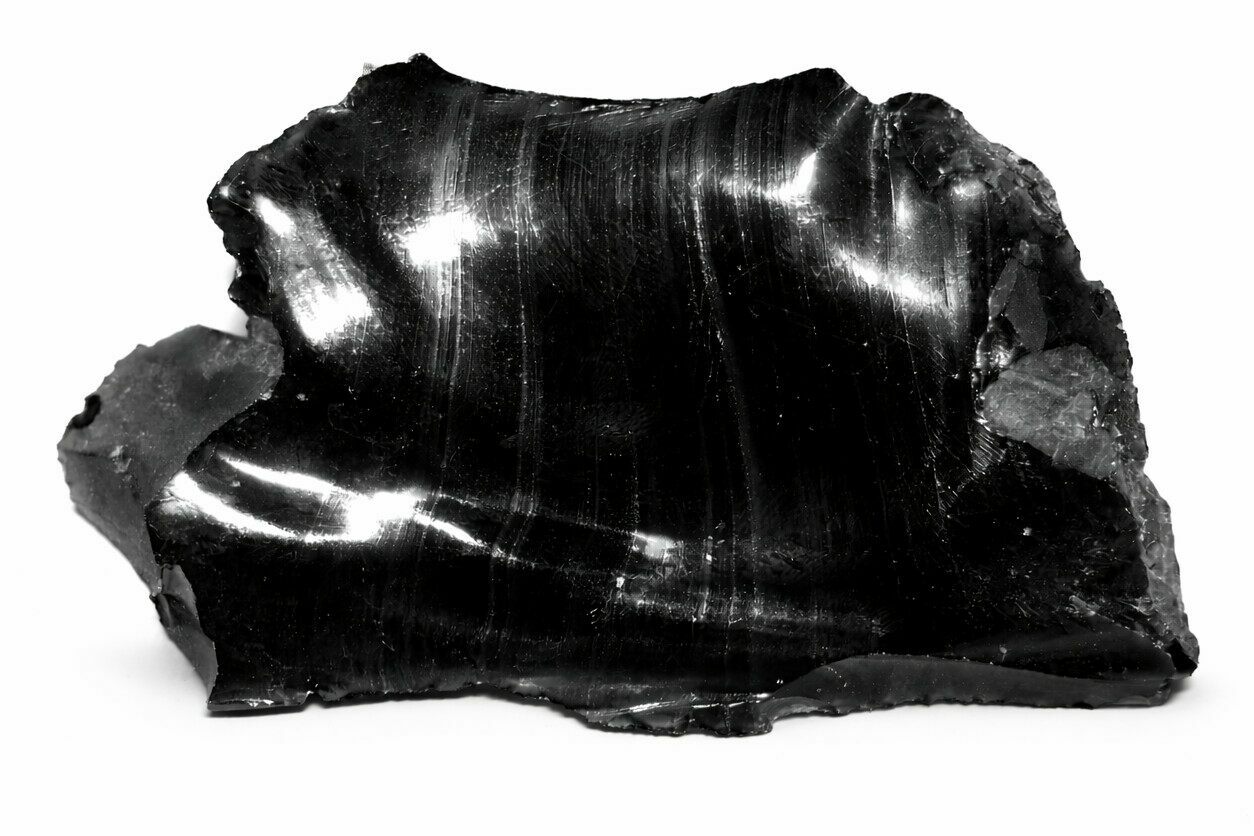
A piece of natural obsidian from Oregon.
Despite being called a “mineral,” obsidian technically is not one—because it lacks a crystalline structure. It is classified as a volcanic glass mineraloid, composed mostly of silicon dioxide (typically 70–75%), along with variable amounts of magnesium, iron, calcium, and alkali metals. Its glassy nature gives it a smooth, lustrous surface, while its chemical impurities contribute to the dramatic variety of colors and patterns that make it a favorite among collectors.
Obsidian also holds a strange connection to space. Some impact events create tektites, glassy materials similar in appearance to obsidian but formed when meteorite impacts melt terrestrial rock. While not true obsidian, these objects—such as moldavite—are often mistaken for it. Conversely, real obsidian has been found embedded in ancient trade routes spanning continents, proving it was one of the first globally valued geologic commodities.

Even more curious: because obsidian forms from rapid cooling, it can trap microscopic bubbles, minerals, and flow banding patterns that act like a frozen record of a volcanic moment. Each specimen is a geological snapshot, a volcanic photograph in stone.
How Obsidian Is Formed
Obsidian forms when felsic (silica-rich) lava cools extremely rapidly, preventing atoms from arranging into a crystalline lattice. This typically occurs at the margins of a lava flow, where molten rock meets air or water and is chilled almost instantly. For obsidian to form, several specific environmental and chemical conditions must align:
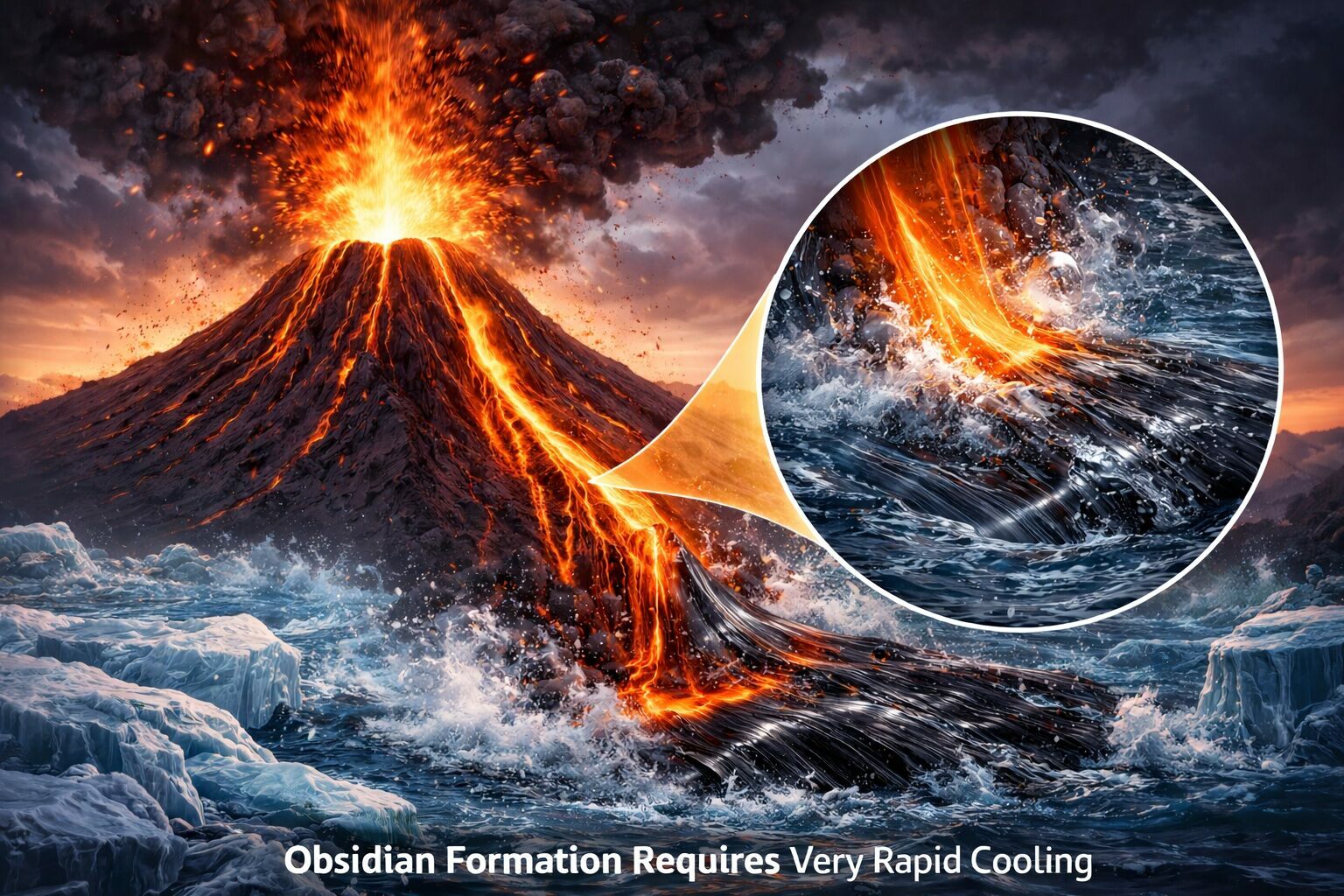
Obsidian Formation Requires Very Rapid Cooling Of High Silica Magma
High Silica Content - The parent magma must be enriched in silica. Obsidian is most commonly associated with rhyolitic and dacitic lavas, which are silica-saturated volcanic melts.
Rapid Cooling Environment - Cooling happens too fast for crystals to form, essentially “freezing” the melt into natural glass. This can occur when lava meets the sudden chill of a lake or ocean, collides with groundwater or rain-soaked earth, or erupts into cold, high-elevation air. It can also form during violent explosions, when lava depressurizes so rapidly that it shatters into glass before crystals ever have a chance to grow.
Viscous Lava Flows - Because silica-rich lava is highly viscous, it tends to form thick, slow-moving flows, domes, and volcanic plugs, creating ideal environments for glassy margins to quench into obsidian.
Low Water Content in Melt (Optional but Helpful) - While obsidian can form in both wet and dry magmas, melts with lower water content are more likely to remain glassy instead of crystallizing into fine-grained rock.
Geologic Environments That Produce Obsidian
Obsidian is commonly found in:
Important obsidian-forming regions include volcanic belts along tectonic subduction zones, continental rift environments, and hotspots. This is why major deposits occur in places like Mexico, the United States (especially Oregon, Utah and California), Iceland, Turkey, Japan, and Indonesia.
History and Uses of Obsidian
Obsidian entered the human story long before metal did. The first time someone struck it, it split into a blade finer than any edge nature had offered before, and civilization quietly changed. In the Old Stone Age, long before pottery or farming, obsidian was already a technological marvel. Early humans learned that it broke predictably, smoothly, and wickedly sharp, and they shaped it into knives, scrapers, and spear points. Some of the oldest known obsidian tools, found in the Rift Valley of Ethiopia, date back hundreds of thousands of years, carrying fingerprints of a world where survival depended on stone and ingenuity.
But obsidian was never just a tool—it was one of humanity’s first luxury materials. Because it was tied to volcanoes, and volcanoes were tied to gods, obsidian took on mythic significance. In ancient Mesoamerica, the Aztecs revered it as the stone of Tezcatlipoca, the Smoking Mirror, a deity of night, sorcery, and reflection. The name itself was literal—obsidian mirrors were polished to such a high sheen that they became instruments of ritual, prophecy, and status. Priests gazed into them seeking visions, warriors carried obsidian blades into ceremony, and nobility wore carved obsidian ear spools and ornaments as symbols of rank. The Maya, too, valued obsidian, not only for blades but for commerce, moving the glass along established trade corridors that stitched together city-states across the Yucatán.
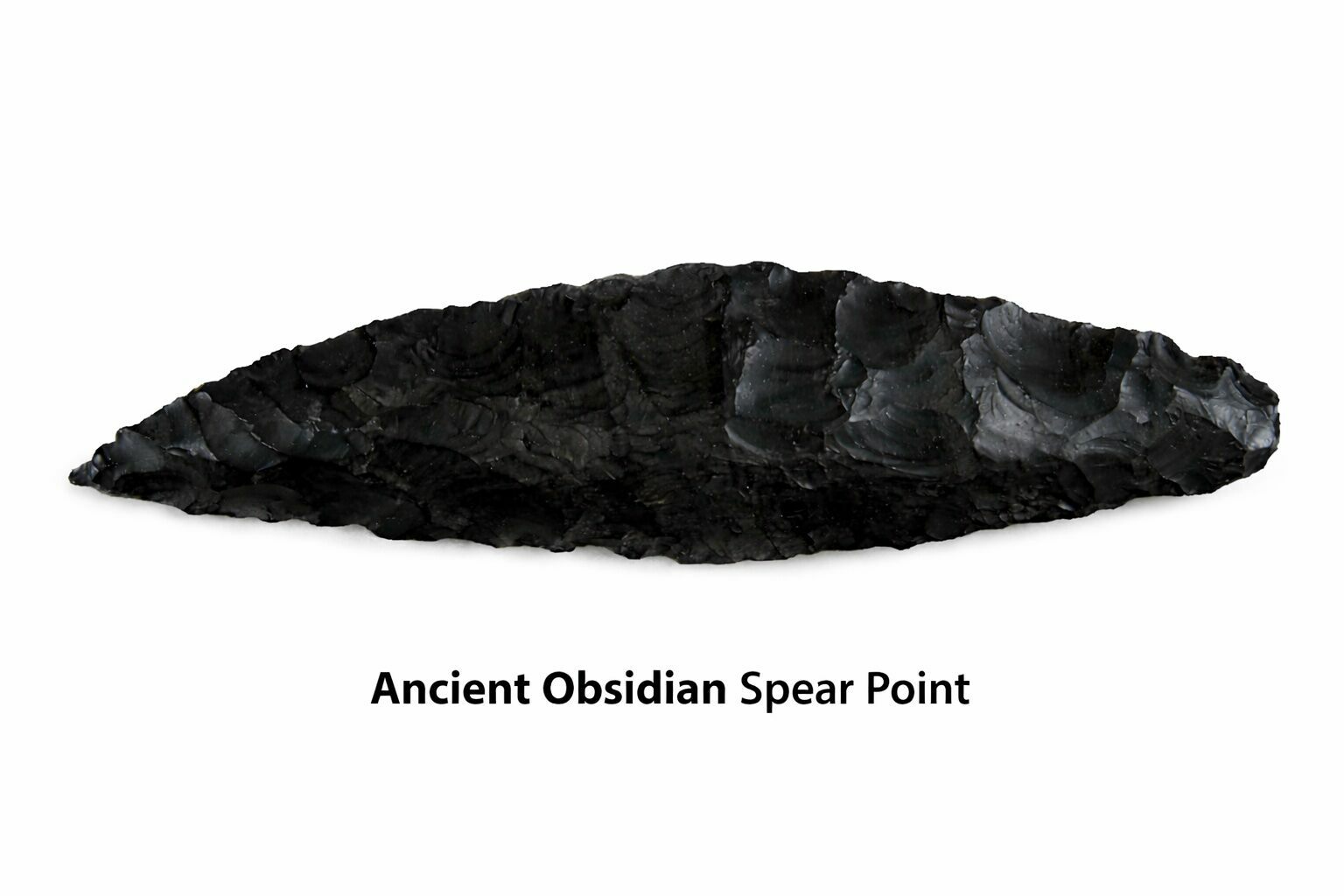
An ancient obsidian spear point. National Parks Service Gallery
Half a world away, obsidian followed different roads, but for the same reasons. In Neolithic Europe, it moved through Mediterranean exchange networks like a black currency. The most famous source was Anatolia, in what is now Turkey, where vast obsidian flows supplied the ancient world. From there it traveled south into the Levant, west into Greece and Italy, and across islands by canoe and caravan. Its presence in archaeological sites far from volcanoes became one of the first ways scientists reconstructed prehistoric trade patterns. Long before coins or contracts, obsidian was proof of connection, negotiation, and value.
When metallurgy eventually rose, obsidian didn’t fall—it adapted. Metal could replace its function, but never its aesthetic or symbolic appeal. In many cultures it remained a talisman of sharpness, clarity, and protection. Even today, traditional knappers continue crafting arrowheads and ceremonial blades, preserving techniques passed down through generations. And in lapidary workshops, obsidian found new purpose as cabochons, spheres, and carved art pieces, where its fluid surface and deep colors could be appreciated without needing to pierce or cut anything at all.
Modern science eventually rediscovered obsidian’s edge in a surprising place—medicine. Because obsidian can fracture into an edge thinner than a wavelength of visible light, experimental obsidian scalpels have been tested for microsurgical procedures. These blades are not mass-produced, but hand-knapped, shaped by impact instead of machining. The irony is poetic: one of the sharpest instruments in modern medicine is made the same way it was 7,000 years ago.
Industry also found obsidian useful, though indirectly. Its glassy structure made it an ideal material for studying conchoidal fracture mechanics, influencing material sciences and even aerospace engineering. Meanwhile, geologists use obsidian hydration dating, a method that measures the microscopic water absorption layer on its surface, to determine the age of volcanic flows—one of the few cases where a material that forms too fast for crystals can still record time with remarkable reliability.
Unique Varieties Of Obsidian
Obsidian isn’t a single look—it’s a spectrum of volcanic instants preserved in glass, each shaped by chemistry, cooling speed, and the trace minerals caught in the melt.
Snowflake Obsidian
Snowflake obsidian is marked by white, radial “snowflake” patterns—crystal clusters of cristobalite, a high-temperature form of silica that nucleates after the surrounding melt has already quenched into glass. Its formation requires a rare two-stage cooling history: lava must first chill rapidly enough to become obsidian, then linger at temperatures around 700–900 °C long enough for cristobalite to begin growing in spherulitic bursts before the entire flow finally solidifies. These snowflakes are a signature of partial devitrification, a process triggered when silica-rich, highly viscous rhyolitic or dacitic lava cools slowly at depth or within the thick interiors of volcanic domes and flow centers, where heat dissipates unevenly and the glass remains plastic for a short but critical window.

Notable snowflake obsidian deposits occur in young volcanic provinces around the world, but some of the most commercially important sources include the United States, Mexico, Turkey, and Japan. In the U.S., it is famously collected from volcanic fields in Utah, Oregon, and Colorado, where silica-saturated flows and domes provided the ideal thermal pause needed for spherulites to form.
Mahogany Obsidian
Mahogany obsidian is a bold, banded volcanic glass defined by swirls and stripes of deep reddish-brown to nearly black, colored by iron-rich mineral inclusions and oxidation within a silica-saturated melt. Unlike the pure jet-black variety that forms when lava quenches instantly at the surface, mahogany obsidian captures a more dynamic moment inside the flow—one where lava was still stretching, folding, and shearing like molten taffy just before it froze into glass. The brown bands come from iron-bearing particles (commonly magnetite or hematite-leaning nanoinclusions) that oxidize in localized zones while the lava is still hot and mobile. The “special circumstance” for this variety is not just speed, but motion + uneven oxidation—it typically forms in viscous rhyolitic or dacitic flows, volcanic domes, and conduit margins where portions of the melt experience brief oxygen exposure, temperature gradients, and internal flow alignment before quenching halts crystal growth entirely.

Mahogany obsidian is found in many of the same volcanic provinces that produce other silica-rich glasses, but major and well-known sources include Mexico, Iceland, Indonesia, Turkey, and the western United States. In the U.S., it is widely collected from volcanic regions in Oregon, Arizona, California, Nevada, Colorado, and Utah, where slow-moving felsic lava bodies provided the internal flow dynamics and iron chemistry needed to paint obsidian in earth-toned bands.
Rainbow Obsidian
Rainbow obsidian is a rare and mesmerizing form of natural volcanic glass that displays shifting bands of green, gold, purple, and sometimes blue, created by thin-film optical interference rather than pigments or crystal impurities. Its colors come from microscopic, layered bubble horizons—ultra-thin zones filled with flattened gas vesicles that formed as silica-rich lava continued flowing internally after its outer rind had already quenched into obsidian. When light enters these nano-scale layers, it reflects and refracts across bubble surfaces spaced at near-wavelength distances, producing iridescent color flashes that change as the stone is tilted, much like the physics behind soap-film rainbows or oil-slick shimmer.

The special circumstance for rainbow obsidian is a precise combination of very high-silica, highly viscous rhyolitic melt, continued internal flow after glass formation, and a thermal pause just long enough for gas bubbles to stretch into ordered, parallel planes before final quenching locks them in place. Too fast, and the bubbles remain random and non-iridescent; too slow, and the glass devitrifies into stone. The finest rainbow obsidian forms in thick flow interiors and dome conduits where pressure gradients create stratified gas escape layers. Notable deposits are found in volcanic provinces of Mexico (especially Jalisco), the western United States, and parts of Asia. In the U.S., rainbow material is most famously associated with volcanic glass localities in Oregon and California, where ancient flow centers preserved the optical architecture needed to generate obsidian’s most colorful light effect.
How to Recognize Fake Obsidian — Imitators in the Shadows
Obsidian’s smooth black surface and glassy luster make it easy to imitate, and the market is filled with convincing stand-ins that range from harmless look-alikes to intentional fakes. The most common material passed off as obsidian is dyed industrial glass, which may look nearly identical to natural obsidian when polished, but often contains perfectly round air bubbles that reveal its manufactured origin. Another widespread impostor is black slag glass (sometimes called “slag obsidian”), a waste product of metal smelting. Slag can appear glossy and dark, but its internal flow textures tend to look unnatural and chaotic compared to the silky, volcanic stretching seen in real obsidian. Dyed black onyx is also frequently misrepresented as obsidian in jewelry—onyx is a real mineral, but it is microcrystalline quartz, heavier, waxier in polish, and shows parallel banding under magnification rather than a glassy fracture. The cheapest imitations are resin and plastic, which mimic the color but not the density, warmth, or fracture behavior of natural volcanic glass. Less common but still encountered are painted ceramics, dyed chalcedony, and even glass-based “spiritual market” carvings sold without disclosure.
How to Identify Fake Obsidian