 Reviews

Orpiment - Mineral & Crystal Guide
Few minerals create the same immediate reaction as orpiment. The first glance is often disbelief—its color feels too rich, too saturated, too alive to be natural. Bright lemon yellow, deep saffron, molten gold-orange: orpiment doesn’t merely reflect light, it seems to emit it. In hand specimen form it can appear as silky, leaf-like blades stacked together, fragile crusts coating rock surfaces, or dense granular masses that shimmer softly when the light shifts. It looks valuable in a deeply instinctive way, echoing the visual language of gold, sunlight, and fire.
Yet orpiment is a mineral of contradictions. It is beautiful but fragile, historically prized but dangerously toxic, visually bold yet chemically sensitive. For thousands of years it has drawn people in with its color while quietly demanding caution. Artists, alchemists, miners, traders, and scholars all encountered orpiment at different moments in history, often praising its brilliance while warning—sometimes cryptically—of its risks. Few minerals occupy such a strange space between admiration and unease.
What makes orpiment especially fascinating is that its story is not confined to geology. It is woven into the history of art, early chemistry, medicine, trade, and even superstition. It is a mineral that helped define how humans understood color long before synthetic pigments existed, and it did so at a cost that was not always fully understood.
From a mineralogical standpoint, orpiment is an arsenic sulfide, composed of arsenic and sulfur bound together in a structure that crystallizes in the monoclinic system. It is very soft—soft enough to be scratched by a fingernail—and this softness is one of its defining physical traits. Because of its perfect cleavage, orpiment often breaks into thin, platy sheets that give it a leafy or layered appearance. These plates can have a pearly or resinous sheen, sometimes appearing silky when crystals grow in parallel bundles.
Despite its softness, orpiment has a surprising heft when held, with a density noticeably higher than many similarly soft minerals. Its streak is yellow, and it is typically transparent to translucent, allowing light to penetrate shallowly and enhance its glow. Orpiment frequently occurs alongside other hydrothermal minerals, especially its close chemical cousin realgar, as well as quartz, calcite, barite, gypsum, pyrite, and stibnite depending on the deposit.
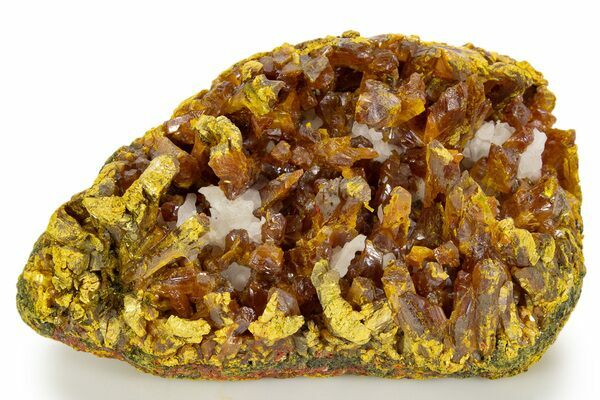
Vibrant orpiment crystals associated with Calcite from China.
Key properties:
Chemical formula: As₂S₃ (arsenic sulfide)
Mineral class: Sulfides
Crystal system: Monoclinic
Color: Bright yellow to yellow-orange; can appear golden, lemon, or orange-yellow
Luster: Pearly to resinous; sometimes silky in fibrous or foliated aggregates
Transparency: Transparent to translucent (rarely nearly opaque in massive material)
Streak: Yellow
Hardness (Mohs): ~1.5–2 (very soft—easily scratched by a fingernail)
Cleavage: Perfect in one direction (gives that “leafy” or platy look)
Typical habit: Foliated/platy masses, bladed crystals, fibrous crusts, granular or massive
Commonly associated minerals: Realgar, stibnite, pyrite, calcite, quartz, barite, gypsum, alunite, cinnabar
Orpiment’s beauty comes with a very real warning. As an arsenic-bearing mineral, it is toxic, and this toxicity has been known—at least in a practical sense—for much of human history. While a stable specimen sitting undisturbed does not actively poison its surroundings, the danger lies in its softness and fragility. Orpiment can easily shed tiny particles if rubbed, scratched, or mishandled, and inhaling or ingesting arsenic-containing dust is hazardous.
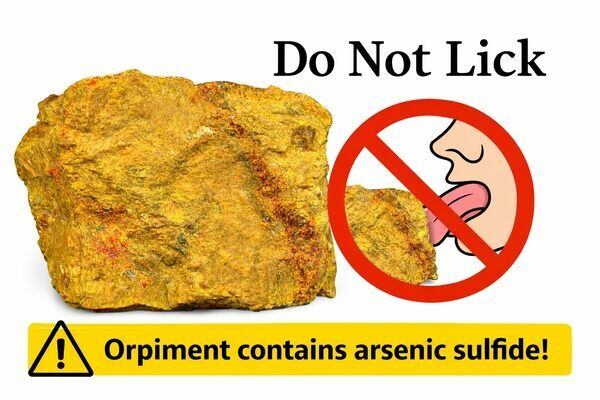
Orpiment contains arsenic and is toxic; careful handling and proper storage are essential.
For this reason, orpiment should never be cut, polished, ground, or otherwise mechanically altered. Even casual over-handling is discouraged. Most modern collectors treat it as a “display mineral,” stored in sealed boxes or specimen cases that both protect the delicate crystal structure and reduce the risk of loose particles. Washing hands after handling and keeping specimens away from food areas, children, and pets is considered standard practice. Prolonged exposure to strong light or heat can also cause some specimens to degrade or alter over time, so careful storage helps preserve both safety and appearance.
Long before modern mineralogy existed, humans were already mining and using orpiment. Its name ultimately derives from ancient words meaning “golden pigment,” a fitting description for a substance that was valued primarily for its intense color. In a world where stable yellow pigments were rare, orpiment stood out dramatically. When ground into powder, it produced a vivid, luminous yellow that retained its strength far better than many plant-based dyes or earth pigments.
This made orpiment especially important in ancient and medieval art. It was used to illuminate manuscripts, decorate murals, and create bold highlights in paintings. Its brilliance allowed artists to depict divine light, royal garments, halos, and ornamental borders with a richness that few other natural pigments could match. At the same time, artists learned—sometimes the hard way—that orpiment could react poorly with other pigments, especially those containing lead or copper. These reactions could cause discoloration or degradation over time, a challenge that modern conservators still contend with today.
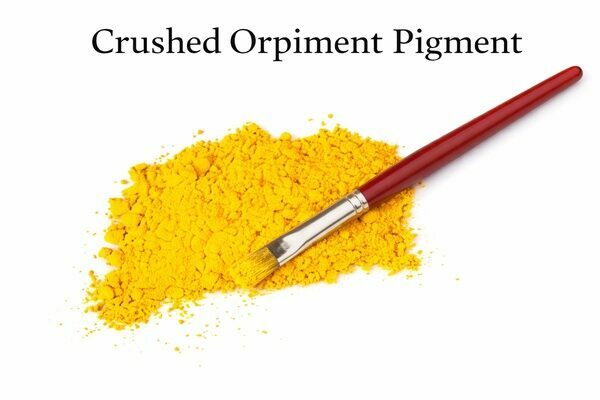
Crushed orpiment was historically used as a bright-yellow pigment.
Beyond art, orpiment found roles in early metallurgy and alchemical practices. It appeared in recipes for treating metals, producing certain colors or surface effects, and experimenting with transformations brought about by heat. In alchemy, substances like orpiment and realgar carried both practical and symbolic weight. They changed dramatically when heated, released pungent fumes, and seemed to embody transformation itself—qualities that fascinated early experimenters even as they posed serious health risks.
Historical texts often hint at this danger. While ancient authors lacked modern chemical terminology, many recognized that orpiment was not benign. It could poison, kill pests, or make people ill if mishandled. The mineral was respected, even feared, yet still used because its usefulness and beauty were difficult to ignore.
In modern times, orpiment has largely retreated from practical use. Synthetic pigments replaced it in art, and advances in chemistry made its risks clear. Today, it is valued primarily as a mineral specimen—a reminder of both the ingenuity and the limits of earlier knowledge.
Orpiment typically forms in low- to moderate-temperature hydrothermal environments, where arsenic-rich fluids circulate through fractures, faults, or porous rock layers. As these fluids cool or encounter changes in chemistry, arsenic and sulfur combine and precipitate out as arsenic sulfide minerals. Orpiment often appears coating fracture surfaces, filling cavities, or replacing portions of host rock.
It is commonly associated with epithermal systems, particularly those related to volcanic or geothermal activity. In such environments, orpiment may form alongside quartz, calcite, barite, or clay minerals, and is frequently found in close association with realgar. In some cases, one mineral may overgrow or partially alter into the other, creating striking red-and-yellow combinations that are highly sought after by collectors.
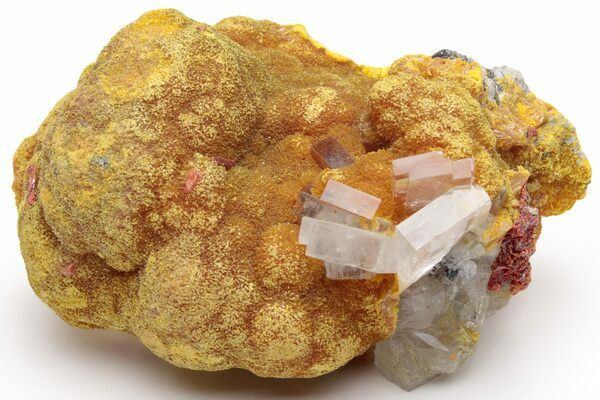
Orpiment with Tabular Barite Crystals from Peru
Because orpiment forms under relatively low temperatures and is chemically sensitive, it can also be unstable over geological or human timescales. Light, heat, and environmental changes can all influence its long-term preservation.
Orpiment is found in many parts of the world, but high-quality specimens tend to come from regions with well-developed hydrothermal systems rich in arsenic. Peru is widely known for producing vivid, attractive orpiment specimens, often associated with realgar and other sulfides. China has also yielded exceptional material from several provinces, with some specimens showing remarkable color saturation and crystal form.
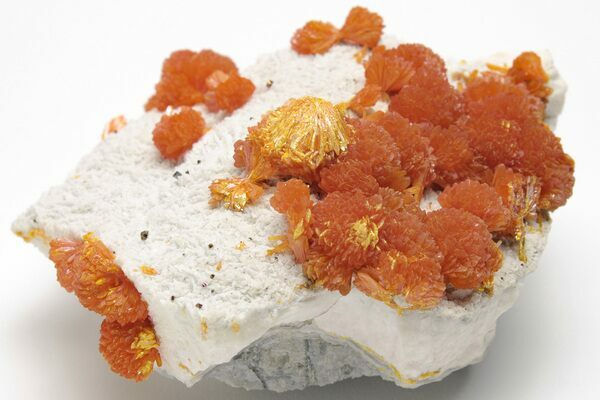
Vibrant Orange Orpiment Crystals on Barite from the El'brusskiy Arsenic Mine in Russia
In Europe, classic occurrences are known from Romania and Italy, particularly in historic mining districts tied to hydrothermal and volcanic activity. Turkey and Russia have also produced notable orpiment from arsenic-rich ore environments. In the United States, orpiment has been found in parts of Nevada, Utah, and California, typically in epithermal or volcanic-related settings. Japan, too, has recorded occurrences associated with its active geological landscape.
While new finds appear from time to time, the overall pattern remains consistent: orpiment favors environments where arsenic-rich fluids move through the crust and have the opportunity to cool, react, and crystallize.
Yet orpiment is a mineral of contradictions. It is beautiful but fragile, historically prized but dangerously toxic, visually bold yet chemically sensitive. For thousands of years it has drawn people in with its color while quietly demanding caution. Artists, alchemists, miners, traders, and scholars all encountered orpiment at different moments in history, often praising its brilliance while warning—sometimes cryptically—of its risks. Few minerals occupy such a strange space between admiration and unease.

What makes orpiment especially fascinating is that its story is not confined to geology. It is woven into the history of art, early chemistry, medicine, trade, and even superstition. It is a mineral that helped define how humans understood color long before synthetic pigments existed, and it did so at a cost that was not always fully understood.
From a mineralogical standpoint, orpiment is an arsenic sulfide, composed of arsenic and sulfur bound together in a structure that crystallizes in the monoclinic system. It is very soft—soft enough to be scratched by a fingernail—and this softness is one of its defining physical traits. Because of its perfect cleavage, orpiment often breaks into thin, platy sheets that give it a leafy or layered appearance. These plates can have a pearly or resinous sheen, sometimes appearing silky when crystals grow in parallel bundles.
Despite its softness, orpiment has a surprising heft when held, with a density noticeably higher than many similarly soft minerals. Its streak is yellow, and it is typically transparent to translucent, allowing light to penetrate shallowly and enhance its glow. Orpiment frequently occurs alongside other hydrothermal minerals, especially its close chemical cousin realgar, as well as quartz, calcite, barite, gypsum, pyrite, and stibnite depending on the deposit.
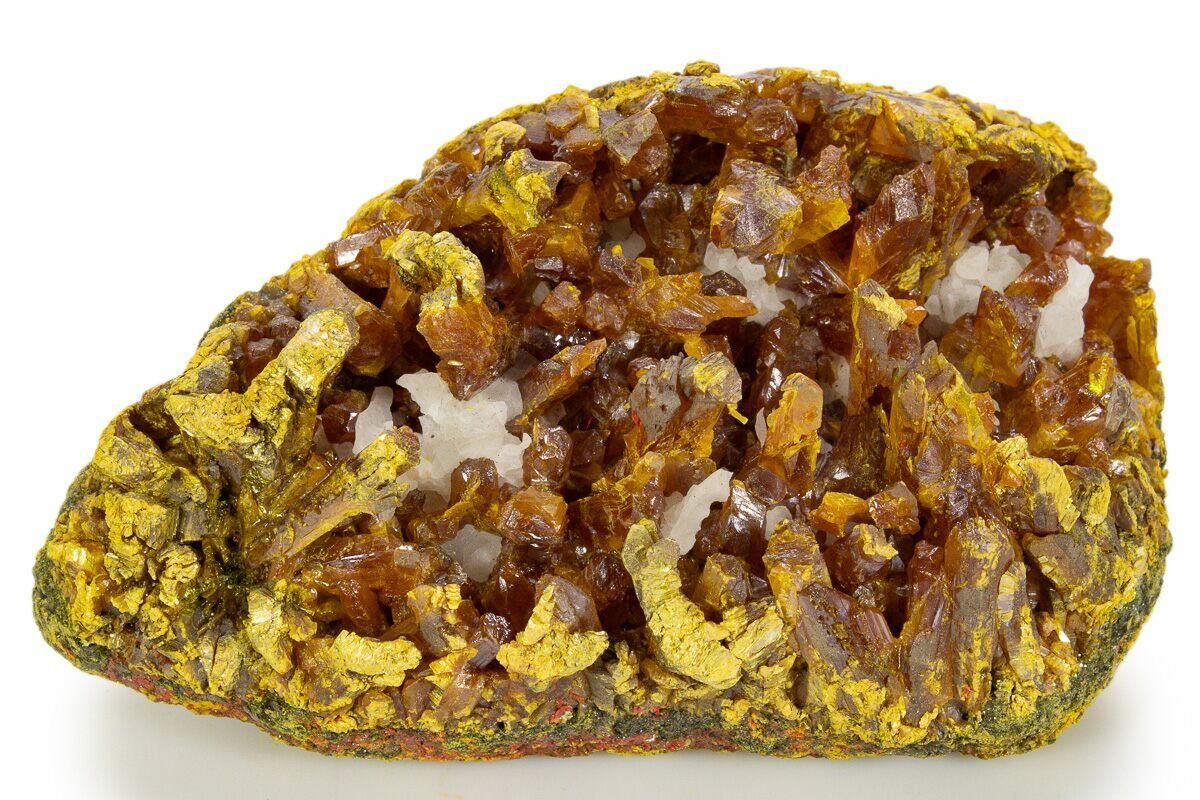
Vibrant orpiment crystals associated with Calcite from China.
Key properties:
Toxicity and Handling
Orpiment’s beauty comes with a very real warning. As an arsenic-bearing mineral, it is toxic, and this toxicity has been known—at least in a practical sense—for much of human history. While a stable specimen sitting undisturbed does not actively poison its surroundings, the danger lies in its softness and fragility. Orpiment can easily shed tiny particles if rubbed, scratched, or mishandled, and inhaling or ingesting arsenic-containing dust is hazardous.
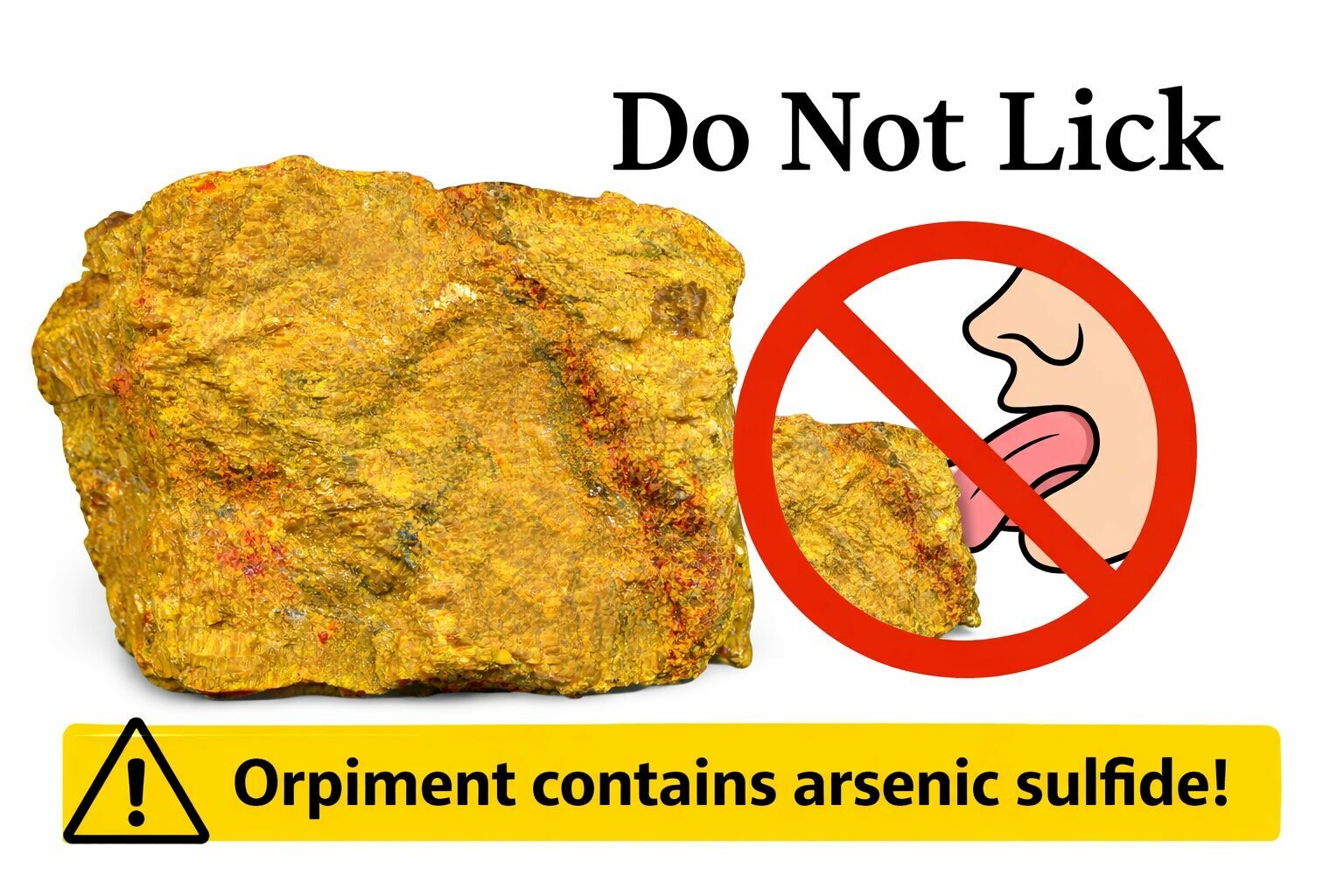
Orpiment contains arsenic and is toxic; careful handling and proper storage are essential.
For this reason, orpiment should never be cut, polished, ground, or otherwise mechanically altered. Even casual over-handling is discouraged. Most modern collectors treat it as a “display mineral,” stored in sealed boxes or specimen cases that both protect the delicate crystal structure and reduce the risk of loose particles. Washing hands after handling and keeping specimens away from food areas, children, and pets is considered standard practice. Prolonged exposure to strong light or heat can also cause some specimens to degrade or alter over time, so careful storage helps preserve both safety and appearance.
History, Discovery & Uses
Long before modern mineralogy existed, humans were already mining and using orpiment. Its name ultimately derives from ancient words meaning “golden pigment,” a fitting description for a substance that was valued primarily for its intense color. In a world where stable yellow pigments were rare, orpiment stood out dramatically. When ground into powder, it produced a vivid, luminous yellow that retained its strength far better than many plant-based dyes or earth pigments.
This made orpiment especially important in ancient and medieval art. It was used to illuminate manuscripts, decorate murals, and create bold highlights in paintings. Its brilliance allowed artists to depict divine light, royal garments, halos, and ornamental borders with a richness that few other natural pigments could match. At the same time, artists learned—sometimes the hard way—that orpiment could react poorly with other pigments, especially those containing lead or copper. These reactions could cause discoloration or degradation over time, a challenge that modern conservators still contend with today.
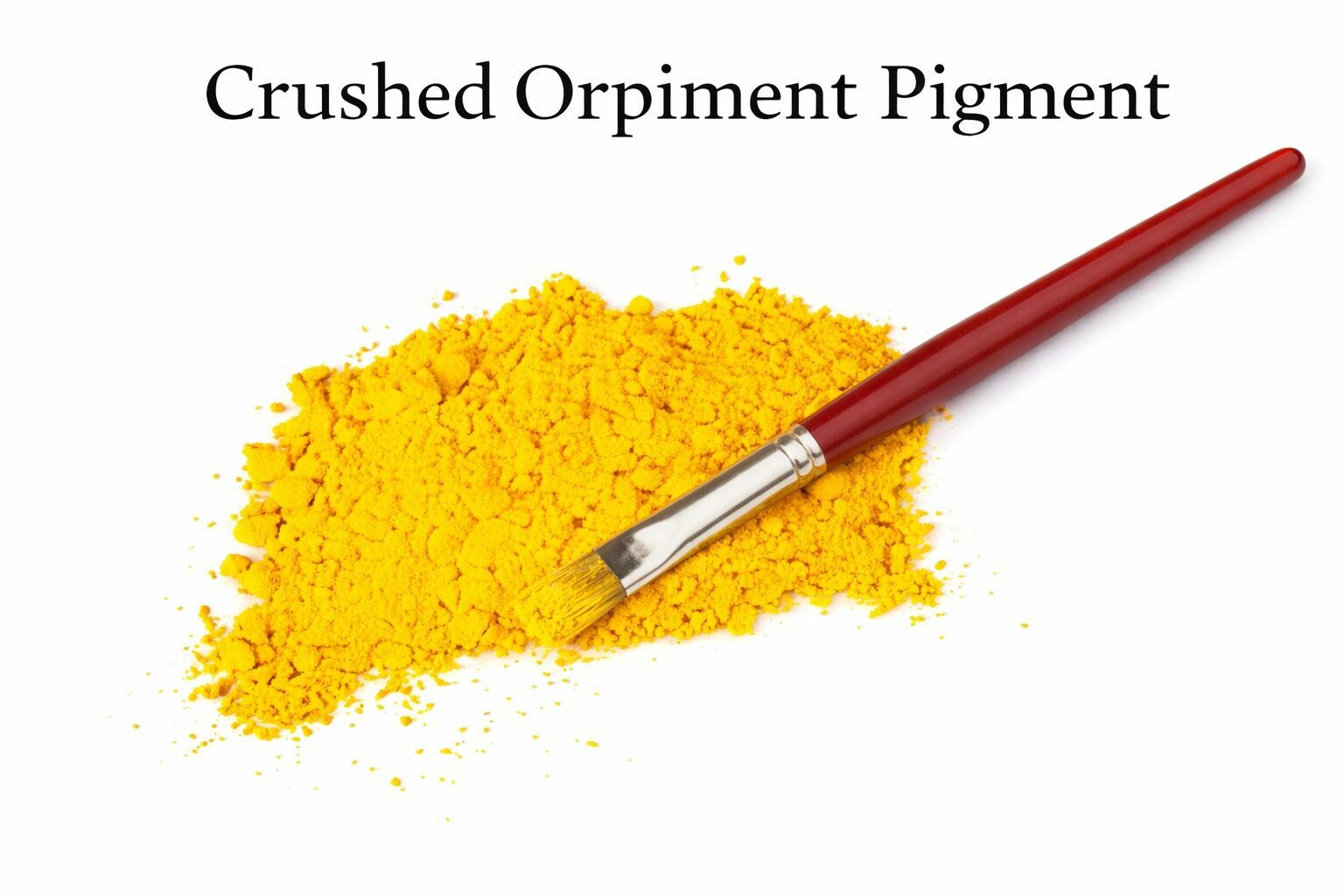
Crushed orpiment was historically used as a bright-yellow pigment.
Beyond art, orpiment found roles in early metallurgy and alchemical practices. It appeared in recipes for treating metals, producing certain colors or surface effects, and experimenting with transformations brought about by heat. In alchemy, substances like orpiment and realgar carried both practical and symbolic weight. They changed dramatically when heated, released pungent fumes, and seemed to embody transformation itself—qualities that fascinated early experimenters even as they posed serious health risks.
Historical texts often hint at this danger. While ancient authors lacked modern chemical terminology, many recognized that orpiment was not benign. It could poison, kill pests, or make people ill if mishandled. The mineral was respected, even feared, yet still used because its usefulness and beauty were difficult to ignore.
In modern times, orpiment has largely retreated from practical use. Synthetic pigments replaced it in art, and advances in chemistry made its risks clear. Today, it is valued primarily as a mineral specimen—a reminder of both the ingenuity and the limits of earlier knowledge.
How Orpiment Forms
Orpiment typically forms in low- to moderate-temperature hydrothermal environments, where arsenic-rich fluids circulate through fractures, faults, or porous rock layers. As these fluids cool or encounter changes in chemistry, arsenic and sulfur combine and precipitate out as arsenic sulfide minerals. Orpiment often appears coating fracture surfaces, filling cavities, or replacing portions of host rock.
It is commonly associated with epithermal systems, particularly those related to volcanic or geothermal activity. In such environments, orpiment may form alongside quartz, calcite, barite, or clay minerals, and is frequently found in close association with realgar. In some cases, one mineral may overgrow or partially alter into the other, creating striking red-and-yellow combinations that are highly sought after by collectors.
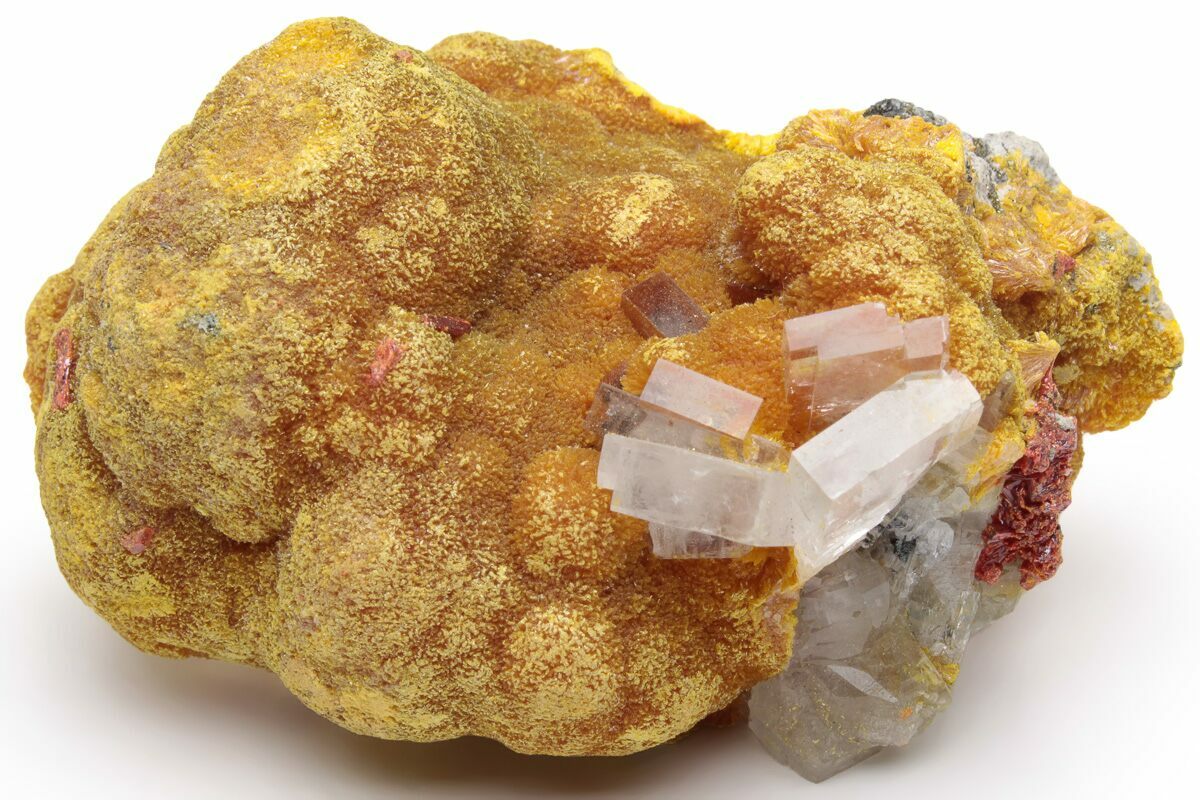
Orpiment with Tabular Barite Crystals from Peru
Because orpiment forms under relatively low temperatures and is chemically sensitive, it can also be unstable over geological or human timescales. Light, heat, and environmental changes can all influence its long-term preservation.
Major Localities and Sources
Orpiment is found in many parts of the world, but high-quality specimens tend to come from regions with well-developed hydrothermal systems rich in arsenic. Peru is widely known for producing vivid, attractive orpiment specimens, often associated with realgar and other sulfides. China has also yielded exceptional material from several provinces, with some specimens showing remarkable color saturation and crystal form.
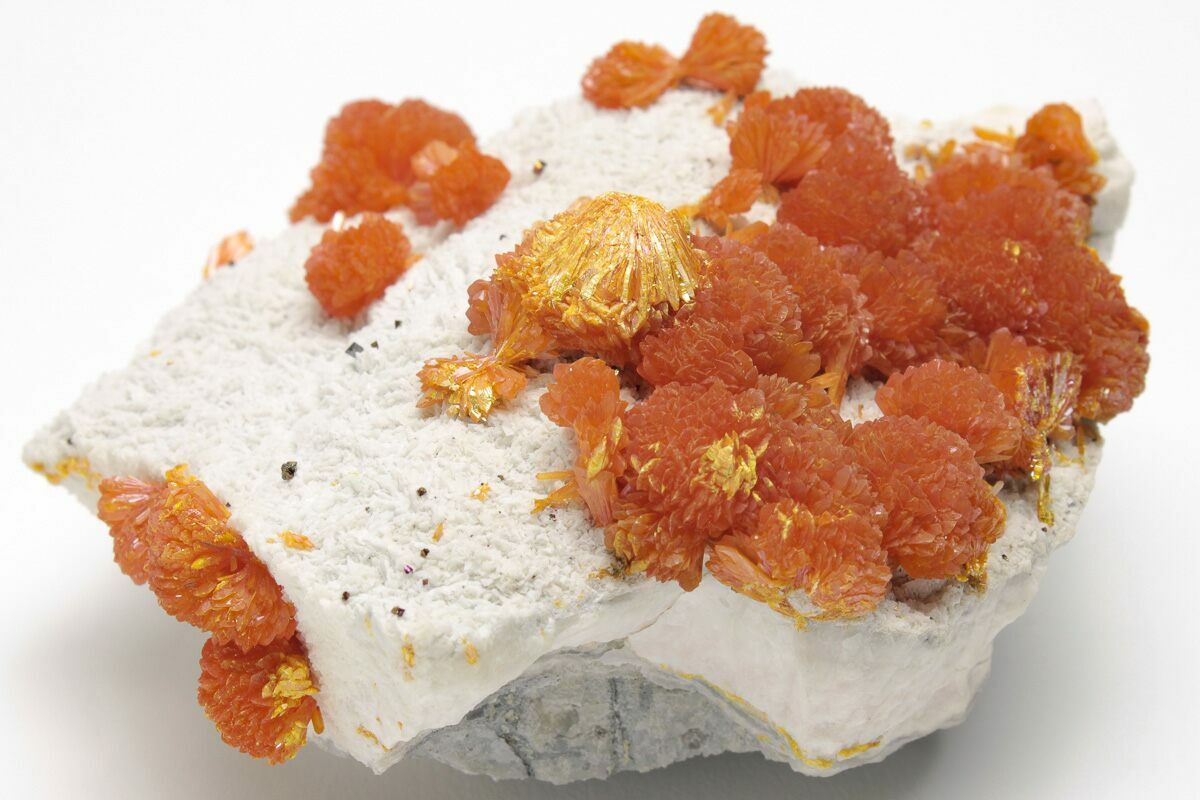
Vibrant Orange Orpiment Crystals on Barite from the El'brusskiy Arsenic Mine in Russia
In Europe, classic occurrences are known from Romania and Italy, particularly in historic mining districts tied to hydrothermal and volcanic activity. Turkey and Russia have also produced notable orpiment from arsenic-rich ore environments. In the United States, orpiment has been found in parts of Nevada, Utah, and California, typically in epithermal or volcanic-related settings. Japan, too, has recorded occurrences associated with its active geological landscape.
While new finds appear from time to time, the overall pattern remains consistent: orpiment favors environments where arsenic-rich fluids move through the crust and have the opportunity to cool, react, and crystallize.


