 Reviews

Selenite: Forming The Worlds Largest Crystals
Selenite is one of those minerals that seems almost unreal the first time you encounter it. Perfectly transparent crystals large enough to read through, delicate blades that glow softly in ambient light, and massive formations that look more like frozen beams than stone—all of these are natural expressions of selenite. Despite its ethereal appearance, selenite is simply a crystalline variety of gypsum, a mineral composed of calcium sulfate dihydrate (CaSO₄·2H₂O). What makes it extraordinary is how clearly it records the conditions of its formation, growing slowly from mineral-rich water into some of the largest crystals known on Earth.
The name selenite comes from the Greek word selēnē, meaning “moon,” a reference to the mineral’s soft, pearly glow rather than any actual lunar connection. Unlike quartz, which grows from silica-rich solutions under a wide range of conditions, selenite forms only when calcium- and sulfate-rich waters evaporate under very calm, stable conditions. This combination of chemistry and environment allows crystals to grow uninterrupted for long periods of time, sometimes reaching truly monumental sizes.
Selenite is also notable for its physical properties. It is exceptionally soft—ranking just 2 on the Mohs hardness scale—which means it can be scratched with a fingernail. This softness is why ancient cultures used thin sheets of selenite as window panes before glass was widely available. These translucent panels, often called “lapis specularis” by the Romans, allowed light to pass through while protecting interiors from wind and weather.
Mineralogically, selenite is one of several crystal habits of gypsum. While “gypsum” is the overarching mineral name, selenite specifically refers to the clear, crystalline form. Other well-known gypsum varieties include satin spar (fibrous and silky), alabaster (fine-grained and massive), and desert rose (bladed crystals clustered with sand).
Selenite crystals typically form as elongated blades, tabular sheets, or sharply defined prisms. They often show excellent crystal faces and can develop internal growth zoning, fluid inclusions, and subtle striations that reveal how the crystal grew over time. Because gypsum contains water in its crystal structure, selenite can dehydrate if exposed to high heat, reverting toward anhydrite—another fascinating reminder that minerals are not static, but part of ongoing geological processes.
Selenite forms in evaporite environments—places where bodies of water slowly evaporate, leaving dissolved minerals behind. These settings include shallow marine basins, saline lakes, playas, and underground cavities fed by mineral-rich groundwater. As water evaporates, calcium sulfate becomes oversaturated and begins to crystallize.
What makes some selenite crystals enormous is stability. If temperature, chemistry, and space remain consistent over long periods, crystals can grow without competition. The most famous example of this process is found in the Cave of the Crystals in Naica, Mexico, where selenite crystals exceed 30 feet in length. These formed from warm, mineral-saturated waters over hundreds of thousands of years, creating one of the most astonishing mineral localities ever discovered.
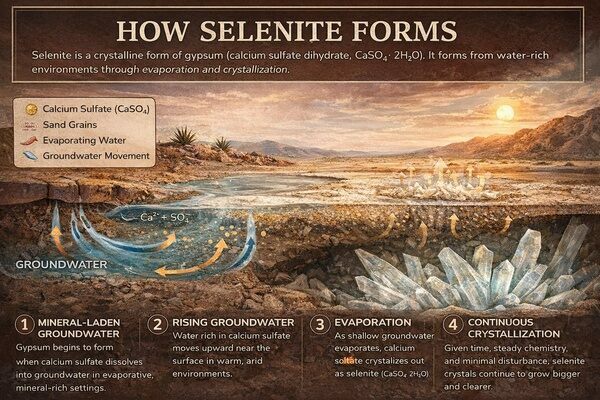
How selenite crystals are formed.
Famous Selenite Localities
Mexico – Home to both the giant Naica crystals and classic clear blades from Chihuahua and other regions.
United States – Oklahoma is famous for hourglass selenite crystals with sand inclusions; Utah and California also produce fine material.
Italy – Historic source of lapis specularis used by the Romans.
Morocco – One of the most prolific modern sources, known especially for sculpted and natural selenite forms.
One of the most extraordinary mineral localities ever discovered is the Cave of the Crystals, located deep within the Naica Mine near the town of Naica in northern Mexico. This cave is famed for containing the largest known natural crystals on Earth—colossal blades of perfectly clear selenite (gypsum) that reach more than 30–40 feet (10–12 meters) in length and weigh many tons.
The crystals formed under an exceptionally narrow set of geological conditions. For hundreds of thousands of years, the cave remained completely flooded with mineral-rich groundwater heated to approximately 55–60°C (130–140°F). At these temperatures, calcium sulfate exists right at the boundary between anhydrite and gypsum stability. As the water chemistry slowly shifted and remained incredibly stable, selenite began to crystallize at an almost unimaginably slow rate. With no disturbances, no sediment influx, and no competing crystal growth, the selenite was able to grow continuously to monumental size.
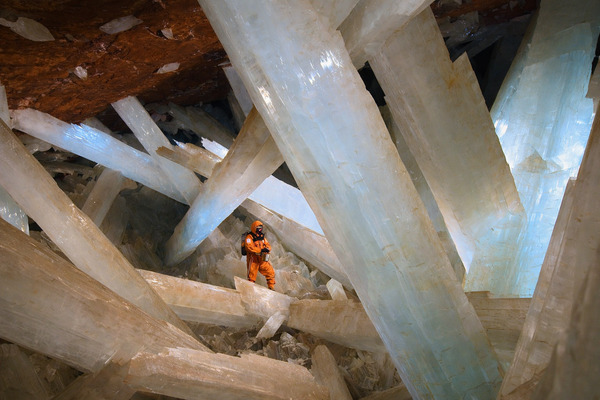
The Cave of the Crystals in Mexico
What makes the Cave of the Crystals even more remarkable is how inhospitable it is to humans. When first discovered in 2000 during mining operations, the cave’s temperature and humidity were so extreme that unprotected exposure could be fatal within minutes. Relative humidity approaches 100%, preventing sweat from evaporating and making heat dissipation nearly impossible. Because of these conditions, scientific exploration has been limited, and the cave has been sealed and reflooded to protect the crystals from degrading in the air.
From a mineralogical perspective, the Cave of the Crystals represents the most dramatic expression of selenite growth ever observed. It serves as a natural laboratory demonstrating how crystal size is governed not by rarity of material, but by time, chemical stability, and environmental consistency. No other known selenite locality—from Morocco to Oklahoma to Italy—comes close to matching the scale or perfection seen at Naica, making this cave the ultimate benchmark against which all other selenite specimens are compared.
Selenite roses—more formally known as gypsum roses or desert roses—are among the most recognizable and evocative forms of selenite. Rather than growing as long, clear blades, these crystals form rosette-like clusters of flattened selenite blades radiating outward like petals. Their resemblance to stone flowers is no accident; the shape reflects how gypsum crystallizes in arid, sandy environments where evaporation and sediment play a direct role in crystal growth.
These formations develop when calcium- and sulfate-rich groundwater slowly evaporates in deserts or semi-arid regions. As selenite begins to crystallize, sand grains become trapped between growing crystal faces, forcing the crystals to fan outward instead of forming simple blades. Over time, this process produces compact rosettes with curved, petal-like blades. The presence of sand is also what gives many selenite roses their warm tan, beige, or rusty coloration, even though pure selenite itself is colorless.
Selenite roses are most commonly associated with desert environments such as the Sahara and arid regions of the American Southwest, but some of the most widely collected examples today come from Morocco. Moroccan selenite roses are prized for their well-defined form, balanced symmetry, and durability compared to some more fragile gypsum varieties. They are typically found partially embedded in sandy matrix, which both stabilizes the specimen and emphasizes its natural origin.
In recent decades, selenite from Morocco has become especially popular in the mineral and crystal market. Large deposits of gypsum in arid regions of the country yield abundant, high-quality selenite that is well-suited for cutting and shaping. Moroccan material is commonly fashioned into towers, lamps, spheres, hearts, bowls, and other decorative forms that highlight the mineral’s natural translucency and soft glow.
The appeal of shaped Moroccan selenite lies in its balance of affordability, size, and visual impact. Because the material is relatively easy to cut and polish (due to its softness), artisans can create large, elegant pieces that still retain the natural internal textures and striations that make selenite distinctive. When illuminated, these pieces diffuse light in a warm, even way that enhances their moonlike appearance.
Natural crystal blades and clusters from Morocco are also widely collected, often showing classic tabular habits with subtle golden or honey tones from trace impurities or desert sediments. Whether left raw or carefully shaped, Moroccan selenite has played a major role in bringing this mineral into mainstream popularity.
One of the most distinctive and regionally important selenite occurrences in North America comes from the Red River Floodway near Winnipeg. These crystals are not found in deep mines or desert basins, but in shallow subsurface sediments exposed during excavation and maintenance of the massive flood-control system built to protect the city from seasonal flooding.
Red River Floodway selenite forms within Quaternary-age clay and silt deposits left behind by glacial Lake Agassiz, a vast proglacial lake that once covered much of central North America near the end of the last Ice Age. As sulfate-rich groundwater moved slowly through these fine-grained sediments, gypsum crystallized in voids and fractures, producing exceptionally clear, well-formed selenite crystals. Unlike desert roses, these crystals typically grow as transparent to translucent blades and plates, sometimes forming loose clusters embedded in soft clay.
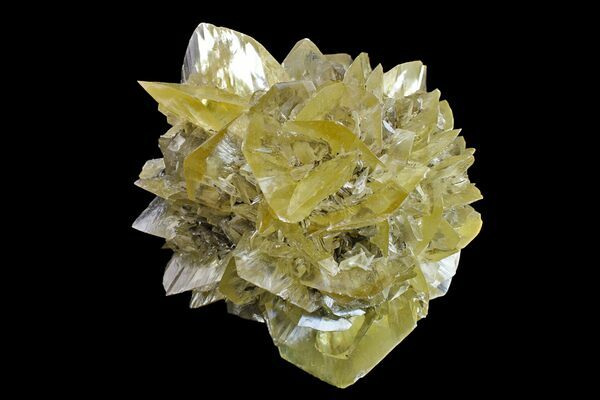
Twinned selenite crystals from the Red River Floodway in Canada
What makes Floodway selenite especially prized by collectors is its clarity and delicacy. Many specimens are water-clear with sharp edges and minimal inclusions, giving them a glassy, almost icy appearance. Some crystals show subtle growth zoning or faint internal clouds that record changes in groundwater chemistry during formation. Because the host sediments are soft, crystals are often recovered intact, though their softness means they are easily damaged if mishandled.
From a geological perspective, Red River Floodway selenite is an excellent example of low-temperature evaporite mineralization in a glacial-lacustrine environment. It demonstrates that impressive selenite crystals do not require extreme heat or deep geological time—only chemically suitable water, stillness, and patience. Today, Floodway selenite is considered a classic Canadian locality specimen, valued both for its beauty and for the clear story it tells about post-glacial landscapes and groundwater-driven crystal growth.
Historically, selenite’s translucency made it a practical material. Roman architects used it for windows, while artists and craftsmen carved it into ornamental objects. Today, its use is primarily decorative and educational, valued for both its aesthetic qualities and its role in teaching crystal growth and evaporite geology. Selenite has also become widely known in the metaphysical and wellness communities, where it is often associated—symbolically—with clarity, calm, and purification. While these interpretations are cultural rather than scientific, they have contributed significantly to the mineral’s modern popularity and widespread availability in shaped forms.
Because selenite is soft and water-soluble, it requires gentle handling. Specimens should be kept dry and protected from abrasion, as even light contact can scratch the surface. Cleaning is best done with a soft, dry cloth—never water. When properly cared for, selenite remains stable and visually stunning for generations.
Selenite stands out among minerals for its ability to combine geological simplicity with visual drama. Formed from nothing more than evaporating water and dissolved salts, it can grow into crystals of astonishing size and clarity. From ancient Roman windows to modern Moroccan carvings, selenite has bridged practical use, natural beauty, and human fascination. It is a mineral that quite literally captures light—and preserves the quiet conditions of its formation in crystal form.

The name selenite comes from the Greek word selēnē, meaning “moon,” a reference to the mineral’s soft, pearly glow rather than any actual lunar connection. Unlike quartz, which grows from silica-rich solutions under a wide range of conditions, selenite forms only when calcium- and sulfate-rich waters evaporate under very calm, stable conditions. This combination of chemistry and environment allows crystals to grow uninterrupted for long periods of time, sometimes reaching truly monumental sizes.
Selenite is also notable for its physical properties. It is exceptionally soft—ranking just 2 on the Mohs hardness scale—which means it can be scratched with a fingernail. This softness is why ancient cultures used thin sheets of selenite as window panes before glass was widely available. These translucent panels, often called “lapis specularis” by the Romans, allowed light to pass through while protecting interiors from wind and weather.
What Is Selenite?
Mineralogically, selenite is one of several crystal habits of gypsum. While “gypsum” is the overarching mineral name, selenite specifically refers to the clear, crystalline form. Other well-known gypsum varieties include satin spar (fibrous and silky), alabaster (fine-grained and massive), and desert rose (bladed crystals clustered with sand).
Selenite crystals typically form as elongated blades, tabular sheets, or sharply defined prisms. They often show excellent crystal faces and can develop internal growth zoning, fluid inclusions, and subtle striations that reveal how the crystal grew over time. Because gypsum contains water in its crystal structure, selenite can dehydrate if exposed to high heat, reverting toward anhydrite—another fascinating reminder that minerals are not static, but part of ongoing geological processes.
How Selenite Forms
Selenite forms in evaporite environments—places where bodies of water slowly evaporate, leaving dissolved minerals behind. These settings include shallow marine basins, saline lakes, playas, and underground cavities fed by mineral-rich groundwater. As water evaporates, calcium sulfate becomes oversaturated and begins to crystallize.
What makes some selenite crystals enormous is stability. If temperature, chemistry, and space remain consistent over long periods, crystals can grow without competition. The most famous example of this process is found in the Cave of the Crystals in Naica, Mexico, where selenite crystals exceed 30 feet in length. These formed from warm, mineral-saturated waters over hundreds of thousands of years, creating one of the most astonishing mineral localities ever discovered.
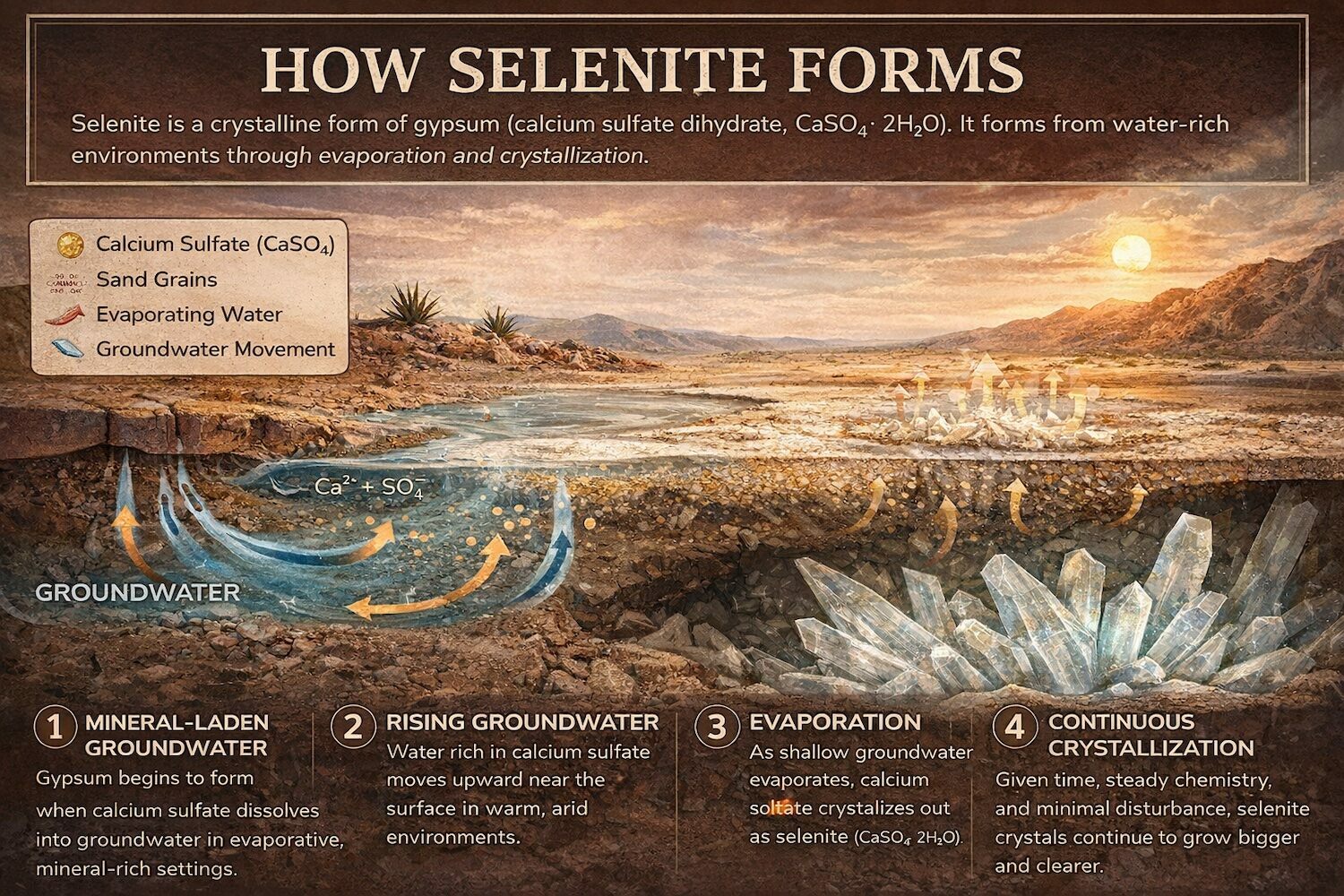
How selenite crystals are formed.
Famous Selenite Localities
The Cave of the Crystals, Mexico: Earth’s Ultimate Selenite Formation
One of the most extraordinary mineral localities ever discovered is the Cave of the Crystals, located deep within the Naica Mine near the town of Naica in northern Mexico. This cave is famed for containing the largest known natural crystals on Earth—colossal blades of perfectly clear selenite (gypsum) that reach more than 30–40 feet (10–12 meters) in length and weigh many tons.
The crystals formed under an exceptionally narrow set of geological conditions. For hundreds of thousands of years, the cave remained completely flooded with mineral-rich groundwater heated to approximately 55–60°C (130–140°F). At these temperatures, calcium sulfate exists right at the boundary between anhydrite and gypsum stability. As the water chemistry slowly shifted and remained incredibly stable, selenite began to crystallize at an almost unimaginably slow rate. With no disturbances, no sediment influx, and no competing crystal growth, the selenite was able to grow continuously to monumental size.
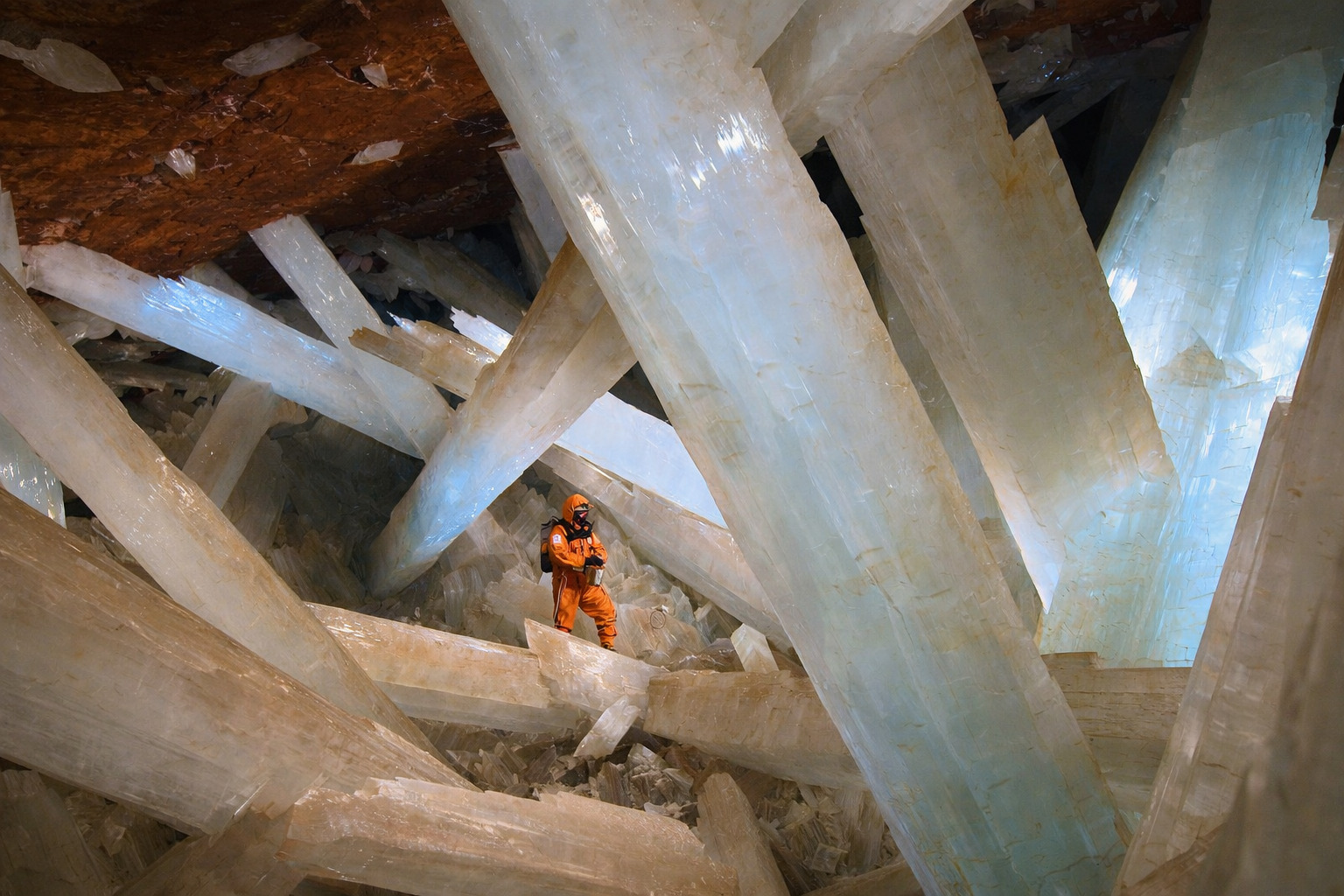
The Cave of the Crystals in Mexico
What makes the Cave of the Crystals even more remarkable is how inhospitable it is to humans. When first discovered in 2000 during mining operations, the cave’s temperature and humidity were so extreme that unprotected exposure could be fatal within minutes. Relative humidity approaches 100%, preventing sweat from evaporating and making heat dissipation nearly impossible. Because of these conditions, scientific exploration has been limited, and the cave has been sealed and reflooded to protect the crystals from degrading in the air.
From a mineralogical perspective, the Cave of the Crystals represents the most dramatic expression of selenite growth ever observed. It serves as a natural laboratory demonstrating how crystal size is governed not by rarity of material, but by time, chemical stability, and environmental consistency. No other known selenite locality—from Morocco to Oklahoma to Italy—comes close to matching the scale or perfection seen at Naica, making this cave the ultimate benchmark against which all other selenite specimens are compared.
Selenite Roses (Desert Rose): Flowers Grown by Evaporation
Selenite roses—more formally known as gypsum roses or desert roses—are among the most recognizable and evocative forms of selenite. Rather than growing as long, clear blades, these crystals form rosette-like clusters of flattened selenite blades radiating outward like petals. Their resemblance to stone flowers is no accident; the shape reflects how gypsum crystallizes in arid, sandy environments where evaporation and sediment play a direct role in crystal growth.

These formations develop when calcium- and sulfate-rich groundwater slowly evaporates in deserts or semi-arid regions. As selenite begins to crystallize, sand grains become trapped between growing crystal faces, forcing the crystals to fan outward instead of forming simple blades. Over time, this process produces compact rosettes with curved, petal-like blades. The presence of sand is also what gives many selenite roses their warm tan, beige, or rusty coloration, even though pure selenite itself is colorless.
Selenite roses are most commonly associated with desert environments such as the Sahara and arid regions of the American Southwest, but some of the most widely collected examples today come from Morocco. Moroccan selenite roses are prized for their well-defined form, balanced symmetry, and durability compared to some more fragile gypsum varieties. They are typically found partially embedded in sandy matrix, which both stabilizes the specimen and emphasizes its natural origin.
Shaped and Sculpted Selenite from Morocco
In recent decades, selenite from Morocco has become especially popular in the mineral and crystal market. Large deposits of gypsum in arid regions of the country yield abundant, high-quality selenite that is well-suited for cutting and shaping. Moroccan material is commonly fashioned into towers, lamps, spheres, hearts, bowls, and other decorative forms that highlight the mineral’s natural translucency and soft glow.

The appeal of shaped Moroccan selenite lies in its balance of affordability, size, and visual impact. Because the material is relatively easy to cut and polish (due to its softness), artisans can create large, elegant pieces that still retain the natural internal textures and striations that make selenite distinctive. When illuminated, these pieces diffuse light in a warm, even way that enhances their moonlike appearance.
Natural crystal blades and clusters from Morocco are also widely collected, often showing classic tabular habits with subtle golden or honey tones from trace impurities or desert sediments. Whether left raw or carefully shaped, Moroccan selenite has played a major role in bringing this mineral into mainstream popularity.
Red River Floodway Selenite: Canada’s Prairie Crystals
One of the most distinctive and regionally important selenite occurrences in North America comes from the Red River Floodway near Winnipeg. These crystals are not found in deep mines or desert basins, but in shallow subsurface sediments exposed during excavation and maintenance of the massive flood-control system built to protect the city from seasonal flooding.
Red River Floodway selenite forms within Quaternary-age clay and silt deposits left behind by glacial Lake Agassiz, a vast proglacial lake that once covered much of central North America near the end of the last Ice Age. As sulfate-rich groundwater moved slowly through these fine-grained sediments, gypsum crystallized in voids and fractures, producing exceptionally clear, well-formed selenite crystals. Unlike desert roses, these crystals typically grow as transparent to translucent blades and plates, sometimes forming loose clusters embedded in soft clay.
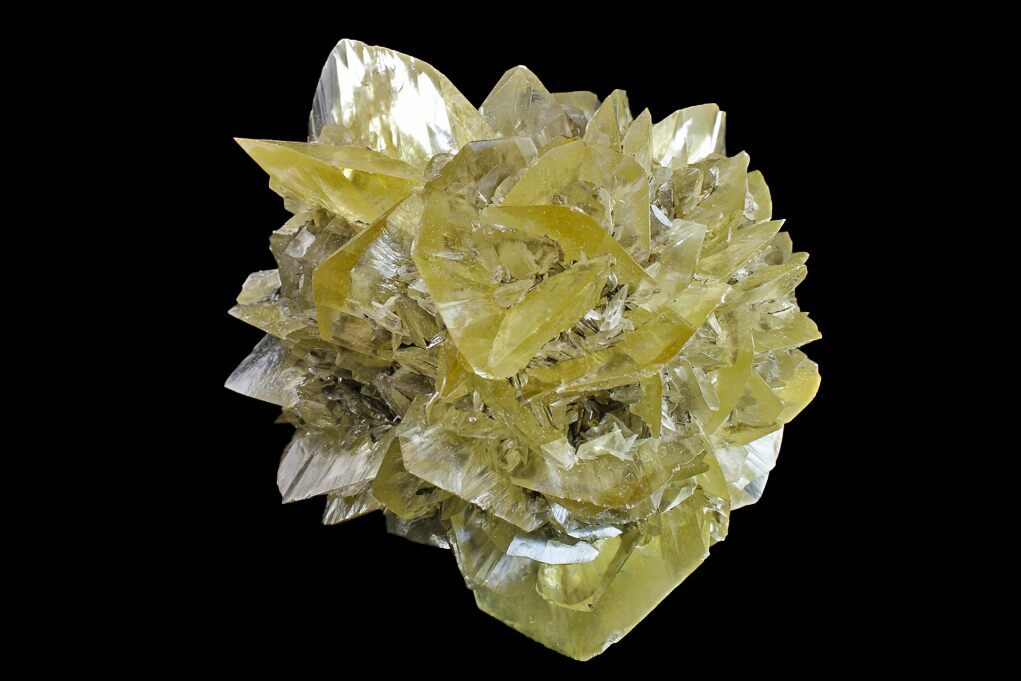
Twinned selenite crystals from the Red River Floodway in Canada
What makes Floodway selenite especially prized by collectors is its clarity and delicacy. Many specimens are water-clear with sharp edges and minimal inclusions, giving them a glassy, almost icy appearance. Some crystals show subtle growth zoning or faint internal clouds that record changes in groundwater chemistry during formation. Because the host sediments are soft, crystals are often recovered intact, though their softness means they are easily damaged if mishandled.
From a geological perspective, Red River Floodway selenite is an excellent example of low-temperature evaporite mineralization in a glacial-lacustrine environment. It demonstrates that impressive selenite crystals do not require extreme heat or deep geological time—only chemically suitable water, stillness, and patience. Today, Floodway selenite is considered a classic Canadian locality specimen, valued both for its beauty and for the clear story it tells about post-glacial landscapes and groundwater-driven crystal growth.
Uses and Cultural Significance
Historically, selenite’s translucency made it a practical material. Roman architects used it for windows, while artists and craftsmen carved it into ornamental objects. Today, its use is primarily decorative and educational, valued for both its aesthetic qualities and its role in teaching crystal growth and evaporite geology. Selenite has also become widely known in the metaphysical and wellness communities, where it is often associated—symbolically—with clarity, calm, and purification. While these interpretations are cultural rather than scientific, they have contributed significantly to the mineral’s modern popularity and widespread availability in shaped forms.
Because selenite is soft and water-soluble, it requires gentle handling. Specimens should be kept dry and protected from abrasion, as even light contact can scratch the surface. Cleaning is best done with a soft, dry cloth—never water. When properly cared for, selenite remains stable and visually stunning for generations.
Selenite stands out among minerals for its ability to combine geological simplicity with visual drama. Formed from nothing more than evaporating water and dissolved salts, it can grow into crystals of astonishing size and clarity. From ancient Roman windows to modern Moroccan carvings, selenite has bridged practical use, natural beauty, and human fascination. It is a mineral that quite literally captures light—and preserves the quiet conditions of its formation in crystal form.


