 Reviews

Pyromorphite: Mineral & Crystal Guide
If you’ve ever seen a cluster of tiny, glossy hexagonal crystals that look like a tray of neon-green candies (or a bouquet of microscopic emerald barrels), there’s a good chance you were looking at pyromorphite. It’s one of those minerals that stops collectors mid-scroll: colors that range from electric apple green to honey yellow, resinous luster that can look wet even when bone-dry, and crystal shapes so cleanly geometric they seem manufactured.
Here’s a fun twist: pyromorphite isn’t “just pretty”—it’s also a mineral that tells a chemistry story about lead, phosphorus, and oxygen coming together in the near-surface environment. In many old mining districts, it forms as nature’s way of locking up toxic lead into a relatively stable mineral. That’s why pyromorphite is famous both as a collector’s gem and as an important player in environmental geochemistry.
Even the name is dramatic. “Pyromorphite” comes from Greek roots meaning “fire-formed”—because early mineralogists noticed that it would melt and recrystallize into different shapes when heated. Long before modern analytical instruments, that behavior was a major clue that it was something distinctive.
What is pyromorphite?
Pyromorphite is a lead chlorophosphate mineral with the formula Pb₅(PO₄)₃Cl. It belongs to the apatite supergroup, meaning it shares a structural “family resemblance” with minerals like apatite (common in bones and teeth, and in phosphate rocks). In pyromorphite, though, the structure is dominated by lead (Pb)—which helps explain its high density and its often rich, saturated colors.
Pyromorphite is most commonly found in the oxidation zones of lead ore deposits, where groundwater and oxygen transform primary sulfide minerals into secondary minerals. It commonly forms botryoidal (grape-like) coatings, drusy crusts, or sharp prismatic hexagonal crystals that can be stubby “barrels” or slender needles depending on growth conditions.
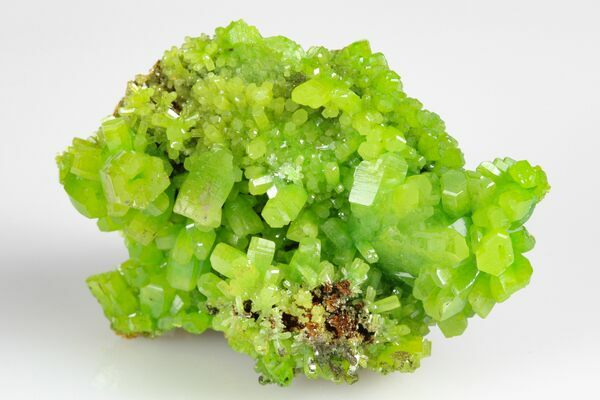
An apple-green Pyrmorphite specimen from the Daoping Mine in China.
Key Properties
Mineral class: Phosphate (apatite group / apatite supergroup)
Chemical formula: Pb₅(PO₄)₃Cl
Crystal system: Hexagonal
Typical crystal habit: Hexagonal prisms, barrel-shaped crystals, acicular crystals, drusy crusts, botryoidal aggregates
Color: Bright green (classic), yellow-green, brown, orange, yellow, gray, sometimes color-zoned
Luster: Resinous to adamantine; sometimes sub-vitreous
Transparency: Transparent to translucent; sometimes opaque in massive forms
Hardness (Mohs): ~3.5–4 (soft—can scratch more easily than quartz)
Streak: White to pale yellowish
Fluorescence: Variable; some localities show weak fluorescence
Common Associations: Galena, Cerussite, Anglesite, Wulfenite, Mimetite, Vanadinite, Smithsonite, Hemimorphite, Goethite, Quartz, Calcite, Barite
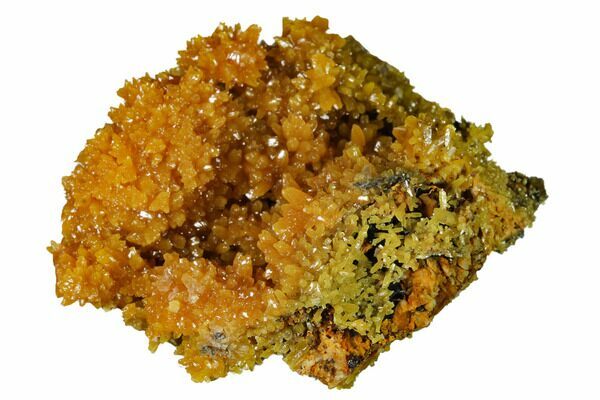
A pyromorphite specimen from the famous Bunker Hill Mine in Idaho.
Pyromorphite is a classic secondary mineral, meaning it forms after the original ore minerals, typically in the near-surface oxidation zone of a lead deposit.
The Process
Why Chloride Matters
Pyromorphite contains chlorine (Cl). Chloride is common in natural waters in small amounts, especially where fluids circulate through evaporitic materials, saline groundwater, or marine-influenced sediments. Even modest chloride availability can steer precipitation toward pyromorphite rather than other lead phosphates.
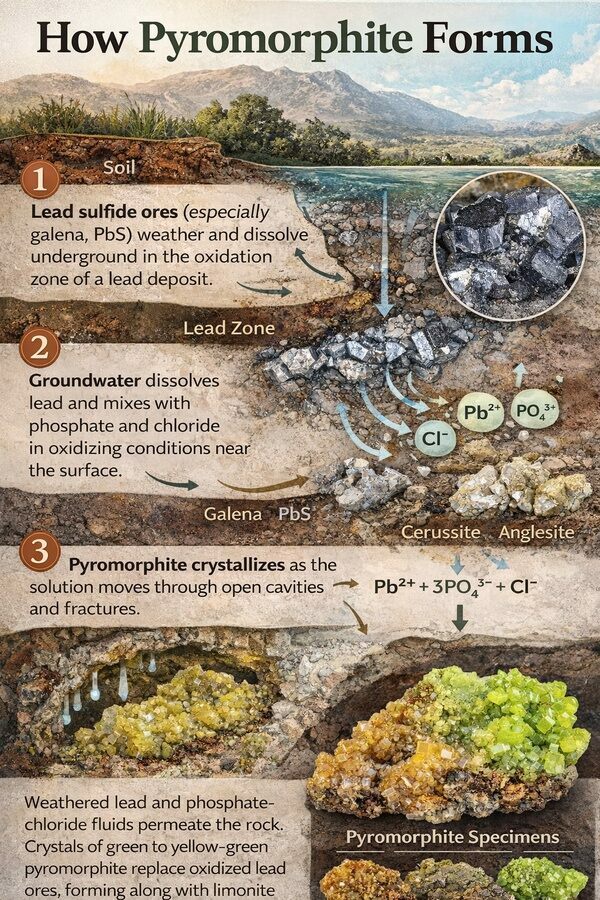
Infographic: How Pyromorphite Crystals Form
Crystal Growth And “Collector-Grade” Forms
The most desirable specimens often form when:
fluids move slowly through open pockets or fractures
chemistry stays relatively stable
there is enough space for crystals to develop freely
iron oxides (like limonite) provide a contrasting “matrix” that highlights the crystal color
That’s why pyromorphite frequently appears as vivid green crystals sprinkled across rusty-brown limonitic rock—an aesthetic combination created by the same oxidizing conditions.
Pyromorphite occurs in lead districts worldwide, especially where oxidized ore zones intersect phosphate-bearing fluids. Some of the most famous (and specimen-producing) localities include:
Democratic Republic of the Congo (DRC) – One of the most important modern sources of pyromorphite. Congolese specimens are renowned for their intense apple-green to emerald-green coloration, high luster, and dense crystal coverage. Crystals commonly form sharp hexagonal prisms or drusy coatings on limonitic matrix, and many examples are considered world-class by today’s collectors.
Morocco – A well-known source of attractive, well-crystallized pyromorphite from oxidized lead deposits, often displaying bright color and good luster.
France (Alsace region, including Bouxwiller) – A classic European locality with strong historical significance in the study of lead phosphate minerals.
Germany – Historically important lead districts that helped define early mineralogical understanding of pyromorphite and related species.
England (Cornwall and Derbyshire) – Famous historic mining regions where pyromorphite occurs with other secondary lead minerals in oxidized veins.
China – A major modern producer of pyromorphite specimens, known for sharp crystal forms, dense drusy coatings, and occasional color zoning.
Australia (Broken Hill, New South Wales) – One of the world’s most famous lead–zinc–silver districts, producing classic examples of pyromorphite and other oxidized lead minerals.
United States (Arizona) – Multiple oxidized lead districts host pyromorphite, commonly associated with wulfenite, vanadinite, and mimetite.
United States (Missouri Lead Belt) – Known for extensive lead mineralization and secondary lead phosphate formation in oxidized zones.
United States (Colorado, Idaho, and Montana) – Historic mining regions where pyromorphite forms as a secondary mineral in lead-bearing veins.
Mexico – Numerous lead districts produce pyromorphite, sometimes alongside vanadinite and other vividly colored secondary lead minerals.
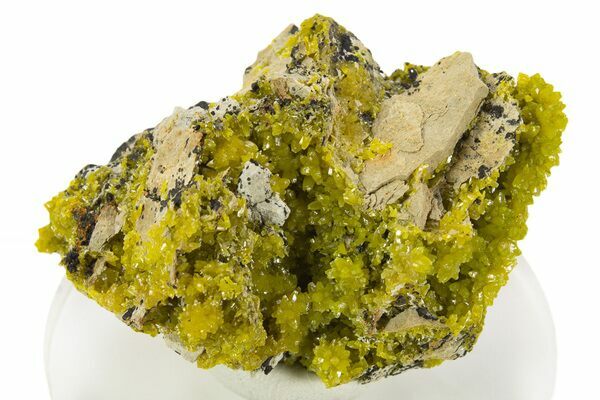
Beautiful pyromorphite crystals from the Department, Republic of the Congo
Long before pyromorphite was formally named or chemically understood, it was already being encountered by miners working the oxidized zones of lead deposits. In medieval and early modern mining districts across Europe, brightly colored green and yellow crusts and crystal clusters were commonly exposed near the surface, often capping veins of galena. These materials were recognized as lead-bearing, but their true nature was poorly understood. To miners, pyromorphite was simply another form of “green lead ore,” grouped loosely with other colorful secondary minerals that formed as primary ores broke down under the influence of air and water.
As mineralogy began to emerge as a scientific discipline in the 18th century, these eye-catching lead minerals attracted the attention of early natural philosophers. Using blowpipes, furnaces, and rudimentary chemical tests, researchers noticed something unusual: when heated, pyromorphite would melt and recrystallize into new shapes rather than simply decomposing. This behavior set it apart from many other lead minerals and ultimately inspired its name. The term pyromorphite, derived from Greek roots meaning “fire-formed,” reflects this distinctive transformation under heat—a key diagnostic property at a time when crystallography and modern analytical tools did not yet exist.
During the 18th and 19th centuries, as European mining expanded and analytical chemistry advanced, pyromorphite gradually gained recognition as a distinct mineral species. It became clear that it was a lead phosphate containing chlorine, structurally related to apatite and closely allied with minerals such as mimetite and vanadinite. This realization helped clarify long-standing confusion, as the three minerals often appear nearly identical in crystal shape and color. Pyromorphite’s identification played an important role in the broader effort to classify minerals not just by appearance, but by composition and internal structure—a foundational shift in mineralogical science.
From a practical standpoint, pyromorphite has historically served as a secondary ore of lead, particularly in oxidized zones where galena had already been weathered away. While rarely the primary target of mining operations, it was often collected and smelted alongside other lead minerals when present in sufficient quantity. Its relatively high lead content made it economically relevant in certain districts, especially before modern beneficiation techniques favored deeper sulfide ores.
In more recent times, pyromorphite’s importance has extended beyond traditional mining. Because it forms a stable, relatively insoluble lead phosphate, it has become a subject of environmental and geochemical study. Scientists have recognized that the natural formation of pyromorphite effectively locks lead into a less mobile and less bioavailable form. This insight has influenced research into soil remediation and mine-waste stabilization, where inducing the formation of lead phosphate minerals can help reduce the environmental impact of lead contamination.
Despite these scientific and industrial associations, pyromorphite is perhaps best known today for its role in the world of mineral collecting. Its vivid colors, sharp hexagonal crystals, and glossy luster have made it one of the most visually striking secondary lead minerals. Classic European specimens laid the groundwork for its reputation, while modern finds—particularly from Africa, China, and the Americas—have elevated it to a showcase species in museums and private collections alike. In this way, pyromorphite bridges the gap between utility and beauty: a mineral once valued mainly as a source of metal, now equally prized as a natural work of art and a window into the chemical processes that shape the Earth’s surface.
Here’s a fun twist: pyromorphite isn’t “just pretty”—it’s also a mineral that tells a chemistry story about lead, phosphorus, and oxygen coming together in the near-surface environment. In many old mining districts, it forms as nature’s way of locking up toxic lead into a relatively stable mineral. That’s why pyromorphite is famous both as a collector’s gem and as an important player in environmental geochemistry.

Even the name is dramatic. “Pyromorphite” comes from Greek roots meaning “fire-formed”—because early mineralogists noticed that it would melt and recrystallize into different shapes when heated. Long before modern analytical instruments, that behavior was a major clue that it was something distinctive.
What is pyromorphite?
Pyromorphite is a lead chlorophosphate mineral with the formula Pb₅(PO₄)₃Cl. It belongs to the apatite supergroup, meaning it shares a structural “family resemblance” with minerals like apatite (common in bones and teeth, and in phosphate rocks). In pyromorphite, though, the structure is dominated by lead (Pb)—which helps explain its high density and its often rich, saturated colors.
Pyromorphite is most commonly found in the oxidation zones of lead ore deposits, where groundwater and oxygen transform primary sulfide minerals into secondary minerals. It commonly forms botryoidal (grape-like) coatings, drusy crusts, or sharp prismatic hexagonal crystals that can be stubby “barrels” or slender needles depending on growth conditions.
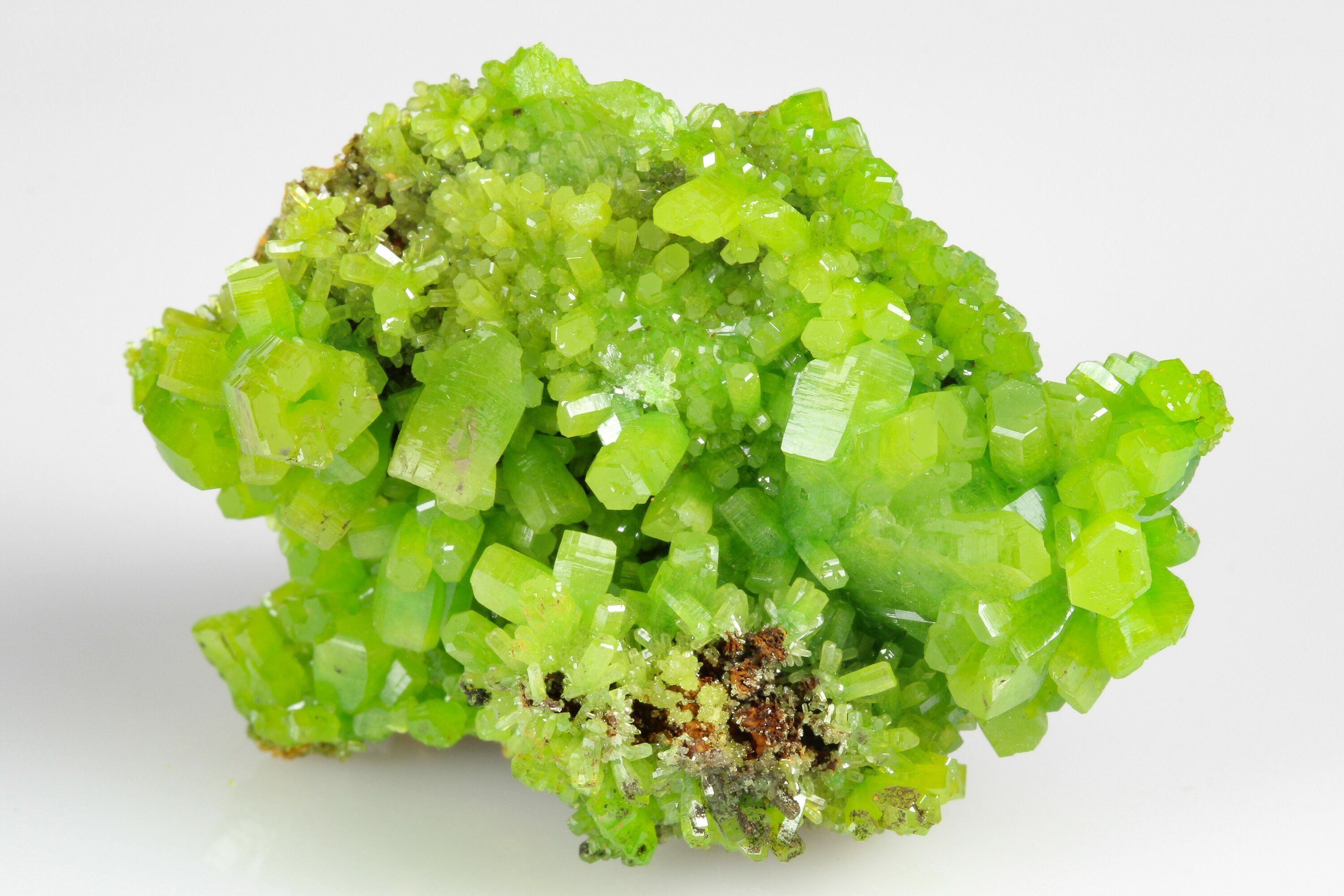
An apple-green Pyrmorphite specimen from the Daoping Mine in China.
Key Properties
Mineral class: Phosphate (apatite group / apatite supergroup)
Chemical formula: Pb₅(PO₄)₃Cl
Crystal system: Hexagonal
Typical crystal habit: Hexagonal prisms, barrel-shaped crystals, acicular crystals, drusy crusts, botryoidal aggregates
Color: Bright green (classic), yellow-green, brown, orange, yellow, gray, sometimes color-zoned
Luster: Resinous to adamantine; sometimes sub-vitreous
Transparency: Transparent to translucent; sometimes opaque in massive forms
Hardness (Mohs): ~3.5–4 (soft—can scratch more easily than quartz)
Streak: White to pale yellowish
Fluorescence: Variable; some localities show weak fluorescence
Common Associations: Galena, Cerussite, Anglesite, Wulfenite, Mimetite, Vanadinite, Smithsonite, Hemimorphite, Goethite, Quartz, Calcite, Barite
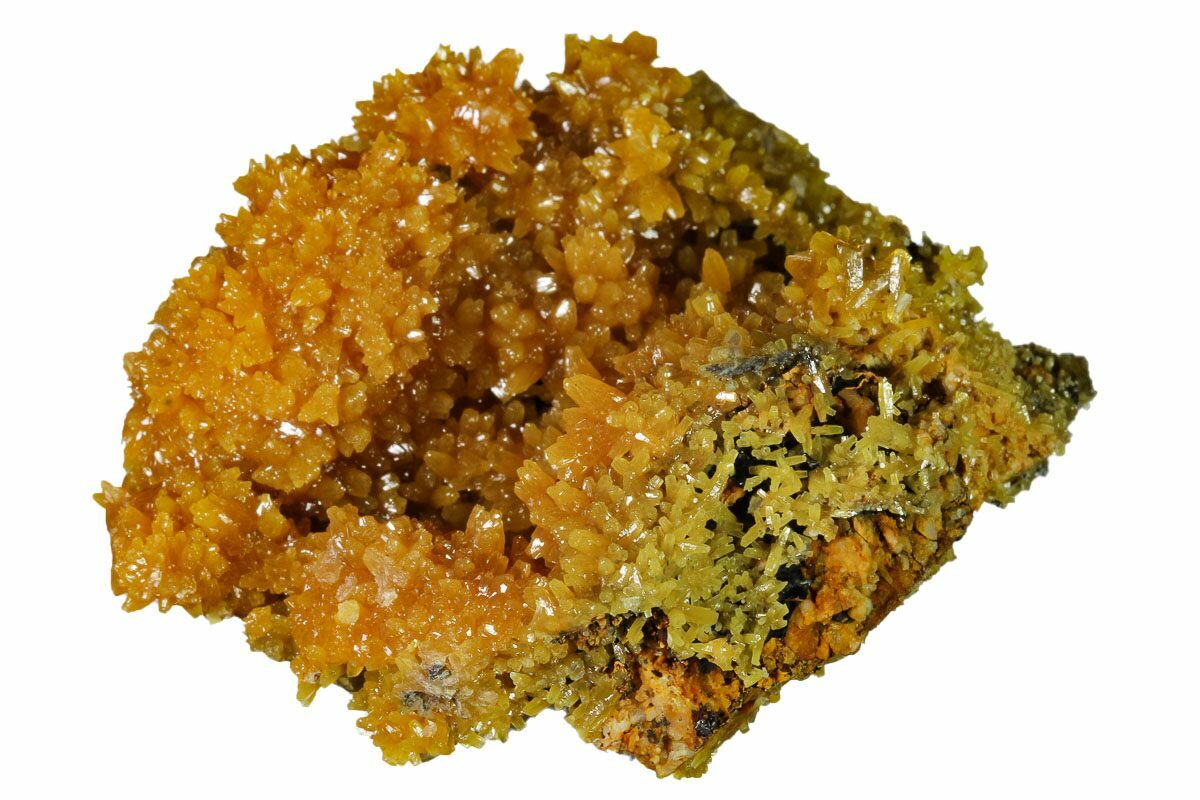
A pyromorphite specimen from the famous Bunker Hill Mine in Idaho.
How Pyromorphite Forms
Pyromorphite is a classic secondary mineral, meaning it forms after the original ore minerals, typically in the near-surface oxidation zone of a lead deposit.
The Process
- Primary lead minerals (especially galena, PbS) are exposed to oxygen-rich groundwater.
- Oxidation and reactions with carbonate/sulfate-rich waters produce secondary lead minerals like cerussite (PbCO₃) and anglesite (PbSO₄).
- If phosphate (PO₄³⁻) is present in the fluids—often sourced from:
- breakdown of phosphate-bearing rocks
- groundwater interacting with soils,
- organic material and guano in karst/cave systems
- phosphate minerals like apatite in surrounding rocks
- then lead in solution can combine with phosphate and chloride to precipitate pyromorphite.
Why Chloride Matters
Pyromorphite contains chlorine (Cl). Chloride is common in natural waters in small amounts, especially where fluids circulate through evaporitic materials, saline groundwater, or marine-influenced sediments. Even modest chloride availability can steer precipitation toward pyromorphite rather than other lead phosphates.
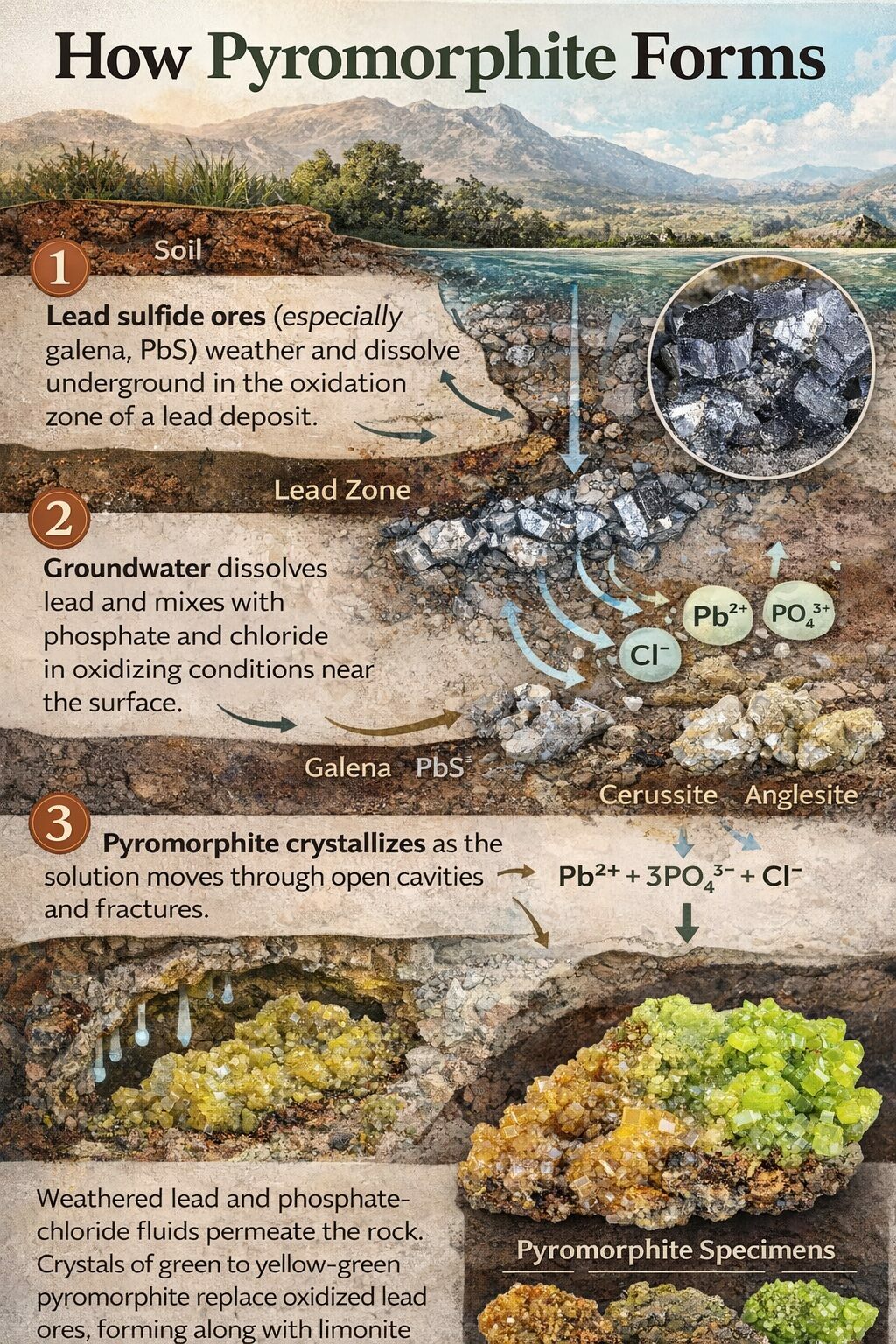
Infographic: How Pyromorphite Crystals Form
Crystal Growth And “Collector-Grade” Forms
The most desirable specimens often form when:
That’s why pyromorphite frequently appears as vivid green crystals sprinkled across rusty-brown limonitic rock—an aesthetic combination created by the same oxidizing conditions.
Well-Known Locations & Famous Deposits
Pyromorphite occurs in lead districts worldwide, especially where oxidized ore zones intersect phosphate-bearing fluids. Some of the most famous (and specimen-producing) localities include:
Democratic Republic of the Congo (DRC) – One of the most important modern sources of pyromorphite. Congolese specimens are renowned for their intense apple-green to emerald-green coloration, high luster, and dense crystal coverage. Crystals commonly form sharp hexagonal prisms or drusy coatings on limonitic matrix, and many examples are considered world-class by today’s collectors.
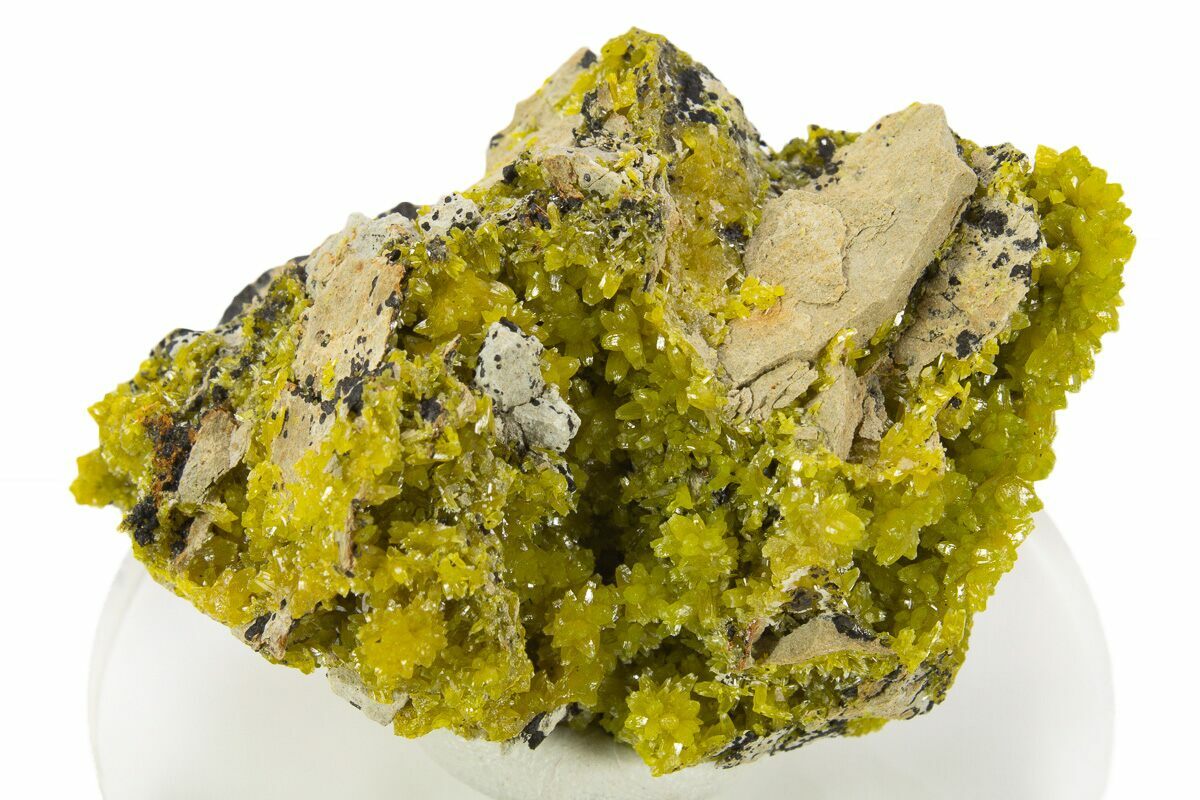
Beautiful pyromorphite crystals from the Department, Republic of the Congo
History & Uses
Long before pyromorphite was formally named or chemically understood, it was already being encountered by miners working the oxidized zones of lead deposits. In medieval and early modern mining districts across Europe, brightly colored green and yellow crusts and crystal clusters were commonly exposed near the surface, often capping veins of galena. These materials were recognized as lead-bearing, but their true nature was poorly understood. To miners, pyromorphite was simply another form of “green lead ore,” grouped loosely with other colorful secondary minerals that formed as primary ores broke down under the influence of air and water.
As mineralogy began to emerge as a scientific discipline in the 18th century, these eye-catching lead minerals attracted the attention of early natural philosophers. Using blowpipes, furnaces, and rudimentary chemical tests, researchers noticed something unusual: when heated, pyromorphite would melt and recrystallize into new shapes rather than simply decomposing. This behavior set it apart from many other lead minerals and ultimately inspired its name. The term pyromorphite, derived from Greek roots meaning “fire-formed,” reflects this distinctive transformation under heat—a key diagnostic property at a time when crystallography and modern analytical tools did not yet exist.
During the 18th and 19th centuries, as European mining expanded and analytical chemistry advanced, pyromorphite gradually gained recognition as a distinct mineral species. It became clear that it was a lead phosphate containing chlorine, structurally related to apatite and closely allied with minerals such as mimetite and vanadinite. This realization helped clarify long-standing confusion, as the three minerals often appear nearly identical in crystal shape and color. Pyromorphite’s identification played an important role in the broader effort to classify minerals not just by appearance, but by composition and internal structure—a foundational shift in mineralogical science.
From a practical standpoint, pyromorphite has historically served as a secondary ore of lead, particularly in oxidized zones where galena had already been weathered away. While rarely the primary target of mining operations, it was often collected and smelted alongside other lead minerals when present in sufficient quantity. Its relatively high lead content made it economically relevant in certain districts, especially before modern beneficiation techniques favored deeper sulfide ores.
In more recent times, pyromorphite’s importance has extended beyond traditional mining. Because it forms a stable, relatively insoluble lead phosphate, it has become a subject of environmental and geochemical study. Scientists have recognized that the natural formation of pyromorphite effectively locks lead into a less mobile and less bioavailable form. This insight has influenced research into soil remediation and mine-waste stabilization, where inducing the formation of lead phosphate minerals can help reduce the environmental impact of lead contamination.
Despite these scientific and industrial associations, pyromorphite is perhaps best known today for its role in the world of mineral collecting. Its vivid colors, sharp hexagonal crystals, and glossy luster have made it one of the most visually striking secondary lead minerals. Classic European specimens laid the groundwork for its reputation, while modern finds—particularly from Africa, China, and the Americas—have elevated it to a showcase species in museums and private collections alike. In this way, pyromorphite bridges the gap between utility and beauty: a mineral once valued mainly as a source of metal, now equally prized as a natural work of art and a window into the chemical processes that shape the Earth’s surface.


