 Reviews


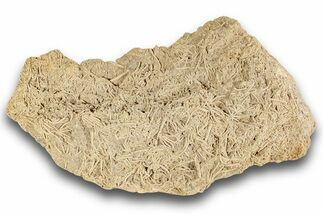
1.3" Floating Crinoid (Saccocoma) Fossil - Solnhofen Limestone


This is a 1.3" wide fossil pelagic or free-floating crinoid (Saccocoma pectinata) from the Jurassic (150 million year old) Solnhofen Limestone in Germany.
It comes with an acrylic display stand.
It comes with an acrylic display stand.
About Saccocoma Crinoids
Saccocoma is one of the most iconic crinoids from the famous Solnhofen Limestone of southern Germany, dating to the Late Jurassic (about 150 million years ago). Unlike the sturdy, stalked “sea lilies” many people imagine when they think of crinoids, Saccocoma was a delicate, free-swimming feather star relative, adapted for life in the open water above the lagoon environments that formed the Solnhofen deposits.
Its body consisted of a small central cup surrounded by long, slender arms covered in fine branching structures used for filter-feeding. These arms helped Saccocoma capture tiny plankton and organic particles drifting through the water. Because of its lightweight build, it likely floated or drifted in the water column rather than remaining anchored to the seafloor.
Saccocoma is one of the most iconic crinoids from the famous Solnhofen Limestone of southern Germany, dating to the Late Jurassic (about 150 million years ago). Unlike the sturdy, stalked “sea lilies” many people imagine when they think of crinoids, Saccocoma was a delicate, free-swimming feather star relative, adapted for life in the open water above the lagoon environments that formed the Solnhofen deposits.
Its body consisted of a small central cup surrounded by long, slender arms covered in fine branching structures used for filter-feeding. These arms helped Saccocoma capture tiny plankton and organic particles drifting through the water. Because of its lightweight build, it likely floated or drifted in the water column rather than remaining anchored to the seafloor.
About The Solnhofen Limestone
The Solnhofen limestone is a famous Upper Jurassic lagerstätte in Germany. It is where one of the most famous fossils of all time, Archaeopteryx, was found. The fine-grained limestone makes excellent building material, which has led to heavy quarrying over the past two centuries. In the process, some spectacular fossils were unearthed, including fossil dragonflies, fish, pterosaurs, shrimp, horseshoe crabs, and many more.
This area represents an ancient archipelago at the edge of a sea. Due to high salt content, the lowest levels in the water column could not support much life and were largely devoid of oxygen. This lack of oxygen and scavengers on the bottom of the sea led to beautiful fossil preservation.
The Solnhofen limestone is a famous Upper Jurassic lagerstätte in Germany. It is where one of the most famous fossils of all time, Archaeopteryx, was found. The fine-grained limestone makes excellent building material, which has led to heavy quarrying over the past two centuries. In the process, some spectacular fossils were unearthed, including fossil dragonflies, fish, pterosaurs, shrimp, horseshoe crabs, and many more.
This area represents an ancient archipelago at the edge of a sea. Due to high salt content, the lowest levels in the water column could not support much life and were largely devoid of oxygen. This lack of oxygen and scavengers on the bottom of the sea led to beautiful fossil preservation.
$35
SPECIES
Saccocoma pectinata
AGE

LOCATION
Eichstatt, Germany
FORMATION
Solnhofen Limestone
SIZE
1.3" wide on 5.9 x 5.4" limestone
CATEGORY
SUB CATEGORY
ITEM
#351015
We guarantee the authenticity of all of our specimens.