 Reviews

Rhodonite: A Deep Dive into the Rose-Colored Mineral
Rhodonite is one of those minerals that manages to be both visually striking and scientifically fascinating. At first glance it’s instantly recognizable: rich pink to rose-red hues, often laced with black veining that looks like ink strokes through watercolor. That alone makes it popular for jewelry and carvings—but rhodonite has a surprisingly deep story that runs from ancient Russia and Native American lore to modern steelmaking and even geology research. Its name comes from the Greek rhodon, meaning “rose,” and in some cultures it was literally treated as a stone of protection for travelers and soldiers, carried as amulets and set into buildings as a symbol of friendship and loyalty.
Geologically, rhodonite is a manganese inosilicate (MnSiO₃) and part of the pyroxenoid group—structurally related to pyroxenes but with a more complex chain-silicate arrangement. Those black veins that are so iconic? They’re typically manganese oxides and hydroxides formed by alteration of the original mineral, creating dramatic contrast that lapidaries love. The vivid pink color itself comes from manganese in the crystal lattice; when conditions are right, rhodonite can even form transparent, gem-quality crystals that rival many well-known pink gemstones in intensity. These gemmy pieces are rare and highly prized, especially when they come from classic localities like Broken Hill in Australia or the famous manganese deposits of Russia.
Beyond its beauty, rhodonite tells a story about how rocks change deep in the Earth. It commonly forms in manganese-rich metamorphic environments—places where pre-existing manganese deposits are altered by heat and pressure. In some deposits, it occurs together with minerals like rhodochrosite, spessartine garnet, tephroite, and hedenbergite, painting a complex picture of metamorphic reactions and fluid activity that geologists can read like a history book. And oddly enough for such a decorative stone, rhodonite also has a thoroughly industrial side: because of its high manganese content, massive occurrences have been mined as manganese ore for use in steel alloys and other industrial applications.
Chemically, rhodonite is usually written as (Mn,Fe,Mg,Ca)SiO₃. Manganese dominates, but iron, magnesium, and calcium can substitute in varying amounts, shifting the color slightly from pure bubble-gum pink to brownish pink or reddish tones. It has a triclinic crystal system, a Mohs hardness of about 5.5–6.5, and a vitreous to pearly luster. It shows perfect cleavage in two directions—an important consideration for lapidaries—and typically leaves a white streak when scratched on an unglazed surface.
In hand specimens, rhodonite ranges from massive, granular material to distinct, prismatic crystals. Transparent crystals are uncommon, and many of the pieces used in jewelry are either massive or slightly translucent. One of the reasons rhodonite is so popular for carvings and cabochons is that it takes a fine polish, which enhances its depth of color. However, heavily altered stones may show more black than pink as manganese oxidizes along fractures and grain boundaries.
Rhodonite occurs in several forms that vary in appearance, chemistry, and desirability. Massive rhodonite—solid, non-crystalline material—is by far the most common. It is the type typically carved into figurines, beads, and decorative slabs, often displaying the characteristic pink background broken by black manganese oxide veining. Crystalline rhodonite, on the other hand, forms distinct prismatic crystals that may be translucent to transparent. These pieces are rare, especially when deeply colored, and can even be faceted as gemstones, though their perfect cleavage makes them challenging to cut. Other variations arise where iron content is higher or alteration more advanced, producing material that shifts toward brownish pink or that is so heavily veined with manganese oxides that it becomes nearly black. In some mining districts, rhodonite appears as part of a manganese ore assemblage, where its industrial value outweighs any aesthetic appeal.
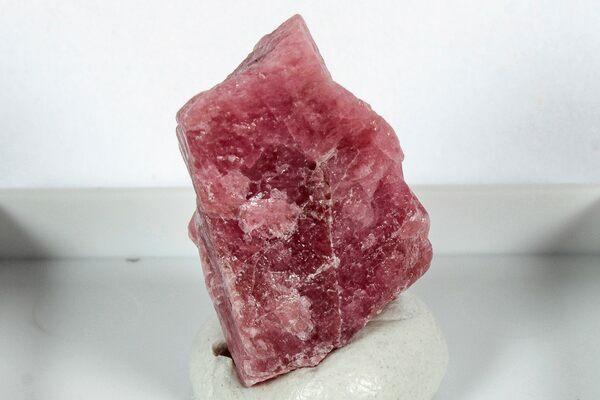
A Rhodonite crystal from the Morro da Mina Mine in Brazil.
Rhodonite primarily forms in manganese-rich metamorphic environments. One common setting involves the metamorphism of manganese-rich sediments buried and subjected to significant heat and pressure; in these conditions, manganese reacts with silica to produce rhodonite and other manganese silicates. Another setting occurs near igneous intrusions, where contact metamorphism and fluid activity generate skarn-like assemblages containing rhodonite, spessartine garnet, tephroite, and related minerals. Hydrothermal processes can also contribute, depositing rhodonite from silica-rich fluids circulating through manganese-bearing rocks.
These environments often produce rhodonite alongside an array of other manganese minerals, including rhodochrosite, spessartine, tephroite, braunite, pyrolusite, bustamite, and quartz. The presence and relationships among these minerals help geologists reconstruct the metamorphic conditions, fluid chemistry, and thermal histories of ancient terrains.
Rhodonite has a particularly rich cultural history in Russia, where deposits in the Ural Mountains were extensively worked from the 18th and 19th centuries onward. Russian artisans transformed enormous blocks of massive rhodonite into architectural elements, decorative columns, religious objects, elaborate vases, and ornate inlay work. The stone, sometimes called the “Eagle Stone,” was believed to offer protection and was occasionally placed in buildings or carried by travelers. Objects crafted from Ural rhodonite became symbols of luxury and national craftsmanship, standing alongside malachite, jasper, and other well-known Russian ornamental stones.
Elsewhere in the world, rhodonite found more modest but still significant cultural uses. During the Victorian era, imported rhodonite became popular in jewelry across Europe, prized for its romantic color and its ability to complement both silver and gold settings. Modern lapidary traditions in North America, South America, and Asia have also embraced the stone, producing carved animals, beads, and polished freeforms for collectors and jewelry designers.
While rhodonite is found in many countries, several localities stand out for their quality, quantity, or historical importance. Russia’s Ural Mountains represent the classic source of massive ornamental rhodonite, producing enormous blocks that fueled centuries of carving and architectural use. Australia’s Broken Hill district is another world-famous locality, renowned for producing sharp, sometimes gem-quality crystals in complex manganese-rich metamorphic ore bodies. Sweden’s Pajsberg and Långban mines are historically important European localities that yielded well-crystallized specimens and contributed greatly to early mineralogical research.
In the United States, rhodonite occurs in several states—Massachusetts, New Jersey, Colorado, and California among them—with Massachusetts even adopting rhodonite as its official state gemstone. Canada also hosts manganese-rich deposits containing attractive pink rhodonite, particularly in British Columbia. Additional sources include Peru, Argentina, Brazil, Japan, China, and Madagascar. Each locality has its own visual signature, with Russian material tending to be more uniformly pink, while Australian and American stones often show bold veining and contrasting patterns.
Rhodonite has long been prized as both an ornamental stone and an industrial mineral, giving it a dual identity that few pink gemstones can claim. Its most familiar role is in the decorative arts, where its vivid coloration and dramatic veining make it an excellent choice for cabochons, beads, bracelets, earrings, and other forms of jewelry. Lapidaries also value the stone for its ability to take a high polish, which brings out the depth of its rose hues and sharp contrast of black manganese oxide. Beyond jewelry, massive rhodonite has been carved for centuries into figurines, spheres, boxes, vases, and inlay panels, with Russian artisans historically elevating the stone to an architectural material used in churches, palaces, and monumental sculptures. Its appearance is unmistakable, allowing it to function both as a centerpiece in elaborate decorative designs and as a subtle accent paired with silver or white metals.
Alongside its aesthetic appeal, rhodonite also plays a role in industry. In several mining districts around the world, especially where the mineral occurs in massive, dark, or heavily altered forms lacking ornamental value, rhodonite has been extracted as a manganese ore. Manganese is critical in steelmaking, where it enhances strength, hardness, and resistance to wear, and it also appears in certain battery chemistries and alloy formulations. In many historic manganese camps, attractive rhodonite specimens were merely an incidental byproduct of ore extraction, though collectors and museums now value these pieces highly.
Rhodonite’s scientific importance should not be overlooked. Because it forms in manganese-rich metamorphic environments, geologists use the mineral to interpret the pressure, temperature, and fluid conditions that shaped ancient terrains. Its associations with other manganese minerals provide insights into the metamorphic pathways of complex ore bodies, making rhodonite an important teaching and research mineral. For collectors, educational institutions, and museums, rhodonite’s combination of color, texture, and geological significance ensures that it remains a fixture in displays and study collections around the world.
For lapidaries, rhodonite is both rewarding and challenging. Its hardness allows for a glossy polish that enhances its vivid pink tones, but its perfect cleavage requires careful orientation during cutting. The very veining that makes the stone visually appealing can also create weak points; carvers must work around these features to avoid fractures. Despite these challenges, rhodonite remains a favorite among carvers and jewelry makers, who often choose freeform shapes that highlight its natural patterns.
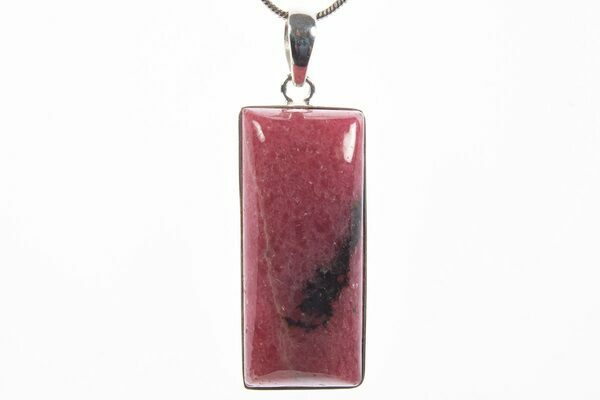
A pendant fashioned from Madagascar rhodonite.
While rhodonite is durable enough for most jewelry applications, it benefits from thoughtful care. Sharp impacts can exploit its cleavage and cause breakage, and stones with numerous fractures or veins should be handled gently. Cleaning with mild soap and water is recommended, while harsh chemicals or ultrasonic cleaners should be avoided for heavily fractured pieces. With proper storage and handling, rhodonite carvings and jewelry can remain beautiful for generations, echoing the enduring legacy of the historic pieces still displayed in Russian palaces and museums today.
Because both minerals owe their color to manganese, rhodonite is frequently confused with rhodochrosite. Yet the two are easily distinguished. Rhodonite is a manganese silicate, whereas rhodochrosite is a manganese carbonate, a difference reflected in their hardness, durability, and reaction to acid. Rhodochrosite is softer, often banded, and will effervesce in dilute hydrochloric acid due to its carbonate composition. Rhodonite is harder, more granular, and typically displays black manganese oxide veining. For jewelers and collectors, these distinctions are essential, influencing everything from pricing to how the stones are cut and cared for.
Geologically, rhodonite is a manganese inosilicate (MnSiO₃) and part of the pyroxenoid group—structurally related to pyroxenes but with a more complex chain-silicate arrangement. Those black veins that are so iconic? They’re typically manganese oxides and hydroxides formed by alteration of the original mineral, creating dramatic contrast that lapidaries love. The vivid pink color itself comes from manganese in the crystal lattice; when conditions are right, rhodonite can even form transparent, gem-quality crystals that rival many well-known pink gemstones in intensity. These gemmy pieces are rare and highly prized, especially when they come from classic localities like Broken Hill in Australia or the famous manganese deposits of Russia.

Beyond its beauty, rhodonite tells a story about how rocks change deep in the Earth. It commonly forms in manganese-rich metamorphic environments—places where pre-existing manganese deposits are altered by heat and pressure. In some deposits, it occurs together with minerals like rhodochrosite, spessartine garnet, tephroite, and hedenbergite, painting a complex picture of metamorphic reactions and fluid activity that geologists can read like a history book. And oddly enough for such a decorative stone, rhodonite also has a thoroughly industrial side: because of its high manganese content, massive occurrences have been mined as manganese ore for use in steel alloys and other industrial applications.
What Is Rhodonite?
Chemically, rhodonite is usually written as (Mn,Fe,Mg,Ca)SiO₃. Manganese dominates, but iron, magnesium, and calcium can substitute in varying amounts, shifting the color slightly from pure bubble-gum pink to brownish pink or reddish tones. It has a triclinic crystal system, a Mohs hardness of about 5.5–6.5, and a vitreous to pearly luster. It shows perfect cleavage in two directions—an important consideration for lapidaries—and typically leaves a white streak when scratched on an unglazed surface.
In hand specimens, rhodonite ranges from massive, granular material to distinct, prismatic crystals. Transparent crystals are uncommon, and many of the pieces used in jewelry are either massive or slightly translucent. One of the reasons rhodonite is so popular for carvings and cabochons is that it takes a fine polish, which enhances its depth of color. However, heavily altered stones may show more black than pink as manganese oxidizes along fractures and grain boundaries.
Types and Varieties of Rhodonite
Rhodonite occurs in several forms that vary in appearance, chemistry, and desirability. Massive rhodonite—solid, non-crystalline material—is by far the most common. It is the type typically carved into figurines, beads, and decorative slabs, often displaying the characteristic pink background broken by black manganese oxide veining. Crystalline rhodonite, on the other hand, forms distinct prismatic crystals that may be translucent to transparent. These pieces are rare, especially when deeply colored, and can even be faceted as gemstones, though their perfect cleavage makes them challenging to cut. Other variations arise where iron content is higher or alteration more advanced, producing material that shifts toward brownish pink or that is so heavily veined with manganese oxides that it becomes nearly black. In some mining districts, rhodonite appears as part of a manganese ore assemblage, where its industrial value outweighs any aesthetic appeal.
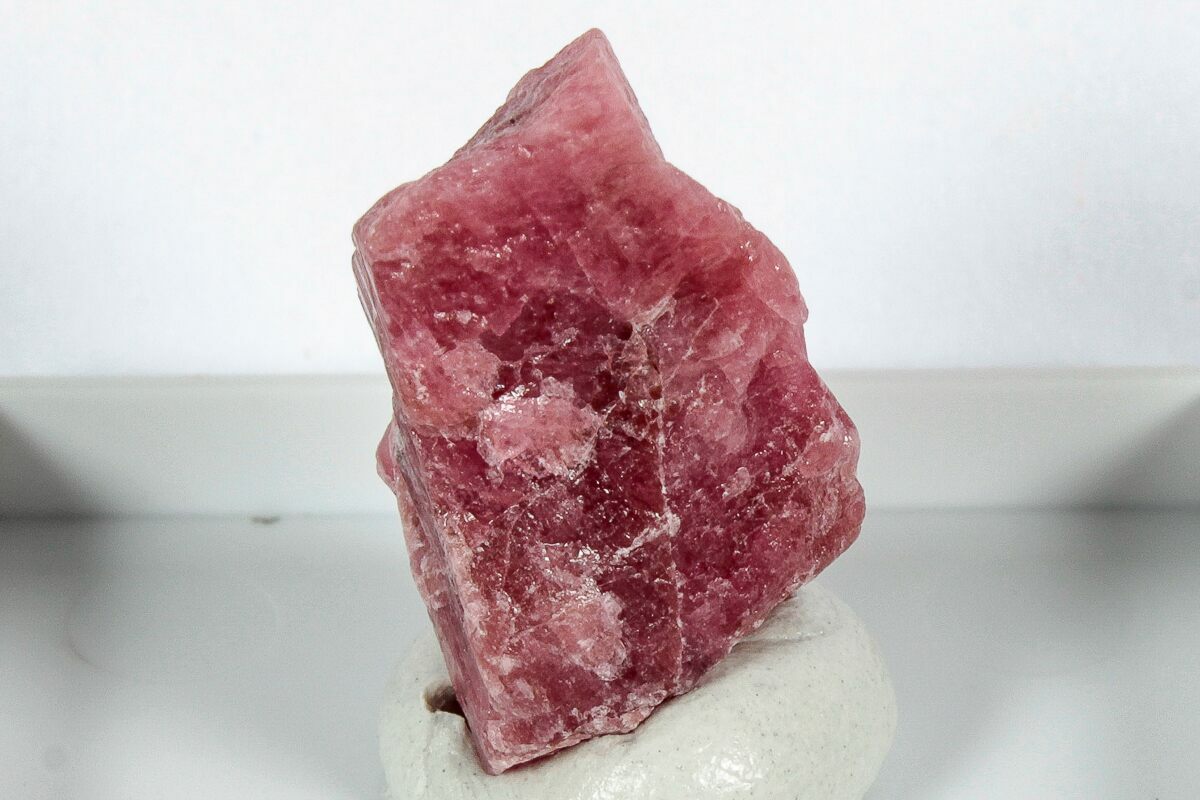
A Rhodonite crystal from the Morro da Mina Mine in Brazil.
How Rhodonite Forms
Rhodonite primarily forms in manganese-rich metamorphic environments. One common setting involves the metamorphism of manganese-rich sediments buried and subjected to significant heat and pressure; in these conditions, manganese reacts with silica to produce rhodonite and other manganese silicates. Another setting occurs near igneous intrusions, where contact metamorphism and fluid activity generate skarn-like assemblages containing rhodonite, spessartine garnet, tephroite, and related minerals. Hydrothermal processes can also contribute, depositing rhodonite from silica-rich fluids circulating through manganese-bearing rocks.
These environments often produce rhodonite alongside an array of other manganese minerals, including rhodochrosite, spessartine, tephroite, braunite, pyrolusite, bustamite, and quartz. The presence and relationships among these minerals help geologists reconstruct the metamorphic conditions, fluid chemistry, and thermal histories of ancient terrains.
Historical and Cultural Significance
Rhodonite has a particularly rich cultural history in Russia, where deposits in the Ural Mountains were extensively worked from the 18th and 19th centuries onward. Russian artisans transformed enormous blocks of massive rhodonite into architectural elements, decorative columns, religious objects, elaborate vases, and ornate inlay work. The stone, sometimes called the “Eagle Stone,” was believed to offer protection and was occasionally placed in buildings or carried by travelers. Objects crafted from Ural rhodonite became symbols of luxury and national craftsmanship, standing alongside malachite, jasper, and other well-known Russian ornamental stones.
Elsewhere in the world, rhodonite found more modest but still significant cultural uses. During the Victorian era, imported rhodonite became popular in jewelry across Europe, prized for its romantic color and its ability to complement both silver and gold settings. Modern lapidary traditions in North America, South America, and Asia have also embraced the stone, producing carved animals, beads, and polished freeforms for collectors and jewelry designers.
Important Rhodonite Localities
While rhodonite is found in many countries, several localities stand out for their quality, quantity, or historical importance. Russia’s Ural Mountains represent the classic source of massive ornamental rhodonite, producing enormous blocks that fueled centuries of carving and architectural use. Australia’s Broken Hill district is another world-famous locality, renowned for producing sharp, sometimes gem-quality crystals in complex manganese-rich metamorphic ore bodies. Sweden’s Pajsberg and Långban mines are historically important European localities that yielded well-crystallized specimens and contributed greatly to early mineralogical research.
In the United States, rhodonite occurs in several states—Massachusetts, New Jersey, Colorado, and California among them—with Massachusetts even adopting rhodonite as its official state gemstone. Canada also hosts manganese-rich deposits containing attractive pink rhodonite, particularly in British Columbia. Additional sources include Peru, Argentina, Brazil, Japan, China, and Madagascar. Each locality has its own visual signature, with Russian material tending to be more uniformly pink, while Australian and American stones often show bold veining and contrasting patterns.
Uses of Rhodonite
Rhodonite has long been prized as both an ornamental stone and an industrial mineral, giving it a dual identity that few pink gemstones can claim. Its most familiar role is in the decorative arts, where its vivid coloration and dramatic veining make it an excellent choice for cabochons, beads, bracelets, earrings, and other forms of jewelry. Lapidaries also value the stone for its ability to take a high polish, which brings out the depth of its rose hues and sharp contrast of black manganese oxide. Beyond jewelry, massive rhodonite has been carved for centuries into figurines, spheres, boxes, vases, and inlay panels, with Russian artisans historically elevating the stone to an architectural material used in churches, palaces, and monumental sculptures. Its appearance is unmistakable, allowing it to function both as a centerpiece in elaborate decorative designs and as a subtle accent paired with silver or white metals.
Alongside its aesthetic appeal, rhodonite also plays a role in industry. In several mining districts around the world, especially where the mineral occurs in massive, dark, or heavily altered forms lacking ornamental value, rhodonite has been extracted as a manganese ore. Manganese is critical in steelmaking, where it enhances strength, hardness, and resistance to wear, and it also appears in certain battery chemistries and alloy formulations. In many historic manganese camps, attractive rhodonite specimens were merely an incidental byproduct of ore extraction, though collectors and museums now value these pieces highly.
Rhodonite’s scientific importance should not be overlooked. Because it forms in manganese-rich metamorphic environments, geologists use the mineral to interpret the pressure, temperature, and fluid conditions that shaped ancient terrains. Its associations with other manganese minerals provide insights into the metamorphic pathways of complex ore bodies, making rhodonite an important teaching and research mineral. For collectors, educational institutions, and museums, rhodonite’s combination of color, texture, and geological significance ensures that it remains a fixture in displays and study collections around the world.
Working with Rhodonite (Lapidary Notes)
For lapidaries, rhodonite is both rewarding and challenging. Its hardness allows for a glossy polish that enhances its vivid pink tones, but its perfect cleavage requires careful orientation during cutting. The very veining that makes the stone visually appealing can also create weak points; carvers must work around these features to avoid fractures. Despite these challenges, rhodonite remains a favorite among carvers and jewelry makers, who often choose freeform shapes that highlight its natural patterns.

A pendant fashioned from Madagascar rhodonite.
While rhodonite is durable enough for most jewelry applications, it benefits from thoughtful care. Sharp impacts can exploit its cleavage and cause breakage, and stones with numerous fractures or veins should be handled gently. Cleaning with mild soap and water is recommended, while harsh chemicals or ultrasonic cleaners should be avoided for heavily fractured pieces. With proper storage and handling, rhodonite carvings and jewelry can remain beautiful for generations, echoing the enduring legacy of the historic pieces still displayed in Russian palaces and museums today.
Rhodonite vs. Rhodochrosite
Because both minerals owe their color to manganese, rhodonite is frequently confused with rhodochrosite. Yet the two are easily distinguished. Rhodonite is a manganese silicate, whereas rhodochrosite is a manganese carbonate, a difference reflected in their hardness, durability, and reaction to acid. Rhodochrosite is softer, often banded, and will effervesce in dilute hydrochloric acid due to its carbonate composition. Rhodonite is harder, more granular, and typically displays black manganese oxide veining. For jewelers and collectors, these distinctions are essential, influencing everything from pricing to how the stones are cut and cared for.


