 Reviews

Vanadinite – Nature’s Fiery Red Lead Mineral
Vanadinite is one of those minerals that immediately captures your attention with its fiery red crystals and geometric precision. At first glance it looks almost artificial — like someone arranged tiny scarlet cylinders on a rock and polished them to a glassy shine. But this vivid appearance is entirely natural, the result of a rare geochemical recipe involving lead ores, arid climates, and trace amounts of vanadium. Its intense color, weighty feel, and perfectly symmetrical hexagonal prisms make vanadinite one of the most recognizable and visually memorable minerals in the collecting world.
Beyond its appearance, vanadinite has a surprisingly rich scientific and historical story. It was originally misidentified as “brown lead” in the early 1800s, until researchers realized it contained an unfamiliar element — vanadium. The metal was ultimately named after Vanadis, the Norse goddess of beauty, a fitting tribute considering the dazzling mineral that helped reveal it. Vanadinite belongs to the apatite mineral group and is unusual in that it incorporates chlorine and vanadium together in a lead-based structure, forming the brilliant red vanadate crystals collectors prize today.
Even though vanadinite occurs in many countries, it requires a precise alignment of geological and climate conditions, making fine specimens relatively uncommon. It forms only in the oxidized zones of lead deposits, typically in desert environments where slow weathering and evaporation concentrate the right chemical ingredients. This is why regions like the Moroccan Sahara produce some of the world’s most remarkable examples — vast landscapes where desert minerals grow with unbelievable clarity and color. Vanadinite is also unusually dense due to its lead content, giving even small crystals a weight that surprises first-time collectors. Combined with its color, luster, and intricate growth habits, these traits have elevated vanadinite from an industrial curiosity to one of the mineral kingdom’s most admired display species.
Vanadinite’s scientific story begins in 1801 when a Spanish mineralogist studying unusual lead ores from Mexico identified a reddish-brown mineral he called “brown lead.” Its behavior puzzled early chemists. When heated, compounds derived from it shifted colors dramatically, an unusual trait that suggested the presence of an element not yet recognized by science. At the time, mineral classification relied heavily on chemical reactions and visual properties, and this enigmatic material didn’t fit neatly into any known category. Although the mineral was noted and described, its true significance remained hidden for several decades.
The key breakthrough came in the 1830s, when a Swedish chemist isolated a new element with similarly unusual color changes and named it vanadium, after the Norse goddess Vanadis. Researchers soon connected this newly described metal to the earlier “brown lead” mineral, realizing that the brilliant red crystals contained substantial amounts of vanadium locked within a lead-chloro-vanadate structure. With its true identity revealed, the mineral was formally renamed vanadinite, linking it forever to the discovery of vanadium. This realization helped cement vanadinite’s importance not only as a collectible species but also as a historically meaningful ore that played a role in unveiling one of the industrial world’s essential metals.
Vanadinite is a lead chlorovanadate with the formula Pb₅(VO₄)₃Cl, a member of the apatite group. It crystallizes in the hexagonal system, which naturally produces the distinctive short, barrel-shaped prisms the mineral is famous for.
Several features make vanadinite easy to recognize:
Color – typically bright red to orange-red, sometimes brownish or yellow.
Crystal Habit – short, hexagonal prisms forming dense clusters or drusy coatings.
Luster – resinous to sub-adamantine, creating a glassy, gem-like surface.
Hardness – 3 to 4 on the Mohs scale.
Density – noticeably heavy due to its lead content.
Transparency – transparent to translucent to opaque depending on crystal thickness.
Some specimens even show subtle fluorescence under ultraviolet light, adding another layer of visual interest.
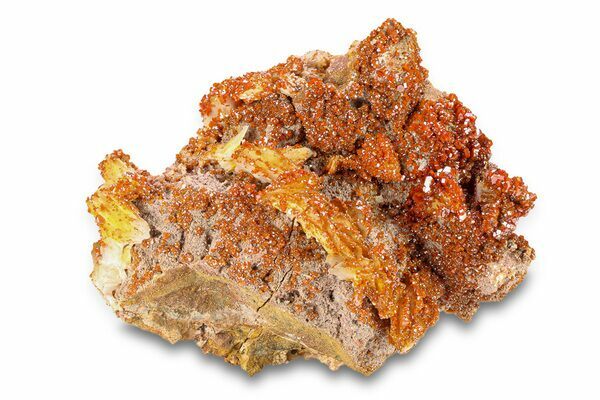
Red/Orange vanadinite crystals from Mibladen, Midelt, Morocco.
Vanadinite forms as a secondary mineral in the oxidized zones of lead deposits. As minerals like galena break down, fluids circulating through the rock transport chlorine and vanadium. Under the right conditions — typically in desert climates where evaporation and slow oxidation dominate — these elements combine with lead to grow vanadinite crystals over long periods of time.
Key Localities
While found in many parts of the world, only a few regions produce truly exceptional crystals:
Mibladen, Morocco – legendary for its vivid red prisms and large, lustrous clusters.
Zimapán, Mexico – the original discovery locality.
Arizona, USA – known for attractive orange-red crystals.
Namibia, South Africa, Argentina, and parts of Europe – producing smaller but collectible specimens.
Although vanadinite is globally distributed, aesthetic display-quality pieces remain relatively limited.
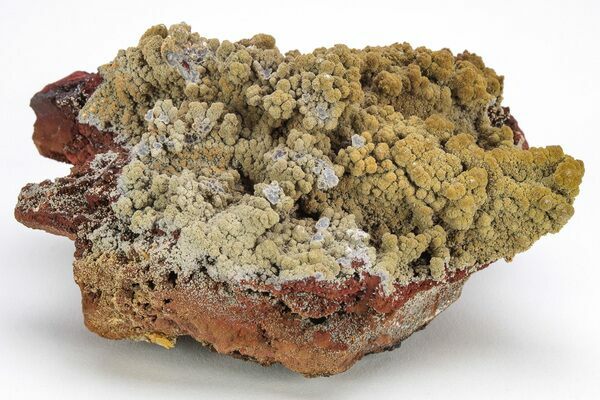
Yellow-Green Vanadinite crystals from the Downeyville Mine in Nevada
Vanadinite played an important role in the early study of vanadium and can serve as an ore of both vanadium and lead. When processed, it can be converted into compounds that yield vanadium pentoxide, used in:
Strengthening steel alloys
Increasing corrosion resistance
Industrial catalysts
Today, however, vanadinite is rarely mined on a large scale for this purpose because other vanadium sources are more economical. Its primary value now lies in its appeal to collectors.
Collectors prize vanadinite for its color, weight, and geometric crystal form. A well-developed specimen — especially from Morocco — can display dense forests of red hexagonal prisms that seem almost architectural. Because the mineral is brittle and relatively soft, it is rarely cut or worn as jewelry. Faceted stones exist but are small and delicate. The true beauty of vanadinite is best appreciated in its natural crystal clusters, displayed as they formed.
Vanadinite is closely related to mimetite and pyromorphite, all belonging to the apatite mineral group. Arsenic can partially substitute for vanadium within vanadinite’s structure, producing a variety known as endlichite, often more orange or brown than pure vanadinite. These substitutions may subtly affect color and luster but preserve the characteristic hexagonal form.

Beyond its appearance, vanadinite has a surprisingly rich scientific and historical story. It was originally misidentified as “brown lead” in the early 1800s, until researchers realized it contained an unfamiliar element — vanadium. The metal was ultimately named after Vanadis, the Norse goddess of beauty, a fitting tribute considering the dazzling mineral that helped reveal it. Vanadinite belongs to the apatite mineral group and is unusual in that it incorporates chlorine and vanadium together in a lead-based structure, forming the brilliant red vanadate crystals collectors prize today.
Even though vanadinite occurs in many countries, it requires a precise alignment of geological and climate conditions, making fine specimens relatively uncommon. It forms only in the oxidized zones of lead deposits, typically in desert environments where slow weathering and evaporation concentrate the right chemical ingredients. This is why regions like the Moroccan Sahara produce some of the world’s most remarkable examples — vast landscapes where desert minerals grow with unbelievable clarity and color. Vanadinite is also unusually dense due to its lead content, giving even small crystals a weight that surprises first-time collectors. Combined with its color, luster, and intricate growth habits, these traits have elevated vanadinite from an industrial curiosity to one of the mineral kingdom’s most admired display species.
Origins & Discovery – From “Brown Lead” to a New Element
Vanadinite’s scientific story begins in 1801 when a Spanish mineralogist studying unusual lead ores from Mexico identified a reddish-brown mineral he called “brown lead.” Its behavior puzzled early chemists. When heated, compounds derived from it shifted colors dramatically, an unusual trait that suggested the presence of an element not yet recognized by science. At the time, mineral classification relied heavily on chemical reactions and visual properties, and this enigmatic material didn’t fit neatly into any known category. Although the mineral was noted and described, its true significance remained hidden for several decades.
The key breakthrough came in the 1830s, when a Swedish chemist isolated a new element with similarly unusual color changes and named it vanadium, after the Norse goddess Vanadis. Researchers soon connected this newly described metal to the earlier “brown lead” mineral, realizing that the brilliant red crystals contained substantial amounts of vanadium locked within a lead-chloro-vanadate structure. With its true identity revealed, the mineral was formally renamed vanadinite, linking it forever to the discovery of vanadium. This realization helped cement vanadinite’s importance not only as a collectible species but also as a historically meaningful ore that played a role in unveiling one of the industrial world’s essential metals.
Chemical Makeup & Physical Characteristics
Vanadinite is a lead chlorovanadate with the formula Pb₅(VO₄)₃Cl, a member of the apatite group. It crystallizes in the hexagonal system, which naturally produces the distinctive short, barrel-shaped prisms the mineral is famous for.
Several features make vanadinite easy to recognize:
Some specimens even show subtle fluorescence under ultraviolet light, adding another layer of visual interest.
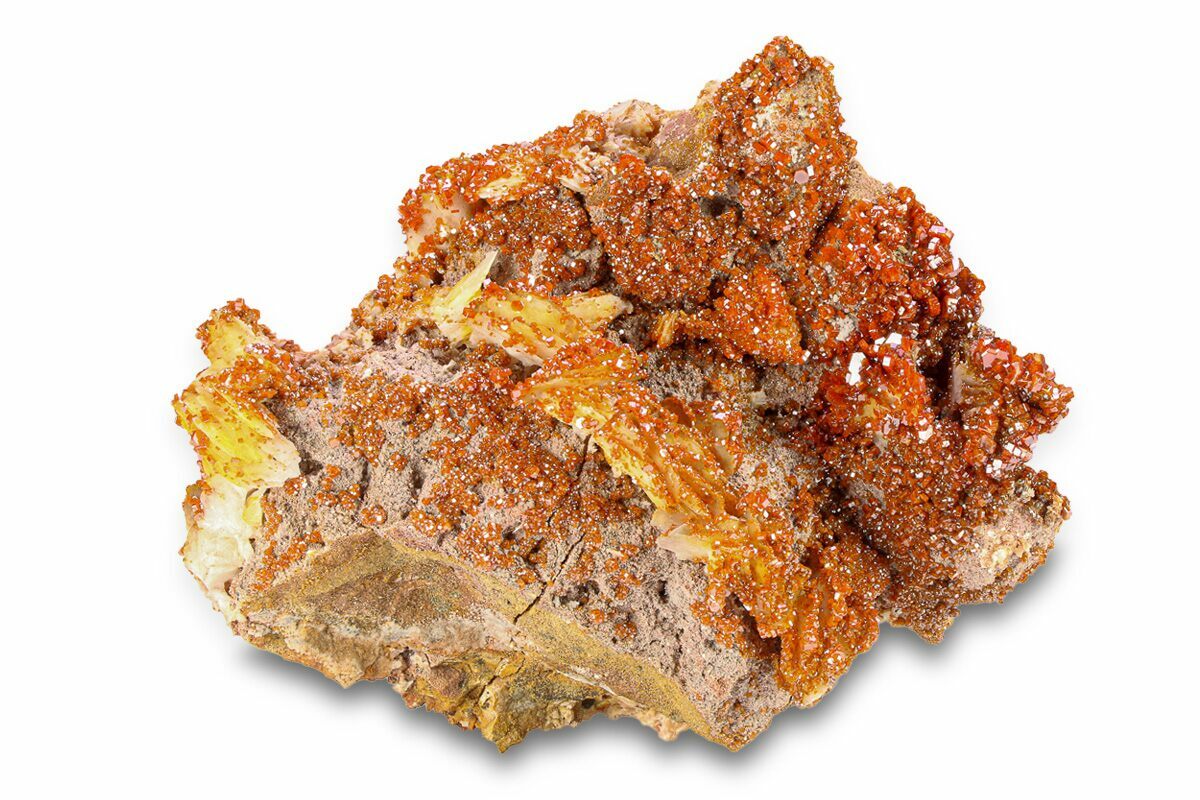
Red/Orange vanadinite crystals from Mibladen, Midelt, Morocco.
How Vanadinite Forms – A Mineral of Desert Environments
Vanadinite forms as a secondary mineral in the oxidized zones of lead deposits. As minerals like galena break down, fluids circulating through the rock transport chlorine and vanadium. Under the right conditions — typically in desert climates where evaporation and slow oxidation dominate — these elements combine with lead to grow vanadinite crystals over long periods of time.
Key Localities
While found in many parts of the world, only a few regions produce truly exceptional crystals:
Although vanadinite is globally distributed, aesthetic display-quality pieces remain relatively limited.
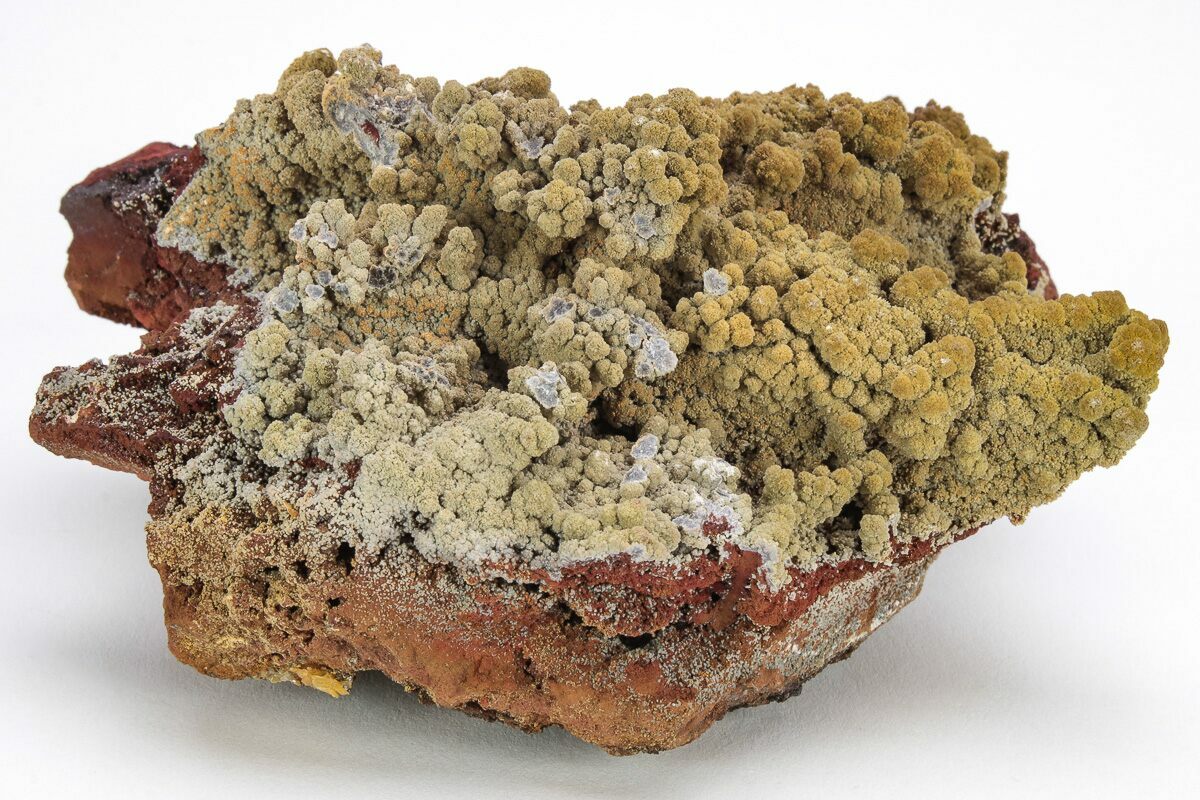
Yellow-Green Vanadinite crystals from the Downeyville Mine in Nevada
Industrial Uses – A Source of Vanadium
Vanadinite played an important role in the early study of vanadium and can serve as an ore of both vanadium and lead. When processed, it can be converted into compounds that yield vanadium pentoxide, used in:
Today, however, vanadinite is rarely mined on a large scale for this purpose because other vanadium sources are more economical. Its primary value now lies in its appeal to collectors.
Vanadinite for Collectors – A Mineral Icon
Collectors prize vanadinite for its color, weight, and geometric crystal form. A well-developed specimen — especially from Morocco — can display dense forests of red hexagonal prisms that seem almost architectural. Because the mineral is brittle and relatively soft, it is rarely cut or worn as jewelry. Faceted stones exist but are small and delicate. The true beauty of vanadinite is best appreciated in its natural crystal clusters, displayed as they formed.
Vanadinite is closely related to mimetite and pyromorphite, all belonging to the apatite mineral group. Arsenic can partially substitute for vanadium within vanadinite’s structure, producing a variety known as endlichite, often more orange or brown than pure vanadinite. These substitutions may subtly affect color and luster but preserve the characteristic hexagonal form.


