 Reviews

Goshenite: Mineral & Crystal Guide
At first glance, goshenite can feel like a gemstone that forgot to show up to the costume party. It’s the colorless-to-near-colorless variety of beryl—often so clean and glassy that a good crystal looks like it’s made of frozen air. But that understatement is exactly its charm: goshenite is essentially beryl before trace elements “turn the color dial,” the same mineral family that becomes emerald, aquamarine, morganite, heliodor, and more when the chemistry shifts just a little.
One of the coolest facts about beryl (and therefore goshenite) is that its crystal structure is built from stacked rings of silicate tetrahedra that create channel-like spaces running down the length of the crystal. Those channels can host small ions and even water molecules—tiny occupants that influence properties and, in other beryls, help enable the substitutions that create color. In other words, goshenite’s “blankness” isn’t emptiness—it’s a kind of purity that makes the structure feel like a transparent blueprint.
Historically, that clarity gave goshenite a practical (and sneaky) role: before modern simulants and synthetics were common, colorless beryl was sometimes used as a diamond look-alike, and it could even be foiled to imitate other gems. Today it’s still cut as a gemstone when the rough is exceptionally clean—less for fiery dispersion and more for crisp brilliance, big shapes, and the quiet satisfaction of owning something deceptively simple.
Mineral family: Beryl (cyclosilicate)
Chemical formula: Be₃Al₂(Si₆O₁₈)
Color: Colorless to near-colorless (often called “white beryl”)
Crystal system / habit: Hexagonal; commonly forms hexagonal prismatic crystals
Hardness: ~7.5–8 (Mohs)
Specific gravity: commonly ~2.65–2.75 (varies by composition/inclusions)
Refractive index: typically ~1.57–1.60 (varies slightly)
Cleavage / fracture: No true cleavage; conchoidal to uneven fracture; generally tough
Commonly associated minerals: quartz, feldspar (microcline/orthoclase, albite), muscovite, and black tourmaline (schorl)
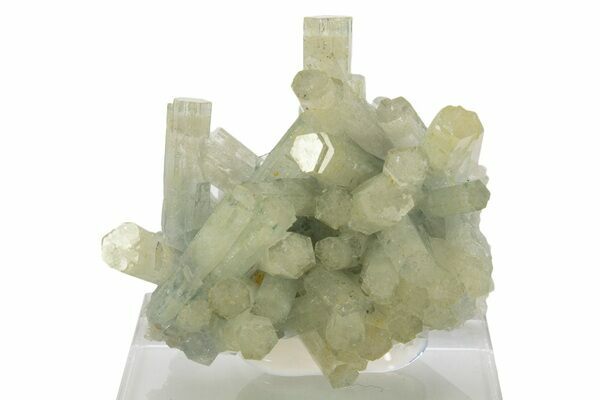
1.6" Gemmy Goshenite Crystal Cluster – Erongo Mountains, Namibia
Most goshenite begins its story late—late in the cooling of a granitic magma system, and late in the chemical “sorting” that happens as minerals crystallize out. Beryllium is an incompatible element in many magmatic systems, meaning it tends to concentrate in the leftover melt and fluids rather than locking up early. As a granite body approaches its final stages of crystallization, beryllium-rich fluids migrate into pockets and fractures around the intrusion.
That’s why pegmatites are so central to goshenite. Granitic pegmatites are famously coarse-grained, packed with quartz, feldspar, and mica—and they can host rare-element minerals when the melt becomes chemically evolved. In the most collector-friendly settings, open cavities (miarolitic pockets) provide the free space for crystals to grow without being crowded, which is a big reason gemmy beryl crystals can develop such sharp hexagonal forms and high clarity.
Goshenite, specifically, is what you get when beryl crystallizes with minimal coloring impurities. In many pegmatites, a small change in trace elements (or later alteration/treatment) is enough to push beryl into pale blues, greens, yellows, or pinks—so truly colorless beryl can be both common as a mineral and uncommon as fine gem rough.
Goshenite’s story is a perfect example of how a mineral can be both scientifically important and quietly elegant. While it may not have the instant fame of emerald or aquamarine, goshenite has played a subtle but fascinating role in the history of gemology—one rooted in purity, early American mineral discovery, and the evolving human desire to imitate brilliance.
Goshenite was first recognized as a distinct variety of beryl in the early-to-mid 19th century, a time when mineralogy in the United States was rapidly developing. The mineral takes its name from Goshen, Hampshire County, Massachusetts, where notable colorless beryl crystals were found in granitic pegmatites.
The variety was formally described from the Barrus Farm locality, which is considered the type locality for goshenite. The mineralogist Charles Upham Shepard is credited with describing it in 1844, giving the gemstone its lasting name and linking it permanently to New England’s rich pegmatite history.
In that era, American pegmatites were of enormous interest because they produced unusually large and well-formed crystals, and beryl was among the most prized. Naming a gemstone variety after a Massachusetts town reflects how important local discoveries were at the time—many mineral varieties were being cataloged for the first time, and each new find carried a sense of scientific excitement.
Understanding goshenite’s historical role also requires understanding what it is: goshenite is essentially beryl in its purest form, lacking the trace impurities that produce strong color.
Chromium and vanadium create emerald
Iron creates aquamarine and heliodor
Manganese creates morganite
And when those coloring elements are absent or extremely minimal, beryl remains colorless—goshenite. Because of this, goshenite is sometimes viewed as the “baseline” beryl, the mineral form before nature adds pigment. This makes it especially interesting to mineralogists, since it highlights the chemistry behind gemstone color.
One of goshenite’s most intriguing historical uses is its role as a diamond substitute. Before the development of modern synthetic gemstones, cubic zirconia, and advanced simulants, people often turned to natural transparent minerals as affordable alternatives. Goshenite’s high clarity and glassy brilliance made it an appealing choice, especially in the 18th and 19th centuries.
While goshenite does not match diamond in hardness or fire, it could still look convincing in candlelight or early indoor lighting—particularly when cut in bright, reflective styles.
In some cases, goshenite was even backed with metallic foil, a common historical practice used to enhance sparkle or add artificial color. Jewelers could tint the backing to imitate emerald, sapphire, or other expensive stones. This practice was not always fraudulent—sometimes it was simply decorative fashion—but it demonstrates how goshenite’s clarity made it a versatile “blank canvas” in early jewelry.
Today, goshenite is rarely used as a mainstream commercial gemstone, largely because the jewelry market tends to favor strong color. However, it is still cut and collected when exceptional material is found. Large goshenite crystals can produce surprisingly striking gemstones, especially in emerald cuts, elongated shapes, or precision faceting that highlights the stone’s crisp transparency. Some goshenite is also heat-treated or irradiated to produce yellow or blue tones, occasionally entering the market under other beryl variety names.
While gem beryl is famous in jewelry, beryl as a mineral has broader significance because it contains beryllium, a metal used in aerospace, electronics, and specialized alloys. Goshenite itself is not typically mined as an industrial ore, since ore-grade beryl is usually massive and opaque rather than gem-clear. Still, goshenite represents the high-purity end of the beryl spectrum, and its crystal chemistry is valuable in scientific study of pegmatite formation and trace element behavior.
Perhaps goshenite’s greatest modern importance is as a mineral specimen. Colorless beryl crystals—especially those that are perfectly terminated, water-clear, or pocket-grown—are highly desirable among collectors. In pegmatite localities like Brazil, Namibia, and Pakistan, goshenite can occur in museum-quality crystals that rival colored beryl varieties in beauty, even without strong pigment.
Collectors often value goshenite for:
Its clean hexagonal geometry
Its rarity in truly colorless form
Its association with classic pegmatite minerals like tourmaline and feldspar
Its connection to the broader beryl gemstone family
Goshen’s role in goshenite is foundational: it’s the type area that gave the variety its name, with Barrus Farm cited as the original described locality. New England pegmatites are famous for producing “textbook” mineral suites—feldspar, quartz, mica, tourmaline, and occasional gem surprises—and goshenite sits right in that tradition. What makes Goshen especially interesting is that the locality is more historically important than commercially dominant; it’s the kind of place where the naming matters as much as the output, a pegmatite chapter preserved in mineralogical memory.
If Goshen is the name, Minas Gerais is the spectacle. Mindat highlights Resplendor as a locality for goshenite, and collectors know the look: clean, glassy beryl crystals with crisp hexagonal faces—sometimes in clusters—often sharing the stage with pegmatite tourmalines. Minas Gerais pegmatites have a global reputation for producing gem-bearing pockets, and goshenite from the region can show that “cavity-grown” perfection: sharp edges, bright luster, and transparent bodies that make the crystal form feel almost architectural.
The Erongo region is a modern legend among mineral collectors, known broadly for pocket minerals and dramatic crystal associations. Goshenite is documented from the Erongo Mountains region, placing it among a cast of cavity-grown specimens that often form in open-space environments prized for crystal aesthetics. In practical terms, Erongo material is loved because it tends to be “display-ready”: clean crystals, strong luster, and photogenic compositions—exactly the conditions that make a colorless gemstone variety feel anything but boring.
Northern Pakistan’s pegmatite regions are famous for producing sharp, gemmy crystals across multiple species, and goshenite is recorded from Gilgit-Baltistan localities (including the Gilgit area and valleys such as Shigar). What makes this region compelling is the combination of geology and logistics: rugged terrain, highly evolved pegmatites, and crystal pockets that can yield remarkable clarity. When goshenite shows up here as well-formed beryl, it often carries that “high alpine” vibe collectors associate with the region—clean lines, bright transparency, and mineral integrity.
Madagascar’s central pegmatite fields are renowned for gem diversity, and the Sahatany Pegmatite Field (Mt Ibity area) is specifically described as hosting many pegmatites—covering a large area and including beryl-type LCT pegmatites among others. That matters because LCT systems (lithium–cesium–tantalum) are exactly the kind of evolved pegmatite environments where beryl and its gem varieties can occur alongside tourmaline and other pegmatite classics. In a setting like Sahatany, goshenite is part of a broader rare-element story: late-stage fluids, pocket growth, and a mineral “ecosystem” where clarity and crystal form can become the main event.

One of the coolest facts about beryl (and therefore goshenite) is that its crystal structure is built from stacked rings of silicate tetrahedra that create channel-like spaces running down the length of the crystal. Those channels can host small ions and even water molecules—tiny occupants that influence properties and, in other beryls, help enable the substitutions that create color. In other words, goshenite’s “blankness” isn’t emptiness—it’s a kind of purity that makes the structure feel like a transparent blueprint.
Historically, that clarity gave goshenite a practical (and sneaky) role: before modern simulants and synthetics were common, colorless beryl was sometimes used as a diamond look-alike, and it could even be foiled to imitate other gems. Today it’s still cut as a gemstone when the rough is exceptionally clean—less for fiery dispersion and more for crisp brilliance, big shapes, and the quiet satisfaction of owning something deceptively simple.
Goshenite Properties
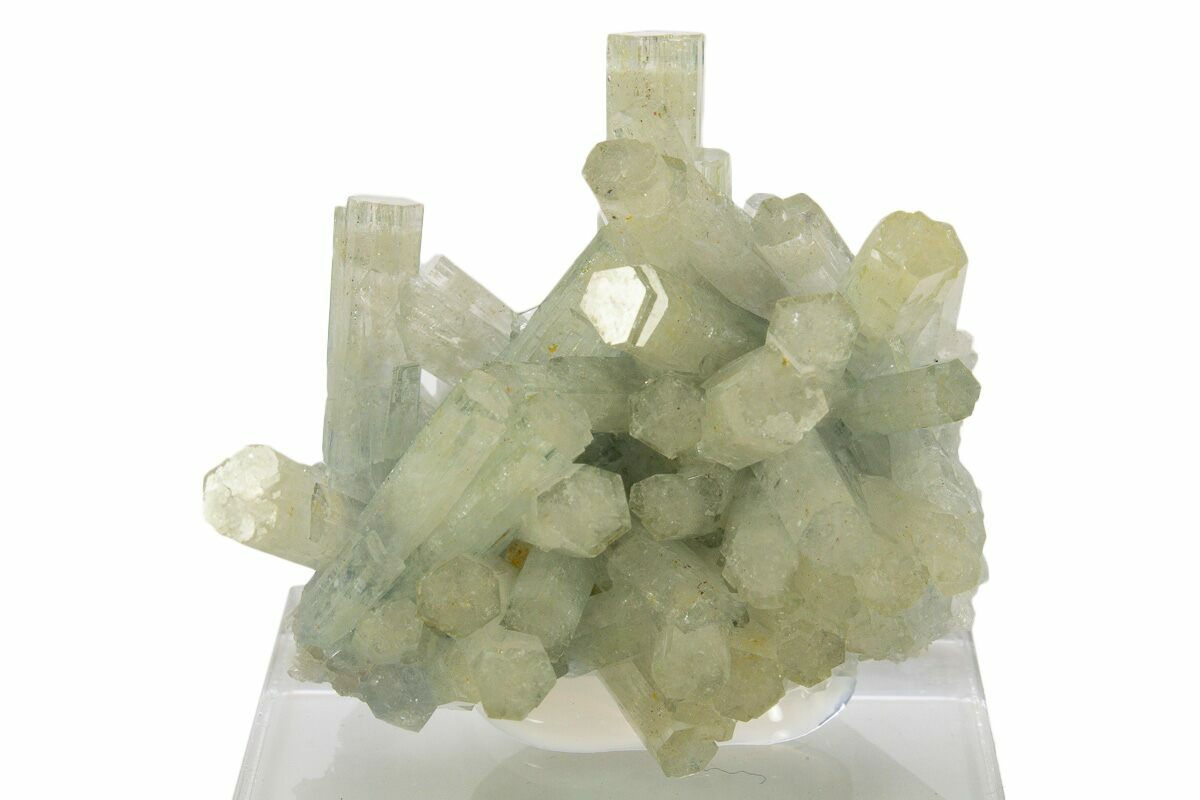
1.6" Gemmy Goshenite Crystal Cluster – Erongo Mountains, Namibia
How Goshenite Forms
Most goshenite begins its story late—late in the cooling of a granitic magma system, and late in the chemical “sorting” that happens as minerals crystallize out. Beryllium is an incompatible element in many magmatic systems, meaning it tends to concentrate in the leftover melt and fluids rather than locking up early. As a granite body approaches its final stages of crystallization, beryllium-rich fluids migrate into pockets and fractures around the intrusion.
That’s why pegmatites are so central to goshenite. Granitic pegmatites are famously coarse-grained, packed with quartz, feldspar, and mica—and they can host rare-element minerals when the melt becomes chemically evolved. In the most collector-friendly settings, open cavities (miarolitic pockets) provide the free space for crystals to grow without being crowded, which is a big reason gemmy beryl crystals can develop such sharp hexagonal forms and high clarity.
Goshenite, specifically, is what you get when beryl crystallizes with minimal coloring impurities. In many pegmatites, a small change in trace elements (or later alteration/treatment) is enough to push beryl into pale blues, greens, yellows, or pinks—so truly colorless beryl can be both common as a mineral and uncommon as fine gem rough.
History and Uses of Goshenite
Goshenite’s story is a perfect example of how a mineral can be both scientifically important and quietly elegant. While it may not have the instant fame of emerald or aquamarine, goshenite has played a subtle but fascinating role in the history of gemology—one rooted in purity, early American mineral discovery, and the evolving human desire to imitate brilliance.
Discovery and Naming
Goshenite was first recognized as a distinct variety of beryl in the early-to-mid 19th century, a time when mineralogy in the United States was rapidly developing. The mineral takes its name from Goshen, Hampshire County, Massachusetts, where notable colorless beryl crystals were found in granitic pegmatites.
The variety was formally described from the Barrus Farm locality, which is considered the type locality for goshenite. The mineralogist Charles Upham Shepard is credited with describing it in 1844, giving the gemstone its lasting name and linking it permanently to New England’s rich pegmatite history.
In that era, American pegmatites were of enormous interest because they produced unusually large and well-formed crystals, and beryl was among the most prized. Naming a gemstone variety after a Massachusetts town reflects how important local discoveries were at the time—many mineral varieties were being cataloged for the first time, and each new find carried a sense of scientific excitement.
Goshenite’s Place in the Beryl Family
Understanding goshenite’s historical role also requires understanding what it is: goshenite is essentially beryl in its purest form, lacking the trace impurities that produce strong color.
And when those coloring elements are absent or extremely minimal, beryl remains colorless—goshenite. Because of this, goshenite is sometimes viewed as the “baseline” beryl, the mineral form before nature adds pigment. This makes it especially interesting to mineralogists, since it highlights the chemistry behind gemstone color.
Historical Uses: The Great Diamond Impostor
One of goshenite’s most intriguing historical uses is its role as a diamond substitute. Before the development of modern synthetic gemstones, cubic zirconia, and advanced simulants, people often turned to natural transparent minerals as affordable alternatives. Goshenite’s high clarity and glassy brilliance made it an appealing choice, especially in the 18th and 19th centuries.
While goshenite does not match diamond in hardness or fire, it could still look convincing in candlelight or early indoor lighting—particularly when cut in bright, reflective styles.
In some cases, goshenite was even backed with metallic foil, a common historical practice used to enhance sparkle or add artificial color. Jewelers could tint the backing to imitate emerald, sapphire, or other expensive stones. This practice was not always fraudulent—sometimes it was simply decorative fashion—but it demonstrates how goshenite’s clarity made it a versatile “blank canvas” in early jewelry.
Today, goshenite is rarely used as a mainstream commercial gemstone, largely because the jewelry market tends to favor strong color. However, it is still cut and collected when exceptional material is found. Large goshenite crystals can produce surprisingly striking gemstones, especially in emerald cuts, elongated shapes, or precision faceting that highlights the stone’s crisp transparency. Some goshenite is also heat-treated or irradiated to produce yellow or blue tones, occasionally entering the market under other beryl variety names.
Industrial and Scientific Importance
While gem beryl is famous in jewelry, beryl as a mineral has broader significance because it contains beryllium, a metal used in aerospace, electronics, and specialized alloys. Goshenite itself is not typically mined as an industrial ore, since ore-grade beryl is usually massive and opaque rather than gem-clear. Still, goshenite represents the high-purity end of the beryl spectrum, and its crystal chemistry is valuable in scientific study of pegmatite formation and trace element behavior.
Collector Value and Specimen Appeal
Perhaps goshenite’s greatest modern importance is as a mineral specimen. Colorless beryl crystals—especially those that are perfectly terminated, water-clear, or pocket-grown—are highly desirable among collectors. In pegmatite localities like Brazil, Namibia, and Pakistan, goshenite can occur in museum-quality crystals that rival colored beryl varieties in beauty, even without strong pigment.
Collectors often value goshenite for:
Key Localities
Goshen, Massachusetts (Barrus Farm pegmatite and the classic name story)
Goshen’s role in goshenite is foundational: it’s the type area that gave the variety its name, with Barrus Farm cited as the original described locality. New England pegmatites are famous for producing “textbook” mineral suites—feldspar, quartz, mica, tourmaline, and occasional gem surprises—and goshenite sits right in that tradition. What makes Goshen especially interesting is that the locality is more historically important than commercially dominant; it’s the kind of place where the naming matters as much as the output, a pegmatite chapter preserved in mineralogical memory.
Resplendor, Minas Gerais, Brazil (the classic gemmy crystal aesthetic)
If Goshen is the name, Minas Gerais is the spectacle. Mindat highlights Resplendor as a locality for goshenite, and collectors know the look: clean, glassy beryl crystals with crisp hexagonal faces—sometimes in clusters—often sharing the stage with pegmatite tourmalines. Minas Gerais pegmatites have a global reputation for producing gem-bearing pockets, and goshenite from the region can show that “cavity-grown” perfection: sharp edges, bright luster, and transparent bodies that make the crystal form feel almost architectural.
Erongo Mountains, Namibia (pocket minerals in a collector’s paradise)
The Erongo region is a modern legend among mineral collectors, known broadly for pocket minerals and dramatic crystal associations. Goshenite is documented from the Erongo Mountains region, placing it among a cast of cavity-grown specimens that often form in open-space environments prized for crystal aesthetics. In practical terms, Erongo material is loved because it tends to be “display-ready”: clean crystals, strong luster, and photogenic compositions—exactly the conditions that make a colorless gemstone variety feel anything but boring.
Gilgit-Baltistan, Pakistan (high-mountain pegmatites and clean beryl)
Northern Pakistan’s pegmatite regions are famous for producing sharp, gemmy crystals across multiple species, and goshenite is recorded from Gilgit-Baltistan localities (including the Gilgit area and valleys such as Shigar). What makes this region compelling is the combination of geology and logistics: rugged terrain, highly evolved pegmatites, and crystal pockets that can yield remarkable clarity. When goshenite shows up here as well-formed beryl, it often carries that “high alpine” vibe collectors associate with the region—clean lines, bright transparency, and mineral integrity.
Sahatany Pegmatite Field (Mt Ibity area), Madagascar
Madagascar’s central pegmatite fields are renowned for gem diversity, and the Sahatany Pegmatite Field (Mt Ibity area) is specifically described as hosting many pegmatites—covering a large area and including beryl-type LCT pegmatites among others. That matters because LCT systems (lithium–cesium–tantalum) are exactly the kind of evolved pegmatite environments where beryl and its gem varieties can occur alongside tourmaline and other pegmatite classics. In a setting like Sahatany, goshenite is part of a broader rare-element story: late-stage fluids, pocket growth, and a mineral “ecosystem” where clarity and crystal form can become the main event.


