 Reviews

Amazonite: A Feldspar Shaped by Radiation and Time
Amazonite is one of the most visually captivating feldspar minerals, instantly recognizable by its soothing blue-green to turquoise hues and soft, pearly luster. Though often mistaken for jade or turquoise, amazonite is neither—it is a distinct variety of microcline feldspar whose color, history, and geological story have fascinated humans for thousands of years. Equal parts gemstone, collector mineral, and geological curiosity, amazonite occupies a unique place at the intersection of mineralogy, archaeology, and mythology.
Despite its name, amazonite is not found in significant quantities along the Amazon River. Early European explorers likely named it after encountering green stones carried by indigenous peoples, mistakenly believing they originated from the Amazon Basin. In reality, notable amazonite deposits are scattered across the globe, from the granite pegmatites of Colorado and Virginia to the ancient rocks of Russia, Madagascar, and Brazil. This misnomer only adds to the mineral’s mystique—amazonite is a stone whose identity has been shaped as much by legend as by science.
One of the most intriguing aspects of amazonite is its color. For decades, scientists debated what gave the mineral its distinctive blue-green tone. It was once attributed to copper, but modern research has revealed a far more complex explanation: trace amounts of lead combined with structural defects in the crystal lattice, enhanced by natural radiation over geological time. This unusual mechanism makes amazonite one of the few gemstones whose color arises from atomic-scale imperfections rather than simple chemical impurities.
Amazonite is a green to blue-green variety of microcline, which is a potassium-rich feldspar with the chemical formula KAlSi₃O₈. Feldspars are the most abundant group of minerals in Earth’s crust, yet amazonite stands out as one of the most colorful and gem-quality members of this family.
It crystallizes in the triclinic crystal system, though well-formed crystals are relatively rare. More commonly, amazonite is found as massive material or as blocky crystals embedded in granite or pegmatite. The mineral has a hardness of 6 to 6.5 on the Mohs scale, making it suitable for jewelry and ornamental use, though it is softer and more brittle than quartz.
Amazonite exhibits two excellent cleavage directions, typical of feldspars, which can make it challenging to cut without fracturing. When polished, however, it develops a smooth, silky luster that enhances its tranquil coloration. Many specimens display subtle white streaks or cross-hatched patterns caused by twinning within the crystal—features that help distinguish genuine amazonite from dyed imitations.
Amazonite forms primarily in granitic pegmatites, which are coarse-grained igneous rocks created during the final stages of magma crystallization. These environments are rich in volatile elements and allow crystals to grow unusually large. Amazonite often occurs alongside minerals such as quartz, albite, orthoclase, smoky quartz, cleavelandite, fluorite, and mica.
Some of the world’s most famous amazonite localities include:
Colorado (USA), particularly the Pikes Peak region, known for vivid amazonite crystals associated with smoky quartz
Virginia and North Carolina (USA), producing massive, gem-quality material
Russia, especially the Ilmen Mountains, a historic source used by Russian royalty
Brazil and Madagascar, yielding material widely used in lapidary and jewelry
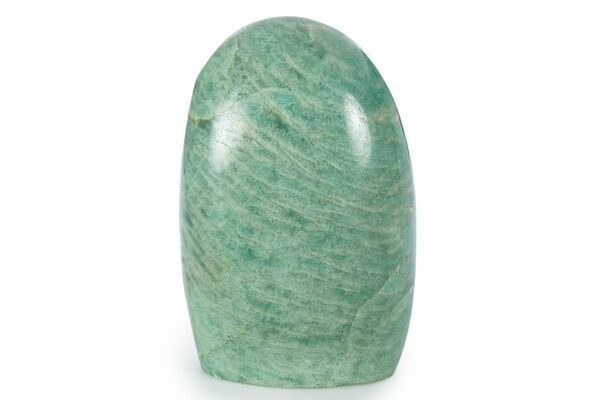
Polished amazonite from Madagascar
The presence of lead impurities and prolonged exposure to natural radiation within these geological settings are critical factors in developing amazonite’s characteristic color, making each deposit subtly unique.
Colorado is home to some of the most famous and visually striking amazonite specimens ever discovered, and for many collectors, the state represents the gold standard for this mineral. The heart of Colorado amazonite production lies in the Pikes Peak region, west and southwest of Colorado Springs, where ancient granitic intrusions created an ideal environment for the formation of large, well-colored amazonite crystals. These deposits have produced museum-quality specimens that are instantly recognizable worldwide.
Colorado amazonite forms within Precambrian granite pegmatites, many of which are over one billion years old. These pegmatites are exceptionally rich in potassium feldspar and volatile elements, allowing crystals to grow large and well-formed. Amazonite from this region is most commonly found in association with smoky quartz, forming dramatic crystal groupings where deep black or translucent brown quartz points contrast sharply with blue-green amazonite. This pairing has become one of the most iconic mineral associations in the world.
Other commonly associated minerals include albite (cleavelandite), orthoclase, microcline, fluorite, zircon, biotite mica, goethite, and occasional topaz. The presence of smoky quartz is especially important, as the same natural radiation responsible for darkening quartz is also believed to play a role in intensifying amazonite’s distinctive color in the region.
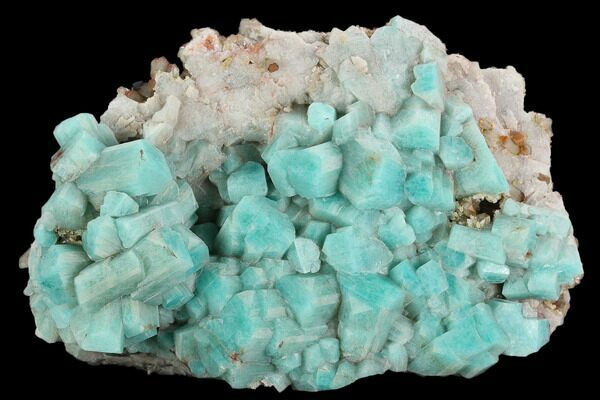
Amazonite crystals on quartz from the 10 Percenter Claim in Colorado
Historic Mines and Early Prospecting
Amazonite mining in Colorado dates back to the late 1800s, when prospectors working the Pikes Peak granite first uncovered unusually vivid green feldspar crystals. While the region was already famous for gold and silver mining, amazonite was initially regarded as a curiosity rather than a commodity. Early miners often discarded or overlooked it until lapidaries and mineral dealers recognized its aesthetic and commercial value.
Some of the most historically significant amazonite localities include the Crystal Peak area, Devil’s Head, Lake George, and Teller County. The Crystal Peak district, in particular, became legendary for producing exceptional amazonite–smoky quartz combinations. By the early 20th century, specimens from these mines were being collected for museums, mineral shows, and private collections around the world.
Mining methods were typically small-scale and labor-intensive, involving hand tools, shallow shafts, and careful extraction of pegmatite pockets to preserve crystal groups. Unlike metal mining, amazonite extraction required patience and precision rather than brute force, as intact specimens were far more valuable than broken material.
Television Exposure and Modern Collecting
Colorado amazonite gained renewed popularity in the modern era through exposure on television, particularly on mineral- and prospecting-focused shows such as “Prospectors” on The Weather Channel. The series showcased real-life miners searching Colorado’s rugged backcountry for gemstones and mineral specimens, including amazonite from the Pikes Peak region. These appearances helped introduce a wider audience to the challenges of specimen mining and highlighted the care required to extract fragile crystals from solid granite.
Television exposure also helped cement Colorado amazonite’s reputation among a new generation of collectors. Scenes of miners uncovering bright blue-green feldspar embedded in massive granite walls emphasized just how rare and exciting high-quality finds can be. For many viewers, these shows were their first introduction to specimen-grade mineral mining as a specialized and demanding pursuit.
Amazonite has been used by human civilizations for thousands of years. Archaeological evidence shows that it was prized by ancient Egyptians, who carved it into amulets, beads, and inlays. The stone appears in jewelry found in Egyptian tombs and was associated with fertility, rebirth, and protection. Some scholars believe amazonite was one of the stones referenced in ancient texts describing sacred green gems.
In Mesopotamia, amazonite was used in seals and decorative objects, while pre-Columbian cultures of Central and South America valued it for ceremonial carvings and ornaments. In Russia, amazonite became popular in the 18th and 19th centuries, where large slabs were used to create vases, columns, and ornamental objects for palaces and museums.
Throughout history, amazonite has been linked symbolically to calmness, balance, and truth. While these associations are cultural rather than scientific, they have contributed to the mineral’s enduring appeal across cultures and time periods.
Today, amazonite is widely used in jewelry, most commonly as cabochons, beads, and pendants. Its gentle color pairs well with silver and white gold, and it is often featured in bohemian, artisan, and contemporary designs. Because it is relatively soft compared to many gemstones, amazonite jewelry is best suited for pendants, earrings, and necklaces rather than rings that see heavy wear.
Beyond jewelry, amazonite is popular in decorative carvings, including spheres, palm stones, figurines, and ornamental tiles. Large, high-quality pieces are especially sought after by collectors, particularly those with intense blue-green coloration and minimal white feldspar streaking.
Mineral collectors value amazonite both as a massive lapidary material and as crystal specimens, especially those associated with smoky quartz from classic localities like Colorado. Well-formed crystals with strong color and aesthetic associations can command significant premiums.
Amazonite is a reminder that beauty in minerals does not always come from rarity alone, but from the complex interplay of chemistry, structure, and deep geological time. Its calming colors, rich history, and unusual scientific story make it one of the most beloved feldspars in the mineral world. From ancient amulets to modern jewelry, from pegmatite pockets to museum displays, amazonite continues to captivate collectors, artists, and geologists alike. It is a mineral that quietly bridges science and storytelling—an enduring testament to the subtle wonders hidden within Earth’s crust.
Despite its name, amazonite is not found in significant quantities along the Amazon River. Early European explorers likely named it after encountering green stones carried by indigenous peoples, mistakenly believing they originated from the Amazon Basin. In reality, notable amazonite deposits are scattered across the globe, from the granite pegmatites of Colorado and Virginia to the ancient rocks of Russia, Madagascar, and Brazil. This misnomer only adds to the mineral’s mystique—amazonite is a stone whose identity has been shaped as much by legend as by science.

One of the most intriguing aspects of amazonite is its color. For decades, scientists debated what gave the mineral its distinctive blue-green tone. It was once attributed to copper, but modern research has revealed a far more complex explanation: trace amounts of lead combined with structural defects in the crystal lattice, enhanced by natural radiation over geological time. This unusual mechanism makes amazonite one of the few gemstones whose color arises from atomic-scale imperfections rather than simple chemical impurities.
Mineral Classification and Physical Properties
Amazonite is a green to blue-green variety of microcline, which is a potassium-rich feldspar with the chemical formula KAlSi₃O₈. Feldspars are the most abundant group of minerals in Earth’s crust, yet amazonite stands out as one of the most colorful and gem-quality members of this family.
It crystallizes in the triclinic crystal system, though well-formed crystals are relatively rare. More commonly, amazonite is found as massive material or as blocky crystals embedded in granite or pegmatite. The mineral has a hardness of 6 to 6.5 on the Mohs scale, making it suitable for jewelry and ornamental use, though it is softer and more brittle than quartz.
Amazonite exhibits two excellent cleavage directions, typical of feldspars, which can make it challenging to cut without fracturing. When polished, however, it develops a smooth, silky luster that enhances its tranquil coloration. Many specimens display subtle white streaks or cross-hatched patterns caused by twinning within the crystal—features that help distinguish genuine amazonite from dyed imitations.
Geological Formation and Occurrence
Amazonite forms primarily in granitic pegmatites, which are coarse-grained igneous rocks created during the final stages of magma crystallization. These environments are rich in volatile elements and allow crystals to grow unusually large. Amazonite often occurs alongside minerals such as quartz, albite, orthoclase, smoky quartz, cleavelandite, fluorite, and mica.
Some of the world’s most famous amazonite localities include:
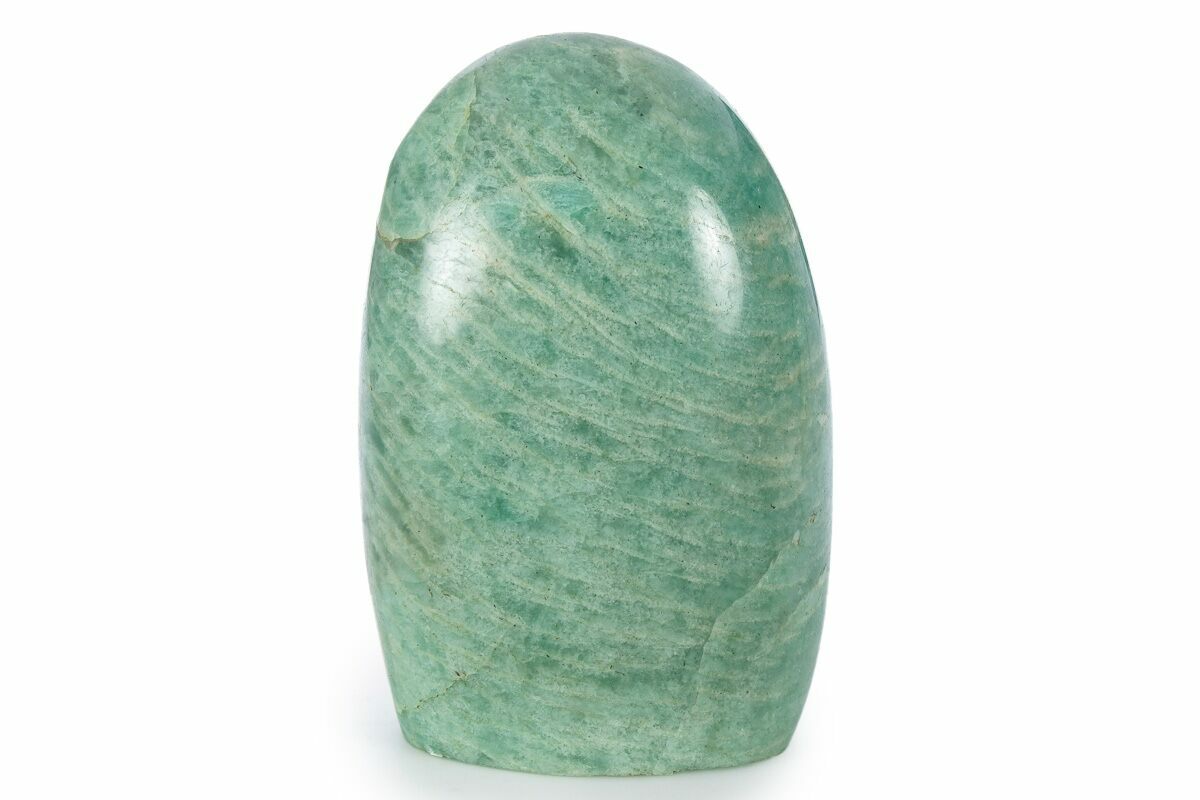
Polished amazonite from Madagascar
The presence of lead impurities and prolonged exposure to natural radiation within these geological settings are critical factors in developing amazonite’s characteristic color, making each deposit subtly unique.
Amazonite Mining in Colorado
Colorado is home to some of the most famous and visually striking amazonite specimens ever discovered, and for many collectors, the state represents the gold standard for this mineral. The heart of Colorado amazonite production lies in the Pikes Peak region, west and southwest of Colorado Springs, where ancient granitic intrusions created an ideal environment for the formation of large, well-colored amazonite crystals. These deposits have produced museum-quality specimens that are instantly recognizable worldwide.
Colorado amazonite forms within Precambrian granite pegmatites, many of which are over one billion years old. These pegmatites are exceptionally rich in potassium feldspar and volatile elements, allowing crystals to grow large and well-formed. Amazonite from this region is most commonly found in association with smoky quartz, forming dramatic crystal groupings where deep black or translucent brown quartz points contrast sharply with blue-green amazonite. This pairing has become one of the most iconic mineral associations in the world.
Other commonly associated minerals include albite (cleavelandite), orthoclase, microcline, fluorite, zircon, biotite mica, goethite, and occasional topaz. The presence of smoky quartz is especially important, as the same natural radiation responsible for darkening quartz is also believed to play a role in intensifying amazonite’s distinctive color in the region.
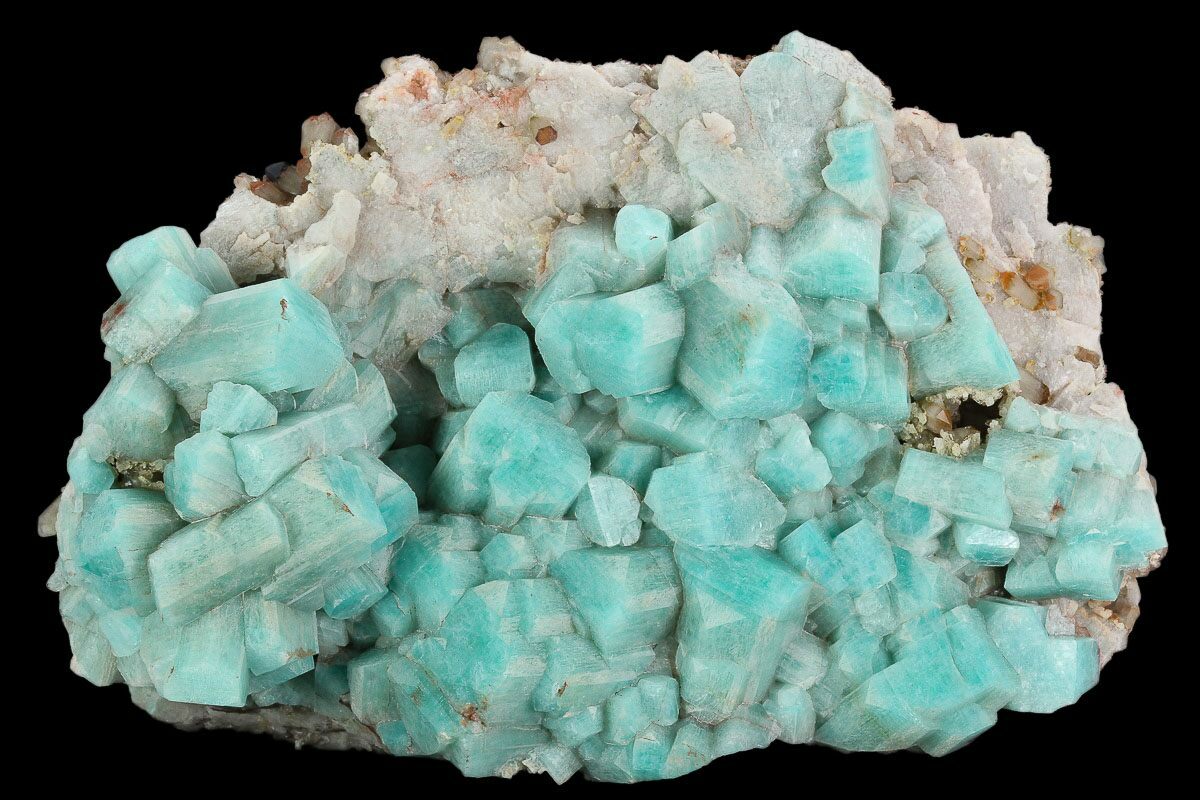
Amazonite crystals on quartz from the 10 Percenter Claim in Colorado
Historic Mines and Early Prospecting
Amazonite mining in Colorado dates back to the late 1800s, when prospectors working the Pikes Peak granite first uncovered unusually vivid green feldspar crystals. While the region was already famous for gold and silver mining, amazonite was initially regarded as a curiosity rather than a commodity. Early miners often discarded or overlooked it until lapidaries and mineral dealers recognized its aesthetic and commercial value.
Some of the most historically significant amazonite localities include the Crystal Peak area, Devil’s Head, Lake George, and Teller County. The Crystal Peak district, in particular, became legendary for producing exceptional amazonite–smoky quartz combinations. By the early 20th century, specimens from these mines were being collected for museums, mineral shows, and private collections around the world.
Mining methods were typically small-scale and labor-intensive, involving hand tools, shallow shafts, and careful extraction of pegmatite pockets to preserve crystal groups. Unlike metal mining, amazonite extraction required patience and precision rather than brute force, as intact specimens were far more valuable than broken material.
Television Exposure and Modern Collecting
Colorado amazonite gained renewed popularity in the modern era through exposure on television, particularly on mineral- and prospecting-focused shows such as “Prospectors” on The Weather Channel. The series showcased real-life miners searching Colorado’s rugged backcountry for gemstones and mineral specimens, including amazonite from the Pikes Peak region. These appearances helped introduce a wider audience to the challenges of specimen mining and highlighted the care required to extract fragile crystals from solid granite.
Television exposure also helped cement Colorado amazonite’s reputation among a new generation of collectors. Scenes of miners uncovering bright blue-green feldspar embedded in massive granite walls emphasized just how rare and exciting high-quality finds can be. For many viewers, these shows were their first introduction to specimen-grade mineral mining as a specialized and demanding pursuit.
History and Cultural Significance
Amazonite has been used by human civilizations for thousands of years. Archaeological evidence shows that it was prized by ancient Egyptians, who carved it into amulets, beads, and inlays. The stone appears in jewelry found in Egyptian tombs and was associated with fertility, rebirth, and protection. Some scholars believe amazonite was one of the stones referenced in ancient texts describing sacred green gems.
In Mesopotamia, amazonite was used in seals and decorative objects, while pre-Columbian cultures of Central and South America valued it for ceremonial carvings and ornaments. In Russia, amazonite became popular in the 18th and 19th centuries, where large slabs were used to create vases, columns, and ornamental objects for palaces and museums.
Throughout history, amazonite has been linked symbolically to calmness, balance, and truth. While these associations are cultural rather than scientific, they have contributed to the mineral’s enduring appeal across cultures and time periods.
Today, amazonite is widely used in jewelry, most commonly as cabochons, beads, and pendants. Its gentle color pairs well with silver and white gold, and it is often featured in bohemian, artisan, and contemporary designs. Because it is relatively soft compared to many gemstones, amazonite jewelry is best suited for pendants, earrings, and necklaces rather than rings that see heavy wear.
Beyond jewelry, amazonite is popular in decorative carvings, including spheres, palm stones, figurines, and ornamental tiles. Large, high-quality pieces are especially sought after by collectors, particularly those with intense blue-green coloration and minimal white feldspar streaking.
Mineral collectors value amazonite both as a massive lapidary material and as crystal specimens, especially those associated with smoky quartz from classic localities like Colorado. Well-formed crystals with strong color and aesthetic associations can command significant premiums.
Amazonite is a reminder that beauty in minerals does not always come from rarity alone, but from the complex interplay of chemistry, structure, and deep geological time. Its calming colors, rich history, and unusual scientific story make it one of the most beloved feldspars in the mineral world. From ancient amulets to modern jewelry, from pegmatite pockets to museum displays, amazonite continues to captivate collectors, artists, and geologists alike. It is a mineral that quietly bridges science and storytelling—an enduring testament to the subtle wonders hidden within Earth’s crust.


