 Reviews

Seraphinite: Mineral & Crystal Guide
Seraphinite is one of those minerals that feels like it has a built-in special effect. Tilt a polished piece and the surface can flash with silvery, feathery plumes that seem to sweep across a deep forest-green background—like frost patterns on a window, or the impression of wings caught mid-motion. That visual phenomenon is chatoyancy (a moving, luminous sheen), and in seraphinite it often organizes into radiating, plumose (feather-like) structures that make the stone instantly recognizable.
What surprises many collectors is that “seraphinite” isn’t a formally distinct mineral species. It’s a trade name used for a particularly striking, gemmy variety of clinochlore, which belongs to the chlorite group of phyllosilicates (sheet silicates). In other words, the drama comes not from a unique chemistry alone, but from how the material grew and arranged its microscopic structure—especially the way fine, reflective fibers and layered silicate sheets interact with light.
The name itself adds to the mystique. “Seraphinite” is derived from seraphim—the “winged” celestial beings of biblical tradition—because the stone’s silvery plumes can resemble feathers or wings. In the gem and lapidary world, this visual metaphor stuck, and the name became part geology, part poetry.
From a practical standpoint, seraphinite is also a lesson in tradeoffs: it can be breathtaking, but it’s comparatively soft for a gemstone—often cited around Mohs 2–4 (sometimes a bit higher depending on the material and reference), which is why it’s more often seen as cabochons, carvings, palm stones, and collector pieces rather than rings meant for daily wear. That softness is tied to its sheet-silicate nature: chlorites cleave easily and can be damaged by abrasion if used in the wrong setting.
Another reason seraphinite has such a devoted following is its rarity in the marketplace. While chlorite minerals occur widely in metamorphic settings, the “classic” gem-quality seraphinite associated with the trade is mined from a limited area of eastern Siberia, Russia, which keeps supply comparatively constrained. So when you find a piece with bold contrast—dark green body color and crisp, bright “feathers”—you’re looking at a combination of geology, structure, and locality that doesn’t happen everywhere, even if the broader mineral family is common.
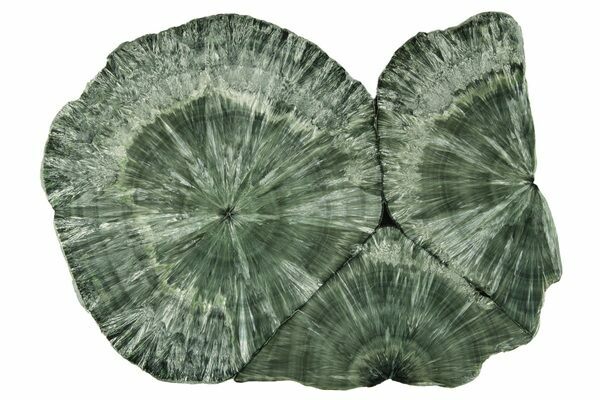
This striking slab of seraphinite from the Korshunovskiy Mine in Siberia displays a dramatic radial structure characteristic of the finest material from this locality.
Mineral identity: variety of clinochlore
Mineral group: Chlorite group (phyllosilicates / sheet silicates)
Typical color: Dark green to gray-green with silvery to white reflective plumes
Optical effect: Chatoyancy producing feather/wing-like patterns
Crystal system: Monoclinic (as clinochlore)
Mohs hardness: Commonly cited around 2–4 (sometimes reported slightly higher in some references)
Luster: Vitreous to silky
Transparency: Opaque to translucent
Cleavage: Typically perfect in one direction
Specific gravity: Often cited roughly ~2.55–2.75 (varies by composition)
Why it shimmers: The feathering is commonly attributed to fine reflective structures/inclusions and the aligned sheet/fibrous texture that interacts strongly with light
Because seraphinite is generally a visually distinctive form of clinochlore (chlorite), its origin is best understood through chlorite-forming geological environments.
Chlorite minerals commonly develop during metamorphism and hydrothermal alteration, especially in rocks rich in magnesium and iron. A classic setting involves ultramafic rocks (mantle-derived rocks high in Mg and Fe) that undergo hydration and alteration—processes that can convert original minerals into new assemblages such as serpentinite and associated alteration minerals. In many metamorphic terrains, chlorite is a hallmark of low- to medium-grade metamorphism (the kinds of conditions that re-equilibrate minerals without fully melting the rock).
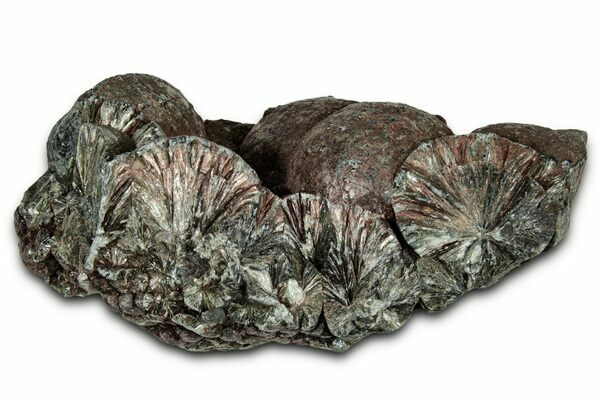
A rough (uncut) piece of seraphinite.
So where does the signature “feather” look come from? In seraphinite, the defining feature is not simply “it’s clinochlore,” but that it often shows a radiating/plumose internal structure. That texture can arise when the mineral grows in fan-like or fibrous aggregates, sometimes influenced by fractures, fluid pathways, and changing temperature/pressure conditions during alteration. In practical terms: the stone’s beauty is a record of directional growth and microstructure, captured and amplified when the material is cut and polished.
Seraphinite is a fascinating example of how a mineral can move from relative obscurity into prominence not because it represents a new scientific discovery, but because its beauty was finally recognized and revealed. While the mineral species behind seraphinite—clinochlore of the chlorite group—has been known to mineralogists since the 19th century, the gem material we call “seraphinite” is a much more recent entrant into the decorative stone market.
Chlorite minerals themselves are common in metamorphic and altered rocks worldwide. For generations, they were studied primarily as rock-forming minerals, not gemstones. Most chlorite occurs as dull green masses, fine-grained aggregates, or microscopic flakes within schists and serpentinites. There was little reason to consider it decorative material. What changed was the discovery of unusually coarse, radiating aggregates of clinochlore in eastern Siberia that displayed a dramatic internal structure. When cut and polished, these stones revealed luminous, silvery plumes sweeping across a deep green background—patterns so evocative of feathers that they inspired a new name.
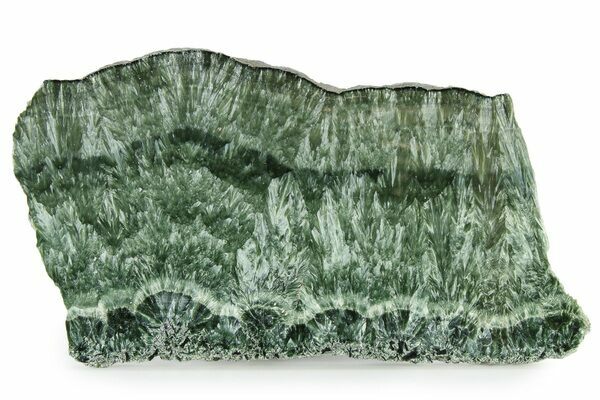
A beautiful, feathering slab of polished Seraphinite (Clinochlore) from Eastern Siberia
The term “seraphinite” derives from “seraphim,” the winged celestial beings of biblical tradition. The resemblance between the mineral’s chatoyant plumes and angelic wings gave the stone a memorable identity within the gem trade. This naming was not part of formal mineral classification but rather a commercial and aesthetic choice, a common practice in the ornamental stone world when an especially attractive material appears in workable quantities.
The most significant source of seraphinite is the Korshunovskoye iron deposit in the Irkutsk Oblast of eastern Siberia, Russia. This region is geologically complex and associated with iron-rich formations and metamorphic processes. The clinochlore that becomes seraphinite formed under conditions involving iron- and magnesium-rich rocks subjected to alteration and metamorphism. Fluids moving through fractures and host rocks allowed chlorite minerals to crystallize in coarse, radiating aggregates rather than the fine-grained textures more typically seen.
Seraphinite is not generally mined as a primary economic mineral. Instead, it is associated with large-scale iron mining operations. Within these deposits, zones containing high-quality, chatoyant clinochlore are selectively recovered when encountered. Because iron is the primary target of extraction, seraphinite production can be intermittent and dependent on broader mining activity. This secondary status contributes to the limited and sometimes unpredictable supply of gem-quality material.
Mining in eastern Siberia presents additional challenges. The region’s remote location, harsh winters, and industrial focus on iron rather than decorative stone mean that seraphinite is not extracted with the same dedicated infrastructure that supports major gemstone industries elsewhere. As a result, the global supply remains geographically concentrated and comparatively restricted. When high-quality material is recovered, it is either shaped locally or exported as rough to be cut and polished by lapidaries in other parts of the world.
Seraphinite began appearing more consistently in Western gem markets in the late 20th century, during a period of growing interest in unusual ornamental stones. Its strong chatoyancy distinguished it immediately from other green stones such as jade, malachite, or aventurine. Jewelers quickly realized that a high polish dramatically enhances the moving, feather-like effect. Domed cabochons proved especially effective at showcasing the luminous plumes, as the curved surface allows light to travel across the stone and activate its internal structure.
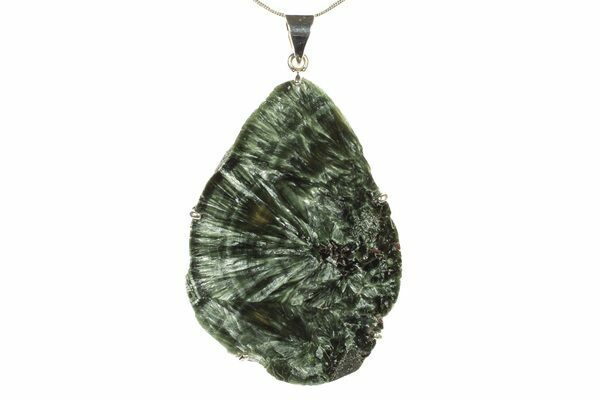
Polished seraphinite that has been crafted into a pendant.
Because seraphinite is relatively soft—commonly cited between Mohs hardness 2 and 4—it is not well suited for high-wear jewelry such as rings. Instead, it is most often used in pendants, earrings, brooches, and beads, where it is protected from abrasion. Its softness, however, makes it easier to carve than many harder gemstones. Artisans have taken advantage of this by producing small figurines, spheres, palm stones, and ornamental slabs that display broad, dramatic sweeps of chatoyant structure.
Beyond jewelry and decorative arts, seraphinite has also become popular among mineral collectors. Fine specimens that clearly display radiating, plumose growth patterns are appreciated as striking examples of chatoyant chlorite. The stone has additionally gained attention in metaphysical markets, where its wing-like patterns and name have inspired symbolic associations with spiritual growth and angelic themes. While these interpretations are cultural rather than scientific, they have played a meaningful role in the stone’s modern popularity.
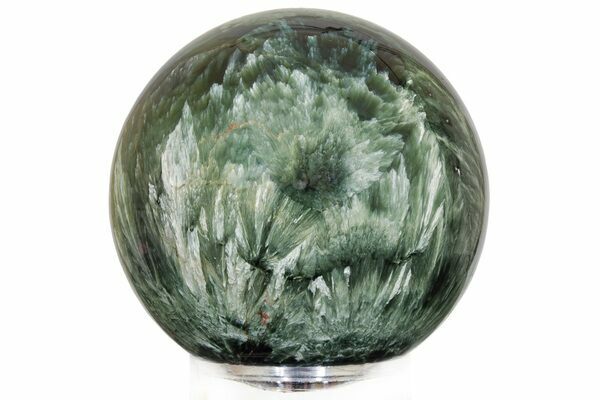
A polished sphere of seraphinite.
Unlike gemstones with millennia of recorded trade and cultural history, seraphinite’s story is largely a modern one. Its recognition is tied to industrial mining in Siberia, advancements in lapidary techniques capable of revealing its internal structure, and the gem trade’s ability to give a memorable name to an unusually beautiful variety of a common mineral. In that sense, seraphinite represents a convergence of geology, industry, craftsmanship, and imagination—a reminder that sometimes the most captivating stones are not those with exotic chemistry, but those whose internal architecture captures and transforms light in extraordinary ways.

What surprises many collectors is that “seraphinite” isn’t a formally distinct mineral species. It’s a trade name used for a particularly striking, gemmy variety of clinochlore, which belongs to the chlorite group of phyllosilicates (sheet silicates). In other words, the drama comes not from a unique chemistry alone, but from how the material grew and arranged its microscopic structure—especially the way fine, reflective fibers and layered silicate sheets interact with light.
The name itself adds to the mystique. “Seraphinite” is derived from seraphim—the “winged” celestial beings of biblical tradition—because the stone’s silvery plumes can resemble feathers or wings. In the gem and lapidary world, this visual metaphor stuck, and the name became part geology, part poetry.
From a practical standpoint, seraphinite is also a lesson in tradeoffs: it can be breathtaking, but it’s comparatively soft for a gemstone—often cited around Mohs 2–4 (sometimes a bit higher depending on the material and reference), which is why it’s more often seen as cabochons, carvings, palm stones, and collector pieces rather than rings meant for daily wear. That softness is tied to its sheet-silicate nature: chlorites cleave easily and can be damaged by abrasion if used in the wrong setting.
Another reason seraphinite has such a devoted following is its rarity in the marketplace. While chlorite minerals occur widely in metamorphic settings, the “classic” gem-quality seraphinite associated with the trade is mined from a limited area of eastern Siberia, Russia, which keeps supply comparatively constrained. So when you find a piece with bold contrast—dark green body color and crisp, bright “feathers”—you’re looking at a combination of geology, structure, and locality that doesn’t happen everywhere, even if the broader mineral family is common.
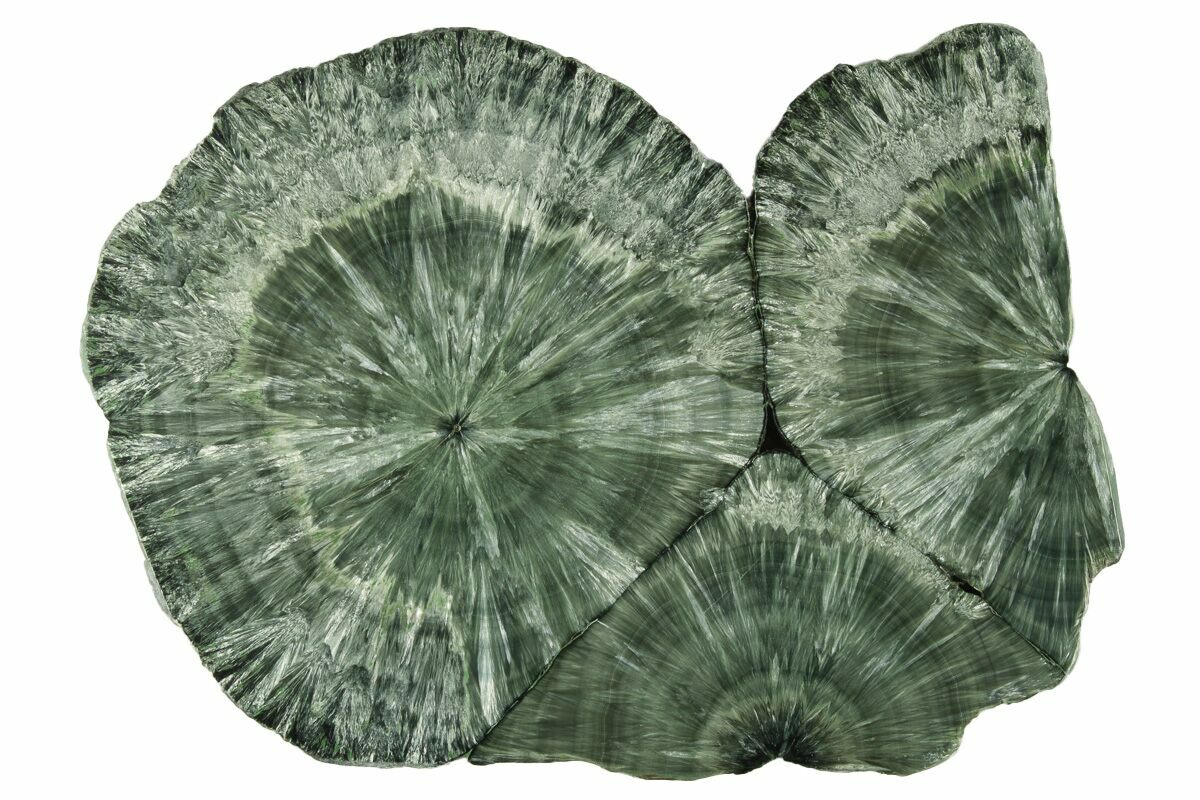
This striking slab of seraphinite from the Korshunovskiy Mine in Siberia displays a dramatic radial structure characteristic of the finest material from this locality.
Key Properties
How Seraphinite Forms
Because seraphinite is generally a visually distinctive form of clinochlore (chlorite), its origin is best understood through chlorite-forming geological environments.
Chlorite minerals commonly develop during metamorphism and hydrothermal alteration, especially in rocks rich in magnesium and iron. A classic setting involves ultramafic rocks (mantle-derived rocks high in Mg and Fe) that undergo hydration and alteration—processes that can convert original minerals into new assemblages such as serpentinite and associated alteration minerals. In many metamorphic terrains, chlorite is a hallmark of low- to medium-grade metamorphism (the kinds of conditions that re-equilibrate minerals without fully melting the rock).
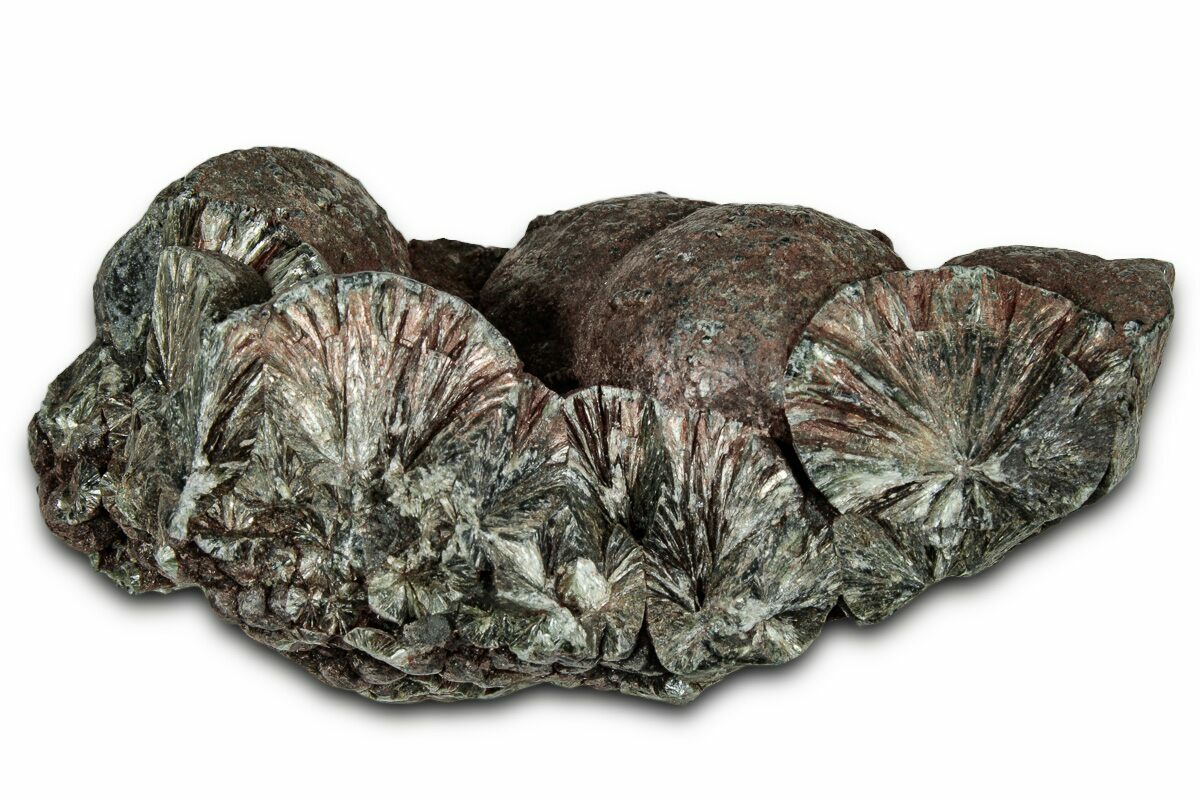
A rough (uncut) piece of seraphinite.
So where does the signature “feather” look come from? In seraphinite, the defining feature is not simply “it’s clinochlore,” but that it often shows a radiating/plumose internal structure. That texture can arise when the mineral grows in fan-like or fibrous aggregates, sometimes influenced by fractures, fluid pathways, and changing temperature/pressure conditions during alteration. In practical terms: the stone’s beauty is a record of directional growth and microstructure, captured and amplified when the material is cut and polished.
History & Uses
Seraphinite is a fascinating example of how a mineral can move from relative obscurity into prominence not because it represents a new scientific discovery, but because its beauty was finally recognized and revealed. While the mineral species behind seraphinite—clinochlore of the chlorite group—has been known to mineralogists since the 19th century, the gem material we call “seraphinite” is a much more recent entrant into the decorative stone market.
Chlorite minerals themselves are common in metamorphic and altered rocks worldwide. For generations, they were studied primarily as rock-forming minerals, not gemstones. Most chlorite occurs as dull green masses, fine-grained aggregates, or microscopic flakes within schists and serpentinites. There was little reason to consider it decorative material. What changed was the discovery of unusually coarse, radiating aggregates of clinochlore in eastern Siberia that displayed a dramatic internal structure. When cut and polished, these stones revealed luminous, silvery plumes sweeping across a deep green background—patterns so evocative of feathers that they inspired a new name.
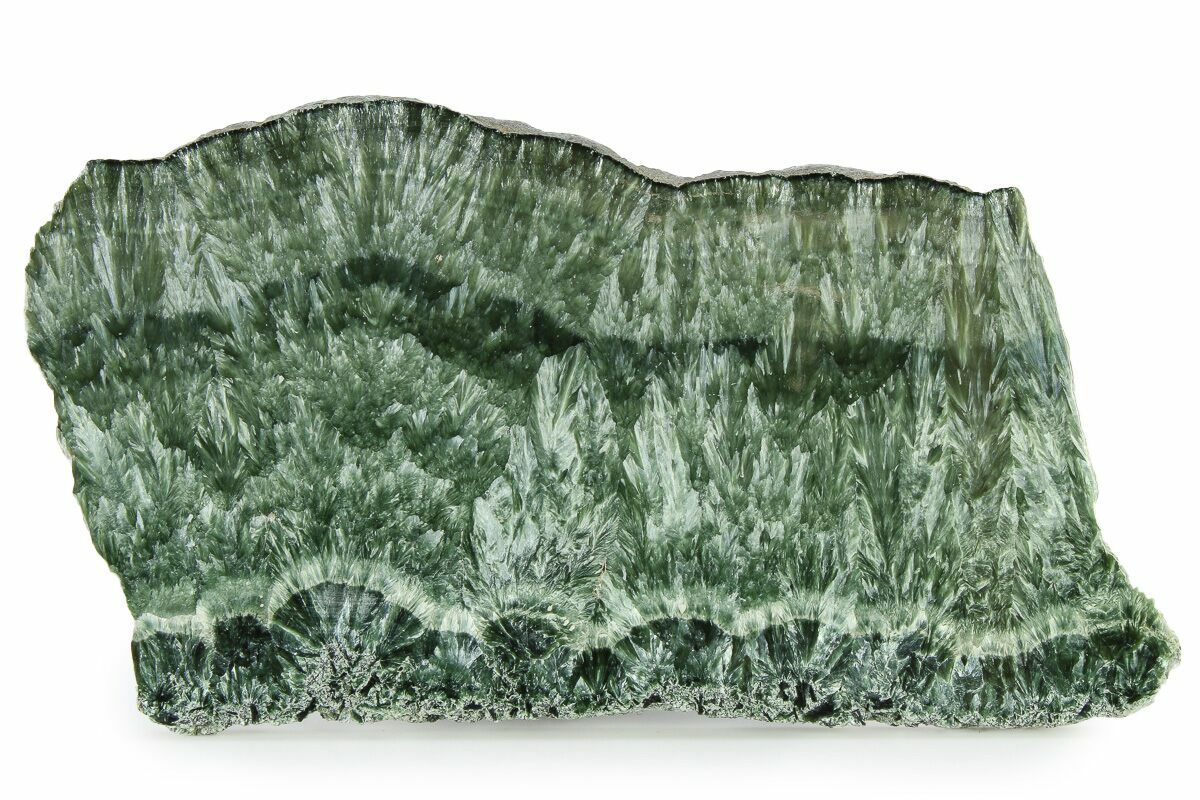
A beautiful, feathering slab of polished Seraphinite (Clinochlore) from Eastern Siberia
The term “seraphinite” derives from “seraphim,” the winged celestial beings of biblical tradition. The resemblance between the mineral’s chatoyant plumes and angelic wings gave the stone a memorable identity within the gem trade. This naming was not part of formal mineral classification but rather a commercial and aesthetic choice, a common practice in the ornamental stone world when an especially attractive material appears in workable quantities.
The most significant source of seraphinite is the Korshunovskoye iron deposit in the Irkutsk Oblast of eastern Siberia, Russia. This region is geologically complex and associated with iron-rich formations and metamorphic processes. The clinochlore that becomes seraphinite formed under conditions involving iron- and magnesium-rich rocks subjected to alteration and metamorphism. Fluids moving through fractures and host rocks allowed chlorite minerals to crystallize in coarse, radiating aggregates rather than the fine-grained textures more typically seen.
Seraphinite is not generally mined as a primary economic mineral. Instead, it is associated with large-scale iron mining operations. Within these deposits, zones containing high-quality, chatoyant clinochlore are selectively recovered when encountered. Because iron is the primary target of extraction, seraphinite production can be intermittent and dependent on broader mining activity. This secondary status contributes to the limited and sometimes unpredictable supply of gem-quality material.
Mining in eastern Siberia presents additional challenges. The region’s remote location, harsh winters, and industrial focus on iron rather than decorative stone mean that seraphinite is not extracted with the same dedicated infrastructure that supports major gemstone industries elsewhere. As a result, the global supply remains geographically concentrated and comparatively restricted. When high-quality material is recovered, it is either shaped locally or exported as rough to be cut and polished by lapidaries in other parts of the world.
Seraphinite began appearing more consistently in Western gem markets in the late 20th century, during a period of growing interest in unusual ornamental stones. Its strong chatoyancy distinguished it immediately from other green stones such as jade, malachite, or aventurine. Jewelers quickly realized that a high polish dramatically enhances the moving, feather-like effect. Domed cabochons proved especially effective at showcasing the luminous plumes, as the curved surface allows light to travel across the stone and activate its internal structure.
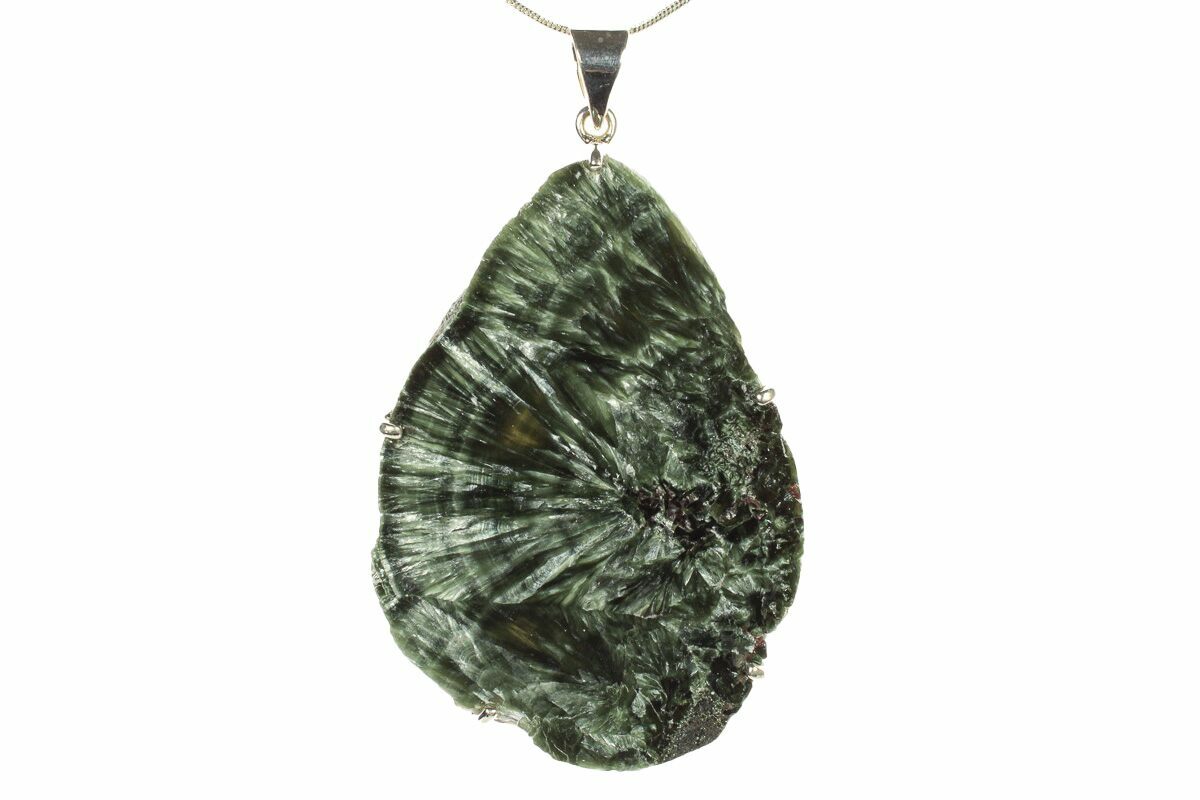
Polished seraphinite that has been crafted into a pendant.
Because seraphinite is relatively soft—commonly cited between Mohs hardness 2 and 4—it is not well suited for high-wear jewelry such as rings. Instead, it is most often used in pendants, earrings, brooches, and beads, where it is protected from abrasion. Its softness, however, makes it easier to carve than many harder gemstones. Artisans have taken advantage of this by producing small figurines, spheres, palm stones, and ornamental slabs that display broad, dramatic sweeps of chatoyant structure.
Beyond jewelry and decorative arts, seraphinite has also become popular among mineral collectors. Fine specimens that clearly display radiating, plumose growth patterns are appreciated as striking examples of chatoyant chlorite. The stone has additionally gained attention in metaphysical markets, where its wing-like patterns and name have inspired symbolic associations with spiritual growth and angelic themes. While these interpretations are cultural rather than scientific, they have played a meaningful role in the stone’s modern popularity.
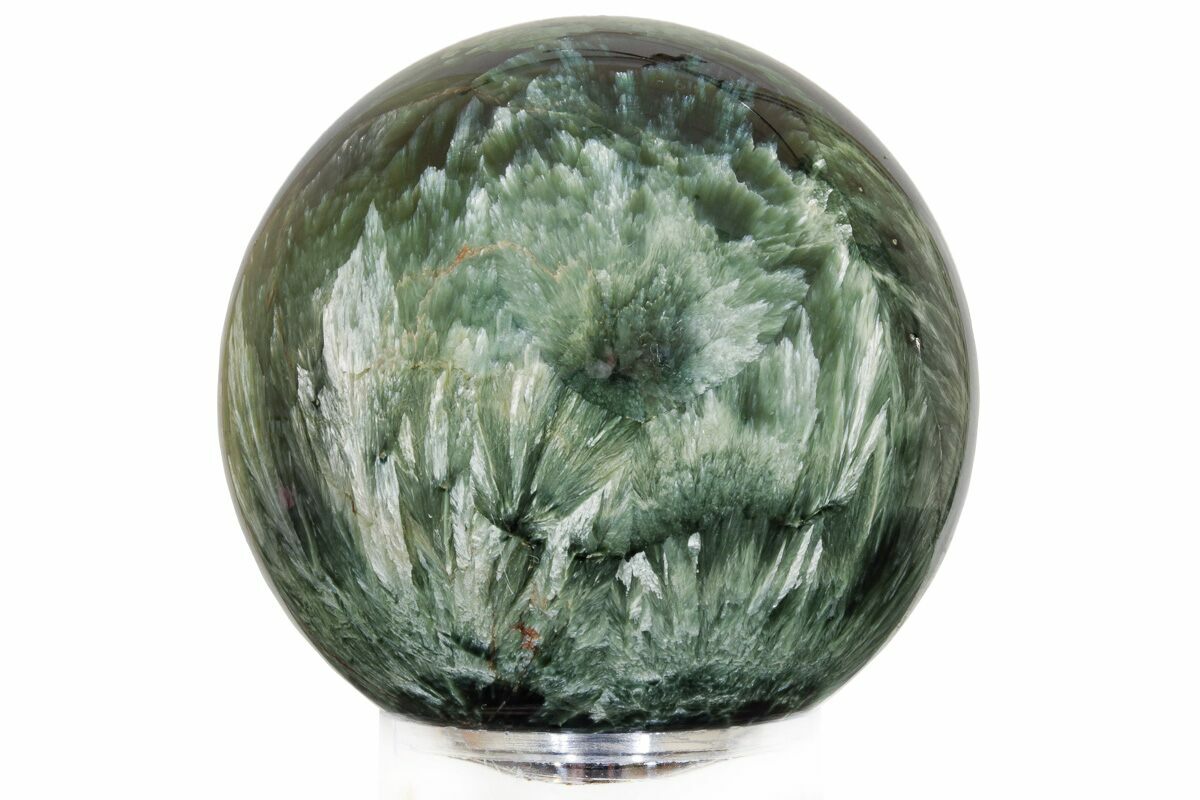
A polished sphere of seraphinite.
Unlike gemstones with millennia of recorded trade and cultural history, seraphinite’s story is largely a modern one. Its recognition is tied to industrial mining in Siberia, advancements in lapidary techniques capable of revealing its internal structure, and the gem trade’s ability to give a memorable name to an unusually beautiful variety of a common mineral. In that sense, seraphinite represents a convergence of geology, industry, craftsmanship, and imagination—a reminder that sometimes the most captivating stones are not those with exotic chemistry, but those whose internal architecture captures and transforms light in extraordinary ways.


