 Reviews

Rhodochrosite: From Silver Mines to Showpieces
There are some minerals that impress with symmetry, some with brilliance, and others with sheer scale — towering crystals, cathedral caverns, or even huge geodes lined with glittering interiors. And then there is rhodochrosite, a mineral that captivates not because it overwhelms, but because it glows. Its appeal is intimate and immediate: a flush of rose, raspberry, and crimson that seems almost improbable in stone. Long before most people learn its name, they recognize its color. It looks less like something dug from the earth and more like something that bloomed there.
Rhodochrosite’s name reflects that first impression. Coined in 1813 from the Greek rhodon (rose) and chroma (color), the name literally means “rose-colored”. It is a manganese carbonate mineral (MnCO₃), structurally related to calcite, and like calcite it crystallizes in the trigonal system, often forming rhombohedral crystals with sharp, geometric faces. But where calcite commonly appears colorless or white, rhodochrosite wears a palette that ranges from delicate pink to saturated cherry-red. The color comes from manganese itself — an element not typically associated with vivid beauty, yet here responsible for some of the most arresting hues in the mineral kingdom.
Its visual personality changes dramatically depending on how it forms. In some deposits, rhodochrosite grows as translucent to transparent crystals lining cavities in hydrothermal veins. These crystals can be glassy and luminous, their faces reflecting light with a richness that makes them seem almost lit from within. In other settings, the mineral forms in layered, stalactitic, or botryoidal masses — building in rhythmic bands of rose, cream, and coral tones. When cut and polished, this banded material reveals swirling patterns that resemble frozen waves or the cross-section of a shell. In Argentina, this variety is known as “Inca Rose”, a national stone and one of the most recognizable ornamental materials in the world.
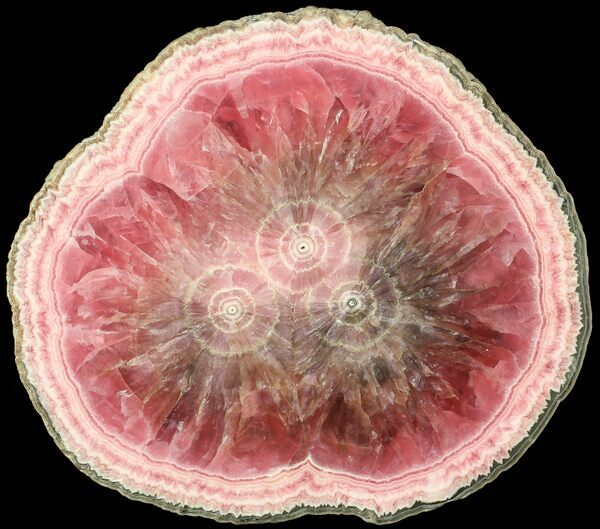
A slice of a Rhodochrosite stalactite from the famed Capillitas Mine in Argentina
Collectors often describe rhodochrosite as a mineral that feels alive. Its crystals are rarely cold or aloof; instead, they appear warm, saturated, and almost organic. Some of the finest specimens, particularly from Colorado’s famed Sweet Home Mine, display sharply defined rhombs in deep, translucent red — crystals so vivid they seem closer to garnet than carbonate. Legendary specimens like the “Alma King” have elevated rhodochrosite into the upper ranks of collector minerals, where it stands not just as a species, but as a symbol of what can happen when chemistry, temperature, pressure, and open space align perfectly underground.
Yet rhodochrosite is not defined by a single look. It may appear as a subtle pink vein cutting through gray rock, as delicate crystal clusters perched on quartz, or as massive manganese ore altered by near-surface oxidation. It can be opaque or gemmy, softly banded or sharply faceted, pale blush or intense crimson. Each variation records a different chapter in the geological story of its deposit — a shift in fluid chemistry, a change in temperature, a pulse of mineral-rich solution moving through fractures deep within the Earth.
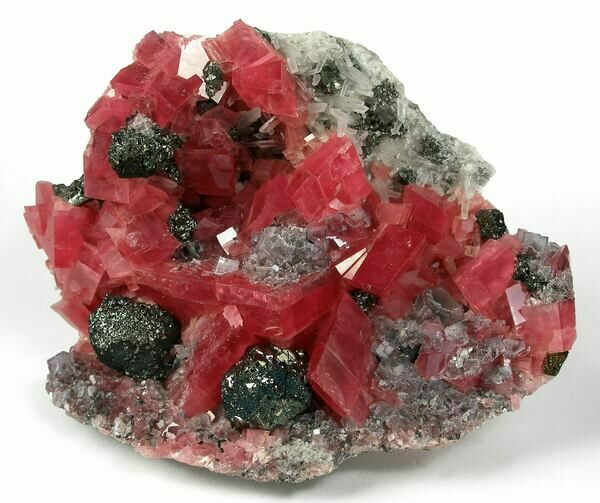
Rhodochrosite with Fluorite,Tetrahedrite, Quartz from the Sweet Home Mine in Colorado
Mineral class: Carbonate
Chemical formula: MnCO₃
Crystal system: Trigonal (calcite-group structure)
Typical color: pink, rose-red to cherry-red; can also be brownish, grayish, or banded
Luster: vitreous to pearly
Streak: white
Mohs hardness: ~3.5–4 (so it scratches fairly easily compared with many gemstones)
Specific gravity: around 3.7
Cleavage: perfect rhombohedral cleavage (like calcite)
Commonly associated minerals: quartz, fluorite, pyrite, sphalerite, galena, calcite/dolomite, barite, and manganese oxides (e.g., manganite/hausmannite)
Rhodochrosite forms when manganese-bearing fluids encounter carbonate chemistry under the right conditions—most often in hydrothermal veins and ore deposits. In many classic specimen localities, warm fluids circulate through fractures and openings in rock, carrying dissolved manganese and carbon dioxide (or carbonate species). As temperature, pressure, pH, and oxidation state shift—sometimes subtly, sometimes dramatically—the fluid becomes “overloaded” with respect to MnCO₃, and rhodochrosite precipitates on cavity walls, building crystals layer by layer.
It also commonly forms as a secondary mineral during oxidation of manganese-rich ores, especially near the surface where oxygenated waters can dissolve, transport, and redeposit manganese and carbonate components. This is one reason it can show up in botryoidal crusts, banded masses, and stalactitic shapes: those forms thrive when mineral-rich solutions repeatedly move through openings, depositing thin films that stack into rhythmic layers—geology’s slow-motion version of dripping candle wax.
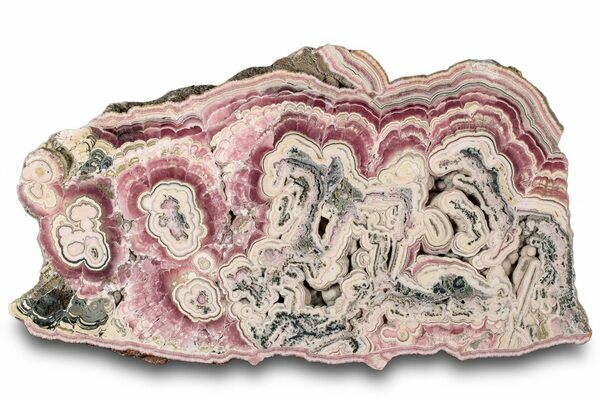
Rhodochrosite banded with pyrite and galena from the Capillitas Mine in Argentina
Because rhodochrosite sits in a compositional “neighborhood” with other carbonate minerals (and can contain substitutions by iron, calcium, magnesium, and zinc), the same deposit can produce multiple looks—from vivid gemmy crystals in one pocket to pale banded material a few meters away, depending on what the fluids were carrying at that moment.
Rhodochrosite’s formal scientific identity began in the early 19th century, but the mineral itself had likely been encountered long before it was properly understood. In European mining districts rich in silver, lead, and copper ores, miners would have seen pink to reddish carbonate material cutting through veins or lining cavities. In many cases it was simply regarded as a manganese-bearing carbonate—interesting, perhaps attractive, but secondary to the metals being pursued. It was not uncommon for colorful vein minerals to be overlooked or discarded in the relentless search for ore.
The turning point came in 1813, when German mineralogist Johann Friedrich Ludwig Hausmann formally described and named the species rhodochrosite, drawing from the Greek words for “rose” and “color.” At the time, mineralogy was transitioning from a largely descriptive science to a more chemical and crystallographic discipline. Naming rhodochrosite as a distinct mineral species signaled that its chemistry—manganese carbonate (MnCO₃)—and crystal structure were sufficiently unique to warrant classification apart from other carbonates such as calcite or siderite.
Its early documented occurrences in Europe, including the Cavnic (Kapnik) mining region of present-day Romania, helped anchor its identity within the polymetallic mining culture of the Austro-Hungarian Empire. These were districts where miners, engineers, and mineralogists worked in close proximity, and where the habit of saving unusual crystals was already developing. In the 18th and 19th centuries, the cabinets of European aristocrats, universities, and scientific societies were expanding rapidly. Attractive minerals from active mines were often preserved not only as curiosities but as scientific teaching tools. Rhodochrosite, with its distinctive color and well-formed rhombohedral crystals, naturally found its way into these early collections.
However, compared to showier minerals like amethyst, native silver, or fluorite, rhodochrosite was slower to gain fame. Part of this was practical: it is relatively soft (Mohs 3.5–4) and has perfect rhombohedral cleavage, making it fragile and difficult to transport without damage. Early specimens were often massive or dull rather than the brilliant crystals that would later redefine its status. For much of the 19th century, rhodochrosite was respected scientifically but not yet revered aesthetically.
That perception changed dramatically with the rise of systematic mineral collecting in the late 19th and early 20th centuries. As mining technology improved and deeper ore bodies were accessed—particularly in the American West—new types of mineral pockets were discovered. In Colorado’s silver districts, especially near Alma, rhodochrosite began appearing in increasingly fine crystal form. These early finds hinted that the mineral was capable of far greater beauty than previously assumed.
The true transformation of rhodochrosite’s reputation occurred in the 20th century, particularly with the rediscovery and redevelopment of the Sweet Home Mine in Colorado. Originally founded in 1873 as a silver mine, Sweet Home became world-famous for producing deep red, gem-quality rhodochrosite crystals in the latter half of the 1900s. When collectors began seeing sharply formed, translucent rhombohedra of extraordinary color emerging from newly discovered pockets, rhodochrosite was elevated into the top tier of collector minerals.
Specimens such as the celebrated “Alma King” crystal demonstrated that rhodochrosite could rival classic gem minerals in color intensity and aesthetic impact. Museums and high-end collectors actively pursued Sweet Home pieces, and rhodochrosite became a headline mineral at shows and auctions. For the first time, it was not merely an accessory mineral in a mining district—it was the prize.
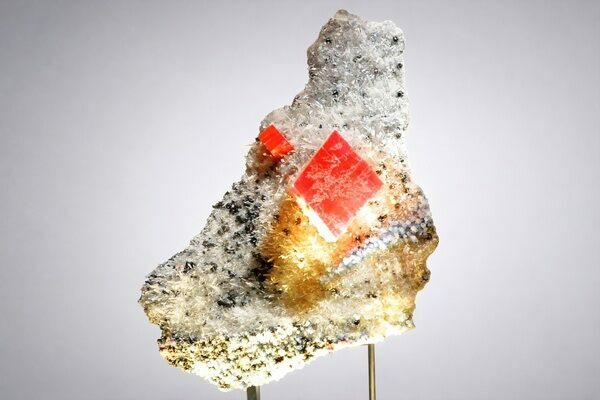
The legendary “Alma King” is a spectacular 14 x 16.5 cm rhombohedral Rhodochrosite crystal from the Sweet Home Mine near Alma, Colorado. Recovered in 1992 from a narrow pocket, it sits dramatically on a matrix of white needle-clear quartz accented by blue fluorite, black sphalerite, tetrahedrite, brassy chalcopyrite, and pale yellow calcite.
Meanwhile, in Argentina’s Capillitas mining district, another chapter of rhodochrosite’s story was unfolding. There, miners encountered thick, banded, stalactitic masses of pink manganese carbonate. This material—later marketed as “Inca Rose”—proved ideal for carving and ornamental use. Unlike fragile crystals, the massive banded variety could be shaped into cabochons, beads, small sculptures, and decorative objects. By the mid-to-late 20th century, Argentine rhodochrosite had become internationally recognized, and in 2002 it was declared Argentina’s national stone.
In terms of practical industrial use, rhodochrosite has played a modest but real role as a manganese ore in some regions. Manganese is essential in steel production and other alloys, and while more abundant manganese oxides are typically mined for this purpose, manganese carbonates like rhodochrosite can contribute to the resource base. However, in most classic specimen localities, the mineral’s collector value far exceeds its ore value. In those cases, rhodochrosite is carefully extracted and preserved rather than processed.
Gem use has always been limited but noteworthy. Transparent rhodochrosite suitable for faceting is rare, and because of its softness and cleavage, faceted stones are generally reserved for collectors rather than daily-wear jewelry. Cabochons cut from banded Argentine material are far more common in the jewelry trade, offering durability and striking patterns without the vulnerability of crystal faces.
While rhodochrosite occurs in manganese-rich environments around the world, only a handful of deposits have produced specimens or material significant enough to define the mineral’s reputation. From legendary crystal pockets in Colorado to the banded “Inca Rose” stone of Argentina, each major locality tells a slightly different geological story. Variations in temperature, chemistry, host rock, and fluid activity have shaped rhodochrosite into dramatically different forms — sharp, gemmy rhombs in one region; layered, stalactitic masses in another. The following localities represent the most important and influential sources of rhodochrosite, both scientifically and for collectors.
Sweet Home is arguably the most famous rhodochrosite locality for crystal specimens, not because it is the largest producer, but because it produced the kind of crystals collectors dream about—deep red, translucent, sharply formed, and sometimes enormous by rhodochrosite standards. The mine’s origin story is classic Colorado: founded in 1873 as a silver mine near Alma, it later became celebrated for rhodochrosite rather than the metal it originally chased.
What makes Sweet Home feel mythic are the pocket discoveries and the way they were preserved and displayed. Accounts of the mine describe legendary finds like the “Crystal Wall,” a reconstructed pocket display now in Denver’s museum, sparkling with numerous rhodochrosite crystals—a literal snapshot of a mineral “room” as it existed underground. Even gemological literature notes that redevelopment brought unusually fine transparent-to-translucent crystals (and limited facetable material) into the market, which is not something you can say about most rhodochrosite localities.
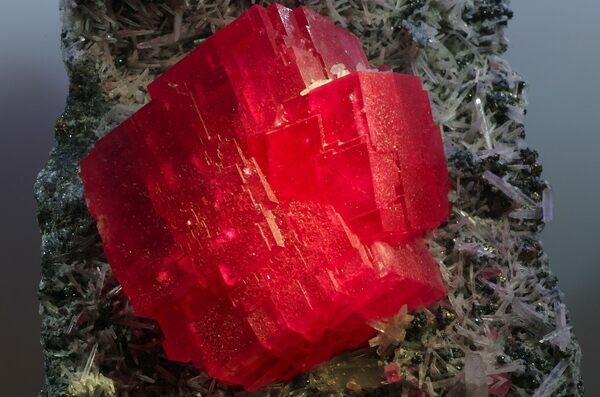
The Searchlight Rhodochrosite Crystal, Sweet Home Mine, Alma, Colorado. Photo Credit: Eric Hunt
Capillitas is the opposite of Sweet Home in appearance: instead of being known first for sharp crystals, it is celebrated for banded, ornamental rhodochrosite—soft pinks, creams, and rose tones layered into stalactites, veins, and massive forms that lapidaries turn into carvings and jewelry. Mindat notes this district for its famous “Inca Rose” banded material, described in the literature by the late 1800s.
Its cultural status is unusually high for a mineral locality. A Rock & Gem feature notes that Argentina’s legislators designated Inca rose as the nation’s official national stone in 2002, and that polished rhodochrosite jewelry and carvings have become iconic souvenirs. In other words, Capillitas doesn’t just supply collectors; it supplies identity—an example of how a mineral deposit can become part of a country’s visual language.
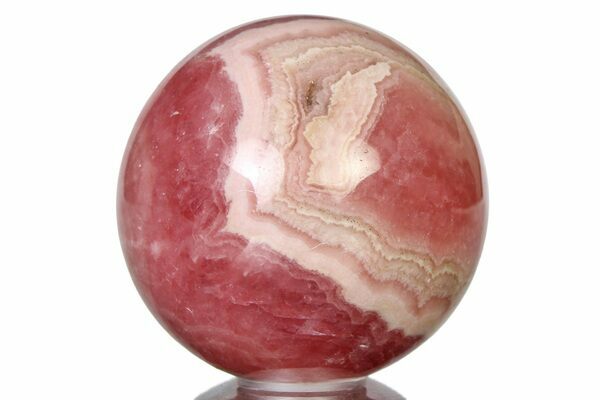
A polished sphere of "Inca Rose" rhodochrosite from the Capillitas mines in Argentina.
In the Kalahari Manganese Field, rhodochrosite appears in a setting that feels industrial and primordial at once: vast manganese-rich geology with pockets capable of producing exceptional specimens. Mindat’s locality notes describe N’Chwaning I as a manganese mine where notable rhodochrosite specimens were associated with minerals like manganite and drusy quartz, highlighting the way rhodochrosite can flourish in manganese-heavy systems.
South African rhodochrosite from this region is often admired for saturated color and attractive crystal habits—material that can look almost sculptural even when the crystals are “simple” rhombs. The locality is also a reminder that rhodochrosite’s beauty often rides on ore geology: the same chemical richness that makes a deposit economically interesting can, in rare cavities, build something museum-worthy.
Cavnic occupies a special place in rhodochrosite lore as a type-locality region referenced in mineral descriptions. It sits within a long-worked mining district known for polymetallic mineralization—exactly the kind of environment where carbonates, sulfides, and quartz can share the same underground stage.
For collectors, Romanian rhodochrosite is often appreciated in association with quartz and sulfides, sometimes forming attractive “flower” or cluster-like arrangements. Even when the crystals aren’t giant, they can be exquisitely balanced: pale-to-strong pink rhombs perched on contrasting matrix, a classic European aesthetic that feels like it belongs in a velvet-lined drawer.
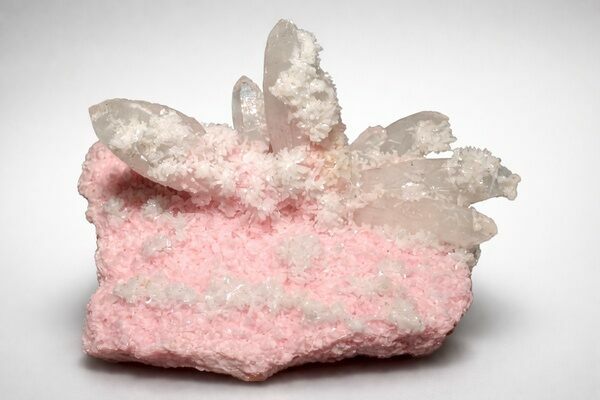
A specimen of Rhodochrosite with quartz crystals from the Cavnic mines in Romania.
China’s Wutong mine is notable in part because it has been discussed explicitly as a rhodochrosite specimen producer, with locality writeups describing it as a small underground operation in Guangxi and detailing its regional access and setting. Wutong material is well known among collectors for bright, attractive crystals often found with other classic vein minerals.
Mindat’s locality entry for Wutong also reflects the typical company rhodochrosite keeps there—minerals like quartz, fluorite, pyrite, sphalerite, barite, calcite, and galena show up in association lists, reinforcing the “hydrothermal vein” character of the deposit.
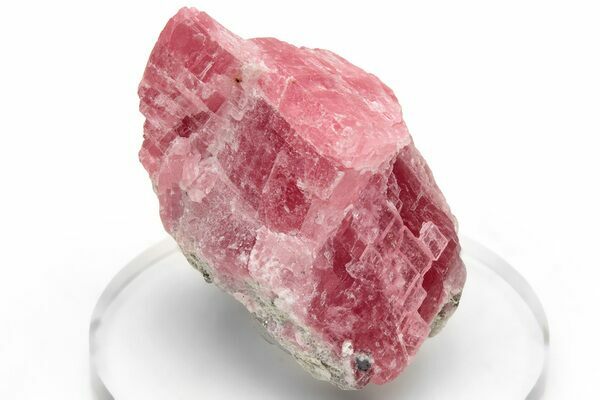
A pink rhodochrosite specimen from the Wutong Mine in China.
Uchucchacua is one of Peru’s famed mines for mineral species diversity and for producing striking specimens across multiple minerals. Descriptions of Uchucchacua note its reputation and the breadth of mineralogical interest at the site, which sets the stage for rhodochrosite to appear not just as a curiosity but as part of a rich mineral ecosystem.
Collector-focused descriptions repeatedly highlight the locality for gemmy, deep red/pink rhodochrosite crystals, the kind that stand out even among global rhodochrosite occurrences. In practical terms, Uchucchacua helps demonstrate a pattern: the most desirable rhodochrosite crystals often come from complex ore systems where open cavities, the right chemistry, and just enough time align—leaving behind a pocket of rose-colored geometry as an accident of underground history.
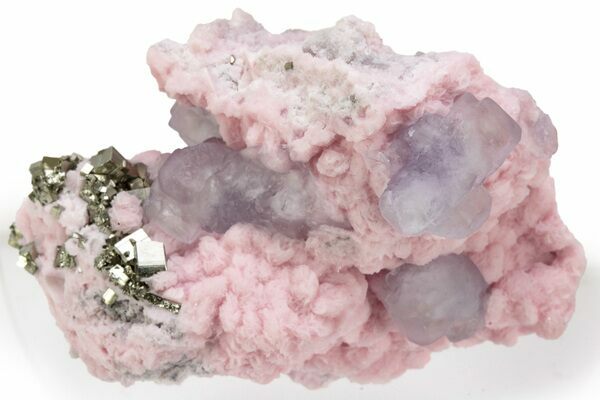
Rhodochrosite with cubic pyrite and purple fluorite from Peru.

Rhodochrosite’s name reflects that first impression. Coined in 1813 from the Greek rhodon (rose) and chroma (color), the name literally means “rose-colored”. It is a manganese carbonate mineral (MnCO₃), structurally related to calcite, and like calcite it crystallizes in the trigonal system, often forming rhombohedral crystals with sharp, geometric faces. But where calcite commonly appears colorless or white, rhodochrosite wears a palette that ranges from delicate pink to saturated cherry-red. The color comes from manganese itself — an element not typically associated with vivid beauty, yet here responsible for some of the most arresting hues in the mineral kingdom.
Its visual personality changes dramatically depending on how it forms. In some deposits, rhodochrosite grows as translucent to transparent crystals lining cavities in hydrothermal veins. These crystals can be glassy and luminous, their faces reflecting light with a richness that makes them seem almost lit from within. In other settings, the mineral forms in layered, stalactitic, or botryoidal masses — building in rhythmic bands of rose, cream, and coral tones. When cut and polished, this banded material reveals swirling patterns that resemble frozen waves or the cross-section of a shell. In Argentina, this variety is known as “Inca Rose”, a national stone and one of the most recognizable ornamental materials in the world.
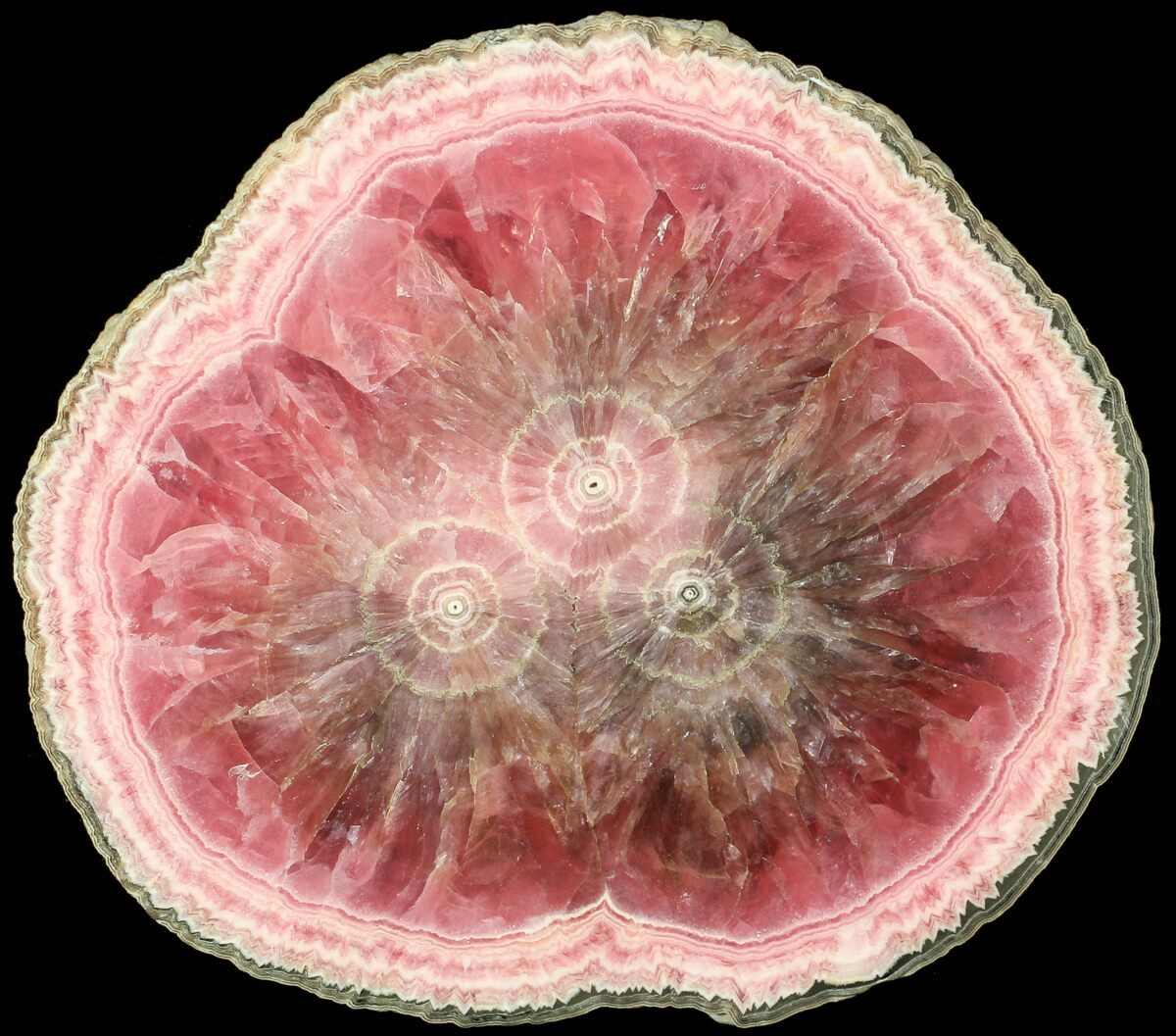
A slice of a Rhodochrosite stalactite from the famed Capillitas Mine in Argentina
Collectors often describe rhodochrosite as a mineral that feels alive. Its crystals are rarely cold or aloof; instead, they appear warm, saturated, and almost organic. Some of the finest specimens, particularly from Colorado’s famed Sweet Home Mine, display sharply defined rhombs in deep, translucent red — crystals so vivid they seem closer to garnet than carbonate. Legendary specimens like the “Alma King” have elevated rhodochrosite into the upper ranks of collector minerals, where it stands not just as a species, but as a symbol of what can happen when chemistry, temperature, pressure, and open space align perfectly underground.
Yet rhodochrosite is not defined by a single look. It may appear as a subtle pink vein cutting through gray rock, as delicate crystal clusters perched on quartz, or as massive manganese ore altered by near-surface oxidation. It can be opaque or gemmy, softly banded or sharply faceted, pale blush or intense crimson. Each variation records a different chapter in the geological story of its deposit — a shift in fluid chemistry, a change in temperature, a pulse of mineral-rich solution moving through fractures deep within the Earth.
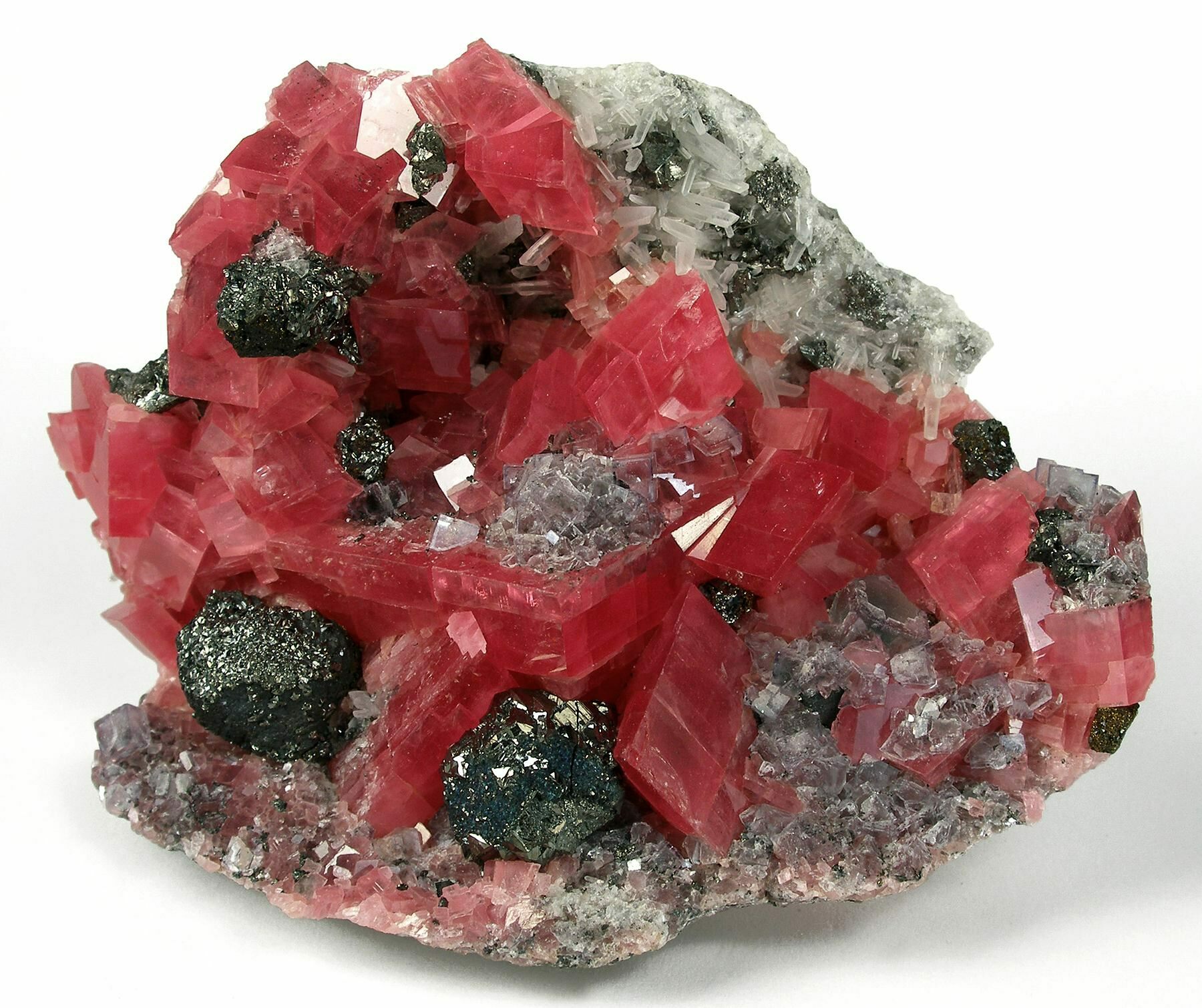
Rhodochrosite with Fluorite,Tetrahedrite, Quartz from the Sweet Home Mine in Colorado
Rhodochrosite Properties:
How Rhodochrosite Forms
Rhodochrosite forms when manganese-bearing fluids encounter carbonate chemistry under the right conditions—most often in hydrothermal veins and ore deposits. In many classic specimen localities, warm fluids circulate through fractures and openings in rock, carrying dissolved manganese and carbon dioxide (or carbonate species). As temperature, pressure, pH, and oxidation state shift—sometimes subtly, sometimes dramatically—the fluid becomes “overloaded” with respect to MnCO₃, and rhodochrosite precipitates on cavity walls, building crystals layer by layer.
It also commonly forms as a secondary mineral during oxidation of manganese-rich ores, especially near the surface where oxygenated waters can dissolve, transport, and redeposit manganese and carbonate components. This is one reason it can show up in botryoidal crusts, banded masses, and stalactitic shapes: those forms thrive when mineral-rich solutions repeatedly move through openings, depositing thin films that stack into rhythmic layers—geology’s slow-motion version of dripping candle wax.
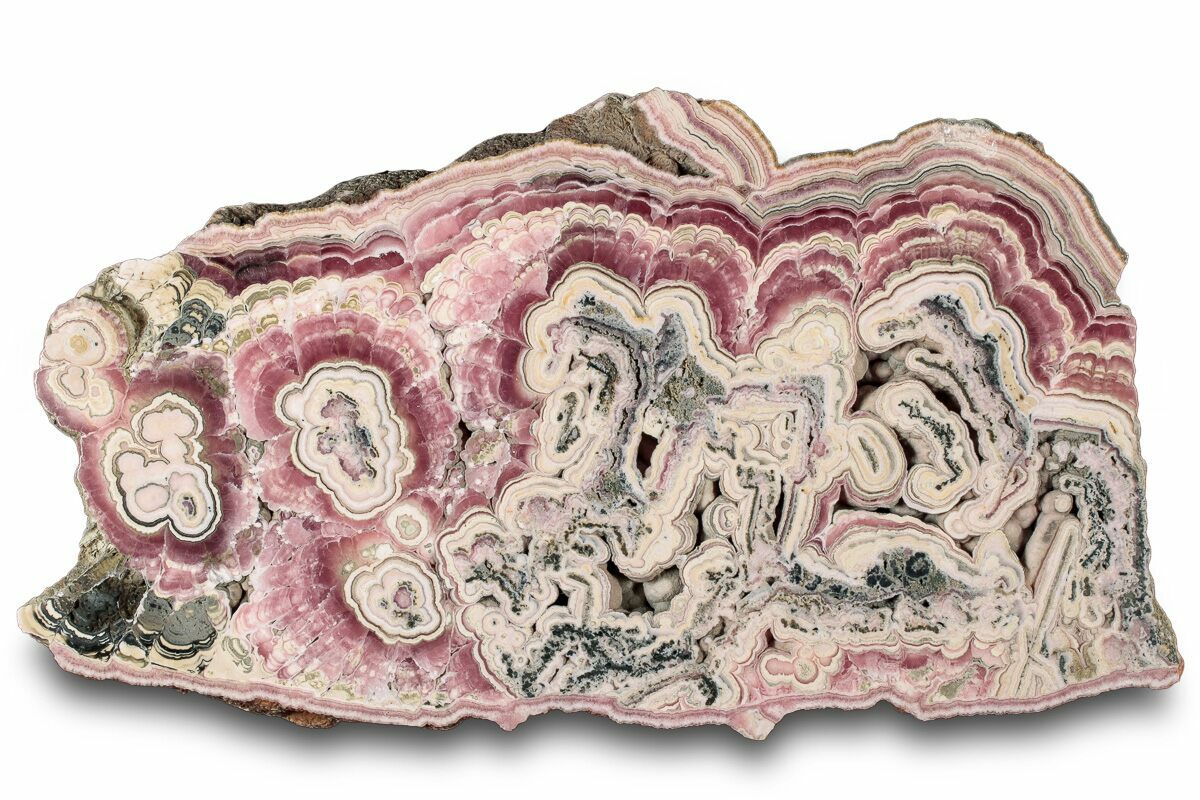
Rhodochrosite banded with pyrite and galena from the Capillitas Mine in Argentina
Because rhodochrosite sits in a compositional “neighborhood” with other carbonate minerals (and can contain substitutions by iron, calcium, magnesium, and zinc), the same deposit can produce multiple looks—from vivid gemmy crystals in one pocket to pale banded material a few meters away, depending on what the fluids were carrying at that moment.
History and Uses
Rhodochrosite’s formal scientific identity began in the early 19th century, but the mineral itself had likely been encountered long before it was properly understood. In European mining districts rich in silver, lead, and copper ores, miners would have seen pink to reddish carbonate material cutting through veins or lining cavities. In many cases it was simply regarded as a manganese-bearing carbonate—interesting, perhaps attractive, but secondary to the metals being pursued. It was not uncommon for colorful vein minerals to be overlooked or discarded in the relentless search for ore.
The turning point came in 1813, when German mineralogist Johann Friedrich Ludwig Hausmann formally described and named the species rhodochrosite, drawing from the Greek words for “rose” and “color.” At the time, mineralogy was transitioning from a largely descriptive science to a more chemical and crystallographic discipline. Naming rhodochrosite as a distinct mineral species signaled that its chemistry—manganese carbonate (MnCO₃)—and crystal structure were sufficiently unique to warrant classification apart from other carbonates such as calcite or siderite.
Its early documented occurrences in Europe, including the Cavnic (Kapnik) mining region of present-day Romania, helped anchor its identity within the polymetallic mining culture of the Austro-Hungarian Empire. These were districts where miners, engineers, and mineralogists worked in close proximity, and where the habit of saving unusual crystals was already developing. In the 18th and 19th centuries, the cabinets of European aristocrats, universities, and scientific societies were expanding rapidly. Attractive minerals from active mines were often preserved not only as curiosities but as scientific teaching tools. Rhodochrosite, with its distinctive color and well-formed rhombohedral crystals, naturally found its way into these early collections.
However, compared to showier minerals like amethyst, native silver, or fluorite, rhodochrosite was slower to gain fame. Part of this was practical: it is relatively soft (Mohs 3.5–4) and has perfect rhombohedral cleavage, making it fragile and difficult to transport without damage. Early specimens were often massive or dull rather than the brilliant crystals that would later redefine its status. For much of the 19th century, rhodochrosite was respected scientifically but not yet revered aesthetically.
That perception changed dramatically with the rise of systematic mineral collecting in the late 19th and early 20th centuries. As mining technology improved and deeper ore bodies were accessed—particularly in the American West—new types of mineral pockets were discovered. In Colorado’s silver districts, especially near Alma, rhodochrosite began appearing in increasingly fine crystal form. These early finds hinted that the mineral was capable of far greater beauty than previously assumed.
The true transformation of rhodochrosite’s reputation occurred in the 20th century, particularly with the rediscovery and redevelopment of the Sweet Home Mine in Colorado. Originally founded in 1873 as a silver mine, Sweet Home became world-famous for producing deep red, gem-quality rhodochrosite crystals in the latter half of the 1900s. When collectors began seeing sharply formed, translucent rhombohedra of extraordinary color emerging from newly discovered pockets, rhodochrosite was elevated into the top tier of collector minerals.
Specimens such as the celebrated “Alma King” crystal demonstrated that rhodochrosite could rival classic gem minerals in color intensity and aesthetic impact. Museums and high-end collectors actively pursued Sweet Home pieces, and rhodochrosite became a headline mineral at shows and auctions. For the first time, it was not merely an accessory mineral in a mining district—it was the prize.
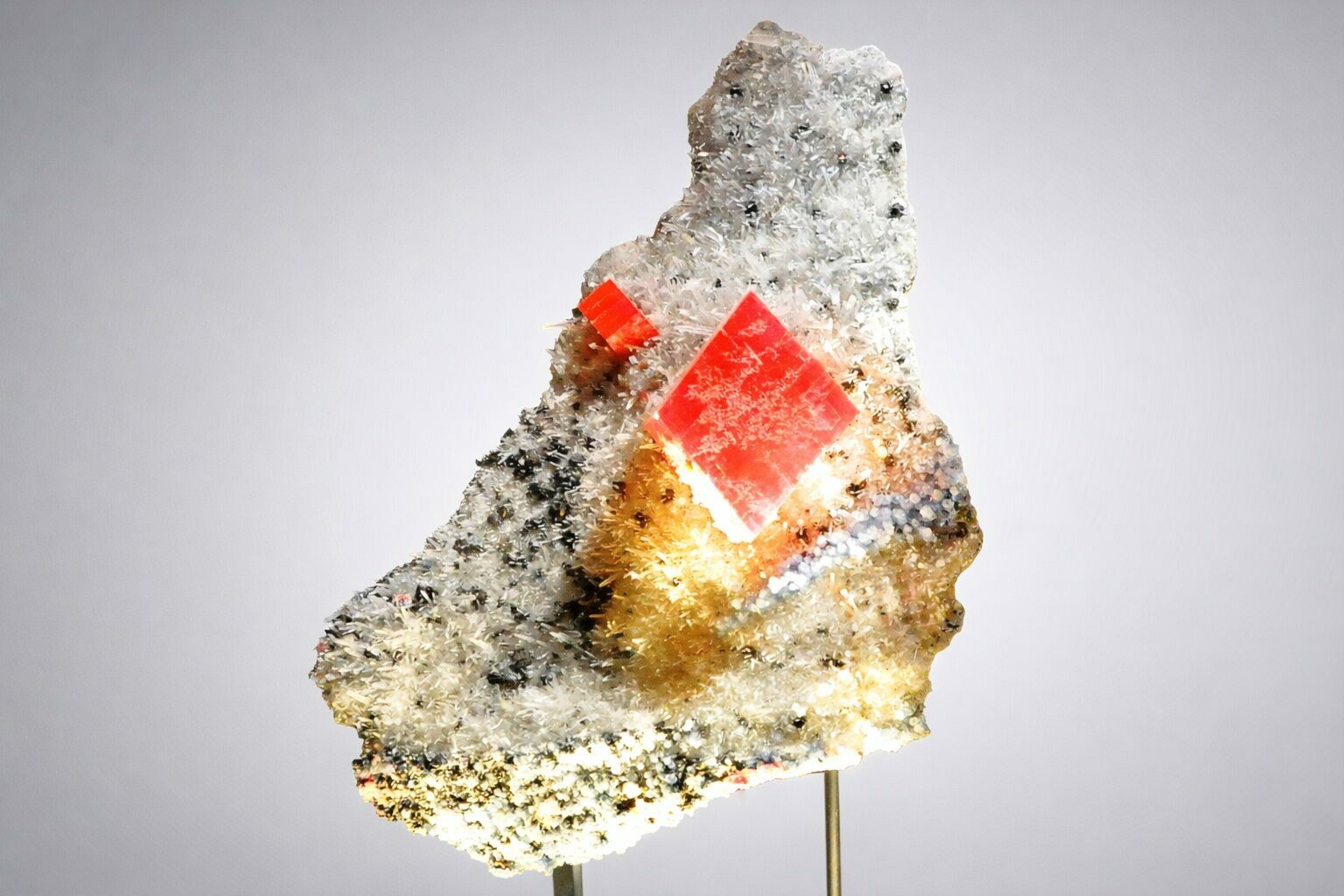
The legendary “Alma King” is a spectacular 14 x 16.5 cm rhombohedral Rhodochrosite crystal from the Sweet Home Mine near Alma, Colorado. Recovered in 1992 from a narrow pocket, it sits dramatically on a matrix of white needle-clear quartz accented by blue fluorite, black sphalerite, tetrahedrite, brassy chalcopyrite, and pale yellow calcite.
Meanwhile, in Argentina’s Capillitas mining district, another chapter of rhodochrosite’s story was unfolding. There, miners encountered thick, banded, stalactitic masses of pink manganese carbonate. This material—later marketed as “Inca Rose”—proved ideal for carving and ornamental use. Unlike fragile crystals, the massive banded variety could be shaped into cabochons, beads, small sculptures, and decorative objects. By the mid-to-late 20th century, Argentine rhodochrosite had become internationally recognized, and in 2002 it was declared Argentina’s national stone.
In terms of practical industrial use, rhodochrosite has played a modest but real role as a manganese ore in some regions. Manganese is essential in steel production and other alloys, and while more abundant manganese oxides are typically mined for this purpose, manganese carbonates like rhodochrosite can contribute to the resource base. However, in most classic specimen localities, the mineral’s collector value far exceeds its ore value. In those cases, rhodochrosite is carefully extracted and preserved rather than processed.
Gem use has always been limited but noteworthy. Transparent rhodochrosite suitable for faceting is rare, and because of its softness and cleavage, faceted stones are generally reserved for collectors rather than daily-wear jewelry. Cabochons cut from banded Argentine material are far more common in the jewelry trade, offering durability and striking patterns without the vulnerability of crystal faces.
Key Localities
While rhodochrosite occurs in manganese-rich environments around the world, only a handful of deposits have produced specimens or material significant enough to define the mineral’s reputation. From legendary crystal pockets in Colorado to the banded “Inca Rose” stone of Argentina, each major locality tells a slightly different geological story. Variations in temperature, chemistry, host rock, and fluid activity have shaped rhodochrosite into dramatically different forms — sharp, gemmy rhombs in one region; layered, stalactitic masses in another. The following localities represent the most important and influential sources of rhodochrosite, both scientifically and for collectors.
Sweet Home Mine, Alma District, Colorado, USA
Sweet Home is arguably the most famous rhodochrosite locality for crystal specimens, not because it is the largest producer, but because it produced the kind of crystals collectors dream about—deep red, translucent, sharply formed, and sometimes enormous by rhodochrosite standards. The mine’s origin story is classic Colorado: founded in 1873 as a silver mine near Alma, it later became celebrated for rhodochrosite rather than the metal it originally chased.
What makes Sweet Home feel mythic are the pocket discoveries and the way they were preserved and displayed. Accounts of the mine describe legendary finds like the “Crystal Wall,” a reconstructed pocket display now in Denver’s museum, sparkling with numerous rhodochrosite crystals—a literal snapshot of a mineral “room” as it existed underground. Even gemological literature notes that redevelopment brought unusually fine transparent-to-translucent crystals (and limited facetable material) into the market, which is not something you can say about most rhodochrosite localities.
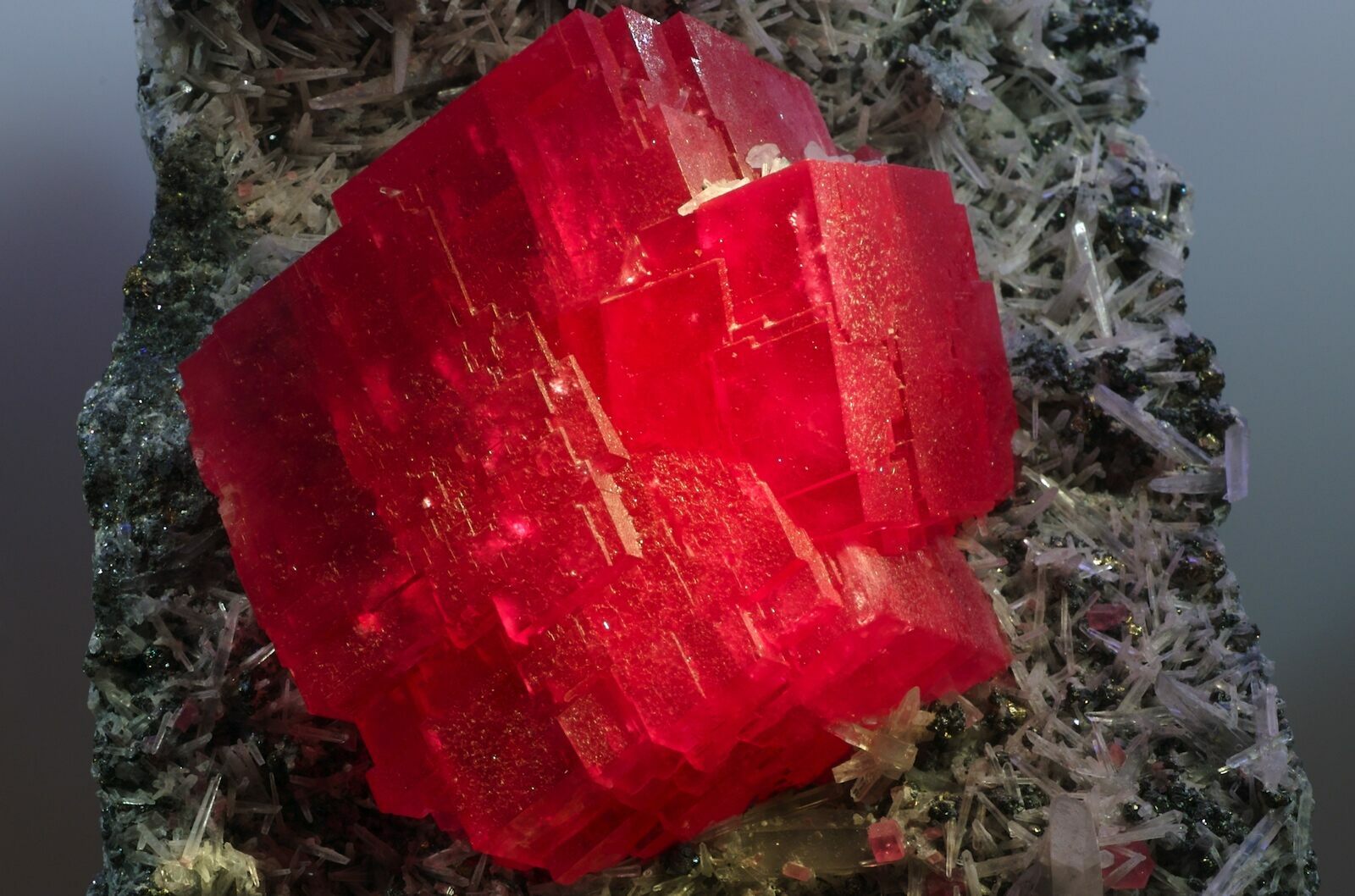
The Searchlight Rhodochrosite Crystal, Sweet Home Mine, Alma, Colorado. Photo Credit: Eric Hunt
Capillitas Mining District, Catamarca, Argentina
Capillitas is the opposite of Sweet Home in appearance: instead of being known first for sharp crystals, it is celebrated for banded, ornamental rhodochrosite—soft pinks, creams, and rose tones layered into stalactites, veins, and massive forms that lapidaries turn into carvings and jewelry. Mindat notes this district for its famous “Inca Rose” banded material, described in the literature by the late 1800s.
Its cultural status is unusually high for a mineral locality. A Rock & Gem feature notes that Argentina’s legislators designated Inca rose as the nation’s official national stone in 2002, and that polished rhodochrosite jewelry and carvings have become iconic souvenirs. In other words, Capillitas doesn’t just supply collectors; it supplies identity—an example of how a mineral deposit can become part of a country’s visual language.
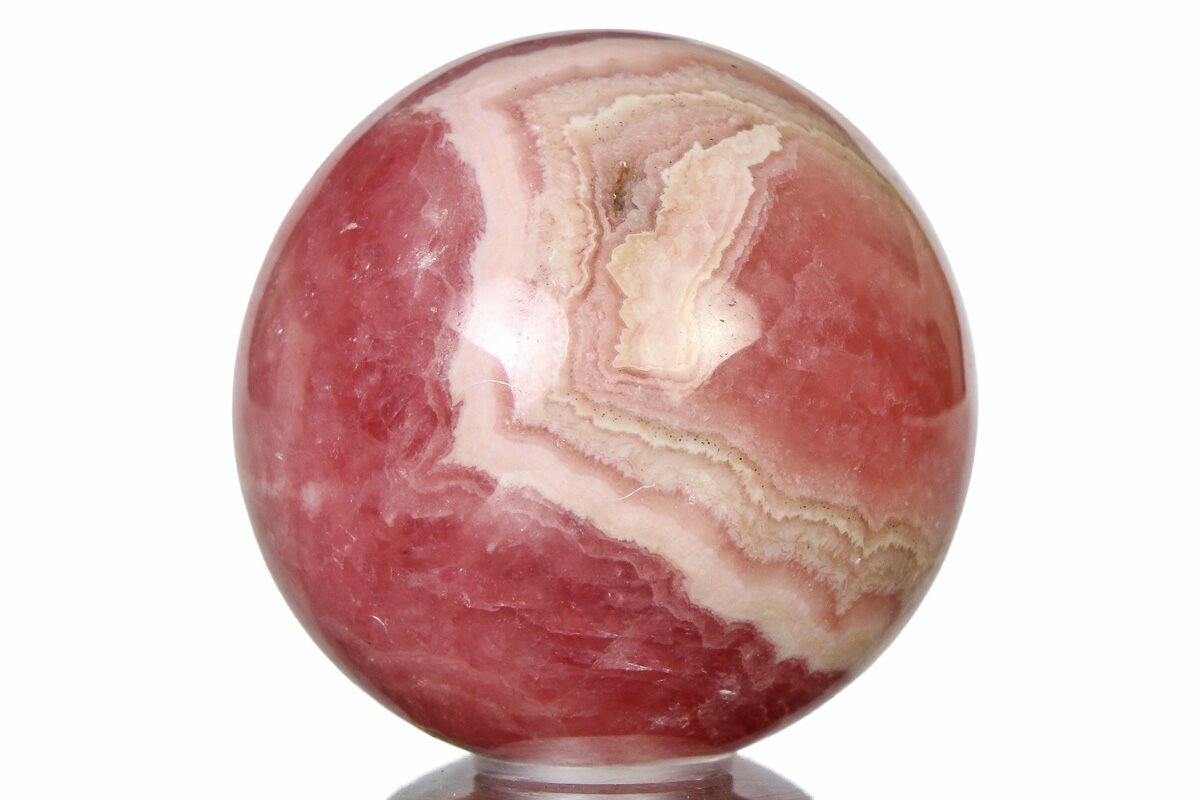
A polished sphere of "Inca Rose" rhodochrosite from the Capillitas mines in Argentina.
N’Chwaning (Kalahari Manganese Field), Northern Cape, South Africa
In the Kalahari Manganese Field, rhodochrosite appears in a setting that feels industrial and primordial at once: vast manganese-rich geology with pockets capable of producing exceptional specimens. Mindat’s locality notes describe N’Chwaning I as a manganese mine where notable rhodochrosite specimens were associated with minerals like manganite and drusy quartz, highlighting the way rhodochrosite can flourish in manganese-heavy systems.
South African rhodochrosite from this region is often admired for saturated color and attractive crystal habits—material that can look almost sculptural even when the crystals are “simple” rhombs. The locality is also a reminder that rhodochrosite’s beauty often rides on ore geology: the same chemical richness that makes a deposit economically interesting can, in rare cavities, build something museum-worthy.
Cavnic mining area, Maramureș County, Romania
Cavnic occupies a special place in rhodochrosite lore as a type-locality region referenced in mineral descriptions. It sits within a long-worked mining district known for polymetallic mineralization—exactly the kind of environment where carbonates, sulfides, and quartz can share the same underground stage.
For collectors, Romanian rhodochrosite is often appreciated in association with quartz and sulfides, sometimes forming attractive “flower” or cluster-like arrangements. Even when the crystals aren’t giant, they can be exquisitely balanced: pale-to-strong pink rhombs perched on contrasting matrix, a classic European aesthetic that feels like it belongs in a velvet-lined drawer.
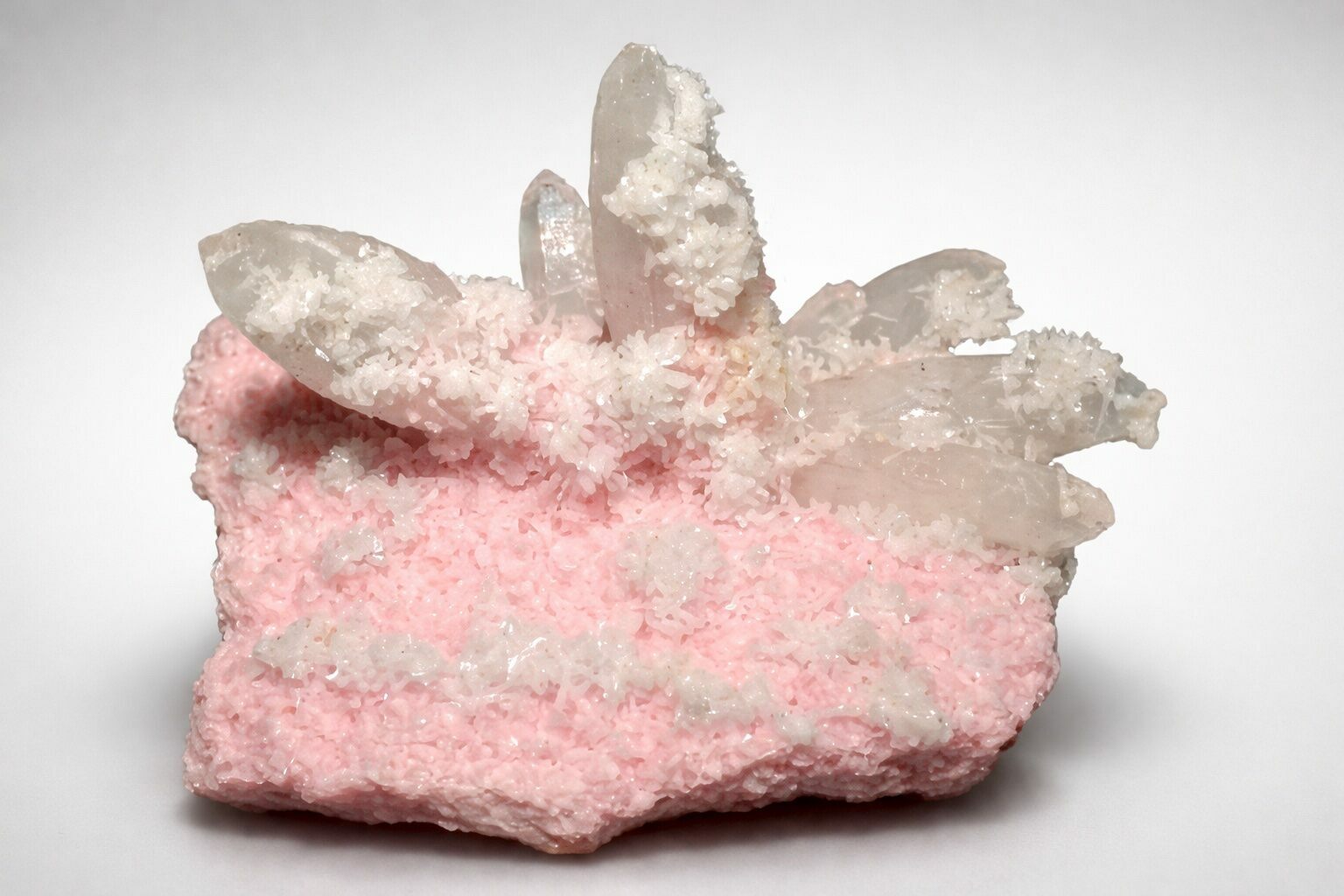
A specimen of Rhodochrosite with quartz crystals from the Cavnic mines in Romania.
Wutong Mine (Wudong), Guangxi, China
China’s Wutong mine is notable in part because it has been discussed explicitly as a rhodochrosite specimen producer, with locality writeups describing it as a small underground operation in Guangxi and detailing its regional access and setting. Wutong material is well known among collectors for bright, attractive crystals often found with other classic vein minerals.
Mindat’s locality entry for Wutong also reflects the typical company rhodochrosite keeps there—minerals like quartz, fluorite, pyrite, sphalerite, barite, calcite, and galena show up in association lists, reinforcing the “hydrothermal vein” character of the deposit.
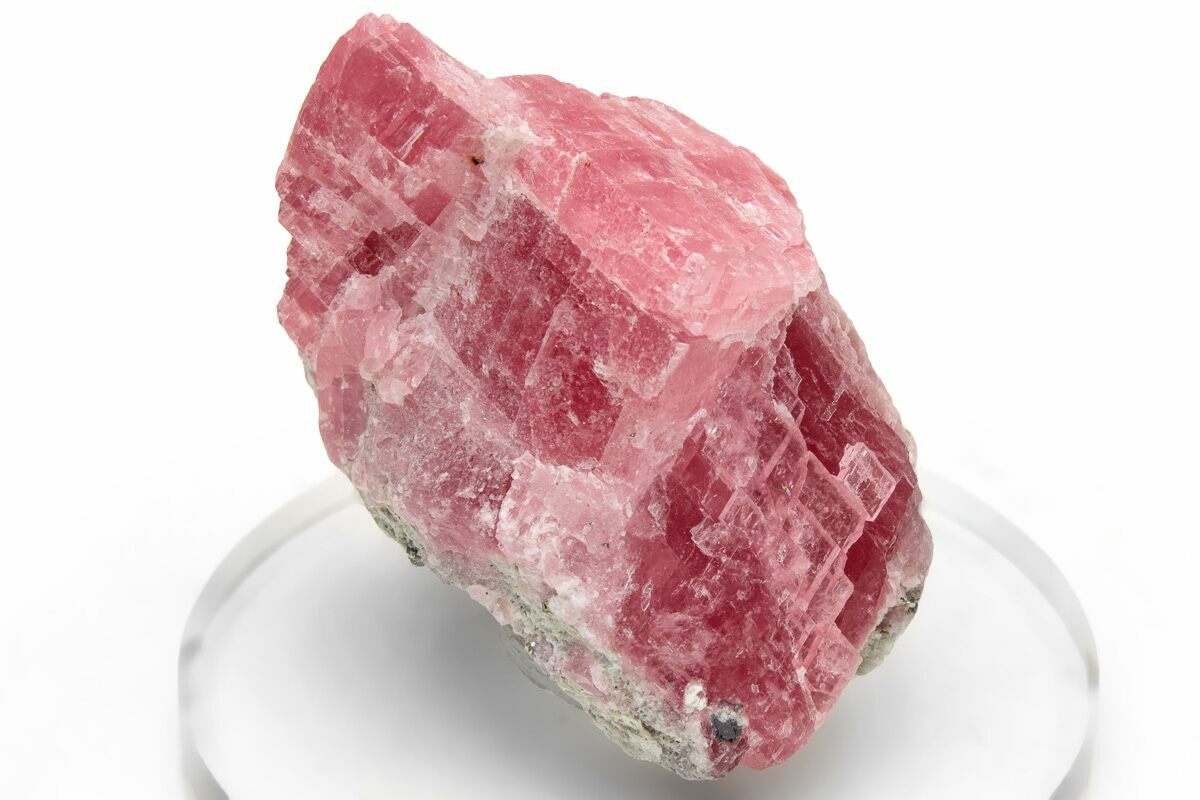
A pink rhodochrosite specimen from the Wutong Mine in China.
Uchucchacua Mine, Oyón Province, Lima Department, Peru
Uchucchacua is one of Peru’s famed mines for mineral species diversity and for producing striking specimens across multiple minerals. Descriptions of Uchucchacua note its reputation and the breadth of mineralogical interest at the site, which sets the stage for rhodochrosite to appear not just as a curiosity but as part of a rich mineral ecosystem.
Collector-focused descriptions repeatedly highlight the locality for gemmy, deep red/pink rhodochrosite crystals, the kind that stand out even among global rhodochrosite occurrences. In practical terms, Uchucchacua helps demonstrate a pattern: the most desirable rhodochrosite crystals often come from complex ore systems where open cavities, the right chemistry, and just enough time align—leaving behind a pocket of rose-colored geometry as an accident of underground history.
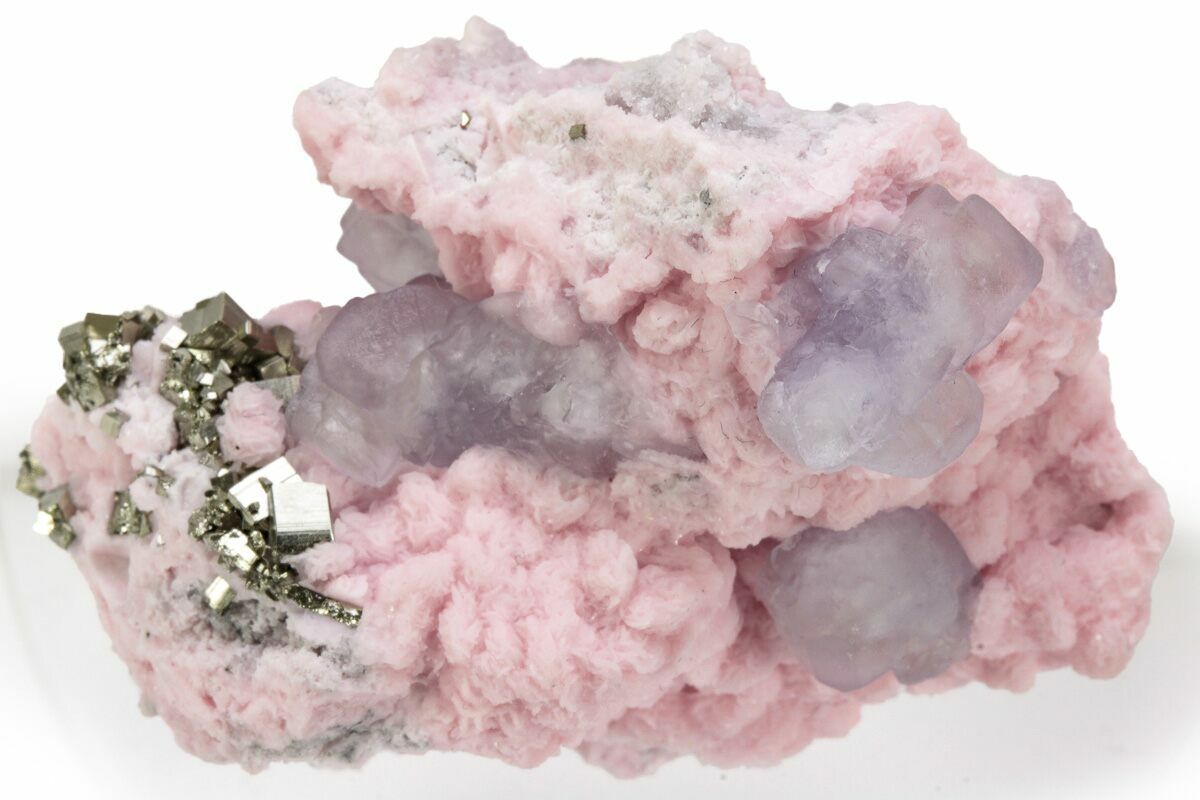
Rhodochrosite with cubic pyrite and purple fluorite from Peru.


