Reviews

Spinosaurus mirabilis: A New Scimitar-Crested Spinosaurus
For more than a century, Spinosaurus has stood as one of the most iconic—and most mysterious—predatory dinosaurs ever discovered. With its crocodile-like snout, conical teeth, towering sail, and debated aquatic lifestyle, it has captured both scientific attention and public imagination since it was first named in 1915.
Yet despite its fame, Spinosaurus has long been known from frustratingly incomplete material. The original Egyptian fossils were destroyed during World War II, and subsequent discoveries across North Africa have only slowly filled in the gaps. For decades, paleontologists debated its appearance, its habits, and even how it moved. That is why the formal announcement of Spinosaurus mirabilis in February 2026 represents such a landmark moment in dinosaur science. It is the first new species of Spinosaurus formally described in more than 100 years—a rare expansion of a genus that many assumed was unlikely to yield another named species.
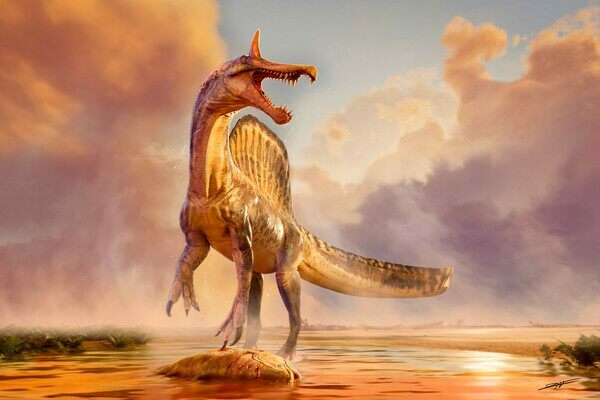
An artists reconstruction of Spinosaurus mirabilis with it's unique Image Credit: Dani Navarro
The fossils of Spinosaurus mirabilis were discovered in the Sahara Desert of central Niger, preserved in rocks of the Cenomanian-aged Farak Formation. Unlike many earlier spinosaur finds that were associated with coastal or near-marine deposits, this material came from an inland river system hundreds of kilometers from the nearest ancient shoreline. This setting alone carries major implications, reinforcing the idea that spinosaurids were deeply tied to freshwater ecosystems and river environments. But what truly set this discovery apart was not just where it was found—it was what the bones revealed.
The story began in 2019, when paleontologist Paul Sereno and his team set out to investigate a tantalizing historical clue buried in a decades-old geological reference. A brief mention from the 1950s described a mysterious “saber-shaped” fossil tooth found somewhere in the Sahara, a detail that had gone largely unexplored for generations. Intrigued by the possibility that the region might preserve important spinosaur material, Sereno’s expedition ventured deep into the desert. The landscape was remote and unforgiving, a vast expanse of rock and sand where fossils erode slowly from ancient river deposits. During their fieldwork, the team encountered a local Tuareg guide who offered to lead them farther into the desert to a place where large bones had been spotted. After hours of travel across harsh terrain, the team arrived at a fossil-rich area later referred to as Jenguebi. With limited time before returning to camp, they began collecting visible material scattered across the surface—teeth and jaw fragments that clearly belonged to a large spinosaurid dinosaur.
Among the collected pieces was an unusual curved fragment of bone that initially puzzled the team. It did not resemble typical spinosaur skull elements, and its shape was unlike anything previously described. Only later, after further excavation and additional expeditions in 2022, did the significance of the fragment become clear. The team recovered two more examples of the same structure, confirming that it was not a deformity or random anomaly. It was part of a distinctive anatomical feature: a dramatic, scimitar-shaped crest rising along the midline of the skull.
This crest is now the defining characteristic of Spinosaurus mirabilis. Blade-like in profile, it would have projected prominently above the animal’s head. Evidence from the bone’s surface suggests it was likely sheathed in keratin during life, potentially making it even taller and more visually striking than the fossilized bone alone indicates. Researchers have suggested that the crest may have served a display function, possibly playing a role in species recognition or social behavior. In life, it may even have been brightly colored, transforming this already imposing predator into an even more spectacular sight along the riverbanks of Cretaceous Africa.
The skull itself also revealed key feeding adaptations. Like other spinosaurids, Spinosaurus mirabilis possessed elongated jaws lined with conical teeth suited for gripping slippery prey. Particularly notable were its interdigitating tooth rows, where the upper and lower teeth overlapped in a way that created an effective trap for struggling fish. Rather than slicing flesh like a typical theropod predator, this animal was specialized for seizing and holding aquatic prey. Combined with its elongated snout and sensory adaptations, the anatomy strongly supports the image of Spinosaurus as a dominant freshwater predator.
Equally important is the environmental context of the discovery. The Farak Formation represents an ancient river system that existed approximately 95 million years ago during the Late Cretaceous. The fossil site was located between 500 and 1,000 kilometers from the nearest marine coastline at the time, demonstrating that these animals were not restricted to coastal environments. The surrounding sediments and associated fossils indicate a lush riverine habitat, likely filled with fish, crocodile-like reptiles, and other aquatic life. In this setting, Spinosaurus mirabilis would have thrived as a large wading predator, stalking shallows much like a gigantic prehistoric heron—albeit one armed with jaws capable of subduing sizable prey.
After the fossils were transported from the desert, the team used modern imaging technology to digitally reconstruct the skull. Solar-powered scanning equipment had already allowed preliminary models to be assembled in the field, but further CT scanning and preparation back in the laboratory confirmed that the material represented a species distinct from Spinosaurus aegyptiacus. The differences in crest structure and skull anatomy were significant enough to justify naming a new species. When the findings were formally published, the dinosaur was given the name Spinosaurus mirabilis, meaning “astonishing” or “remarkable”—an apt description for both its appearance and its scientific importance.
The naming of Spinosaurus mirabilis reshapes our understanding of spinosaur diversity in North Africa. For decades, most material was broadly assigned to S. aegyptiacus, but this new species demonstrates that multiple forms of Spinosaurus may have coexisted across the region’s varied ecosystems. It also adds new anatomical information to a genus long plagued by incomplete remains. More than a century after Spinosaurus first entered scientific literature, the Sahara has yielded another chapter in its story—one that reveals unexpected ornamentation, confirms freshwater specialization, and underscores how much there is still to discover.
Even for one of the most famous dinosaurs in the world, the sands of the Sahara continue to hold surprises.
Yet despite its fame, Spinosaurus has long been known from frustratingly incomplete material. The original Egyptian fossils were destroyed during World War II, and subsequent discoveries across North Africa have only slowly filled in the gaps. For decades, paleontologists debated its appearance, its habits, and even how it moved. That is why the formal announcement of Spinosaurus mirabilis in February 2026 represents such a landmark moment in dinosaur science. It is the first new species of Spinosaurus formally described in more than 100 years—a rare expansion of a genus that many assumed was unlikely to yield another named species.
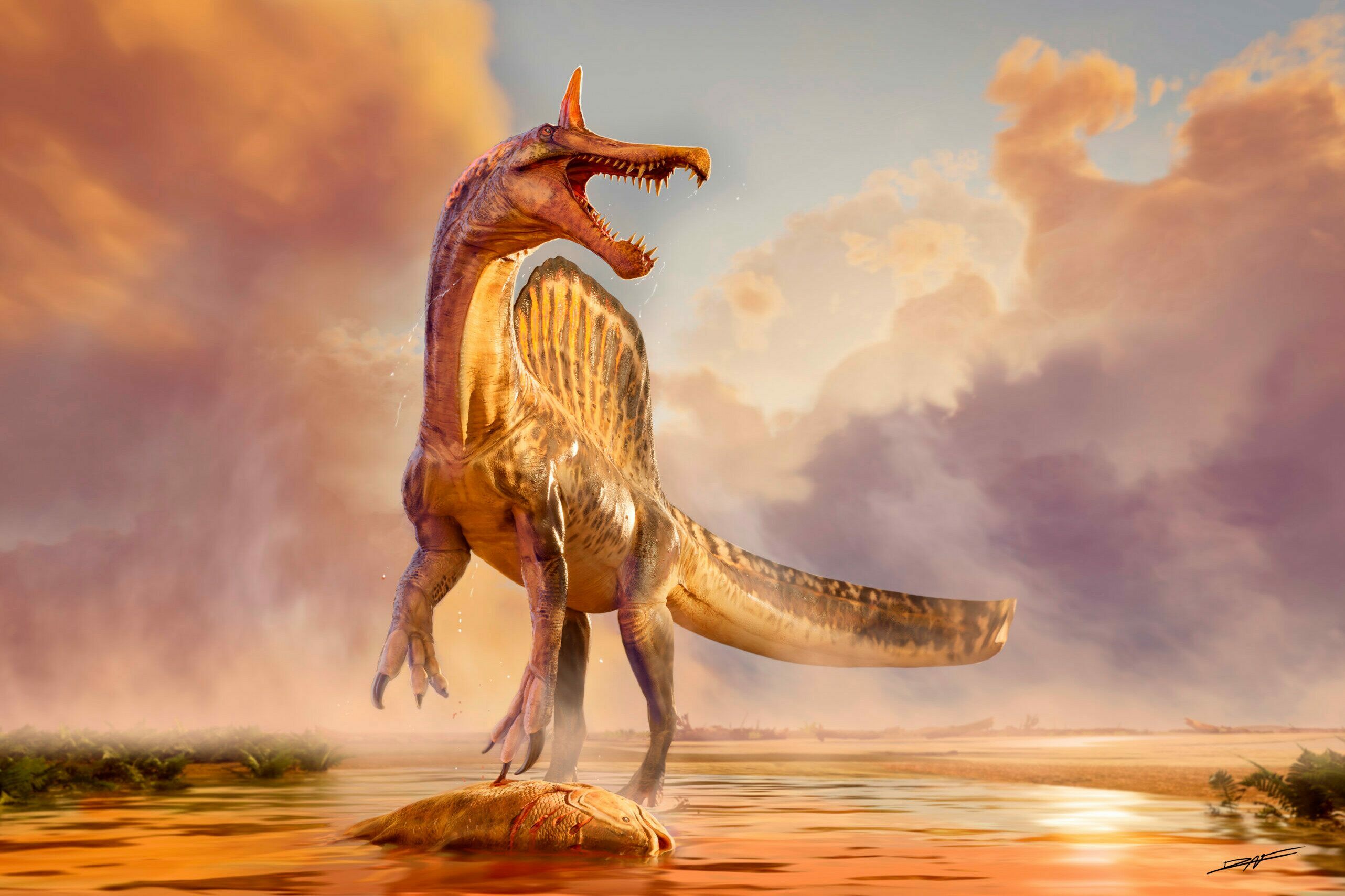
An artists reconstruction of Spinosaurus mirabilis with it's unique Image Credit: Dani Navarro
The fossils of Spinosaurus mirabilis were discovered in the Sahara Desert of central Niger, preserved in rocks of the Cenomanian-aged Farak Formation. Unlike many earlier spinosaur finds that were associated with coastal or near-marine deposits, this material came from an inland river system hundreds of kilometers from the nearest ancient shoreline. This setting alone carries major implications, reinforcing the idea that spinosaurids were deeply tied to freshwater ecosystems and river environments. But what truly set this discovery apart was not just where it was found—it was what the bones revealed.
A Clue Buried In The Past
The story began in 2019, when paleontologist Paul Sereno and his team set out to investigate a tantalizing historical clue buried in a decades-old geological reference. A brief mention from the 1950s described a mysterious “saber-shaped” fossil tooth found somewhere in the Sahara, a detail that had gone largely unexplored for generations. Intrigued by the possibility that the region might preserve important spinosaur material, Sereno’s expedition ventured deep into the desert. The landscape was remote and unforgiving, a vast expanse of rock and sand where fossils erode slowly from ancient river deposits. During their fieldwork, the team encountered a local Tuareg guide who offered to lead them farther into the desert to a place where large bones had been spotted. After hours of travel across harsh terrain, the team arrived at a fossil-rich area later referred to as Jenguebi. With limited time before returning to camp, they began collecting visible material scattered across the surface—teeth and jaw fragments that clearly belonged to a large spinosaurid dinosaur.
Among the collected pieces was an unusual curved fragment of bone that initially puzzled the team. It did not resemble typical spinosaur skull elements, and its shape was unlike anything previously described. Only later, after further excavation and additional expeditions in 2022, did the significance of the fragment become clear. The team recovered two more examples of the same structure, confirming that it was not a deformity or random anomaly. It was part of a distinctive anatomical feature: a dramatic, scimitar-shaped crest rising along the midline of the skull.
This crest is now the defining characteristic of Spinosaurus mirabilis. Blade-like in profile, it would have projected prominently above the animal’s head. Evidence from the bone’s surface suggests it was likely sheathed in keratin during life, potentially making it even taller and more visually striking than the fossilized bone alone indicates. Researchers have suggested that the crest may have served a display function, possibly playing a role in species recognition or social behavior. In life, it may even have been brightly colored, transforming this already imposing predator into an even more spectacular sight along the riverbanks of Cretaceous Africa.
The skull itself also revealed key feeding adaptations. Like other spinosaurids, Spinosaurus mirabilis possessed elongated jaws lined with conical teeth suited for gripping slippery prey. Particularly notable were its interdigitating tooth rows, where the upper and lower teeth overlapped in a way that created an effective trap for struggling fish. Rather than slicing flesh like a typical theropod predator, this animal was specialized for seizing and holding aquatic prey. Combined with its elongated snout and sensory adaptations, the anatomy strongly supports the image of Spinosaurus as a dominant freshwater predator.
Equally important is the environmental context of the discovery. The Farak Formation represents an ancient river system that existed approximately 95 million years ago during the Late Cretaceous. The fossil site was located between 500 and 1,000 kilometers from the nearest marine coastline at the time, demonstrating that these animals were not restricted to coastal environments. The surrounding sediments and associated fossils indicate a lush riverine habitat, likely filled with fish, crocodile-like reptiles, and other aquatic life. In this setting, Spinosaurus mirabilis would have thrived as a large wading predator, stalking shallows much like a gigantic prehistoric heron—albeit one armed with jaws capable of subduing sizable prey.
After the fossils were transported from the desert, the team used modern imaging technology to digitally reconstruct the skull. Solar-powered scanning equipment had already allowed preliminary models to be assembled in the field, but further CT scanning and preparation back in the laboratory confirmed that the material represented a species distinct from Spinosaurus aegyptiacus. The differences in crest structure and skull anatomy were significant enough to justify naming a new species. When the findings were formally published, the dinosaur was given the name Spinosaurus mirabilis, meaning “astonishing” or “remarkable”—an apt description for both its appearance and its scientific importance.

The naming of Spinosaurus mirabilis reshapes our understanding of spinosaur diversity in North Africa. For decades, most material was broadly assigned to S. aegyptiacus, but this new species demonstrates that multiple forms of Spinosaurus may have coexisted across the region’s varied ecosystems. It also adds new anatomical information to a genus long plagued by incomplete remains. More than a century after Spinosaurus first entered scientific literature, the Sahara has yielded another chapter in its story—one that reveals unexpected ornamentation, confirms freshwater specialization, and underscores how much there is still to discover.
Even for one of the most famous dinosaurs in the world, the sands of the Sahara continue to hold surprises.