 Reviews

Are Serpentine and Jade the Same Mineral?
Serpentine and jade are often confused—and for good reason. Both are typically green, both have been carved and treasured for thousands of years, and historically they were frequently mistaken for one another. Despite these similarities, serpentine and jade are not the same mineral. They differ in composition, structure, hardness, and geological origin, even though their histories are closely intertwined.
Here are the key differences at a glance:
Mineral definition: Jade refers to two specific minerals (nephrite and jadeite), while serpentine is a group of related minerals.
Hardness: Jade is significantly harder (about 6–7 on the Mohs scale) than serpentine (about 2.5–4).
Toughness: Jade is exceptionally tough and resistant to breaking; serpentine is comparatively softer and less durable.
Chemical composition: Jade is a calcium-magnesium-iron silicate (nephrite) or sodium-aluminum silicate (jadeite); serpentine is a magnesium-rich silicate.
Geological origin: Jade forms under high-pressure metamorphic conditions, while serpentine forms through hydration of mantle rocks (serpentinization).
Value and usage: True jade is rarer and generally far more valuable; serpentine is widely used as an ornamental and carving stone.
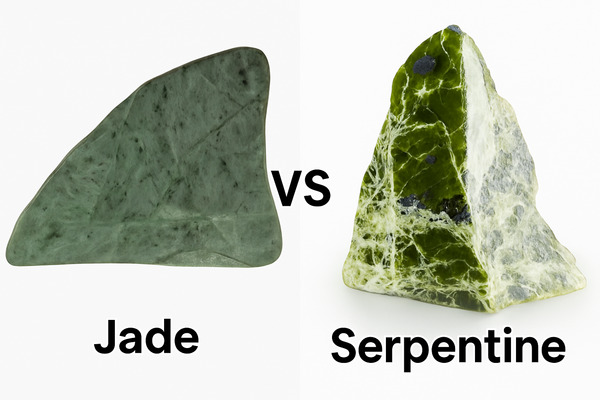
Serpentine Vs. Jade
Despite these differences, the two stones have been confused for thousands of years due to their similar green colors, smooth polish, and long shared history in carved objects. Understanding how they differ helps clarify both their geological origins and their cultural significance.
"Jade" is a cultural and gemological term rather than a single mineral name. Scientifically, true jade refers to only two distinct minerals, both prized for their exceptional toughness, beauty, and long history of human use:
Nephrite
Nephrite is a calcium magnesium iron silicate belonging to the amphibole mineral group. It is composed of tightly interlocking microscopic fibers, which give it extraordinary toughness—meaning it resists breaking and chipping far better than most stones. Nephrite typically appears in shades of creamy white, gray, olive green, deep forest green, and nearly black. Historically, nephrite was the jade used by many ancient cultures, including early Chinese civilizations, Māori carvers in New Zealand, and Indigenous peoples of North America. Because of its durability, it was commonly shaped into tools, weapons, ceremonial objects, and intricate carvings long before metalworking became widespread.
Jadeite
Jadeite is a sodium aluminum silicate belonging to the pyroxene group and is generally harder and rarer than nephrite. It forms under extremely high-pressure metamorphic conditions, often associated with subduction zones. Jadeite exhibits a broader and more vivid color range than nephrite, including bright emerald green, lavender, blue, yellow, orange, white, and black. The most valuable jadeite—often called imperial jade—comes primarily from Myanmar (Burma) and is renowned for its intense green color, translucency, and fine texture. Jadeite is the variety most associated with high-end jewelry and museum-quality carvings today.
Both forms of jade are exceptionally tough, meaning they resist breaking even more than they resist scratching. This toughness made jade ideal for tools, weapons, and carvings in ancient cultures. Jadeite is generally harder and rarer than nephrite and is the variety most associated with high-value imperial jade from Myanmar (Burma).
Serpentine refers to a group of magnesium-rich silicate minerals formed through a geological process called serpentinization, where ultramafic rocks from Earth’s mantle react with water. This transformation produces green, waxy-looking stones that can resemble jade. Serpentine is softer than jade, typically ranging from about 2.5 to 4 on the Mohs hardness scale, though some varieties—especially bowenite—can approach jade’s appearance and durability. Because it is easier to carve, serpentine has been widely used for decorative objects, ritual carvings, and architectural stone.
Because of their visual similarity, serpentine is sometimes marketed as “new jade,” “olive jade,” or “Korean jade.” While not fraudulent if properly disclosed, these names can be misleading. True jade—especially jadeite—commands far higher prices due to its rarity, toughness, and cultural significance. That said, serpentine has its own legitimate value. Its rich green tones, smooth polish, and long history of use make it an important ornamental stone in its own right.
Here are the key differences at a glance:
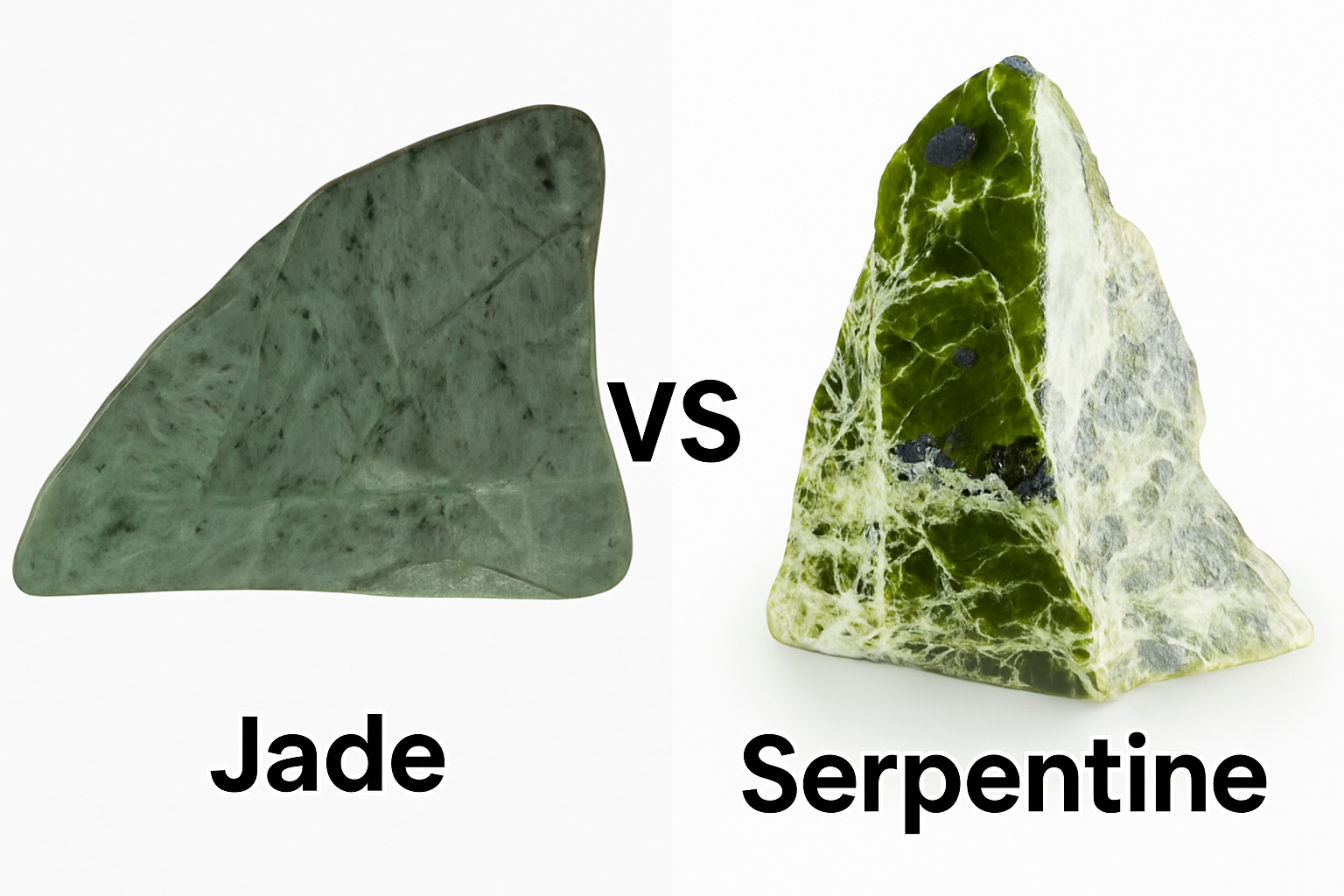
Serpentine Vs. Jade
Despite these differences, the two stones have been confused for thousands of years due to their similar green colors, smooth polish, and long shared history in carved objects. Understanding how they differ helps clarify both their geological origins and their cultural significance.
What Is Jade?
"Jade" is a cultural and gemological term rather than a single mineral name. Scientifically, true jade refers to only two distinct minerals, both prized for their exceptional toughness, beauty, and long history of human use:
Nephrite
Nephrite is a calcium magnesium iron silicate belonging to the amphibole mineral group. It is composed of tightly interlocking microscopic fibers, which give it extraordinary toughness—meaning it resists breaking and chipping far better than most stones. Nephrite typically appears in shades of creamy white, gray, olive green, deep forest green, and nearly black. Historically, nephrite was the jade used by many ancient cultures, including early Chinese civilizations, Māori carvers in New Zealand, and Indigenous peoples of North America. Because of its durability, it was commonly shaped into tools, weapons, ceremonial objects, and intricate carvings long before metalworking became widespread.
Jadeite
Jadeite is a sodium aluminum silicate belonging to the pyroxene group and is generally harder and rarer than nephrite. It forms under extremely high-pressure metamorphic conditions, often associated with subduction zones. Jadeite exhibits a broader and more vivid color range than nephrite, including bright emerald green, lavender, blue, yellow, orange, white, and black. The most valuable jadeite—often called imperial jade—comes primarily from Myanmar (Burma) and is renowned for its intense green color, translucency, and fine texture. Jadeite is the variety most associated with high-end jewelry and museum-quality carvings today.
Both forms of jade are exceptionally tough, meaning they resist breaking even more than they resist scratching. This toughness made jade ideal for tools, weapons, and carvings in ancient cultures. Jadeite is generally harder and rarer than nephrite and is the variety most associated with high-value imperial jade from Myanmar (Burma).
What Is Serpentine?
Serpentine refers to a group of magnesium-rich silicate minerals formed through a geological process called serpentinization, where ultramafic rocks from Earth’s mantle react with water. This transformation produces green, waxy-looking stones that can resemble jade. Serpentine is softer than jade, typically ranging from about 2.5 to 4 on the Mohs hardness scale, though some varieties—especially bowenite—can approach jade’s appearance and durability. Because it is easier to carve, serpentine has been widely used for decorative objects, ritual carvings, and architectural stone.
Because of their visual similarity, serpentine is sometimes marketed as “new jade,” “olive jade,” or “Korean jade.” While not fraudulent if properly disclosed, these names can be misleading. True jade—especially jadeite—commands far higher prices due to its rarity, toughness, and cultural significance. That said, serpentine has its own legitimate value. Its rich green tones, smooth polish, and long history of use make it an important ornamental stone in its own right.


