 Reviews

Kämmererite: The Rare Purple Chlorite Mineral
Kämmererite is one of the most visually shocking minerals in nature, not because it forms enormous crystals like selenite or flashy metallic forms like pyrite, but because it breaks the expectations of an entire mineral group. Chlorites are typically dull-to-bright green sheet silicates that form in altered ultramafic rocks and metamorphic environments. They are abundant, earthy, and rarely exciting to the average collector.
Then there is Kämmererite — a mineral that appears in vivid purples, pink-violet magentas, lavender, raspberry-red, and sometimes deep lilac, glittering like crushed grape hard candy when well crystallized. It earns its color from chromium, the same element responsible for emerald’s green, ruby’s red, and the rare violet hues in some corundum. In Kämmererite, chromium replaces aluminum inside the crystal lattice of the chlorite mineral clinochlore, creating a result that looks more like a fragile mica or lepidolite than a typical chlorite.
Unlike most minerals whose colors are surface stains or oxidation effects, Kämmererite’s purple tone is intrinsic — it is part of the crystal chemistry itself. This makes it a powerful indicator mineral for geologists: when you find Kämmererite, you have likely found rocks that originated deep in Earth’s mantle and later interacted with chromium-rich fluids during hydration and tectonic uplift.
Some of the best specimens form in thin, flexible plates, stacked rosettes, or shimmering pseudo-hexagonal crystal clusters that can show faint pleochroism — shifting slightly in tone when viewed from different angles. Although it is soft, it is chemically stable, meaning its color doesn’t come and go like many copper-based minerals. Instead, its challenge lies in its durability, not its beauty.
Physical Properties
Mineral group: Chlorite group (phyllosilicate; sheet silicate)
Idealized formula: Mg₅(Al,Cr)₂Si₃O₁₀(OH)₈
Crystal system: Monoclinic (often pseudo-hexagonal appearance reported for clinochlore varieties)
Color: Lilac, violet, purple, sometimes pinkish-red; intensity generally tracks chromium content
Luster: Often pearly to vitreous/greasy (mica-like sheen is common)
Cleavage: Perfect in one direction (sheet mineral behavior)
Mohs hardness: ~2–2.5 (soft)
Specific gravity: ~2.55–2.75
Transparency: Transparent to translucent in rare clean material; more often translucent/opaque in masses
Commonly associated minerals
Chromite / Chromium Spinel (primary chromium source)
serpentine minerals (formed during host rock alteration)
Magnesite & other carbonates
Talc
Green chlorite varieties
Cr-rich spinel alteration halos
Iron oxides (occasional coatings but not the source of color)
Kämmererite was never meant to be purple. It doesn’t crystallize directly from magma like most minerals born of fire. Instead, it appears much later in the rock’s life, forged not by melting, but by water—a mineral remade by hydration, reaction, and transformation.
Its story begins deep below our feet, in the dense, dark realms of Earth’s mantle, where chromium-rich ultramafic rocks take shape under immense pressure. Within these primordial stones, tiny grains of chromite (chromium spinel) persist like flecks of metallic DNA, quietly storing the element that will one day paint the mineral violet.
Then comes the great upheaval. Through tectonic collision and the emplacement of ophiolites, slabs of mantle rock are heaved upward, cracked, fractured, and exposed to a world they were never meant to see. Along these new pathways, water begins its slow invasion—percolating downward through faults and fissures, initiating the process of serpentinization, where olivine and pyroxene surrender their original forms, reborn as soft green serpentine minerals.
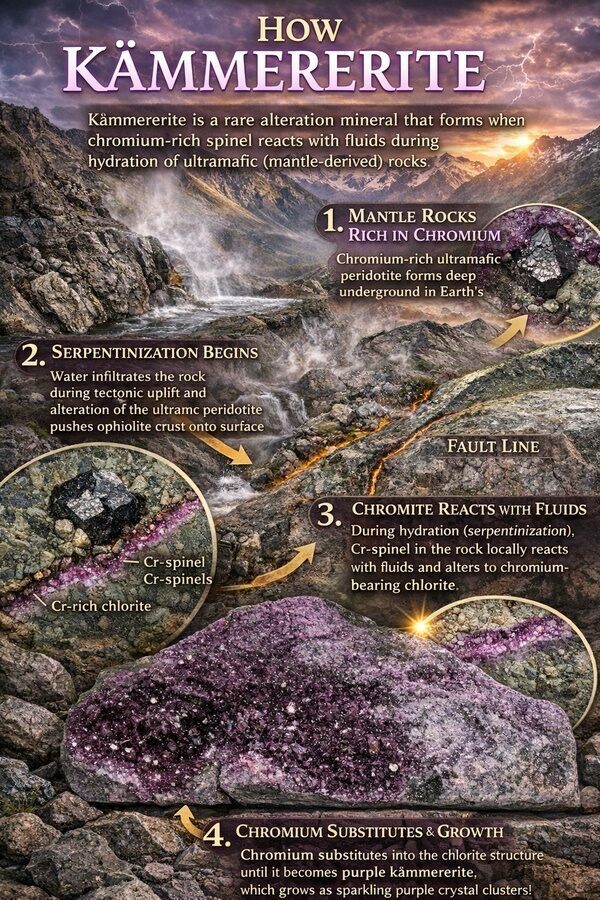
Infographic: How Kämmererite Forms
But the transformation isn’t over. The same fluids that rewrote the silicate minerals now turn their attention to chromium spinel. Around each chromite grain, chemical reactions bloom outward like halos, forming chromium-rich chlorite rims—the first hint that something unusual is happening. When enough chromium finally replaces aluminum inside the lattice of clinochlore, the green mineral crosses a threshold, and Kämmererite emerges in shades of purple, lilac, and violet.
The crystals that form are often stacked like fragile pages in a stone-bound book, shimmering in clusters or spreading outward in thin flexible plates, frequently nestled right beside the chromite that gave them life. The result is a mineral whose color tells a story without words: a purple signal of mantle hydration and chromium’s quiet availability, a geologic autograph left behind by fluids reacting with Earth’s deepest rocks.
True Kämmererite remains uncommon, because the conditions required to create it are so exacting. But when the chemistry aligns and the crystals grow freely, it rewards the world with extraordinary beauty—a mineral altered by water, colored by chromium, and uplifted by tectonics, carrying the legacy of the mantle in brilliant violet hues.
Kämmererite is not a mineral you stumble on around the world. Because it forms only where chromium-rich spinel, magnesium, aluminum, and hydrating fluids meet in just the right proportions, the conditions required are so rare that the mineral itself is correspondingly scarce. It is simply not found in many places, not because it is unstable, but because its recipe is so geochemically exacting that few geologic environments ever achieve it. That rarity makes each occurrence notable—but Turkey stands overwhelmingly above the rest.
In Turkey, along the ophiolite-carved mountain belts of Erzurum, Sivas, and the Kop Dağları range, Kämmererite forms as a late-stage alteration mineral in chromite-bearing serpentinites—born from mantle rocks that were fractured, uplifted, hydrated, and rewritten by fluids over millions of years. Here, and almost nowhere else with meaningful specimen output, the mineral grows into intensely purple, micaceous plates and shimmering crystal stacks, often crystallizing directly beside the chromite grains that supplied their chromium. The fact that it is not widespread globally only amplifies Turkey’s importance: this region is not just Kämmererite’s best source, it is one of the only reliable homes it has on Earth, and the reason the mineral is known to collectors at all.
Kämmererite was first recognized by science in the mid-1800s, an era when mineralogy was still more notebook than marketplace, more hand lens than e-commerce. It was identified not as a new species, but as something equally fascinating—a radically colored variant of clinochlore, a humble green chlorite mineral that almost no one outside of geology paid much attention to. What set it apart was its color: a natural purple unlike anything expected from its mineral family. Early mineralogists quickly understood that chromium was the culprit, replacing aluminum in the structure and tinting the crystals violet, lavender, and raspberry-pink.
The mineral was formally named by Finnish geologist Nils Gustaf Nordenskiöld, who chose to honor August Alexander Kämmerer, an Austrian mining engineer whose work intersected with chromium deposits. At the time, the name was more tribute than product label—there was no commercial use for the mineral, no cutting, no polishing, no jewelry demand. Chlorites were simply too soft and too common to warrant it. And yet, from the very beginning, Kämmererite did have a use—just not the one we think of today. It became an indicator mineral, quietly helping geologists trace chromium-rich ultramafic rocks and altered chromite bodies. In a sense, its first practical value was directional: it pointed scientists toward the types of rocks that came from Earth’s mantle, altered by hydration, uplift, and geochemical reaction.
For much of its early life, Kämmererite lived exclusively in museum trays and academic collections, valued for its diagnostic chemistry and flamboyant defiance of chlorite norms. It was frequently misidentified by newcomers as lepidolite or other purple micas, and even trained geologists debated its boundaries—was it just chromian chlorite? A chromium halo mineral? A structural cousin of leuchtenbergite? The debates, however, only added to its mystique.
Its second life—its commercial history—didn’t begin until much later, when chromite mines in Turkey started yielding collector-grade material. Suddenly, the mineral wasn’t just an academic curiosity, it was a specimen of desire. Collectors began seeking it out for the same reason Nordenskiöld first noticed it: it was purple in a world of green. The uses expanded from scientific classification into human fascination: mineral cabinets, display cases, trade shows, and eventually, the global specimen market.
Lapidary artists experimented with it, cutting small cabochons and polishing thin sections despite its Mohs hardness of 2–2.5 and perfect basal cleavage. These early cut pieces never became mainstream gemstones, but they did carve out a footnote in jewelry history: Kämmererite was among the first chromium-colored sheet silicates to be faceted and polished purely for aesthetic reasons rather than durability or tradition. Its occasional appearance in pendants and protected settings today is part of that same lineage—jewelry not built for wear, but built for wonder.

Then there is Kämmererite — a mineral that appears in vivid purples, pink-violet magentas, lavender, raspberry-red, and sometimes deep lilac, glittering like crushed grape hard candy when well crystallized. It earns its color from chromium, the same element responsible for emerald’s green, ruby’s red, and the rare violet hues in some corundum. In Kämmererite, chromium replaces aluminum inside the crystal lattice of the chlorite mineral clinochlore, creating a result that looks more like a fragile mica or lepidolite than a typical chlorite.
Unlike most minerals whose colors are surface stains or oxidation effects, Kämmererite’s purple tone is intrinsic — it is part of the crystal chemistry itself. This makes it a powerful indicator mineral for geologists: when you find Kämmererite, you have likely found rocks that originated deep in Earth’s mantle and later interacted with chromium-rich fluids during hydration and tectonic uplift.
Some of the best specimens form in thin, flexible plates, stacked rosettes, or shimmering pseudo-hexagonal crystal clusters that can show faint pleochroism — shifting slightly in tone when viewed from different angles. Although it is soft, it is chemically stable, meaning its color doesn’t come and go like many copper-based minerals. Instead, its challenge lies in its durability, not its beauty.
Physical Properties
Mineral group: Chlorite group (phyllosilicate; sheet silicate)
Idealized formula: Mg₅(Al,Cr)₂Si₃O₁₀(OH)₈
Crystal system: Monoclinic (often pseudo-hexagonal appearance reported for clinochlore varieties)
Color: Lilac, violet, purple, sometimes pinkish-red; intensity generally tracks chromium content
Luster: Often pearly to vitreous/greasy (mica-like sheen is common)
Cleavage: Perfect in one direction (sheet mineral behavior)
Mohs hardness: ~2–2.5 (soft)
Specific gravity: ~2.55–2.75
Transparency: Transparent to translucent in rare clean material; more often translucent/opaque in masses
Commonly associated minerals
How Kämmererite Forms
Kämmererite was never meant to be purple. It doesn’t crystallize directly from magma like most minerals born of fire. Instead, it appears much later in the rock’s life, forged not by melting, but by water—a mineral remade by hydration, reaction, and transformation.
Its story begins deep below our feet, in the dense, dark realms of Earth’s mantle, where chromium-rich ultramafic rocks take shape under immense pressure. Within these primordial stones, tiny grains of chromite (chromium spinel) persist like flecks of metallic DNA, quietly storing the element that will one day paint the mineral violet.
Then comes the great upheaval. Through tectonic collision and the emplacement of ophiolites, slabs of mantle rock are heaved upward, cracked, fractured, and exposed to a world they were never meant to see. Along these new pathways, water begins its slow invasion—percolating downward through faults and fissures, initiating the process of serpentinization, where olivine and pyroxene surrender their original forms, reborn as soft green serpentine minerals.
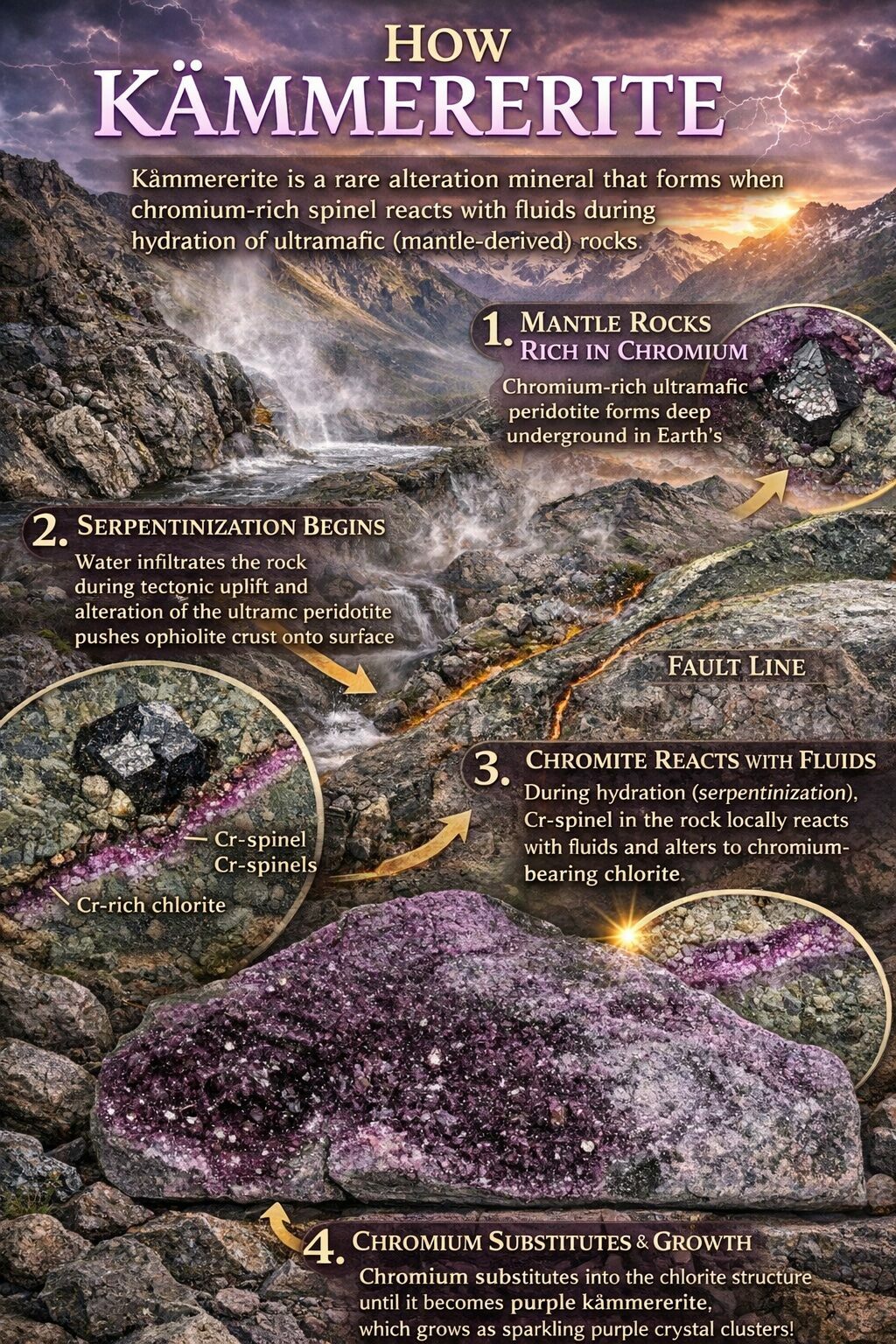
Infographic: How Kämmererite Forms
But the transformation isn’t over. The same fluids that rewrote the silicate minerals now turn their attention to chromium spinel. Around each chromite grain, chemical reactions bloom outward like halos, forming chromium-rich chlorite rims—the first hint that something unusual is happening. When enough chromium finally replaces aluminum inside the lattice of clinochlore, the green mineral crosses a threshold, and Kämmererite emerges in shades of purple, lilac, and violet.
The crystals that form are often stacked like fragile pages in a stone-bound book, shimmering in clusters or spreading outward in thin flexible plates, frequently nestled right beside the chromite that gave them life. The result is a mineral whose color tells a story without words: a purple signal of mantle hydration and chromium’s quiet availability, a geologic autograph left behind by fluids reacting with Earth’s deepest rocks.
True Kämmererite remains uncommon, because the conditions required to create it are so exacting. But when the chemistry aligns and the crystals grow freely, it rewards the world with extraordinary beauty—a mineral altered by water, colored by chromium, and uplifted by tectonics, carrying the legacy of the mantle in brilliant violet hues.
Major Localities (Turkey)
Kämmererite is not a mineral you stumble on around the world. Because it forms only where chromium-rich spinel, magnesium, aluminum, and hydrating fluids meet in just the right proportions, the conditions required are so rare that the mineral itself is correspondingly scarce. It is simply not found in many places, not because it is unstable, but because its recipe is so geochemically exacting that few geologic environments ever achieve it. That rarity makes each occurrence notable—but Turkey stands overwhelmingly above the rest.
In Turkey, along the ophiolite-carved mountain belts of Erzurum, Sivas, and the Kop Dağları range, Kämmererite forms as a late-stage alteration mineral in chromite-bearing serpentinites—born from mantle rocks that were fractured, uplifted, hydrated, and rewritten by fluids over millions of years. Here, and almost nowhere else with meaningful specimen output, the mineral grows into intensely purple, micaceous plates and shimmering crystal stacks, often crystallizing directly beside the chromite grains that supplied their chromium. The fact that it is not widespread globally only amplifies Turkey’s importance: this region is not just Kämmererite’s best source, it is one of the only reliable homes it has on Earth, and the reason the mineral is known to collectors at all.
History & Uses
Kämmererite was first recognized by science in the mid-1800s, an era when mineralogy was still more notebook than marketplace, more hand lens than e-commerce. It was identified not as a new species, but as something equally fascinating—a radically colored variant of clinochlore, a humble green chlorite mineral that almost no one outside of geology paid much attention to. What set it apart was its color: a natural purple unlike anything expected from its mineral family. Early mineralogists quickly understood that chromium was the culprit, replacing aluminum in the structure and tinting the crystals violet, lavender, and raspberry-pink.
The mineral was formally named by Finnish geologist Nils Gustaf Nordenskiöld, who chose to honor August Alexander Kämmerer, an Austrian mining engineer whose work intersected with chromium deposits. At the time, the name was more tribute than product label—there was no commercial use for the mineral, no cutting, no polishing, no jewelry demand. Chlorites were simply too soft and too common to warrant it. And yet, from the very beginning, Kämmererite did have a use—just not the one we think of today. It became an indicator mineral, quietly helping geologists trace chromium-rich ultramafic rocks and altered chromite bodies. In a sense, its first practical value was directional: it pointed scientists toward the types of rocks that came from Earth’s mantle, altered by hydration, uplift, and geochemical reaction.
For much of its early life, Kämmererite lived exclusively in museum trays and academic collections, valued for its diagnostic chemistry and flamboyant defiance of chlorite norms. It was frequently misidentified by newcomers as lepidolite or other purple micas, and even trained geologists debated its boundaries—was it just chromian chlorite? A chromium halo mineral? A structural cousin of leuchtenbergite? The debates, however, only added to its mystique.
Its second life—its commercial history—didn’t begin until much later, when chromite mines in Turkey started yielding collector-grade material. Suddenly, the mineral wasn’t just an academic curiosity, it was a specimen of desire. Collectors began seeking it out for the same reason Nordenskiöld first noticed it: it was purple in a world of green. The uses expanded from scientific classification into human fascination: mineral cabinets, display cases, trade shows, and eventually, the global specimen market.
Lapidary artists experimented with it, cutting small cabochons and polishing thin sections despite its Mohs hardness of 2–2.5 and perfect basal cleavage. These early cut pieces never became mainstream gemstones, but they did carve out a footnote in jewelry history: Kämmererite was among the first chromium-colored sheet silicates to be faceted and polished purely for aesthetic reasons rather than durability or tradition. Its occasional appearance in pendants and protected settings today is part of that same lineage—jewelry not built for wear, but built for wonder.


