 Reviews

Wulfenite: One of Nature’s Most Striking Lead Minerals
Wulfenite is one of the most visually arresting minerals ever discovered, instantly recognizable by its brilliant orange, red, or honey-yellow tabular crystals that often appear almost unreal in color and luster. Despite its relatively modest hardness, wulfenite has earned legendary status among mineral collectors due to its vibrant hues, geometric crystal forms, and association with some of the world’s most famous mineral localities. Even small specimens can command attention, while exceptional crystals are considered museum-grade treasures.
Chemically known as lead molybdate (PbMoO₄), wulfenite is a secondary mineral that forms in the oxidized zones of lead ore deposits. Its formation requires a very specific combination of lead and molybdenum-rich fluids, making high-quality wulfenite comparatively rare. This scarcity, combined with its intense coloration and high adamantine to resinous luster, has made wulfenite one of the most sought-after minerals for collectors worldwide. Interestingly, despite containing lead, wulfenite crystals often form with sharp, delicate edges and pristine faces, giving them a jewel-like appearance.
Wulfenite was first scientifically described in 1845 and named in honor of Austrian mineralogist Franz Xaver von Wulfen, who studied lead minerals in the Eastern Alps. Since then, it has become a classic mineral species studied in crystallography, geochemistry, and ore deposit research, as well as a centerpiece mineral in private and museum collections alike.
Wulfenite belongs to the tetragonal crystal system and typically forms thin, square or rectangular tabular crystals, often with beveled edges or stepped growth patterns. Less commonly, it can form pyramidal or bipyramidal crystals, granular aggregates, or crusts coating matrix rock.
Its chemical composition, PbMoO₄, places it among the molybdate minerals, closely related to minerals such as scheelite (calcium tungstate) and powellite (calcium molybdate). In fact, wulfenite can form solid-solution series with powellite, and subtle substitutions of calcium for lead can influence crystal color and translucency.
Wulfenite is relatively soft, with a Mohs hardness of about 2.5–3, and it has a high specific gravity due to its lead content. Crystals are typically transparent to translucent, though some may be opaque depending on thickness and impurities.
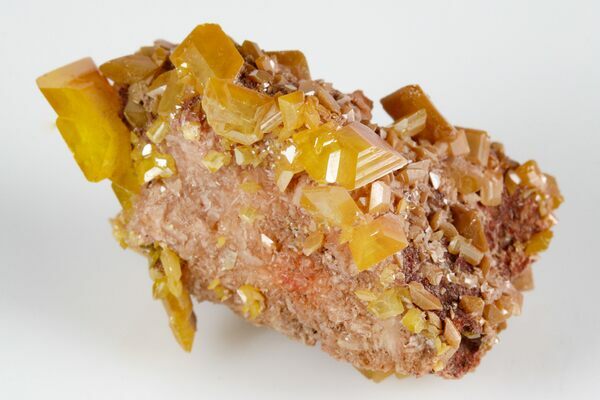
Tabular wulfenite crystals from the La Morita Mine in Mexico.
One of wulfenite’s defining characteristics is its spectacular color range. Most specimens are known for vivid orange, red-orange, or fiery amber tones, but crystals can also appear yellow, honey-brown, or even pale gray. These colors are intrinsic to the mineral’s chemical structure rather than surface staining, contributing to their remarkable saturation and depth. The flat, reflective crystal faces of wulfenite often create dramatic light reflections, especially when crystals grow in stacked or overlapping formations. Thin crystals may appear almost glassy, while thicker crystals develop a deeper, resinous glow that enhances their visual appeal.
Wulfenite forms as a secondary mineral in the oxidation zones of lead deposits, particularly where primary lead sulfides such as galena have undergone weathering. Oxygen-rich groundwater mobilizes molybdenum and lead, allowing wulfenite to crystallize in fractures, cavities, and vugs within limestone, dolomite, or other host rocks.
Because molybdenum is not as abundant as many other elements, the conditions required for wulfenite formation are relatively uncommon. This is why high-quality wulfenite crystals are often confined to a small number of classic localities and why new discoveries frequently generate excitement in the mineral collecting world.
Commonly Associated Minerals
Wulfenite is most often found alongside other secondary lead and copper minerals formed in oxidized ore environments. Commonly associated minerals include:
Galena – the primary lead sulfide that serves as the source of lead for wulfenite formation
Cerussite – lead carbonate, often forming alongside or beneath wulfenite crystals
Vanadinite – another highly colorful lead mineral, especially common in Moroccan deposits
Mimetite – lead arsenate chloride, frequently forming yellow to orange crystals
Calcite – a common matrix mineral providing contrast to bright wulfenite crystals
Barite – often present as tabular or bladed crystals in the same environments
Limonite and goethite – iron oxides that form earthy or botryoidal matrix coatings
Azurite and malachite – copper carbonates occasionally found in mixed lead-copper deposits
Powellite – a calcium molybdate that may occur as a secondary overgrowth or mixed phase
These associations often create striking multicolored specimens, particularly when wulfenite crystals sit atop contrasting white calcite or dark limonitic matrix.
Some of the world’s finest wulfenite specimens come from a handful of classic mining districts:
Red Cloud Mine, Arizona, USA – arguably the most famous wulfenite locality, known for exceptionally large, bright red to orange tabular crystals
Ahmadabad and Mibladen, Morocco – prolific producers of sharp orange crystals often associated with vanadinite and cerussite
Los Lamentos Mountains, Mexico – source of well-formed orange and honey-colored crystals
Bleiberg, Austria – historically important European locality studied by von Wulfen himself
Kuruktag Mountains, China – modern source of highly aesthetic specimens with excellent color and crystal form
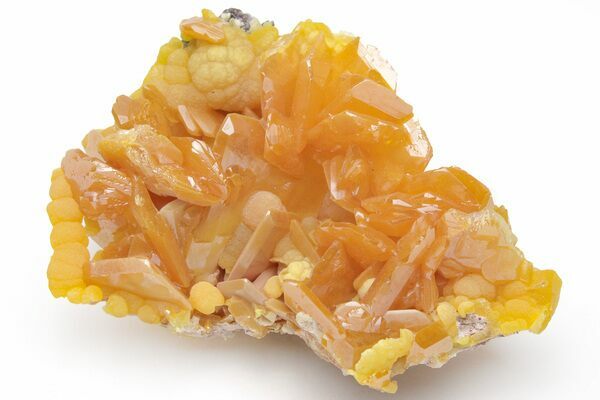
Wulfenite & Botryoidal Mimetite from the La Morita Mine in Mexico.
Each locality produces wulfenite with distinctive habits and color tones, allowing experienced collectors to often identify origin at a glance.
The mineral was first recognized scientifically in the late eighteenth century, during a period when mineralogy was rapidly evolving from simple curiosity into a formal discipline. Early specimens came from lead mines in Austria, particularly from the famous Bleiberg mining district in Carinthia. These mines were already known for producing lead and zinc ores, but the discovery of unusual secondary minerals like wulfenite added a new layer of intrigue to their workings. While miners may not have cared much for the delicate orange crystals appearing in pockets of oxidized ore, natural philosophers and mineral collectors certainly did.
Wulfenite was named in honor of Franz Xaver von Wulfen, an Austrian Jesuit priest and naturalist who made important contributions to the study of minerals and botany in the Alpine regions. Although von Wulfen did not discover the mineral in the modern sense, his careful documentation of mineral occurrences helped establish the groundwork for its later classification. The naming reflects a common tradition in mineralogy, attaching the legacy of early researchers to the natural substances they helped bring into scientific focus. Before it was officially defined as wulfenite, the mineral was sometimes confused with other lead-based secondary minerals, because the oxidized zones of lead deposits are chemically complex environments. Only with improved chemical analysis did scientists realize this mineral contained molybdenum in a distinct form, setting it apart.
Unlike many industrial ores, wulfenite has rarely been mined as a primary source of lead or molybdenum. Instead, it is typically found as a secondary mineral, forming when primary lead ores such as galena undergo oxidation and interact with molybdenum-bearing solutions. This means wulfenite is often discovered in the upper, weathered portions of old mining districts rather than deep underground. Historically, it appeared as a kind of brilliant byproduct of mining, an unexpected treasure in the walls of lead workings.
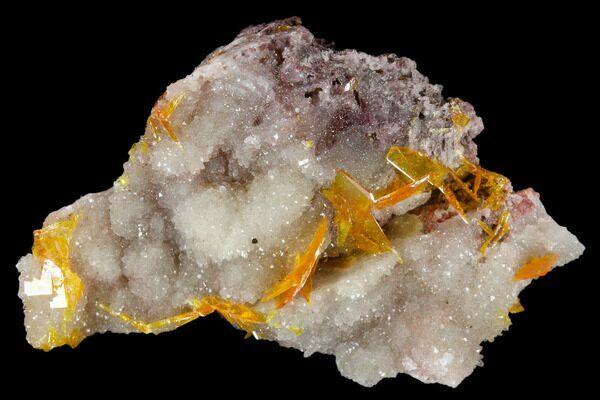
Tabular wulfenite crystals from the famous Red Cloud Mine in Arizona.
Some of the world’s most famous wulfenite localities developed alongside major lead mining regions. Austria remains the classic European source tied to its naming, while Mexico, especially mines such as Los Lamentos and Ojuela, has produced some of the finest deep-orange crystals ever found. In the United States, Arizona localities like the Red Cloud Mine became legendary among collectors. More recent discoveries in places such as Morocco and Namibia have continued to add to the mineral’s reputation for beauty. In these regions, wulfenite became less a mined commodity and more a mineralogical prize, eagerly sought by collectors.
Wulfenite’s importance has always been more specialized than widespread. While it contains both lead and molybdenum, it is rarely abundant enough to serve as a major ore mineral. Still, in certain deposits it has contributed modestly as a minor source of molybdenum. Its greatest value, however, has long been cultural and scientific rather than industrial. Its vivid crystals make it one of the most desirable collector minerals in the world, and its presence helps geologists understand the chemical processes at work in oxidized ore bodies. Its striking appearance also makes it a favorite example in teaching mineralogy and crystallography.
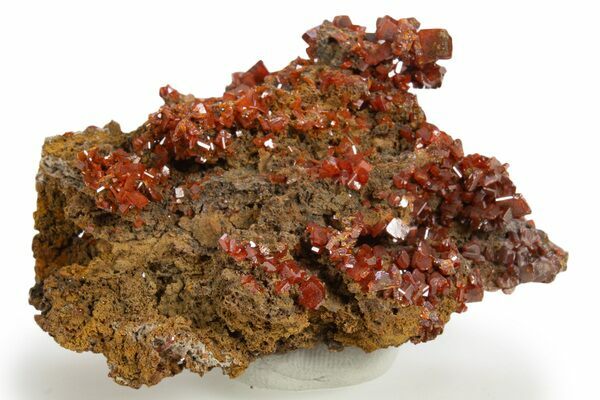
Fiery red wulfenite crsytals from the Kuruktag Mountains in China.
There is something almost poetic about wulfenite’s story. It is not a mineral that built empires or fueled industry on its own, but one that emerged from the transformation of older ores, a bright and fragile beauty born from decay and change underground. From the mines of the Austrian Alps to the deserts of Arizona and Mexico, wulfenite has remained a symbol of mineralogical elegance, a reminder that even in the most industrial landscapes, nature quietly produces works of art.
Chemically known as lead molybdate (PbMoO₄), wulfenite is a secondary mineral that forms in the oxidized zones of lead ore deposits. Its formation requires a very specific combination of lead and molybdenum-rich fluids, making high-quality wulfenite comparatively rare. This scarcity, combined with its intense coloration and high adamantine to resinous luster, has made wulfenite one of the most sought-after minerals for collectors worldwide. Interestingly, despite containing lead, wulfenite crystals often form with sharp, delicate edges and pristine faces, giving them a jewel-like appearance.

Wulfenite was first scientifically described in 1845 and named in honor of Austrian mineralogist Franz Xaver von Wulfen, who studied lead minerals in the Eastern Alps. Since then, it has become a classic mineral species studied in crystallography, geochemistry, and ore deposit research, as well as a centerpiece mineral in private and museum collections alike.
Chemical Composition and Crystal Structure
Wulfenite belongs to the tetragonal crystal system and typically forms thin, square or rectangular tabular crystals, often with beveled edges or stepped growth patterns. Less commonly, it can form pyramidal or bipyramidal crystals, granular aggregates, or crusts coating matrix rock.
Its chemical composition, PbMoO₄, places it among the molybdate minerals, closely related to minerals such as scheelite (calcium tungstate) and powellite (calcium molybdate). In fact, wulfenite can form solid-solution series with powellite, and subtle substitutions of calcium for lead can influence crystal color and translucency.
Wulfenite is relatively soft, with a Mohs hardness of about 2.5–3, and it has a high specific gravity due to its lead content. Crystals are typically transparent to translucent, though some may be opaque depending on thickness and impurities.
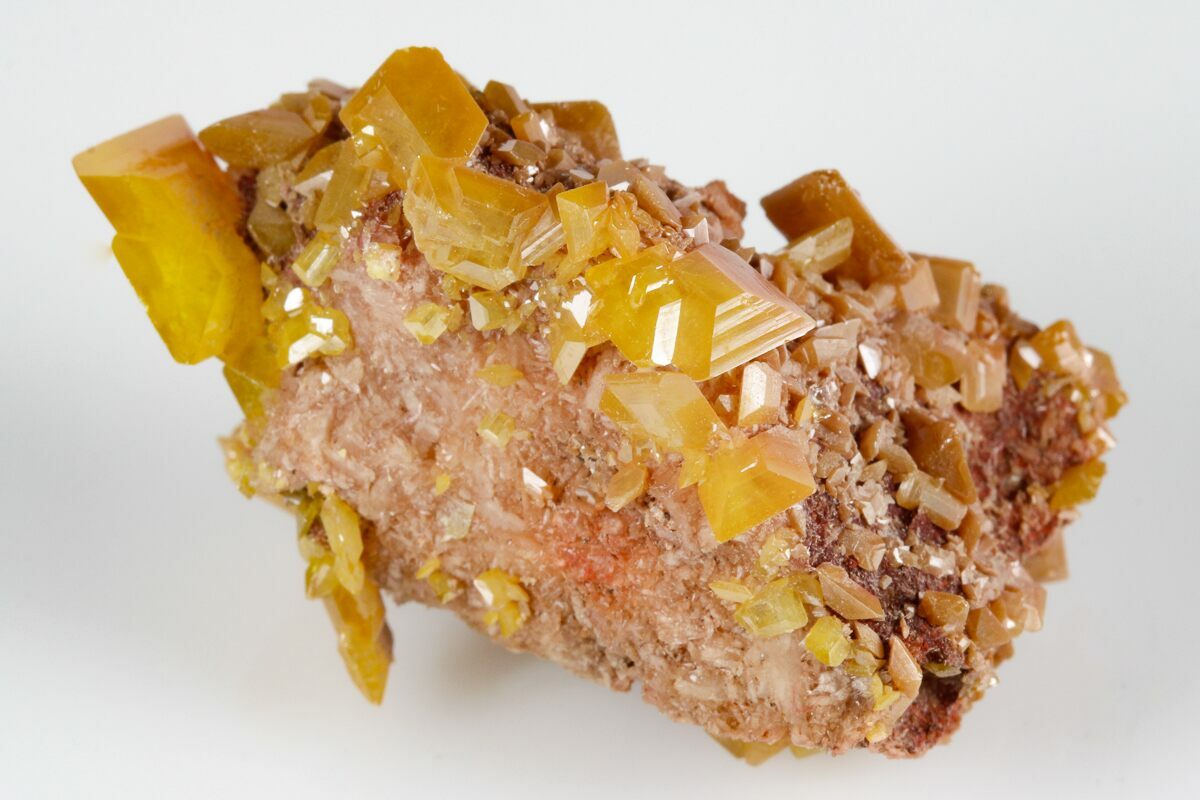
Tabular wulfenite crystals from the La Morita Mine in Mexico.
One of wulfenite’s defining characteristics is its spectacular color range. Most specimens are known for vivid orange, red-orange, or fiery amber tones, but crystals can also appear yellow, honey-brown, or even pale gray. These colors are intrinsic to the mineral’s chemical structure rather than surface staining, contributing to their remarkable saturation and depth. The flat, reflective crystal faces of wulfenite often create dramatic light reflections, especially when crystals grow in stacked or overlapping formations. Thin crystals may appear almost glassy, while thicker crystals develop a deeper, resinous glow that enhances their visual appeal.
Formation and Geological Environment
Wulfenite forms as a secondary mineral in the oxidation zones of lead deposits, particularly where primary lead sulfides such as galena have undergone weathering. Oxygen-rich groundwater mobilizes molybdenum and lead, allowing wulfenite to crystallize in fractures, cavities, and vugs within limestone, dolomite, or other host rocks.
Because molybdenum is not as abundant as many other elements, the conditions required for wulfenite formation are relatively uncommon. This is why high-quality wulfenite crystals are often confined to a small number of classic localities and why new discoveries frequently generate excitement in the mineral collecting world.
Commonly Associated Minerals
Wulfenite is most often found alongside other secondary lead and copper minerals formed in oxidized ore environments. Commonly associated minerals include:
These associations often create striking multicolored specimens, particularly when wulfenite crystals sit atop contrasting white calcite or dark limonitic matrix.
Famous Localities
Some of the world’s finest wulfenite specimens come from a handful of classic mining districts:
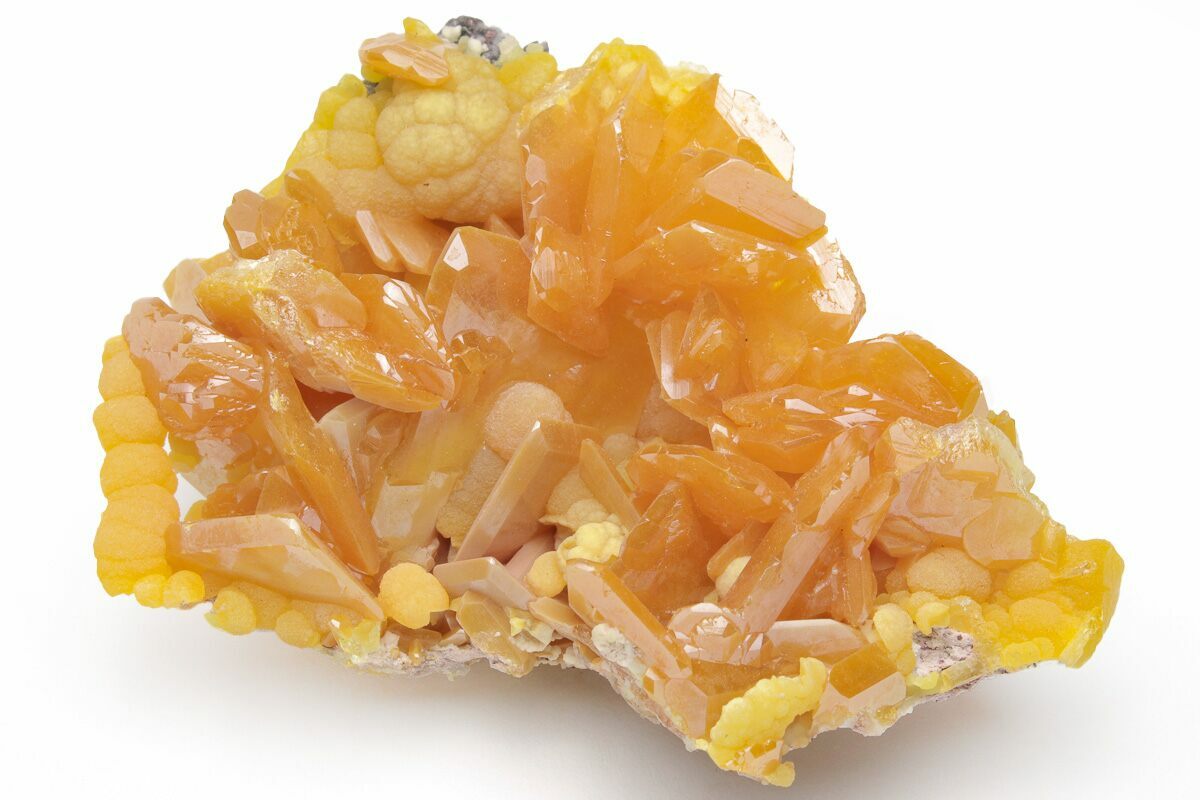
Wulfenite & Botryoidal Mimetite from the La Morita Mine in Mexico.
Each locality produces wulfenite with distinctive habits and color tones, allowing experienced collectors to often identify origin at a glance.
History & Uses
The mineral was first recognized scientifically in the late eighteenth century, during a period when mineralogy was rapidly evolving from simple curiosity into a formal discipline. Early specimens came from lead mines in Austria, particularly from the famous Bleiberg mining district in Carinthia. These mines were already known for producing lead and zinc ores, but the discovery of unusual secondary minerals like wulfenite added a new layer of intrigue to their workings. While miners may not have cared much for the delicate orange crystals appearing in pockets of oxidized ore, natural philosophers and mineral collectors certainly did.
Wulfenite was named in honor of Franz Xaver von Wulfen, an Austrian Jesuit priest and naturalist who made important contributions to the study of minerals and botany in the Alpine regions. Although von Wulfen did not discover the mineral in the modern sense, his careful documentation of mineral occurrences helped establish the groundwork for its later classification. The naming reflects a common tradition in mineralogy, attaching the legacy of early researchers to the natural substances they helped bring into scientific focus. Before it was officially defined as wulfenite, the mineral was sometimes confused with other lead-based secondary minerals, because the oxidized zones of lead deposits are chemically complex environments. Only with improved chemical analysis did scientists realize this mineral contained molybdenum in a distinct form, setting it apart.
Unlike many industrial ores, wulfenite has rarely been mined as a primary source of lead or molybdenum. Instead, it is typically found as a secondary mineral, forming when primary lead ores such as galena undergo oxidation and interact with molybdenum-bearing solutions. This means wulfenite is often discovered in the upper, weathered portions of old mining districts rather than deep underground. Historically, it appeared as a kind of brilliant byproduct of mining, an unexpected treasure in the walls of lead workings.
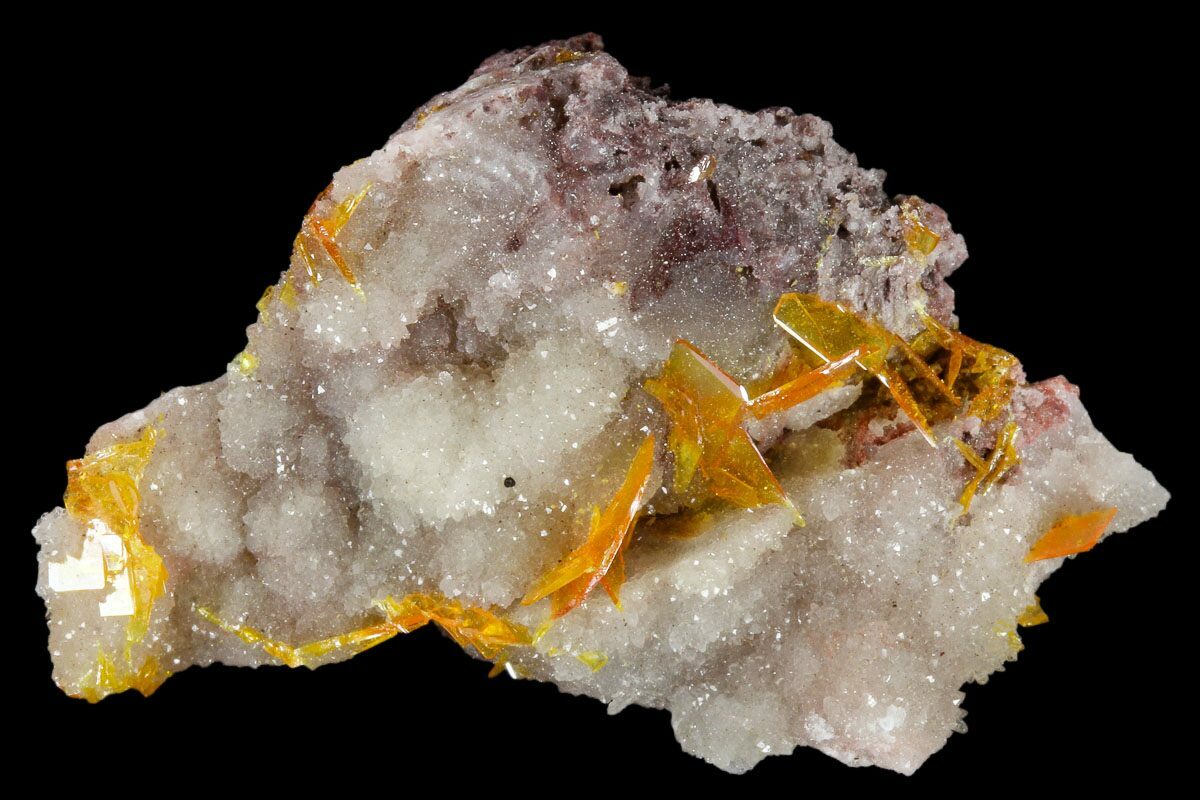
Tabular wulfenite crystals from the famous Red Cloud Mine in Arizona.
Some of the world’s most famous wulfenite localities developed alongside major lead mining regions. Austria remains the classic European source tied to its naming, while Mexico, especially mines such as Los Lamentos and Ojuela, has produced some of the finest deep-orange crystals ever found. In the United States, Arizona localities like the Red Cloud Mine became legendary among collectors. More recent discoveries in places such as Morocco and Namibia have continued to add to the mineral’s reputation for beauty. In these regions, wulfenite became less a mined commodity and more a mineralogical prize, eagerly sought by collectors.
Wulfenite’s importance has always been more specialized than widespread. While it contains both lead and molybdenum, it is rarely abundant enough to serve as a major ore mineral. Still, in certain deposits it has contributed modestly as a minor source of molybdenum. Its greatest value, however, has long been cultural and scientific rather than industrial. Its vivid crystals make it one of the most desirable collector minerals in the world, and its presence helps geologists understand the chemical processes at work in oxidized ore bodies. Its striking appearance also makes it a favorite example in teaching mineralogy and crystallography.
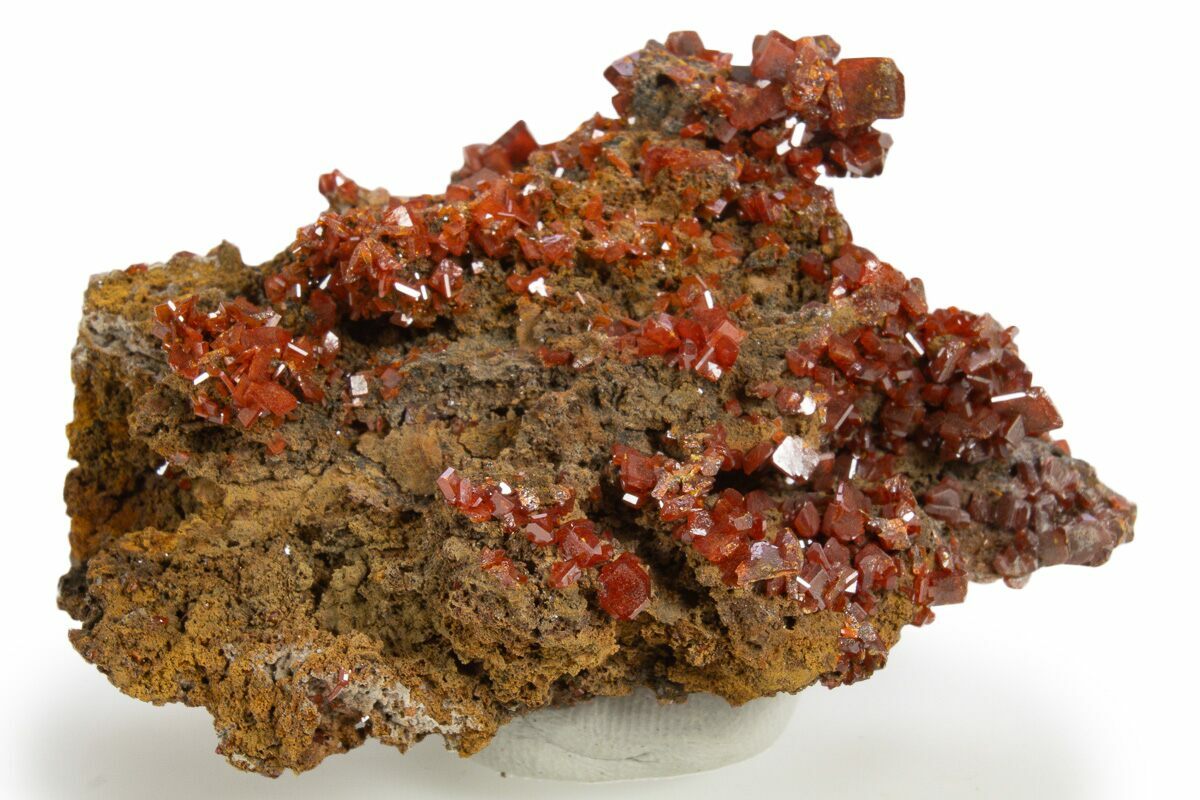
Fiery red wulfenite crsytals from the Kuruktag Mountains in China.
There is something almost poetic about wulfenite’s story. It is not a mineral that built empires or fueled industry on its own, but one that emerged from the transformation of older ores, a bright and fragile beauty born from decay and change underground. From the mines of the Austrian Alps to the deserts of Arizona and Mexico, wulfenite has remained a symbol of mineralogical elegance, a reminder that even in the most industrial landscapes, nature quietly produces works of art.


