 Reviews

Shattuckite - Minerals & Crystal Guide
Shattuckite is one of those minerals that feels almost unreal when you see it in person. Its colors range from soft sky blue to deep teal and blue-green, often arranged in bubbly botryoidal crusts or dramatic radiating sprays of tiny needle-like crystals. These sprays can build into spherical, starburst-like forms that look more organic than mineral, earning shattuckite a reputation as one of the most visually dynamic copper silicates.
Despite its delicate appearance, shattuckite has some surprising physical traits. It is a non-metallic mineral, yet it feels unusually heavy for a silicate when held in the hand. Even more distinctive, it can leave a noticeably blue streak—something relatively uncommon among blue minerals and a helpful clue for identification. Its close visual and structural relationship with minerals like plancheite has also made it a favorite subject of discussion (and occasional confusion) among collectors.
Geologically, shattuckite belongs to a family of minerals that form in the oxidized zones of copper deposits. These near-surface environments are rich in color and mineral diversity, and shattuckite is a classic example of the complex chemistry that can occur when copper-bearing rocks interact with oxygen and silica-rich fluids.
Chemical formula: Cu₅(SiO₃)₄(OH)₂
Mineral class: Inosilicate (chain silicate)
Crystal system: Orthorhombic
Typical color: Light to deep blue, turquoise, blue-green
Habit: Radiating and spherulitic aggregates of acicular (needle-like) crystals; also massive, granular, and botryoidal
Luster: Dull to silky, occasionally vitreous on fibrous surfaces
Hardness (Mohs): ~3.5
Cleavage: Perfect in two directions
Specific gravity: ~4.1
Streak: Blue
Commonly associated minerals: Malachite, chrysocolla, dioptase, quartz (including smoky quartz), azurite, cuprite, plancheite, calcite, cerussite
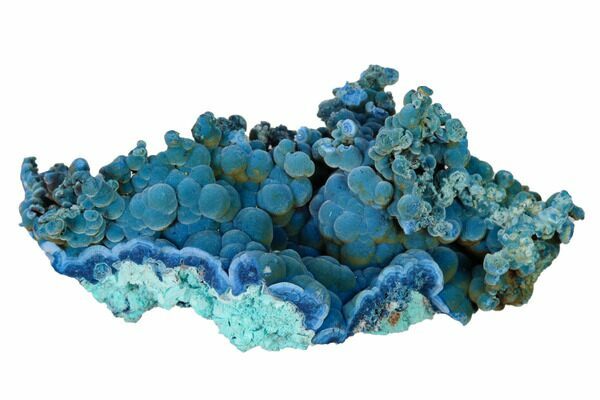
Botryoidal shattuckite on chrysocolla from Rancho Jacalito, Mexico
Shattuckite is a secondary mineral, meaning it forms as a result of chemical alteration rather than crystallizing directly from molten rock. Its formation takes place in the oxidized zones of copper deposits, typically close to the Earth’s surface.
As copper sulfide ores are exposed to oxygen and circulating groundwater, copper becomes mobile in solution. When these copper-rich fluids encounter silica—often derived from surrounding silicate rocks—and the right alkaline conditions, shattuckite can precipitate. It commonly grows along fractures, coats cavity walls, or replaces earlier-formed minerals.
One of the more fascinating aspects of shattuckite formation is its ability to replace other copper minerals while preserving their outward shape. In some localities, shattuckite forms pseudomorphs after malachite, where the crystal structure and chemistry change but the original malachite form remains intact. This process highlights the dynamic, evolving nature of oxidized copper environments.
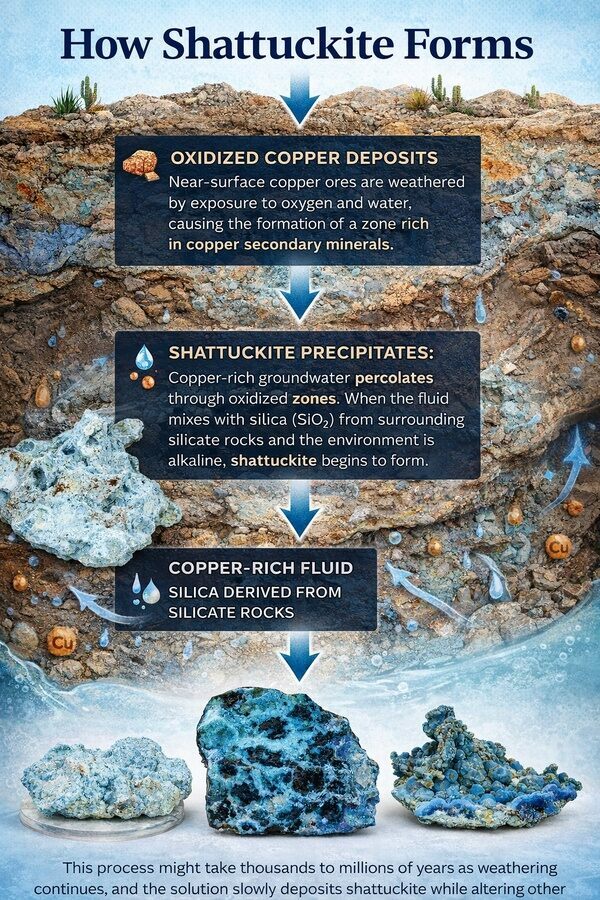
Infographic - How Shattuckite Forms
Shattuckite was first identified in the early 20th century at the Shattuck Mine in Bisbee, Arizona, a mining district already famous for its spectacular copper minerals. As mineralogists studied the complex assemblages coming from Bisbee’s oxidized zones, shattuckite stood out as a distinct copper silicate worthy of its own name.
While shattuckite has never been an important ore of copper, its vivid color and unusual crystal habits quickly earned it a place in mineral collections. Over time, especially with the discovery of exceptional material from Africa, it became increasingly valued for its beauty rather than any industrial purpose.
Today, shattuckite is primarily appreciated as a collector mineral and ornamental stone. Well-crystallized radial sprays and richly colored botryoidal specimens are highly sought after by collectors. In lapidary work, shattuckite is occasionally cut into cabochons or carved into decorative objects. Because it is relatively soft and sometimes fibrous or porous, it is best suited for display pieces or jewelry that won’t see heavy wear.
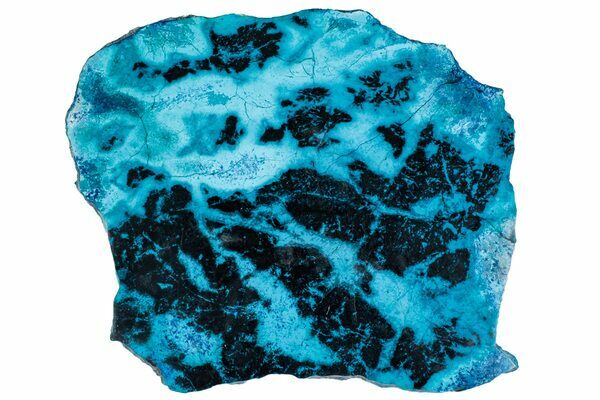
A polished slab of Shattuckite and Chrysocolla from Mexico.
Shattuckite is found in oxidized copper deposits around the world, but only a few regions are known for producing exceptional specimens:
Bisbee, Arizona, USA – The type locality where shattuckite was first described; classic material includes pseudomorphs and vein coatings from historic mines.
Kaokoveld Plateau, Kunene Region, Namibia – Famous for world-class shattuckite with vivid blue color, radial sprays, spheres, and botryoidal crusts, often associated with malachite and quartz.
Tsumeb, Namibia – A legendary mineral locality where shattuckite occurs among a diverse suite of copper minerals in oxidized ore zones.
Haut-Katanga, Democratic Republic of the Congo – Produces attractive shattuckite associated with dioptase, malachite, and quartz from copper-rich deposits.
Mexico – Occurs in several copper mining districts, typically as part of oxidized copper assemblages alongside other secondary copper minerals.

Despite its delicate appearance, shattuckite has some surprising physical traits. It is a non-metallic mineral, yet it feels unusually heavy for a silicate when held in the hand. Even more distinctive, it can leave a noticeably blue streak—something relatively uncommon among blue minerals and a helpful clue for identification. Its close visual and structural relationship with minerals like plancheite has also made it a favorite subject of discussion (and occasional confusion) among collectors.
Geologically, shattuckite belongs to a family of minerals that form in the oxidized zones of copper deposits. These near-surface environments are rich in color and mineral diversity, and shattuckite is a classic example of the complex chemistry that can occur when copper-bearing rocks interact with oxygen and silica-rich fluids.
Key properties
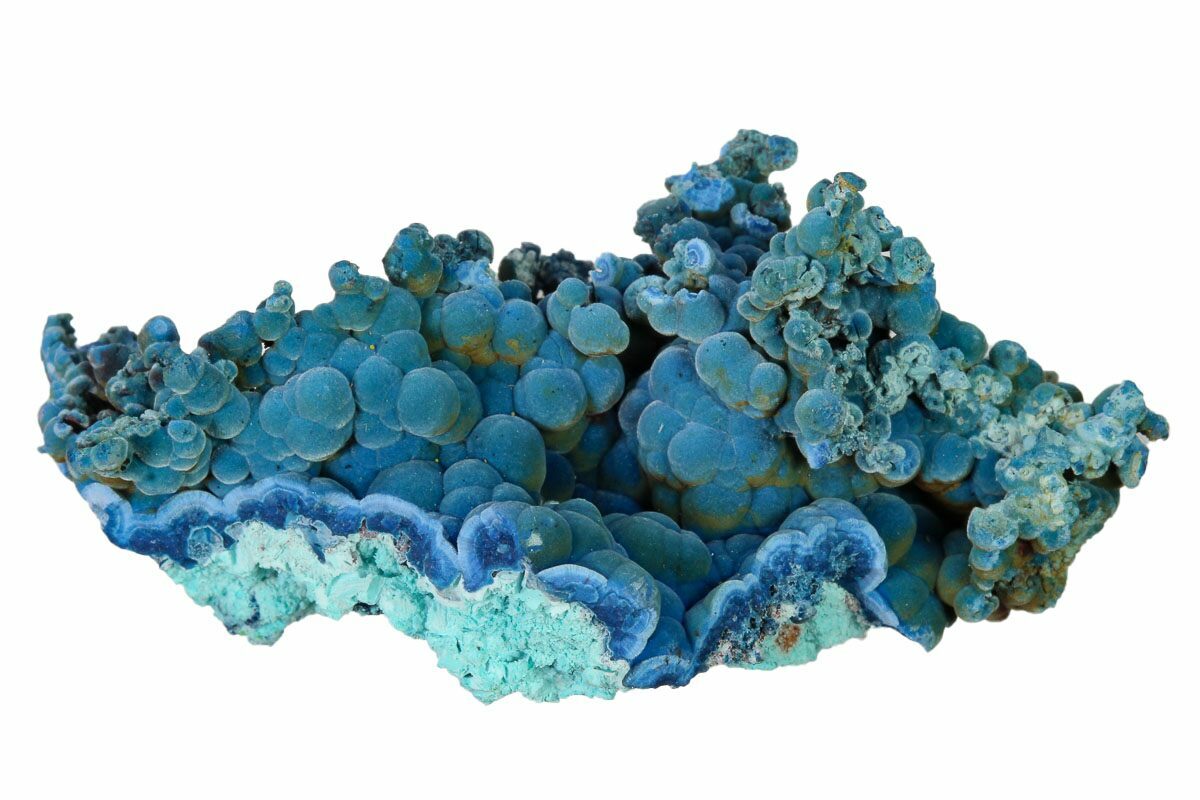
Botryoidal shattuckite on chrysocolla from Rancho Jacalito, Mexico
How shattuckite forms
Shattuckite is a secondary mineral, meaning it forms as a result of chemical alteration rather than crystallizing directly from molten rock. Its formation takes place in the oxidized zones of copper deposits, typically close to the Earth’s surface.
As copper sulfide ores are exposed to oxygen and circulating groundwater, copper becomes mobile in solution. When these copper-rich fluids encounter silica—often derived from surrounding silicate rocks—and the right alkaline conditions, shattuckite can precipitate. It commonly grows along fractures, coats cavity walls, or replaces earlier-formed minerals.
One of the more fascinating aspects of shattuckite formation is its ability to replace other copper minerals while preserving their outward shape. In some localities, shattuckite forms pseudomorphs after malachite, where the crystal structure and chemistry change but the original malachite form remains intact. This process highlights the dynamic, evolving nature of oxidized copper environments.
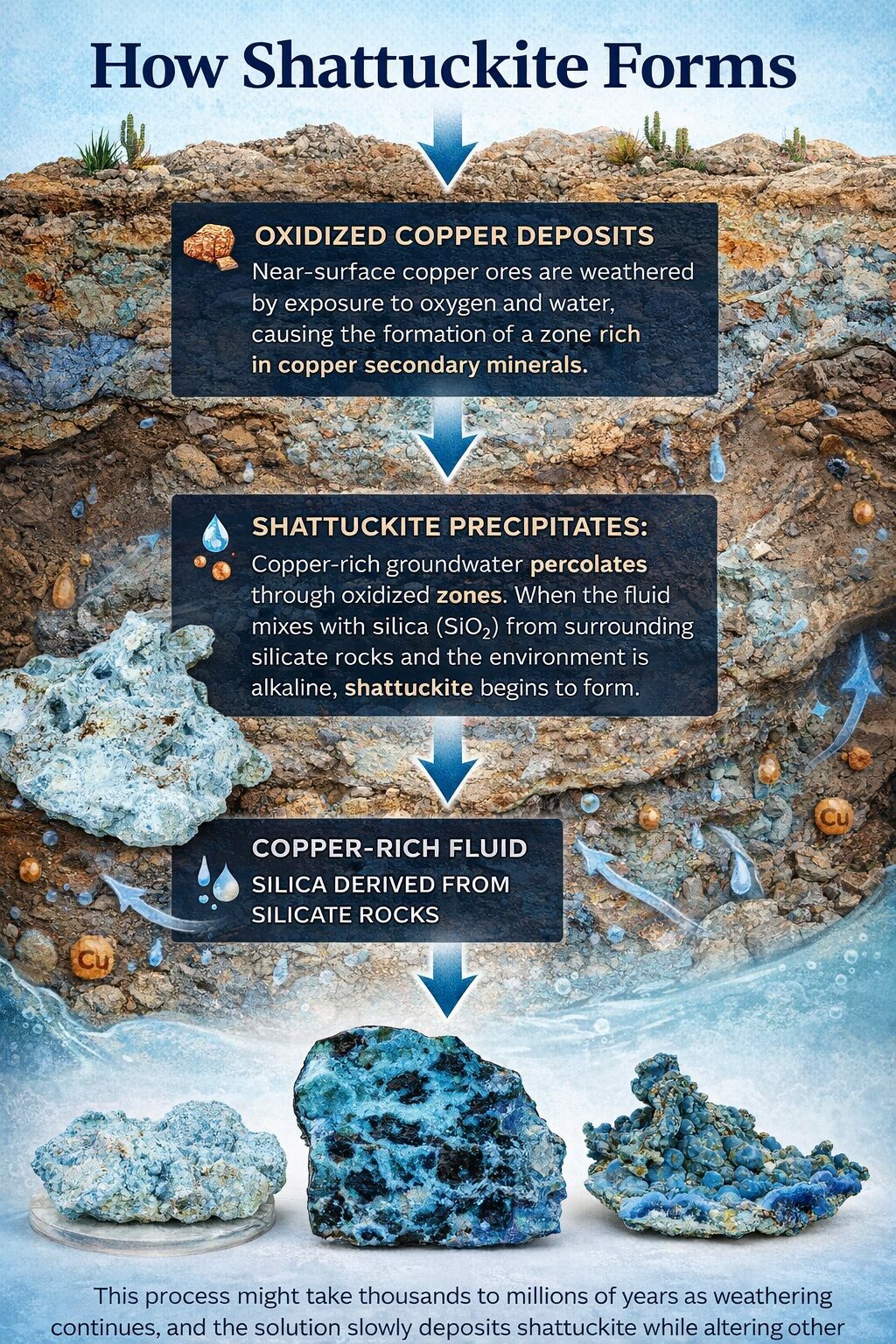
Infographic - How Shattuckite Forms
History and uses
Shattuckite was first identified in the early 20th century at the Shattuck Mine in Bisbee, Arizona, a mining district already famous for its spectacular copper minerals. As mineralogists studied the complex assemblages coming from Bisbee’s oxidized zones, shattuckite stood out as a distinct copper silicate worthy of its own name.
While shattuckite has never been an important ore of copper, its vivid color and unusual crystal habits quickly earned it a place in mineral collections. Over time, especially with the discovery of exceptional material from Africa, it became increasingly valued for its beauty rather than any industrial purpose.
Today, shattuckite is primarily appreciated as a collector mineral and ornamental stone. Well-crystallized radial sprays and richly colored botryoidal specimens are highly sought after by collectors. In lapidary work, shattuckite is occasionally cut into cabochons or carved into decorative objects. Because it is relatively soft and sometimes fibrous or porous, it is best suited for display pieces or jewelry that won’t see heavy wear.
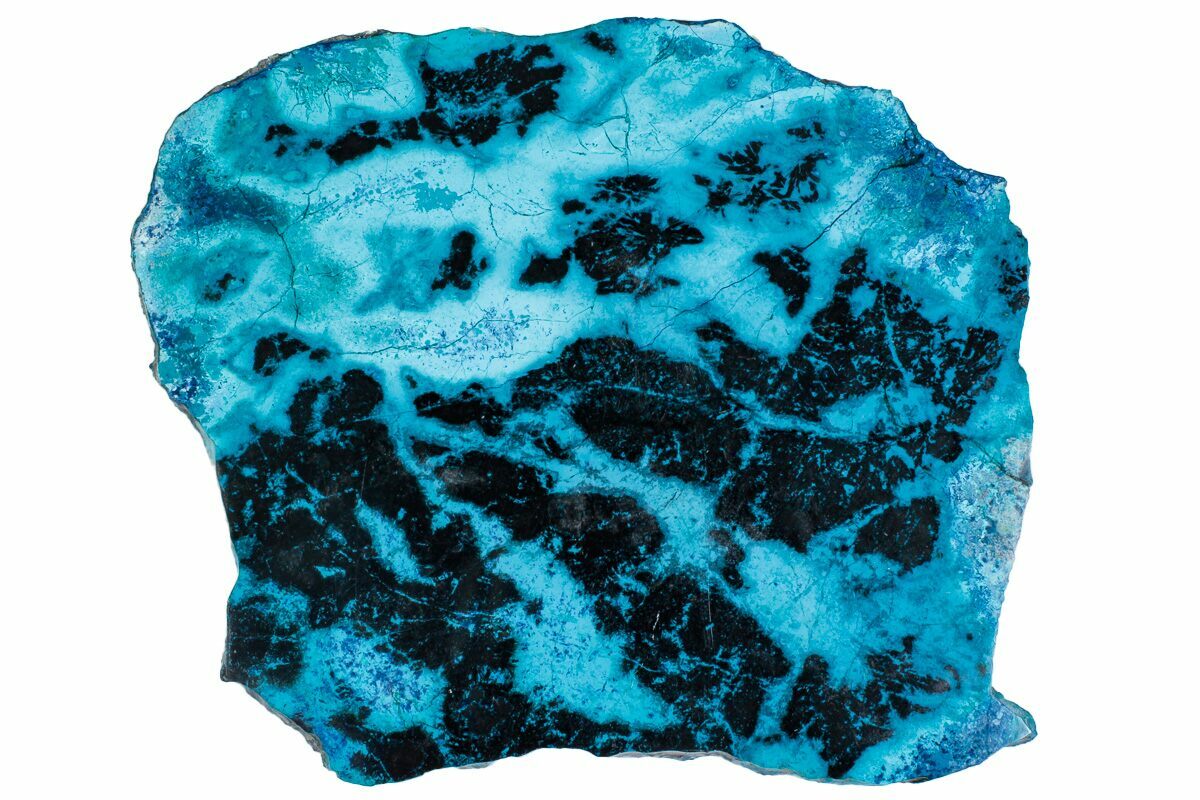
A polished slab of Shattuckite and Chrysocolla from Mexico.
Key locations
Shattuckite is found in oxidized copper deposits around the world, but only a few regions are known for producing exceptional specimens:


