 Reviews

Hemimorphite: Mineral & Crystal Guide
Hemimorphite is a mineral that doesn’t just look stunning—it tells stories. Known for dreamy ocean-blue botryoidal crusts and glittering sprays of crystals, it forms when zinc ores weather near the Earth’s surface, transforming underground metal into sculptural art. For centuries, miners confused it with smithsonite under the broad label calamine, until chemistry and crystal shape finally exposed its true identity: a hydrated zinc silicate with one of the rarest crystal growth habits in nature—hemimorphism, where opposite ends of the same crystal grow into totally different shapes. It’s like the mineral world’s version of having two different hairstyles at once.
Despite being a silicate, hemimorphite often looks like frozen foam, dripping candle wax, or melted blue sugar when it grows in curved, bubbly forms. Those iconic blues and blue-greens? They usually come from trace copper influence, acting like nature’s tiny paintbrush. Some of the best specimens sparkle intensely because they’re coated in microscopic druse crystals that refract light like a million tiny disco mirrors. And while it’s not super hard (around 4.5–5 on the Mohs scale), that softness actually helps it grow into those delicate, feathery sprays that look like mineral “fireworks frozen mid-blast.”
Hemimorphite also has an adventurous side. One famous variety from China grows into tight crystal fans that mineral collectors describe as looking like blue angel wings. The largest specimens come from massive lead-zinc deposits around the world, including China, Congo, Namibia, Mexico, and historic mining districts in the western United States. It even played a key economic role in the 18th and 19th centuries as a zinc ore mineral used for smelting—meaning this gemmy blue beauty once helped make the galvanized metal protecting roofs, bridges, and early industry itself.
And the fun facts don’t stop underground. Hemimorphite is technically a clue mineral, signaling oxidized zinc-rich zones—so finding it was often like striking a neon blue treasure map pointing to valuable ore below. It also has a tiny bit of pyroelectric behavior (it can generate a weak charge when heated or cooled), though not nearly as dramatically as tourmaline. In modern times, its main job is no longer industry—it’s to steal the show in collections, museums, and display cases around the world. Beautiful, rare, scientifically quirky, and historically misunderstood, hemimorphite remains one of the most personality-filled minerals you can put on a shelf.
Hemimorphite Properties
Chemical formula: Zn₄Si₂O₇(OH)₂·H₂O (hydrated zinc silicate)
Mineral class: Silicates (sorosilicate)
Crystal system: Orthorhombic
Crystal habit: Hemimorphic crystals; bladed/prismatic crystals; radiating sprays; drusy coatings; botryoidal and stalactitic masses
Color: Commonly blue to blue-green, also green, white, colorless, gray, yellow, brown
Luster: Vitreous to silky; waxy in massive/botryoidal forms
Transparency: Transparent to translucent; often translucent in botryoidal material
Hardness (Mohs): ~4.5–5
Cleavage: Perfect in one direction (often visible in crystals)
Streak: White
Associations: Commonly with smithsonite, willemite, cerussite, anglesite, limonite/goethite, calcite/dolomite, and other oxidized-zone minerals
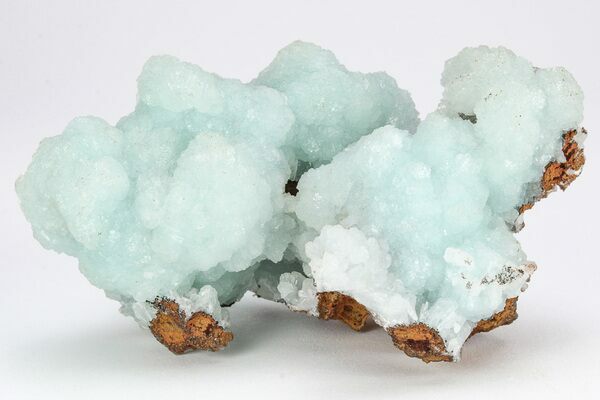
A sky-blue hemimorphite specimen from the Qaleh-Zari Mine in Iran
Hemimorphite crystallizes in the orthorhombic system, but its structure is what really drives its personality. It’s a hydrated zinc silicate with hydroxyl (OH) groups and water built into the crystal lattice. That water-bearing structure influences everything from its relatively modest hardness to the way it can grow in delicate sprays and crusts.
Most crystals are symmetrical in how they develop along a crystal axis—one end mirrors the other. Hemimorphite is different: along one axis, the “top” termination and the “bottom” termination can develop different crystal faces. In hand specimens, this can show up as crystals that look subtly “two-faced,” with one end more sharply terminated while the other end is flatter or differently faceted. Hemimorphism is uncommon, and it’s one of the reasons well-crystallized hemimorphite is so collectible.
Common Crystal Forms and Habits
Hemimorphite has a “greatest hits album” of collector habits:
Botryoidal (“grape-like”) masses - Probably the most iconic form. These rounded bubbles can be tight and uniform or large and lumpy, often with a sugary drusy sparkle. Blue botryoidal hemimorphite is a classic showpiece.
Radiating sprays and bladed crystals - In cavities, hemimorphite can crystallize as fan-like sprays or bladed prisms. When crystals are distinct and lustrous, they can look like icy blue clusters.
Drusy coatings and crusts - Many specimens form as glittering linings over matrix—especially with contrasting brown limonite/goethite, white calcite/dolomite, or other zinc minerals.
Stalactitic forms - Less common, but prized: dripping, stalactite-like hemimorphite can look like mineral “icicles” or flowing curtains.
Hemimorphite is commonly blue or blue-green, but it can also appear white, colorless, gray, yellow, brown, or pale green. The base mineral is typically colorless to white; vivid colors generally come from trace impurities and subtle chemical substitutions.
Blue / blue-green: often linked to trace copper influence and/or surface chemistry in oxidized zones
Green: can occur with various trace elements and mixed mineral coatings
White / colorless: purer compositions or microcrystalline masses without strong coloring agents
Yellow / brown: staining from iron oxides/hydroxides (goethite/limonite) or other oxidized-zone films
Because hemimorphite commonly grows as microcrystals on curved surfaces (botryoidal crusts), it can also show color zoning—pale layers under more saturated skins—or sparkling druse that changes color with lighting.
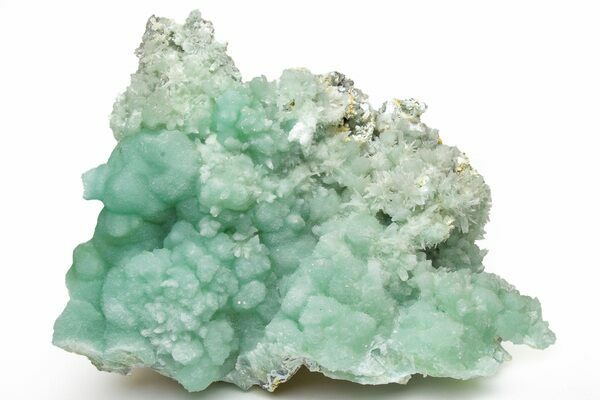
Sparkly Hemimorphite Aggregation From The Wenshan Mine In China
Hemimorphite is a hallmark mineral of the oxidized zone above zinc ore bodies. The process typically looks like this:
Primary zinc ores (especially sphalerite) are exposed to oxygenated water near surface environments.
Zinc is mobilized during weathering; sulfides break down and acidity can develop locally.
As conditions change—pH, silica availability, carbonate content—secondary minerals precipitate.
Where silica is abundant, hemimorphite forms; where carbonates dominate, smithsonite (ZnCO₃) may be favored.
That’s why hemimorphite is frequently found alongside other oxidized lead-zinc minerals and iron oxide “gossan” material.
Hemimorphite occurs worldwide wherever zinc deposits oxidize, but a few regions are especially famous among collectors:
China (notably Guangxi and Yunnan): prolific producer of sharp crystal clusters, sprays, and vibrant drusy plates
Democratic Republic of Congo: well-known for vivid blue botryoidal material and attractive contrasting matrices
Mexico: classic oxidized-zone deposits yielding colorful crusts and cavity-lined specimens
Namibia: notable specimens from lead-zinc districts; often associated with attractive oxidized-zone mineral suites
Morocco: botryoidal and crusty forms occur in oxidized base-metal deposits
United States (historic districts in the West): classic occurrences tied to old lead-zinc mining regions
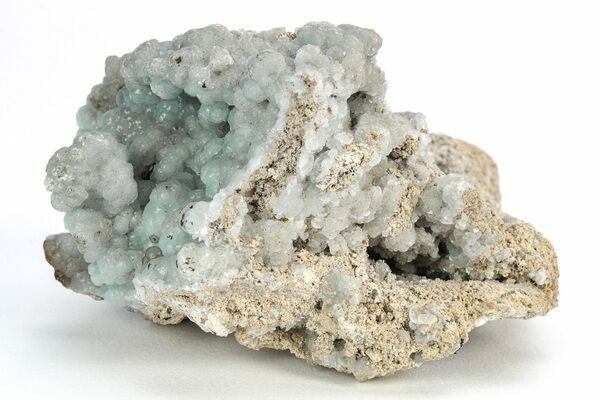
Powder-Blue hemimorphite from the 79 mine in Arizona
Locality-specific aesthetics can differ dramatically—some produce crisp crystals, others excel in saturated botryoidal blues, and others yield mixed-species cabinets with smithsonite, cerussite, or willemite in the same pocket.
Hemimorphite’s history is a great example of how science evolves—and how even experts can be fooled by beauty. For centuries, the mineral was bundled under the name calamine, a broad miners’ term used for any oxidized zinc ore that could be smelted into metal. Because hemimorphite and smithsonite commonly formed in the same lead-zinc deposits, especially in the colorful, oxidized upper zones of mines, they were assumed to be the same substance. To complicate things further, both minerals often grew into botryoidal or massive forms—rounded, bubbly crusts that looked nearly identical without chemical testing. Miners were practical, not microscopic: if it looked like zinc ore, it was zinc ore.
The breakthrough came in the late 18th and early 19th centuries, when analytical chemistry finally entered the mine. Scientists began applying acid tests, blowpipe analysis, and later quantitative chemistry, revealing a key difference: smithsonite reacted vigorously with acid (it’s a carbonate), while hemimorphite did not (it’s a silicate). In 1803, the mineralogist René Just Haüy, often called the “Father of Modern Crystallography,” formally described hemimorphite’s crystal symmetry and internal order, helping separate it from calamine’s catch-all label. But it wasn’t until 1853 that the name hemimorphite was officially adopted, proposed by German mineralogist Adolph Kenngott, who recognized that the mineral’s most defining trait wasn’t chemistry alone—it was crystal morphology.
Unlike most minerals, hemimorphite crystals grow with different terminations on opposite ends along the polar axis—an uncommon habit known as hemimorphism. Kenngott chose the name deliberately: hemi (half) and morphe (shape), meaning “half-shaped,” a nod to its asymmetrical crystal endings. This made hemimorphite one of the few minerals named for a visual crystallographic trait rather than composition, joining rare company like axinite and tourmaline (which are named for other structural quirks). Its reclassification marked a turning point in mineralogy, proving that how a crystal grows can be just as important as what it’s made of.
By the mid-1800s, hemimorphite had fully stepped out of smithsonite’s shadow and into museum drawers, collector cabinets, and academic literature. Its identity crisis ended, but its mystique only grew stronger—what was once dismissed as generic ore is now celebrated as one of the most aesthetically unique and historically misunderstood zinc minerals in the world, a favorite of collectors for both its color and its crystallographic personality.
Zinc ore indicator
Historically, hemimorphite was important as a zinc ore mineral, especially in oxidized deposits. It signaled zinc-rich zones that could be mined and processed, though the economic importance varies by deposit and era.
Collector specimens
Today, hemimorphite’s biggest “use” is its collector value. Vivid blue botryoidal specimens and sharp crystal clusters are highly sought after, especially pieces with strong luster, clean aesthetics, and dramatic contrast on matrix. Hemimorphite hits a sweet spot: it’s scientifically interesting (hemimorphism! hydrated structure!), visually dramatic (blue botryoids and sparkling druse), and geologically meaningful (a signpost of oxidized zinc deposits). Whether you prefer crisp, glassy crystal clusters or those classic “bubble” forms that look like blue foam frozen in stone, hemimorphite is a mineral that never feels boring on the shelf.
Lapidary and jewelry (limited)
Hemimorphite can be cut and polished—especially compact botryoidal material—but it’s relatively soft (Mohs ~4.5–5). That means it’s best suited for pendants or careful-wear pieces rather than rings. High-quality material can take a beautiful polish and show watery blue translucence.

Despite being a silicate, hemimorphite often looks like frozen foam, dripping candle wax, or melted blue sugar when it grows in curved, bubbly forms. Those iconic blues and blue-greens? They usually come from trace copper influence, acting like nature’s tiny paintbrush. Some of the best specimens sparkle intensely because they’re coated in microscopic druse crystals that refract light like a million tiny disco mirrors. And while it’s not super hard (around 4.5–5 on the Mohs scale), that softness actually helps it grow into those delicate, feathery sprays that look like mineral “fireworks frozen mid-blast.”
Hemimorphite also has an adventurous side. One famous variety from China grows into tight crystal fans that mineral collectors describe as looking like blue angel wings. The largest specimens come from massive lead-zinc deposits around the world, including China, Congo, Namibia, Mexico, and historic mining districts in the western United States. It even played a key economic role in the 18th and 19th centuries as a zinc ore mineral used for smelting—meaning this gemmy blue beauty once helped make the galvanized metal protecting roofs, bridges, and early industry itself.
And the fun facts don’t stop underground. Hemimorphite is technically a clue mineral, signaling oxidized zinc-rich zones—so finding it was often like striking a neon blue treasure map pointing to valuable ore below. It also has a tiny bit of pyroelectric behavior (it can generate a weak charge when heated or cooled), though not nearly as dramatically as tourmaline. In modern times, its main job is no longer industry—it’s to steal the show in collections, museums, and display cases around the world. Beautiful, rare, scientifically quirky, and historically misunderstood, hemimorphite remains one of the most personality-filled minerals you can put on a shelf.
Hemimorphite Properties
Chemical formula: Zn₄Si₂O₇(OH)₂·H₂O (hydrated zinc silicate)
Mineral class: Silicates (sorosilicate)
Crystal system: Orthorhombic
Crystal habit: Hemimorphic crystals; bladed/prismatic crystals; radiating sprays; drusy coatings; botryoidal and stalactitic masses
Color: Commonly blue to blue-green, also green, white, colorless, gray, yellow, brown
Luster: Vitreous to silky; waxy in massive/botryoidal forms
Transparency: Transparent to translucent; often translucent in botryoidal material
Hardness (Mohs): ~4.5–5
Cleavage: Perfect in one direction (often visible in crystals)
Streak: White
Associations: Commonly with smithsonite, willemite, cerussite, anglesite, limonite/goethite, calcite/dolomite, and other oxidized-zone minerals
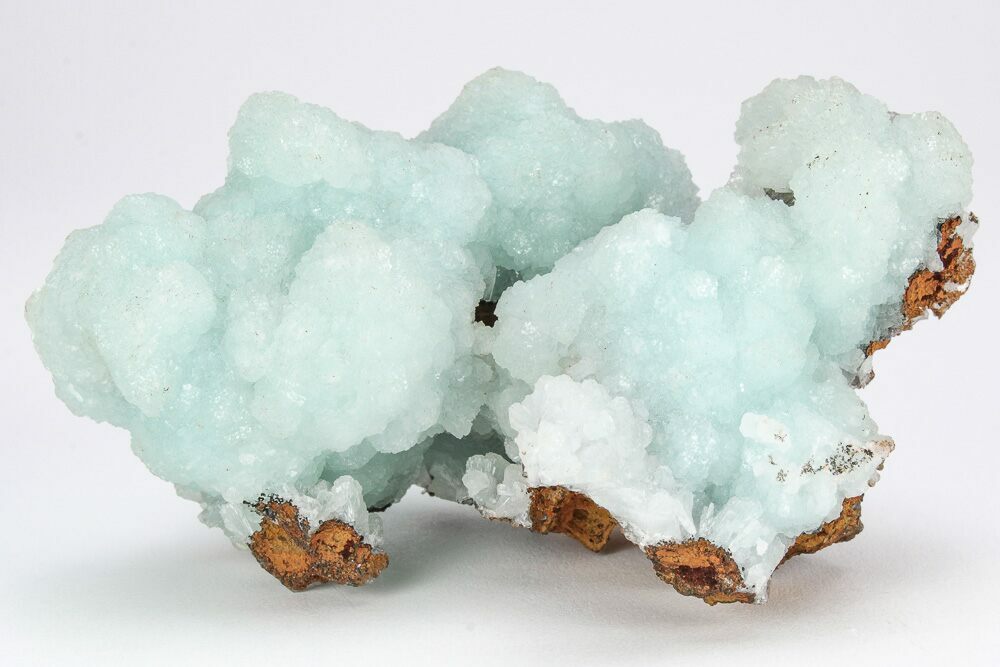
A sky-blue hemimorphite specimen from the Qaleh-Zari Mine in Iran
Crystal Structure and Hemimorphism
Hemimorphite crystallizes in the orthorhombic system, but its structure is what really drives its personality. It’s a hydrated zinc silicate with hydroxyl (OH) groups and water built into the crystal lattice. That water-bearing structure influences everything from its relatively modest hardness to the way it can grow in delicate sprays and crusts.
Most crystals are symmetrical in how they develop along a crystal axis—one end mirrors the other. Hemimorphite is different: along one axis, the “top” termination and the “bottom” termination can develop different crystal faces. In hand specimens, this can show up as crystals that look subtly “two-faced,” with one end more sharply terminated while the other end is flatter or differently faceted. Hemimorphism is uncommon, and it’s one of the reasons well-crystallized hemimorphite is so collectible.
Common Crystal Forms and Habits
Hemimorphite has a “greatest hits album” of collector habits:
Botryoidal (“grape-like”) masses - Probably the most iconic form. These rounded bubbles can be tight and uniform or large and lumpy, often with a sugary drusy sparkle. Blue botryoidal hemimorphite is a classic showpiece.
Radiating sprays and bladed crystals - In cavities, hemimorphite can crystallize as fan-like sprays or bladed prisms. When crystals are distinct and lustrous, they can look like icy blue clusters.
Drusy coatings and crusts - Many specimens form as glittering linings over matrix—especially with contrasting brown limonite/goethite, white calcite/dolomite, or other zinc minerals.
Stalactitic forms - Less common, but prized: dripping, stalactite-like hemimorphite can look like mineral “icicles” or flowing curtains.
Color: Why So Many Shades?
Hemimorphite is commonly blue or blue-green, but it can also appear white, colorless, gray, yellow, brown, or pale green. The base mineral is typically colorless to white; vivid colors generally come from trace impurities and subtle chemical substitutions.
Blue / blue-green: often linked to trace copper influence and/or surface chemistry in oxidized zones
Green: can occur with various trace elements and mixed mineral coatings
White / colorless: purer compositions or microcrystalline masses without strong coloring agents
Yellow / brown: staining from iron oxides/hydroxides (goethite/limonite) or other oxidized-zone films
Because hemimorphite commonly grows as microcrystals on curved surfaces (botryoidal crusts), it can also show color zoning—pale layers under more saturated skins—or sparkling druse that changes color with lighting.
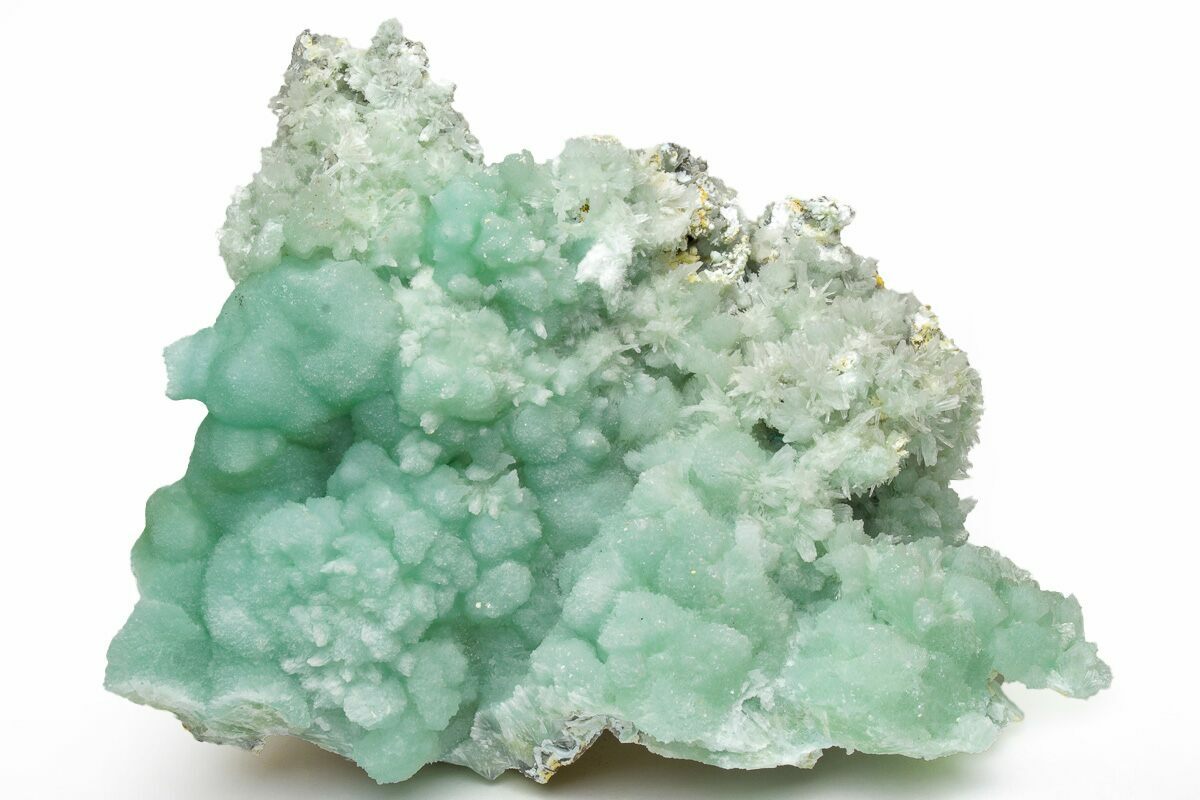
Sparkly Hemimorphite Aggregation From The Wenshan Mine In China
Geological Setting: How Hemimorphite Forms
Hemimorphite is a hallmark mineral of the oxidized zone above zinc ore bodies. The process typically looks like this:
Key Localities
Hemimorphite occurs worldwide wherever zinc deposits oxidize, but a few regions are especially famous among collectors:
China (notably Guangxi and Yunnan): prolific producer of sharp crystal clusters, sprays, and vibrant drusy plates
Democratic Republic of Congo: well-known for vivid blue botryoidal material and attractive contrasting matrices
Mexico: classic oxidized-zone deposits yielding colorful crusts and cavity-lined specimens
Namibia: notable specimens from lead-zinc districts; often associated with attractive oxidized-zone mineral suites
Morocco: botryoidal and crusty forms occur in oxidized base-metal deposits
United States (historic districts in the West): classic occurrences tied to old lead-zinc mining regions
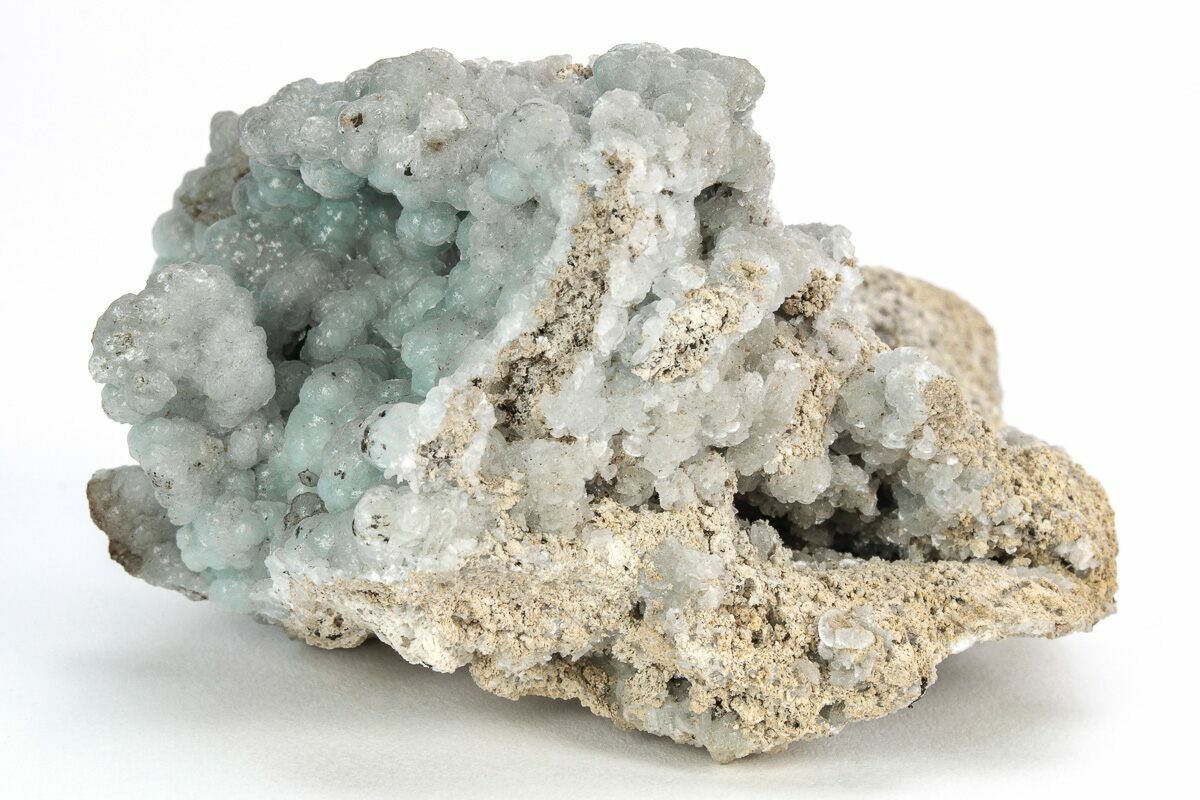
Powder-Blue hemimorphite from the 79 mine in Arizona
Locality-specific aesthetics can differ dramatically—some produce crisp crystals, others excel in saturated botryoidal blues, and others yield mixed-species cabinets with smithsonite, cerussite, or willemite in the same pocket.
A Bit of History: Confused Identity and a New Name
Hemimorphite’s history is a great example of how science evolves—and how even experts can be fooled by beauty. For centuries, the mineral was bundled under the name calamine, a broad miners’ term used for any oxidized zinc ore that could be smelted into metal. Because hemimorphite and smithsonite commonly formed in the same lead-zinc deposits, especially in the colorful, oxidized upper zones of mines, they were assumed to be the same substance. To complicate things further, both minerals often grew into botryoidal or massive forms—rounded, bubbly crusts that looked nearly identical without chemical testing. Miners were practical, not microscopic: if it looked like zinc ore, it was zinc ore.
The breakthrough came in the late 18th and early 19th centuries, when analytical chemistry finally entered the mine. Scientists began applying acid tests, blowpipe analysis, and later quantitative chemistry, revealing a key difference: smithsonite reacted vigorously with acid (it’s a carbonate), while hemimorphite did not (it’s a silicate). In 1803, the mineralogist René Just Haüy, often called the “Father of Modern Crystallography,” formally described hemimorphite’s crystal symmetry and internal order, helping separate it from calamine’s catch-all label. But it wasn’t until 1853 that the name hemimorphite was officially adopted, proposed by German mineralogist Adolph Kenngott, who recognized that the mineral’s most defining trait wasn’t chemistry alone—it was crystal morphology.
Unlike most minerals, hemimorphite crystals grow with different terminations on opposite ends along the polar axis—an uncommon habit known as hemimorphism. Kenngott chose the name deliberately: hemi (half) and morphe (shape), meaning “half-shaped,” a nod to its asymmetrical crystal endings. This made hemimorphite one of the few minerals named for a visual crystallographic trait rather than composition, joining rare company like axinite and tourmaline (which are named for other structural quirks). Its reclassification marked a turning point in mineralogy, proving that how a crystal grows can be just as important as what it’s made of.
By the mid-1800s, hemimorphite had fully stepped out of smithsonite’s shadow and into museum drawers, collector cabinets, and academic literature. Its identity crisis ended, but its mystique only grew stronger—what was once dismissed as generic ore is now celebrated as one of the most aesthetically unique and historically misunderstood zinc minerals in the world, a favorite of collectors for both its color and its crystallographic personality.
Uses: Ore, Collector Mineral, and Lapidary Material
Zinc ore indicator
Historically, hemimorphite was important as a zinc ore mineral, especially in oxidized deposits. It signaled zinc-rich zones that could be mined and processed, though the economic importance varies by deposit and era.
Collector specimens
Today, hemimorphite’s biggest “use” is its collector value. Vivid blue botryoidal specimens and sharp crystal clusters are highly sought after, especially pieces with strong luster, clean aesthetics, and dramatic contrast on matrix. Hemimorphite hits a sweet spot: it’s scientifically interesting (hemimorphism! hydrated structure!), visually dramatic (blue botryoids and sparkling druse), and geologically meaningful (a signpost of oxidized zinc deposits). Whether you prefer crisp, glassy crystal clusters or those classic “bubble” forms that look like blue foam frozen in stone, hemimorphite is a mineral that never feels boring on the shelf.
Lapidary and jewelry (limited)
Hemimorphite can be cut and polished—especially compact botryoidal material—but it’s relatively soft (Mohs ~4.5–5). That means it’s best suited for pendants or careful-wear pieces rather than rings. High-quality material can take a beautiful polish and show watery blue translucence.


