 Reviews

Plumbogummite: Mineral & Crystal Guide
Plumbogummite is one of those minerals that feels like a geological plot twist. It forms late—often long after the big, headline-making ore minerals were emplaced—and yet it can become a key “fingerprint” for what happened to a deposit during weathering. It’s a lead aluminum phosphate, typically showing up as soft-looking crusts, botryoidal (grape-like) coatings, or tiny hexagonal crystals that can range from chalky and dull to surprisingly gemmy. If you’ve ever seen pale blue-green, cream, or yellowish coatings lining fractures in old lead workings, there’s a decent chance you’ve brushed past a member of the alunite supergroup—plumbogummite being one of the most distinctive lead-bearing representatives.
Its name is wonderfully literal and a little odd: plumbo- for lead, and gummite referencing “gummite,” a historic catch-all term miners used for gummy or earthy alteration products (often uranium-related) that looked like sticky coatings or crusts. Plumbogummite doesn’t actually behave like chewing gum, but its common habits—waxy, botryoidal, earthy crusts—make the name feel oddly appropriate. Mineralogically, it’s even more interesting: it’s part of a solid-solution family where different elements can swap into similar structural roles. That means plumbogummite can grade into close relatives depending on what a deposit’s fluids were carrying—so a single hand specimen can hint at a whole chemical story about the weathering environment.
And here’s the collector’s kicker: plumbogummite is often a secondary mineral, meaning it’s a product of alteration, not the original “primary” ore. That makes it a mineral of transformation—evidence that oxygenated water, acidic conditions, phosphate sources, and lead minerals all intersected in just the right way. In many districts, its presence is a sign that lead minerals like galena didn’t just oxidize into the obvious carbonates and sulfates they also got “locked up” into more complex phosphate phases, sometimes alongside beautiful blue-green companions like pyromorphite or turquoise-toned crusts in the same micro-ecosystem.
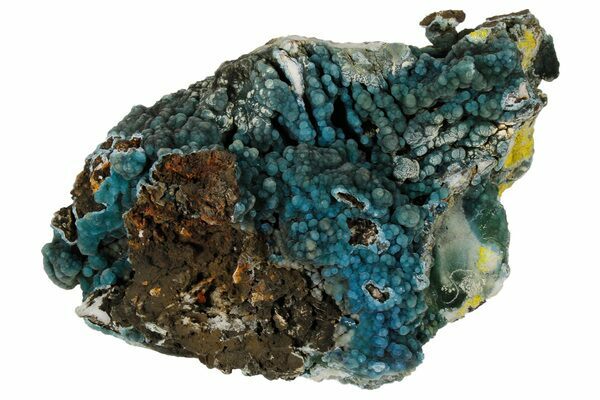
Plumbogummite After Pyromorphite From The Yangshuo Mine In China
Key properties
Mineral class: Phosphates (alunite supergroup)
Chemical formula: PbAl₃(PO₄)₂(OH)₅·H₂O
Crystal system: Trigonal (often described with hexagonal-looking crystal forms)
Typical habit: Botryoidal crusts, drusy coatings, earthy masses small tabular to prismatic crystals
Color: White, cream, pale yellow, gray often pale blue to blue-green or greenish
Luster: Dull/earthy to waxy crystals may be vitreous to resinous
Transparency: Opaque to translucent rarely transparent in tiny crystals
Streak: White
Hardness (Mohs): ~4–5 (often feels a bit softer in earthy crusts)
Cleavage/fracture: Cleavage poor/indistinct fracture uneven to earthy
Notable traits: Secondary “oxidation-zone” mineral can form attractive coatings and microcrystals commonly intergrown with other lead phosphates
Commonly associated minerals
Plumbogummite most often appears in the oxidized portions of lead deposits and phosphate-rich alteration zones. Typical associates include:
Galena: - primary lead sulfide precursor
Cerussite and anglesite: - classic lead oxidation minerals
Pyromorphite: - a major lead phosphate companion and “competitor”
Mimetite: - lead arsenate analog often nearby in mixed systems
Smithsonite and hemimorphite: - zinc oxidation minerals in Pb–Zn deposits
Goethite, limonite, hematite: - iron-oxide “gossan” minerals
Wulfenite: - in some oxidized lead environments
Turquoise, variscite, wavellite: - phosphates in Al-rich, weathered settings
Quartz, calcite, barite: - common gangue minerals in many districts
Kaolinite and other clays: - weathering products in the same zone
Plumbogummite is, above all, a mineral of weathering chemistry—a product of the oxidation zone where groundwater and oxygen transform primary sulfide ores into new minerals. Its formation usually requires four key ingredients to overlap:
A source of lead (Pb) - Most commonly from the breakdown of galena (PbS). When galena oxidizes, it first tends to produce soluble lead species and then common secondary phases like cerussite (PbCO₃) and anglesite (PbSO₄) depending on the local carbonate and sulfate activity. Plumbogummite enters the story when phosphate becomes available.
A source of phosphate (PO₄) - Phosphate can enter near-surface systems from several pathways: breakdown of apatite in the host rock, guano or organic inputs in some environments, phosphate-bearing sediments, or phosphate-rich fluids circulating through fractures. Even small amounts can matter because lead readily forms stable phosphate minerals.
Aluminum availability (Al) - Aluminum is often supplied by the weathering of feldspars and other aluminosilicate minerals, producing clays and releasing Al into slightly acidic waters. Oxidation zones can be surprisingly Al-active when conditions are right.
The “right” pH/Eh conditions - Plumbogummite typically forms under oxidizing conditions with waters that can carry phosphate and aluminum. Slightly acidic to near-neutral conditions are common in many oxidation zones, especially where sulfide oxidation generates acidity but is partially buffered by carbonates.
Lead phosphates tend to be very stable at the Earth’s surface. If phosphate is present, lead often gets sequestered into minerals like pyromorphite and related phases because they’re low-solubility “sinks” for lead. Plumbogummite forms when the system is not just Pb + phosphate, but also Al-rich and favorable for the alunite-supergroup framework—often in microenvironments along fractures, vugs, and porous gossan where fluids repeatedly wet and dry the rock.
Habit clues
Botryoidal crusts and smooth coatings often indicate precipitation from thin films of water moving through pores.
Drusy microcrystals suggest open-space growth in vugs or fractures with repeated fluid replenishment.
Earthy masses can form when precipitation is rapid or mixed with clays and iron oxides.
Where plumbogummite is found
Plumbogummite is best known from oxidation zones of lead deposits, especially those with phosphate sources or phosphate-bearing host rocks. It can occur in:
Lead and lead-zinc mines where galena is abundant
Gossans (iron-rich weathered caps) above sulfide bodies
Fracture coatings in weathered veins and replacement deposits
Phosphate-influenced weathering environments where apatite or other phosphate sources are present
Plumbogummite’s name reflects an era when mineral classification was still catching up to the messy reality of oxidation zones. Early miners and mineralogists often used descriptive umbrella terms—gummite among them—for soft alteration products that didn’t fit neatly into the better-known ore minerals. As analytical methods improved (optical microscopy, X-ray diffraction, modern chemistry), plumbogummite emerged as a distinct species: a lead-dominant member of a broader structural family.
Scientifically, its importance is tied to what it reveals about element mobility during weathering. Oxidation zones are not just “destruction” of ore—they’re chemical reactors that can concentrate, immobilize, or redistribute metals. Plumbogummite is part of that immobilization story: it’s one of the ways lead can become “fixed” in a stable phosphate framework, especially in Al-rich environments.
It also sits in a neighborhood of closely related minerals (the alunite supergroup) where substitutions are common. That makes it useful for mineralogists mapping the subtle transitions from one chemical microenvironment to another within a deposit.
Plumbogummite is not a major industrial ore mineral in its own right—its lead content is real, but it typically occurs in small quantities as a secondary phase. Its value is mainly:
Mineral collecting - gives plumbogummite much of its appeal, as its pale blue-green, cream, and yellow botryoidal crusts form eye-catching aesthetic coatings, particularly when contrasted against limonite or quartz. Association specimens featuring plumbogummite alongside minerals such as pyromorphite, cerussite, anglesite, or goethite act like single-plate narratives, preserving a classic oxidation-zone paragenesis that documents the chemical transformation of lead in real time.
In teaching and geology - plumbogummite serves as a dependable oxidation-zone indicator mineral, frequently used to illustrate secondary mineralization, supergene alteration, and the role of phosphate in immobilizing metals. Its presence is a geochemical breadcrumb trail showing that phosphate-bearing fluids once moved through the system and that lead was being captured into stable, low-solubility secondary phases within an aluminum-rich alunite-supergroup framework.
Environmentally -at least in concept—plumbogummite reinforces a broader geochemical principle: lead phosphates are among nature’s most effective low-solubility “sinks” for lead, which is why phosphate treatments are often discussed in soil remediation as a method for converting mobile lead into stable mineral forms. In supergene environments, plumbogummite represents one of several possible end-states of lead fixation, forming when oxidizing waters, aluminum, and phosphate intersect under the right pH and redox conditions, even though the exact lead phosphate species produced ultimately depends on the local chemistry and fluid history of the deposit.
Because it often occurs as crusts and microcrystals, plumbogummite can be confused with other secondary minerals:
Pyromorphite - Often brighter green and commonly forms more obvious hexagonal prisms/barrels; heavier “lead phosphate” feel overlaps, but habits can differ.
Cerussite / anglesite - Usually more clearly crystalline and not typically waxy botryoidal coatings in the same way; cerussite can be sparkly and adamantine.
Turquoise / variscite - Can share blue-green tones, but these are copper/aluminum or aluminum phosphates without lead; specific gravity and associations help.
Wavellite - Often forms radiating sprays; different look and common in different settings.
For a confident ID, mineralogists rely on a combo of habit, associations, density feel, and—when needed—XRD/EDS analysis, especially because alunite-group minerals can be subtly similar.

Its name is wonderfully literal and a little odd: plumbo- for lead, and gummite referencing “gummite,” a historic catch-all term miners used for gummy or earthy alteration products (often uranium-related) that looked like sticky coatings or crusts. Plumbogummite doesn’t actually behave like chewing gum, but its common habits—waxy, botryoidal, earthy crusts—make the name feel oddly appropriate. Mineralogically, it’s even more interesting: it’s part of a solid-solution family where different elements can swap into similar structural roles. That means plumbogummite can grade into close relatives depending on what a deposit’s fluids were carrying—so a single hand specimen can hint at a whole chemical story about the weathering environment.
And here’s the collector’s kicker: plumbogummite is often a secondary mineral, meaning it’s a product of alteration, not the original “primary” ore. That makes it a mineral of transformation—evidence that oxygenated water, acidic conditions, phosphate sources, and lead minerals all intersected in just the right way. In many districts, its presence is a sign that lead minerals like galena didn’t just oxidize into the obvious carbonates and sulfates they also got “locked up” into more complex phosphate phases, sometimes alongside beautiful blue-green companions like pyromorphite or turquoise-toned crusts in the same micro-ecosystem.
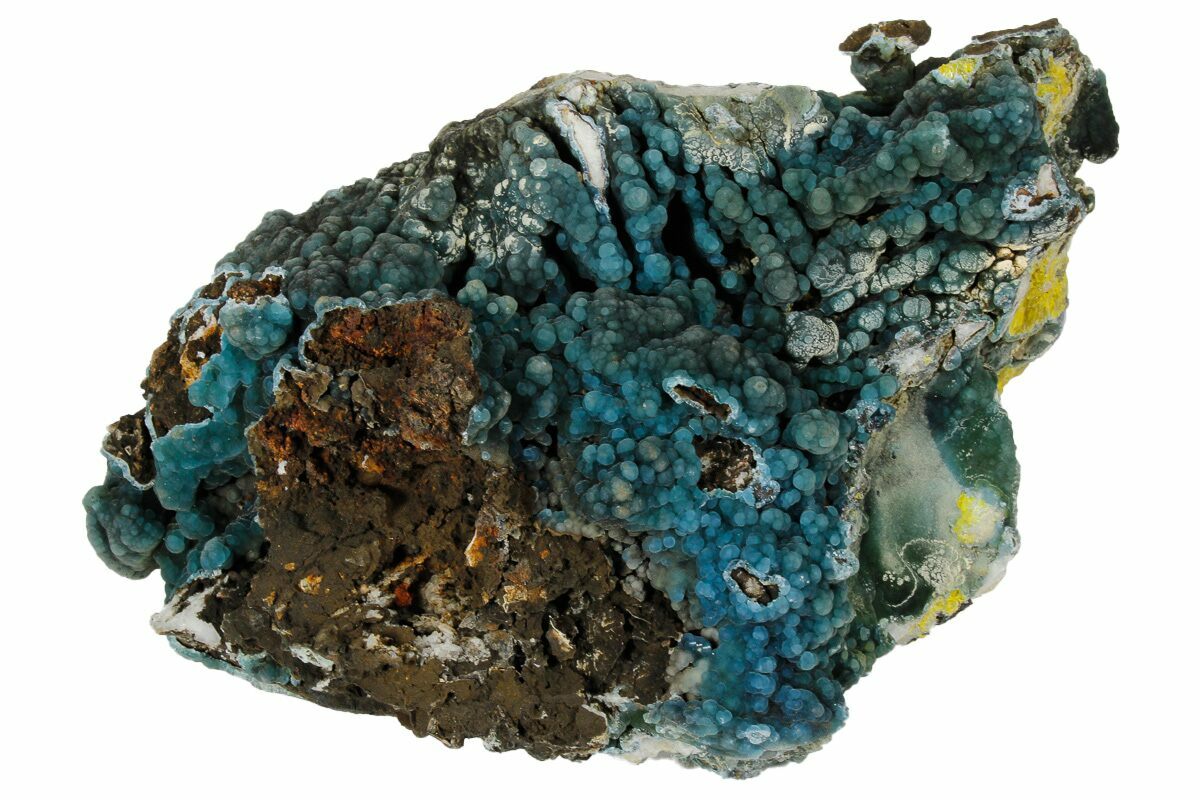
Plumbogummite After Pyromorphite From The Yangshuo Mine In China
Key properties
Mineral class: Phosphates (alunite supergroup)
Chemical formula: PbAl₃(PO₄)₂(OH)₅·H₂O
Crystal system: Trigonal (often described with hexagonal-looking crystal forms)
Typical habit: Botryoidal crusts, drusy coatings, earthy masses small tabular to prismatic crystals
Color: White, cream, pale yellow, gray often pale blue to blue-green or greenish
Luster: Dull/earthy to waxy crystals may be vitreous to resinous
Transparency: Opaque to translucent rarely transparent in tiny crystals
Streak: White
Hardness (Mohs): ~4–5 (often feels a bit softer in earthy crusts)
Cleavage/fracture: Cleavage poor/indistinct fracture uneven to earthy
Notable traits: Secondary “oxidation-zone” mineral can form attractive coatings and microcrystals commonly intergrown with other lead phosphates
Commonly associated minerals
Plumbogummite most often appears in the oxidized portions of lead deposits and phosphate-rich alteration zones. Typical associates include:
Galena: - primary lead sulfide precursor
Cerussite and anglesite: - classic lead oxidation minerals
Pyromorphite: - a major lead phosphate companion and “competitor”
Mimetite: - lead arsenate analog often nearby in mixed systems
Smithsonite and hemimorphite: - zinc oxidation minerals in Pb–Zn deposits
Goethite, limonite, hematite: - iron-oxide “gossan” minerals
Wulfenite: - in some oxidized lead environments
Turquoise, variscite, wavellite: - phosphates in Al-rich, weathered settings
Quartz, calcite, barite: - common gangue minerals in many districts
Kaolinite and other clays: - weathering products in the same zone
How Plumbogummite Forms
Plumbogummite is, above all, a mineral of weathering chemistry—a product of the oxidation zone where groundwater and oxygen transform primary sulfide ores into new minerals. Its formation usually requires four key ingredients to overlap:
A source of lead (Pb) - Most commonly from the breakdown of galena (PbS). When galena oxidizes, it first tends to produce soluble lead species and then common secondary phases like cerussite (PbCO₃) and anglesite (PbSO₄) depending on the local carbonate and sulfate activity. Plumbogummite enters the story when phosphate becomes available.
A source of phosphate (PO₄) - Phosphate can enter near-surface systems from several pathways: breakdown of apatite in the host rock, guano or organic inputs in some environments, phosphate-bearing sediments, or phosphate-rich fluids circulating through fractures. Even small amounts can matter because lead readily forms stable phosphate minerals.
Aluminum availability (Al) - Aluminum is often supplied by the weathering of feldspars and other aluminosilicate minerals, producing clays and releasing Al into slightly acidic waters. Oxidation zones can be surprisingly Al-active when conditions are right.
The “right” pH/Eh conditions - Plumbogummite typically forms under oxidizing conditions with waters that can carry phosphate and aluminum. Slightly acidic to near-neutral conditions are common in many oxidation zones, especially where sulfide oxidation generates acidity but is partially buffered by carbonates.
Lead phosphates tend to be very stable at the Earth’s surface. If phosphate is present, lead often gets sequestered into minerals like pyromorphite and related phases because they’re low-solubility “sinks” for lead. Plumbogummite forms when the system is not just Pb + phosphate, but also Al-rich and favorable for the alunite-supergroup framework—often in microenvironments along fractures, vugs, and porous gossan where fluids repeatedly wet and dry the rock.
Habit clues
Where plumbogummite is found
Plumbogummite is best known from oxidation zones of lead deposits, especially those with phosphate sources or phosphate-bearing host rocks. It can occur in:
History, Naming, and Scientific Significance
Plumbogummite’s name reflects an era when mineral classification was still catching up to the messy reality of oxidation zones. Early miners and mineralogists often used descriptive umbrella terms—gummite among them—for soft alteration products that didn’t fit neatly into the better-known ore minerals. As analytical methods improved (optical microscopy, X-ray diffraction, modern chemistry), plumbogummite emerged as a distinct species: a lead-dominant member of a broader structural family.
Scientifically, its importance is tied to what it reveals about element mobility during weathering. Oxidation zones are not just “destruction” of ore—they’re chemical reactors that can concentrate, immobilize, or redistribute metals. Plumbogummite is part of that immobilization story: it’s one of the ways lead can become “fixed” in a stable phosphate framework, especially in Al-rich environments.
It also sits in a neighborhood of closely related minerals (the alunite supergroup) where substitutions are common. That makes it useful for mineralogists mapping the subtle transitions from one chemical microenvironment to another within a deposit.
Uses and Collector Appeale
Plumbogummite is not a major industrial ore mineral in its own right—its lead content is real, but it typically occurs in small quantities as a secondary phase. Its value is mainly:
Mineral collecting - gives plumbogummite much of its appeal, as its pale blue-green, cream, and yellow botryoidal crusts form eye-catching aesthetic coatings, particularly when contrasted against limonite or quartz. Association specimens featuring plumbogummite alongside minerals such as pyromorphite, cerussite, anglesite, or goethite act like single-plate narratives, preserving a classic oxidation-zone paragenesis that documents the chemical transformation of lead in real time.
In teaching and geology - plumbogummite serves as a dependable oxidation-zone indicator mineral, frequently used to illustrate secondary mineralization, supergene alteration, and the role of phosphate in immobilizing metals. Its presence is a geochemical breadcrumb trail showing that phosphate-bearing fluids once moved through the system and that lead was being captured into stable, low-solubility secondary phases within an aluminum-rich alunite-supergroup framework.
Environmentally -at least in concept—plumbogummite reinforces a broader geochemical principle: lead phosphates are among nature’s most effective low-solubility “sinks” for lead, which is why phosphate treatments are often discussed in soil remediation as a method for converting mobile lead into stable mineral forms. In supergene environments, plumbogummite represents one of several possible end-states of lead fixation, forming when oxidizing waters, aluminum, and phosphate intersect under the right pH and redox conditions, even though the exact lead phosphate species produced ultimately depends on the local chemistry and fluid history of the deposit.
How to Distinguish Plumbogummite From Similar Minerals
Because it often occurs as crusts and microcrystals, plumbogummite can be confused with other secondary minerals:
Pyromorphite - Often brighter green and commonly forms more obvious hexagonal prisms/barrels; heavier “lead phosphate” feel overlaps, but habits can differ.
Cerussite / anglesite - Usually more clearly crystalline and not typically waxy botryoidal coatings in the same way; cerussite can be sparkly and adamantine.
Turquoise / variscite - Can share blue-green tones, but these are copper/aluminum or aluminum phosphates without lead; specific gravity and associations help.
Wavellite - Often forms radiating sprays; different look and common in different settings.
For a confident ID, mineralogists rely on a combo of habit, associations, density feel, and—when needed—XRD/EDS analysis, especially because alunite-group minerals can be subtly similar.


