 Reviews

Uvarovite - The Green Jewel of the Garnet Family
Uvarovite is one of the most dazzling and coveted members of the garnet family, instantly recognizable by its vivid, natural emerald-green color—a hue so intense that early mineralogists mistook it for a new form of emerald. First described in 1832, uvarovite is not only the rarest of all the major garnet species, but also the only garnet that is consistently bright green due to its unusually high chromium content, the same element that colors emeralds and jade.
Its crystals are typically small but are often perfectly shaped dodecahedra, forming sparkling drusy blankets that look almost “sugar-coated” in green gemstones. Unlike more common garnets that appear in dozens of colors, true uvarovite is found only in a handful of geological environments worldwide, where chromium-rich fluids interact with calcium-rich rocks under precise metamorphic conditions. Because these environments are extremely rare, and the crystals seldom grow large, fine uvarovite specimens remain scarce even after nearly two centuries of collecting. Its combination of rarity, intense natural color, chemical purity, and its striking jewel-like appearance has made uvarovite one of the most celebrated and desirable minerals in the world.
Uvarovite was first identified in 1832 by the German chemist Germain Henri Hess, who named the mineral in honor of Count Sergei Uvarov, a prominent Russian statesman, scholar, and president of the St. Petersburg Academy of Sciences. Count Uvarov’s support of scientific study and mineralogical research during the 19th century helped advance mineral discovery in Russia, making the naming a fitting tribute.
From the earliest descriptions, mineralogists recognized uvarovite as something special. Its brilliant green color was unlike any other garnet species, and its small but exceptionally well-formed crystals made it a standout specimen long before modern mineral collecting became widespread. Early specimens from Russia, Finland, and the Ural Mountains became prized pieces in museum collections and private European cabinets of curiosity.
Several characteristics set uvarovite apart from all other garnet species:
1. It is the only emerald-green garnet.
The rich green color comes from trivalent chromium (Cr³⁺), the same element that gives emeralds their famous color. Unlike green grossular (tsavorite) or demantoid andradite garnets—whose colors vary—uvarovite is consistently deep green.
2. It rarely forms large crystals.
Most uvarovite occurs as tiny but perfectly formed dodecahedral crystals, often less than a few millimeters in size. These crystals develop in dense drusy layers that sparkle intensely under light. Large crystals over a centimeter are extremely rare and highly valuable.
3. It forms only under very specific geological conditions.
Uvarovite is a calcium–chromium garnet (ugrandite series) and requires both calcium-rich rocks and chromium-rich fluids to crystallize. These conditions occur mainly:
In metamorphosed ultramafic rocks such as serpentinite
In chromite-rich deposits
Along contact zones where fluids introduce chromium into the host rock
Because such environments are limited, uvarovite is far rarer than other garnets such as grossular or almandine.
4. True top-quality specimens are scarce.
Despite being found in several countries, uvarovite deposits are often small, irregular, or difficult to mine. Many crystals are too tiny, too included, or poorly formed. Fine pieces with brilliant luster and rich green color are uncommon and increasingly sought after.
Uvarovite is a rare mineral even on a global scale, largely because it requires an unusual combination of geological ingredients: calcium-rich host rocks and chromium-rich environments. These conditions occur mainly in metamorphosed ultramafic rocks—ancient seafloor peridotites and serpentinites that have been altered by heat, pressure, and chemically rich fluids. As a result, uvarovite deposits tend to be small, isolated pockets rather than widespread veins, and fine specimens are uncommon everywhere they occur.
The most historically significant and best-known locality is Russia, particularly the Ural Mountains. Uvarovite was first described from these deposits in the early 19th century, and Russian specimens soon became the standard by which all others were compared. In the Urals, chromium-rich serpentinite and chromite-bearing rocks create ideal conditions for the mineral to form. The drusy coatings from this region are famous for their vivid emerald-green color, dense coverage of perfectly shaped crystals, and brilliant luster. For more than a century, Russian material dominated museum collections and private mineral cabinets across Europe.
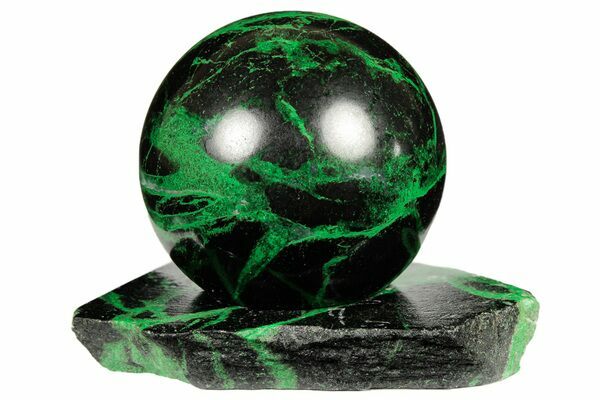
A polished sphere containing veins of Uvarovite garnets from Russia
Finland is another classic source, especially the Outokumpu mining district. Here, uvarovite forms within complex metamorphosed volcanic and sedimentary rocks enriched in chromium. Finnish crystals are often exceptionally sharp and display slightly deeper, more saturated greens than many other localities. They tend to occur as small but jewel-like clusters and druses, making them highly desirable among collectors. While production has never been large, Finnish specimens frequently rival Russian pieces in quality.
In Poland, the Szklary Massif in Lower Silesia has produced excellent uvarovite for decades. This area contains ancient ophiolites—sections of oceanic crust thrust onto land—where chromium-rich fluids permeated calcium-bearing rocks. Polish uvarovite is known for intensely bright crystal faces and dense drusy plates of uniform color. As Russian material becomes harder to obtain, Polish specimens have become increasingly important on the market and remain a favorite among European collectors.
Canada has yielded attractive uvarovite as well, particularly in Quebec. The mineral typically appears in chromite-bearing serpentinite, forming bright patches of small crystals across dark host rock. While Canadian deposits generally produce smaller pockets and less continuous drusy surfaces than Russia or Poland, the color purity and crystal sharpness of better pieces make them significant. Occasional larger plates have been found, though most specimens consist of modest but vividly colored druses.
Spain, Norway, and South Africa each provide additional but more limited sources. In Spain, uvarovite occurs in small pockets within chromium-rich metamorphic rocks, often forming sharply defined miniature dodecahedra with deep green color. Norwegian uvarovite typically forms in skarn zones and serpentinites, producing small but intensely colored crystals that are admired for their brightness even if they rarely form large plates. In South Africa, the mineral emerges from parts of the Bushveld Complex, one of the world’s largest layered ultramafic intrusions. These crystals are usually tiny but exceptionally vivid, and because production is sporadic, South African pieces are often prized simply for their rarity and geological significance.
Minor occurrences have also been reported in India, Turkey, Kazakhstan, and Brazil, though most produce only small clusters or sparse druses. These localities demonstrate the global distribution of uvarovite but do little to increase the supply of collectible, high-quality material.
Across all these regions, the style of uvarovite varies noticeably. Russia and Poland tend to produce the most dramatic drusy carpets of densely packed crystals. Finland often yields deeper hues and slightly larger crystal forms. Canada commonly produces isolated or patchy druses that stand out sharply against dark background rock. Norway and South Africa provide small but incredibly bright crystals, while Spanish specimens are admired for their clarity and perfect geometry. Many collectors enjoy comparing locality styles, and some specialize in assembling regional series that highlight these subtle differences.
Despite occurring in several countries, fine uvarovite remains rare for several reasons. The mineral’s ideal crystallization conditions are uncommon; even when they exist, crystals seldom grow large. Extracting fragile drusy coatings from hard serpentinite requires skill and patience, and many deposits are either remote, short-lived, or economically insignificant to mine. Because new finds are sporadic, and because collectors greatly value the mineral’s natural emerald color and intense sparkle, the best specimens remain highly sought after.

Its crystals are typically small but are often perfectly shaped dodecahedra, forming sparkling drusy blankets that look almost “sugar-coated” in green gemstones. Unlike more common garnets that appear in dozens of colors, true uvarovite is found only in a handful of geological environments worldwide, where chromium-rich fluids interact with calcium-rich rocks under precise metamorphic conditions. Because these environments are extremely rare, and the crystals seldom grow large, fine uvarovite specimens remain scarce even after nearly two centuries of collecting. Its combination of rarity, intense natural color, chemical purity, and its striking jewel-like appearance has made uvarovite one of the most celebrated and desirable minerals in the world.
Uvarovite was first identified in 1832 by the German chemist Germain Henri Hess, who named the mineral in honor of Count Sergei Uvarov, a prominent Russian statesman, scholar, and president of the St. Petersburg Academy of Sciences. Count Uvarov’s support of scientific study and mineralogical research during the 19th century helped advance mineral discovery in Russia, making the naming a fitting tribute.
From the earliest descriptions, mineralogists recognized uvarovite as something special. Its brilliant green color was unlike any other garnet species, and its small but exceptionally well-formed crystals made it a standout specimen long before modern mineral collecting became widespread. Early specimens from Russia, Finland, and the Ural Mountains became prized pieces in museum collections and private European cabinets of curiosity.
What Makes Uvarovite So Unique?
Several characteristics set uvarovite apart from all other garnet species:
1. It is the only emerald-green garnet.
The rich green color comes from trivalent chromium (Cr³⁺), the same element that gives emeralds their famous color. Unlike green grossular (tsavorite) or demantoid andradite garnets—whose colors vary—uvarovite is consistently deep green.
2. It rarely forms large crystals.
Most uvarovite occurs as tiny but perfectly formed dodecahedral crystals, often less than a few millimeters in size. These crystals develop in dense drusy layers that sparkle intensely under light. Large crystals over a centimeter are extremely rare and highly valuable.
3. It forms only under very specific geological conditions.
Uvarovite is a calcium–chromium garnet (ugrandite series) and requires both calcium-rich rocks and chromium-rich fluids to crystallize. These conditions occur mainly:
Because such environments are limited, uvarovite is far rarer than other garnets such as grossular or almandine.
4. True top-quality specimens are scarce.
Despite being found in several countries, uvarovite deposits are often small, irregular, or difficult to mine. Many crystals are too tiny, too included, or poorly formed. Fine pieces with brilliant luster and rich green color are uncommon and increasingly sought after.
Where Uvarovite Is Found
Uvarovite is a rare mineral even on a global scale, largely because it requires an unusual combination of geological ingredients: calcium-rich host rocks and chromium-rich environments. These conditions occur mainly in metamorphosed ultramafic rocks—ancient seafloor peridotites and serpentinites that have been altered by heat, pressure, and chemically rich fluids. As a result, uvarovite deposits tend to be small, isolated pockets rather than widespread veins, and fine specimens are uncommon everywhere they occur.
The most historically significant and best-known locality is Russia, particularly the Ural Mountains. Uvarovite was first described from these deposits in the early 19th century, and Russian specimens soon became the standard by which all others were compared. In the Urals, chromium-rich serpentinite and chromite-bearing rocks create ideal conditions for the mineral to form. The drusy coatings from this region are famous for their vivid emerald-green color, dense coverage of perfectly shaped crystals, and brilliant luster. For more than a century, Russian material dominated museum collections and private mineral cabinets across Europe.
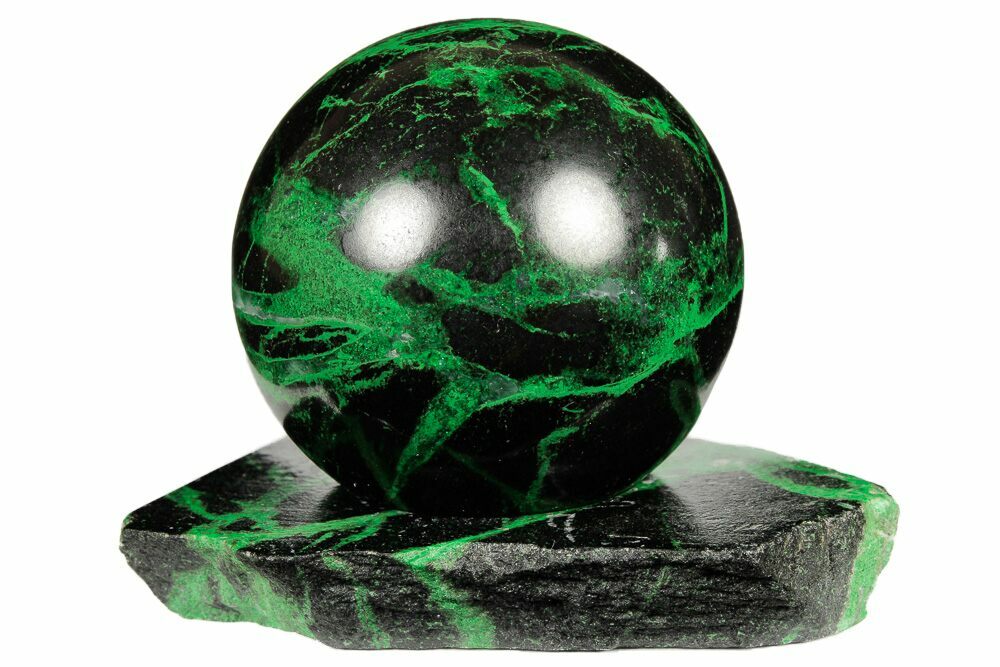
A polished sphere containing veins of Uvarovite garnets from Russia
Finland is another classic source, especially the Outokumpu mining district. Here, uvarovite forms within complex metamorphosed volcanic and sedimentary rocks enriched in chromium. Finnish crystals are often exceptionally sharp and display slightly deeper, more saturated greens than many other localities. They tend to occur as small but jewel-like clusters and druses, making them highly desirable among collectors. While production has never been large, Finnish specimens frequently rival Russian pieces in quality.
In Poland, the Szklary Massif in Lower Silesia has produced excellent uvarovite for decades. This area contains ancient ophiolites—sections of oceanic crust thrust onto land—where chromium-rich fluids permeated calcium-bearing rocks. Polish uvarovite is known for intensely bright crystal faces and dense drusy plates of uniform color. As Russian material becomes harder to obtain, Polish specimens have become increasingly important on the market and remain a favorite among European collectors.
Canada has yielded attractive uvarovite as well, particularly in Quebec. The mineral typically appears in chromite-bearing serpentinite, forming bright patches of small crystals across dark host rock. While Canadian deposits generally produce smaller pockets and less continuous drusy surfaces than Russia or Poland, the color purity and crystal sharpness of better pieces make them significant. Occasional larger plates have been found, though most specimens consist of modest but vividly colored druses.
Spain, Norway, and South Africa each provide additional but more limited sources. In Spain, uvarovite occurs in small pockets within chromium-rich metamorphic rocks, often forming sharply defined miniature dodecahedra with deep green color. Norwegian uvarovite typically forms in skarn zones and serpentinites, producing small but intensely colored crystals that are admired for their brightness even if they rarely form large plates. In South Africa, the mineral emerges from parts of the Bushveld Complex, one of the world’s largest layered ultramafic intrusions. These crystals are usually tiny but exceptionally vivid, and because production is sporadic, South African pieces are often prized simply for their rarity and geological significance.
Minor occurrences have also been reported in India, Turkey, Kazakhstan, and Brazil, though most produce only small clusters or sparse druses. These localities demonstrate the global distribution of uvarovite but do little to increase the supply of collectible, high-quality material.
Across all these regions, the style of uvarovite varies noticeably. Russia and Poland tend to produce the most dramatic drusy carpets of densely packed crystals. Finland often yields deeper hues and slightly larger crystal forms. Canada commonly produces isolated or patchy druses that stand out sharply against dark background rock. Norway and South Africa provide small but incredibly bright crystals, while Spanish specimens are admired for their clarity and perfect geometry. Many collectors enjoy comparing locality styles, and some specialize in assembling regional series that highlight these subtle differences.
Despite occurring in several countries, fine uvarovite remains rare for several reasons. The mineral’s ideal crystallization conditions are uncommon; even when they exist, crystals seldom grow large. Extracting fragile drusy coatings from hard serpentinite requires skill and patience, and many deposits are either remote, short-lived, or economically insignificant to mine. Because new finds are sporadic, and because collectors greatly value the mineral’s natural emerald color and intense sparkle, the best specimens remain highly sought after.


